You’re tired of jewelry that fades, tarnishes, or turns your skin green after a few wears… right?
That’s exactly where PVD jewelry comes in.
In this guide, you’ll see why Physical Vapor Deposition (PVD) is becoming the go-to choice for durable, waterproof, tarnish-resistant jewelry that actually survives daily life—showers, sweat, and all. You’ll learn how PVD coating works, how it compares to gold plated and solid gold, and how long it really lasts in the real world.
And if you’re looking for affordable, high-quality PVD pieces—whether for personal use, your brand, or wholesale—I’ll show you how manufacturers like Dongguan HonHo Jewelry are using thick 18K gold PVD on 316L stainless steel to create jewelry that looks premium, wears hard, and stays beautiful.
If you want luxury-looking, non-tarnish jewelry without paying solid gold prices, keep reading.
What Is PVD Jewelry?
If you’re tired of jewelry fading, rubbing off in weeks, or turning your skin green, PVD jewelry is exactly what you’ve been looking for.
PVD Meaning in Jewelry
PVD (Physical Vapor Deposition) is a high-tech vacuum plating process used to bond color and metal finishes onto jewelry:
- The jewelry (usually stainless steel) goes into a vacuum chamber
- Metal (like titanium nitride or 18K gold) is vaporized into a gas
- That vapor bonds on a molecular level to the surface of the jewelry
The result: a thin, dense, scratch‑resistant coating that’s much tougher than normal gold plating.
How PVD Coating Works on Stainless Steel
Most quality PVD jewelry uses 316L stainless steel as the base because it’s:
- Non-tarnish and corrosion-resistant
- Hypoallergenic for most skin types
- Strong enough for daily, active wear
On stainless steel and other base metals, PVD jewelry coating creates:
- A hard outer layer (gold, black, rose gold, silver tone, etc.)
- Excellent adhesion, so it doesn’t flake or peel like cheap electroplating
- A finish that keeps its color and shine for years with normal use
PVD vs Gold Plated vs Gold Filled
Here’s the core difference in plain terms:
- Traditional gold plated
- Very thin electroplated layer
- Wears off quickly with water, sweat, or friction
- Common on ultra-cheap fashion jewelry
- Gold filled
- Thick layer of gold mechanically bonded to brass
- More durable than plating, but still wears at high-friction points
- Usually more expensive and limited in styles
- PVD jewelry (18K gold PVD, black PVD, etc.)
- Gold or color finish is vapor-bonded in a vacuum
- Harder and more scratch resistant than standard plating
- Better color retention and everyday performance for the price
Think of PVD as an engineered finish built for real-life wear, not a fragile “weekend only” coating.
Why PVD Jewelry Is Trending in 2026
In 2026, PVD jewelry is booming because people want:
- Waterproof and sweatproof everyday jewelry they can wear in the shower, gym, ocean, and pool
- Non tarnish stainless steel jewelry that actually stays gold-colored or black, not dull and patchy
- Hypoallergenic PVD jewelry that doesn’t irritate sensitive skin
- A modern, streetwear-inspired look (black PVD chains, chunky 18K gold PVD plating, rose gold PVD necklace styles) without solid-gold prices
- More eco-friendly jewelry coating process options with less chemical waste than traditional plating
You get long lasting gold color jewelry and bold finishes at an accessible price point—that’s why PVD isn’t a fad; it’s the new standard for smart, everyday jewelry.
Benefits of PVD Jewelry
PVD jewelry isn’t just “plated” – it’s engineered to handle real daily life. Here’s what you actually get.
Durable & Scratch-Resistant
PVD (Physical Vapor Deposition) bonds to the metal at a molecular level, so it holds up way better than normal gold plating.
What that means in real life:
- Less surface scratching from keys, laptops, or gym equipment
- Better color hold on high-friction pieces like rings and bracelets
- Ideal for people who never take their jewelry off
| Feature | Cheap Plating | PVD Jewelry Coating |
|---|---|---|
| Bond to metal | Weak | Strong, engineered |
| Daily wear resistance | Low | High |
| Best for | Occasional | Everyday, long term |
If you want to dig deeper into how strong stainless steel bases can be under PVD, I break it down in this guide to how long stainless steel jewelry lasts.
Waterproof & Sweatproof
PVD jewelry works for people who live in their pieces:
- Shower-safe
- Gym and sweat-safe
- Ocean and pool-friendly (rinse after salt or chlorine)
You don’t need to baby it like soft gold plating. It’s made for real daily wear, not just “special occasion” use.
Tarnish-Resistant & Fade-Resistant
A good PVD coating on stainless steel is:
- Highly resistant to tarnish
- Much slower to fade than electroplated gold
- Stable in normal air, sweat, and humidity
You get long-lasting gold color jewelry without constant polishing.
Hypoallergenic for Sensitive Skin
When we use 316L surgical stainless steel with PVD:
- No green skin
- Very low risk of irritation
- Nickel-safe for most wearers
If you usually react to cheap fashion jewelry, hypoallergenic PVD jewelry is a solid upgrade.
Eco-Friendly Coating Process
The PVD process is:
- A vacuum plated stainless steel system with minimal liquid waste
- No toxic chemical baths like some traditional plating
- Long-lasting, which means less throwaway jewelry
You get a more eco-friendly jewelry coating process and longer product life.
Cost vs Value
Compared to other options:
| Type | Cost Level | Durability | Daily Wear Value |
|---|---|---|---|
| Cheap gold plating | $ | Low | Poor |
| PVD on stainless steel | $$ | High | Excellent |
| Gold-filled | $$$ | High | Very good |
| Solid gold | $$$$+ | Very high | Best, expensive |
With PVD jewelry you pay a mid-range price but get:
- High durability
- Strong color retention
- A “wear it every day” piece without solid gold pricing
For anyone building a daily stack, PVD gives you the best balance between cost and performance.
PVD Jewelry vs Gold Plated, Gold Filled & Solid Gold
When customers compare pvd jewelry to gold plated, gold filled, and solid gold, they’re really asking: how long will it last, how will it look, and is it worth my money? Here’s the short version.
Coating Thickness & Bonding
- PVD (Physical Vapor Deposition)
- Ultra-thin, but highly compressed and bonded on a molecular level.
- Coating is “locked” to the metal in a vacuum, making it far harder to rub off than normal plating.
- Gold Plated
- Usually 0.1–0.5 microns of gold.
- Attached by electroplating, so it wears off faster, especially on rings and bracelets.
- Gold Filled
- Mechanically bonded thick gold layer (often 5–10+ microns).
- Thicker than PVD and plated, but limited design flexibility and higher cost.
- Solid Gold
- No coating at all, gold all the way through.
- Can be polished over and over; lasts for decades with care.
Quick Comparison Table
| Type | Durability (Daily Wear) | Cost Level | Color Retention | Maintenance |
|---|---|---|---|---|
| PVD on 316L steel | High | $$ | Excellent, low fade | Low |
| Gold plated | Low–Medium | $ | Fades / wears quickly | High |
| Gold filled | High | $$$ | Very good | Medium |
| Solid gold (14K/18K) | Very High | $$$$ | Can dull, but restorable | Medium |
PVD vs Electroplating (Gold Plated)
- Electroplating:
- Uses an electric current to attach a thin gold layer.
- More pores, weaker bond, easier to scratch and rub off.
- PVD coating:
- Uses a vacuum chamber to vaporize metals and fuse them to the surface.
- Better adhesion, more scratch resistant, and less likely to peel or flake under normal use.
- For context, I use the same mindset I apply to our stainless steel jewelry manufacturing – focus on base metal quality first, then coating.
When to Choose PVD vs Solid Gold
Choose PVD jewelry when:
- You want daily wear, waterproof, sweatproof pieces on a realistic budget.
- You love the solid gold look but don’t want to baby your jewelry.
- You need multiple trendy pieces (layers, stacks) without spending thousands.
Choose solid gold when:
- You’re buying an heirloom, engagement ring, or investment piece.
- You want something that can be resized, polished, and passed down for decades.
- Budget is flexible and long-term value is the priority.
“Fake” vs “Engineered” Finishes – Clearing the Myths
- Myth: PVD jewelry is “fake gold.”
Reality: PVD is an engineered surface finish using real metal compounds (like 18K gold tones or titanium nitride) applied in a high-tech process. It’s not pretending to be solid gold; it’s delivering solid-gold color with better practicality and lower cost. - Myth: All coatings are the same.
Reality: Cheap flash plating and vacuum PVD jewelry coating are not even close. PVD is used on luxury watches, high-end hardware, and pro tools because of its durability.
In short, if you’re building a wear-all-day, gym-to-office collection, high-quality PVD on stainless steel is usually the smartest balance between price, performance, and long-lasting color.
How PVD Coating Works on Jewelry
Step-by-step PVD jewelry process
Here’s how PVD jewelry coating is actually done in the factory:
- Deep cleaning
- The base metal (usually 316L stainless steel) is polished and ultrasonically cleaned.
- Oils, dust, and polishing compound are removed so the coating can bond properly.
- Vacuum chamber
- The jewelry is placed on racks inside a vacuum chamber.
- Air is removed to create a low-pressure environment so metal particles can travel cleanly and lock onto the surface.
- Vaporizing the metal
- Coating metals (like titanium, zirconium, or gold) are heated or bombarded with energy until they turn into vapor.
- These metal particles move through the chamber and bond on a molecular level to the jewelry surface.
- Deposition and bonding
- The vapor forms a thin, even layer around the entire piece.
- This is where the “Physical Vapor Deposition” name comes from—solid metal turns to vapor, then back to solid, fused tightly to the base.
- Cooling and finishing
- The coated jewelry is cooled, inspected, and lightly polished if needed.
- What you get is a hard, dense, scratch-resistant PVD finish that doesn’t rub off easily like cheap plating.
If you want to see what we typically use underneath PVD, our stainless steel jewelry is a good reference point.
Metals used in PVD jewelry
With physical vapor deposition jewelry, different coating materials give different colors and performance:
- Titanium nitride (TiN) – classic warm gold tone, very hard, extremely wear-resistant.
- Zirconium nitride (ZrN) – also used for gold tones and champagne shades.
- Gold PVD (18K gold PVD plating) – real gold used in the coating mix for a richer, more authentic gold color.
- Black PVD finish – made using black zirconium or carbon-based coatings for deep black or gunmetal tones.
- Rose gold PVD – created by mixing gold with copper tones for a soft pink rose gold effect, ideal for a rose gold PVD necklace or rings.
- Silver and rhodium-like tones – for bright, cool “sterling” or rhodium-style finishes that don’t tarnish like standard silver.
Because the coating is engineered, we can repeat the same shade consistently across rings, chains, bracelets, earrings, and watches.
Coating thickness & wear time
Thickness matters more than marketing buzzwords:
- Typical cheap electroplating: ~0.03 microns+0.1 TIN protective layer
- Decent PVD jewelry coating: ~0.05–0.1 microns +0.5 TIN protective layer or more
What this means in real life:
- Thicker PVD = longer color life under daily friction (rings, watch bands, bracelets).
- Thinner PVD = okay for light-wear items like occasional earrings or pendants.
For most customers:
- Daily-use chains, bracelets, and rings: go for thicker PVD on stainless steel if you want 3–5+ years of solid performance with normal care.
Why 316L stainless steel is the best base for PVD jewelry
We build most of our PVD pieces on 316L stainless steel for a reason:
- Hypoallergenic – low nickel release, safer for sensitive skin compared to random base metals.
- Corrosion-resistant – handles sweat, sea water, and humidity better than brass or alloy.
- Hard and stable – gives the PVD coating a solid base so it doesn’t crack or flake.
- Non-tarnish stainless steel jewelry – even if the coating slowly wears after many years, the base metal doesn’t turn green or chalky.
This combo—316L stainless steel + thick PVD—is currently one of the best setups for sweatproof everyday jewelry in the global market.
How PVD gets rich, long-lasting color
PVD isn’t just paint or dipped color—it’s a vacuum plated stainless steel process that locks color into a hard metal layer:
- Colors come from metal compounds, not dye, so they stay stable over time.
- The finish is dense and smooth, which helps it stay tarnish resistant and fade resistant.
- With the right recipe, we can match 18K gold PVD, deep black PVD jewelry finish, or soft rose gold repeatedly across big wholesale runs.
For brands, this means:
- Consistent color from batch to batch
- Less returns for fading or turning green
- A more premium “solid gold look” at an accessible price point
This is exactly why more labels are switching to engineered PVD jewelry finishes instead of basic gold plating.
How Long Does PVD Jewelry Really Last?
Realistic lifespan: daily wear vs light wear
For quality PVD jewelry coating on 316L stainless steel, here’s what I actually see in real life use:
- Heavy daily wear (showers, gym, beach, sleep in it):
- Good PVD: 3–5+ years before you see noticeable fading on high-friction spots.
- Gentle/rotating wear (take it off to sleep, no harsh sports):
- Good PVD: 5–10+ years of strong color and shine.
Cheap “PVD” or thin vac-plating on weak base metals can start looking tired in 6–12 months.
What really affects PVD jewelry longevity
The lifespan of physical vapor deposition jewelry mainly comes down to:
- Coating thickness – Thicker PVD layers last longer against friction and micro-scratches.
- Base metal – 316L stainless steel holds PVD far better than brass, zinc or mystery alloys.
- Lifestyle – Sand, concrete, heavy lifting, stacking too many rings on one finger all speed up wear.
- Piece type – Rings and bracelets wear faster (constant contact) than necklaces and earrings.
What to expect after 1, 3, and 5+ years
Assuming you’re wearing 18K gold PVD plating or similar high-quality finishes on stainless steel:
- After 1 year
- Still rich color, maybe micro-scratches if you’re rough.
- No peeling, no green skin, no obvious patchiness for good PVD.
- After 3 years
- High-friction points (ring edges, bracelet clasps) might soften in color a bit.
- Overall look still “gold” and clean if the coating was thick and well-bonded.
- After 5+ years
- Some soft fading where metal rubs constantly, especially for rings.
- Necklaces, earrings, and low-impact pieces often still look close to new.
If something looks badly worn in under a year with normal use, that’s almost always cheap plating, not true PVD.
Normal wear vs poor-quality PVD coating
Normal wear signs on good tarnish resistant PVD accessories:
- Tiny hairline scratches from daily life.
- Very gradual color softening on edges and contact points.
- Still even color overall, no weird spots.
Red flags of low-quality or fake “PVD”:
- Peeling or flaking like paint.
- Rapid brass or copper showing through.
- Patchy dark spots or rough texture.
- Skin irritation or green marks (usually bad base metal, not real hypoallergenic PVD jewelry).
How we extend PVD jewelry durability at Dongguan HonHo
At Dongguan HonHo Jewelry, we engineer our PVD jewelry to handle real life – sweat, travel, everyday grind. We focus on:
- 316L stainless steel or better as the default base for most vacuum plated stainless steel pieces.
- Thicker PVD layers than basic fashion brands use, especially on high-wear pieces like scratch resistant PVD rings and chains.
- Tight process control – deep cleaning, controlled vacuum, stable temperature and proper metal targets for long lasting gold color jewelry.
- Wear testing – salt-spray tests, friction tests, and sweat simulations so our waterproof PVD gold holds up on global customers who wear their pieces hard.
If you’re planning custom or wholesale lines and want pieces that still look premium after years of daily wear, that’s exactly the performance level we build for.
Popular Types of PVD Jewelry
PVD jewelry is everywhere right now because it looks premium, wears hard, and doesn’t cost crazy money. Here’s how people are actually wearing PVD jewelry day to day:
PVD Rings
I lean on PVD rings when someone wants daily pieces that don’t baby out after a few months.
- Wedding bands in black PVD or 18K gold PVD for men and women
- Stackable rings in thin bands you can mix in gold, rose gold, black, and silver tones
- Minimalist styles with clean edges, flat bands, signet-style tops, and micro pavé accents
The scratch-resistant PVD jewelry coating on stainless steel means rings survive handwashing, laptops, and daily errands without fading fast.
PVD Necklaces & Chains
For chains, physical vapor deposition jewelry gives you that solid-gold look without the solid-gold bill.
- Paperclip chains for layering with pendants
- Rope and Cuban chains for bold, heavy looks (popular in streetwear and hip-hop style)
- Pendant chains with crosses, initials, lock pendants, and minimalist bars
Most customers go for 18K gold PVD plating or black PVD when they want standout, long-lasting color.
PVD Bracelets & Bangles
Non tarnish stainless steel jewelry really shines on the wrist where pieces take more abuse.
- Link bracelets (Cuban, Byzantine, mariner, Figaro) for men and women
- Cuffs and bangles in smooth, brushed, or hammered finishes
- Slim, stackable bangles in rose gold PVD and yellow gold PVD for everyday wear
Because the coating is hard and bonded, these stay sweatproof everyday jewelry pieces for gym, office, and travel.
PVD Earrings
Ears are where hypoallergenic PVD jewelry really matters, especially for sensitive skin.
- Hoops & huggies in micro to chunky profiles
- Studs with simple balls, CZ stones, or flat discs
- Statement earrings in black PVD, two-tone, or mixed textures
PVD on surgical-grade stainless steel means no green ears and far fewer allergy issues compared to cheap plating.
PVD Watches & Watch Bands
Watch brands are using vacuum plated stainless steel more and more because it holds color and finish for years.
- PVD watch cases in black, gold, and rose gold finishes
- Watch bands: mesh, oyster-style links, and solid links in PVD gold or black
- Matching long lasting gold color jewelry sets: watch + bracelet + ring for a clean, coordinated look
If you’re building or sourcing a line that mixes watches with chains and rings, PVD lets you keep the color and finish consistent across the whole collection.
Best PVD Jewelry Styles and Trends in 2026
Trending PVD Finishes in 2026
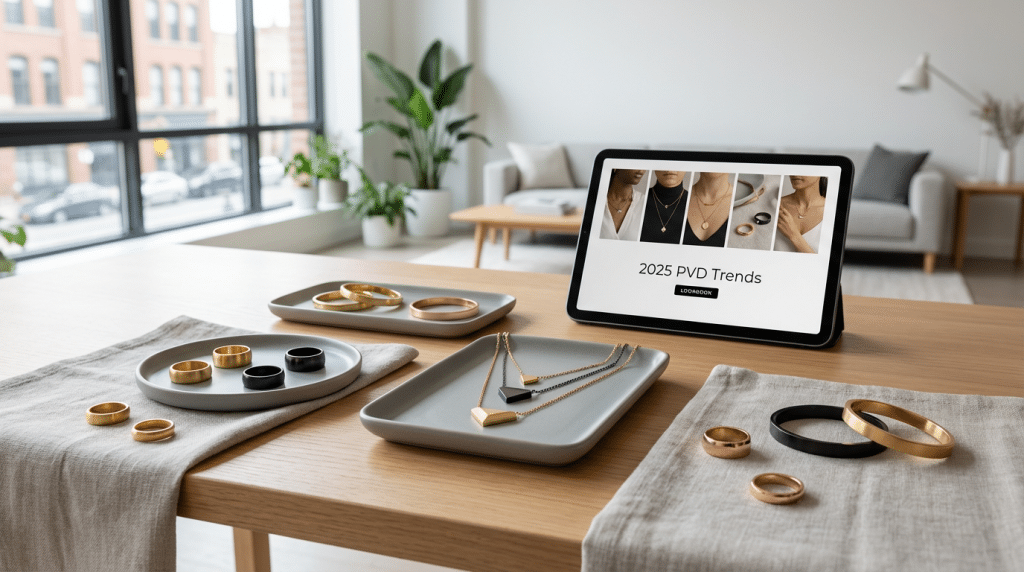
In 2026, four PVD jewelry finishes are leading the pack:
- Black PVD jewelry finish – Matte or glossy, perfect for streetwear, techwear, and minimalist outfits.
- 18K gold PVD plating – Warm, rich color that looks close to solid gold but holds up better than cheap plating.
- Rose gold PVD necklaces and rings – Still big in global markets, especially for women’s and couple sets.
- Silver-tone PVD jewelry – Clean, stainless look with non tarnish stainless steel performance for everyday wear.
These PVD jewelry coatings deliver a long lasting gold color jewelry or deep black finish that doesn’t fade fast, even if you wear it daily.
Chunky Chains, Layers, and Stacks
For styling, 2026 is all about visible, easy-to-wear statements:
- Chunky PVD chains (Cuban, rope, paperclip) in black PVD or 18K gold PVD are everywhere.
- Layered PVD necklaces – 2–3 chains in different lengths for a quick, styled look.
- Stacking PVD rings – Thin bands mixed with 1–2 bold rings for a balanced hand stack.
Because PVD is scratch resistant and sweatproof, people are comfortable stacking and layering without babying their pieces.
Minimalist vs Bold PVD Jewelry
Both ends of the style spectrum are strong:
- Minimalist everyday PVD jewelry:
- Slim bands, small hoops, simple bar or coin pendants.
- Great for office, travel, or “never take it off” wear.
- Bold statement PVD pieces:
- Oversized hoops, wide rings, chunky bracelets.
- Often done in black PVD or mixed black-and-gold for contrast.
The win with PVD: you can build both a minimal base and a bold weekend stack without blowing a huge budget.
Unisex and Men’s PVD Jewelry Trends
Unisex and men’s styles are a huge growth area for physical vapor deposition jewelry:
- Black PVD rings and bracelets – Clean, masculine, but still modern.
- Gold PVD Cuban chains and rope chains – Popular across US, Europe, and Middle East streetwear scenes.
- PVD watches and vacuum plated stainless steel watch bands – Everyday accessories that are waterproof, sweatproof, and office-friendly.
Hypoallergenic PVD jewelry on 316L stainless steel is especially popular for guys who want zero skin irritation.
How Fashion Brands Use PVD for Streetwear
Fashion and streetwear brands are leaning hard into PVD jewelry coating because it:
- Delivers waterproof PVD gold and black finishes that fit modern, urban looks.
- Holds up to festivals, gyms, and travel without turning green or dull.
- Scales well for capsule drops, collabs, and private-label collections.
If you’re building your own line, PVD makes it easy to offer consistent, sweatproof everyday jewelry in gold, black, and rose finishes. For brand owners and buyers, a reliable wholesale PVD jewelry manufacturer is key; that’s why many brands work directly with a specialized jewelry supplier offering private-label manufacturing to lock in quality and finish options.
Pros and Cons of PVD Jewelry
Key Pros of PVD Jewelry
PVD jewelry (Physical Vapor Deposition) has some real, everyday benefits:
- Super durable: The PVD jewelry coating bonds tightly to stainless steel, making it far more scratch resistant than regular gold plated pieces. Great for people who are hard on their jewelry.
- Waterproof & sweatproof: You can usually wear quality waterproof PVD gold in the shower, gym, pool, or ocean without it washing off or turning dull quickly.
- Low maintenance: It stays bright with minimal effort—just a quick wipe with a soft cloth. No constant polishing or babying.
- Non tarnish performance: On good 316L stainless steel, PVD means tarnish resistant PVD accessories that won’t go black or green easily.
- Skin-friendly: With hypoallergenic base metals like surgical stainless steel, hypoallergenic PVD jewelry is a strong option for sensitive skin and people who react to cheap plating.
- Eco-friendlier process: PVD is a vacuum plated stainless steel process with less chemical waste than old-school electroplating, making it a more eco friendly jewelry coating process overall.
- Strong value: You get the look of 18K gold PVD plating or black PVD at a fraction of the price of solid gold, but far better longevity than cheap gold plate.
Real Drawbacks of PVD Jewelry
PVD is great, but it’s not magic. There are trade-offs:
- Still a coating: At the end of the day, it’s a surface layer. Under extreme abuse (heavy rubbing on tools, concrete, metal edges), the coating can slowly wear down over years.
- Resizing is tricky: For rings, major resizing or big alterations can crack or burn the PVD finish. Often the jeweler must re-coat the piece afterward.
- Not pure metal: If you care about metal recyclability, solid gold wins. PVD on stainless steel is more complex to recycle than a simple gold bar or heirloom ring.
- Can’t fix deep damage easily: Deep gouges that cut through the coating usually mean full refinishing, not a quick buff.
Who PVD Jewelry Is Best For
PVD jewelry makes the most sense if you:
- Want sweatproof everyday jewelry you can forget about—gym, travel, office, weekend.
- Have a medium budget and want long lasting gold color jewelry without paying solid gold prices.
- Prefer non tarnish stainless steel jewelry you don’t need to baby.
- Are building a daily stack (rings, chains, bracelets) and care more about style + durability than metal resale value.
If you’re buying an heirloom, planning to pass it down, or care about gold’s investment value, solid gold still has its place. But for daily wear and modern style, well-made PVD jewelry hits the sweet spot on durability, look, and price.
Is PVD Jewelry Worth It in 2026?

For 2026, PVD jewelry is absolutely worth it if you care about style, durability, and price in one package.
Who PVD jewelry is best for
PVD jewelry is a smart pick if you’re:
- Active – gym, sports, outdoor, work with your hands
- A traveler – don’t want to risk losing expensive solid gold
- A minimalist – prefer a small, reliable “wear it every day” set
- A stacker – wear multiple rings, chains, and bracelets daily
You get the look of 14K–18K gold without stressing about damage, sweat, or water.
When PVD beats solid gold
PVD jewelry is usually the better choice when:
- You want waterproof, sweatproof everyday jewelry that you don’t have to baby
- You like trend pieces (chunky chains, stackable rings) that might go out of style
- You need non tarnish stainless steel jewelry that won’t turn your skin green
- You want long lasting gold color jewelry on a realistic budget
For daily wear, 18K gold PVD plating on 316L stainless steel gives you a mix of durability + price that solid gold simply can’t match.
When solid gold still makes sense
Solid gold is still the right call for:
- Heirloom pieces you plan to pass down
- High-value investment jewelry
- Rings that might need resizing many times over the years
- Very traditional markets or buyers who only want precious metals
Think: one or two key solid gold pieces, supported by a bigger PVD rotation.
Building a “wear-it-daily” collection with PVD
With PVD jewelry, you can build a full daily rotation:
- A scratch resistant PVD ring you never take off
- A waterproof PVD gold chain for shower, gym, and beach
- A rose gold PVD necklace for office-to-dinner
- Sweatproof everyday jewelry for travel and busy days
Because the coating bonds so strongly to stainless steel, you don’t have to baby your pieces the way you would with cheap plating.
Real-world use cases
Here’s how people actually use PVD in 2026:
- Office + gym lifestyle – Wear the same PVD chain and bracelet from meetings to workouts without tarnish.
- Digital nomads / frequent flyers – Travel with tarnish resistant PVD accessories instead of risking solid gold.
- Streetwear fans – Layer black PVD jewelry finishes and bold Cuban chains for a modern look.
- Gift buyers – Give stylish jewelry that looks premium, lasts, and doesn’t blow the budget.
If you’re building a practical, everyday collection that can handle water, sweat, and real life, PVD is one of the smartest moves you can make in 2026.
Care and Maintenance for PVD Jewelry
Even though PVD jewelry is tough, waterproof, and sweatproof, a little care keeps it looking new for years.
Daily care for PVD jewelry
- Rinse with lukewarm water and a drop of mild soap.
- Gently wipe with a soft, non-abrasive cloth or microfiber.
- Dry completely before you store it – moisture won’t ruin PVD, but trapped water can leave marks.
What to avoid
To protect your PVD jewelry coating, avoid:
- Harsh chemicals: bleach, chlorine, strong cleaning sprays, hand sanitizer on repeat, acetone.
- Abrasives: scrubbing pads, rough towels, polishing pastes meant for raw metal.
- Repeated impact with rough surfaces: concrete, metal gym equipment, sand.
You don’t need to baby it, but don’t intentionally abuse it either.
Storage best practices
- Store pieces separately in pouches, a lined jewelry box, or soft compartments.
- Keep chains clasped to avoid tangles and friction.
- Avoid tossing your scratch resistant PVD rings and chains together in one hard box.
If you’re building a capsule of non tarnish stainless steel jewelry, good storage makes a big difference long term.
After workouts, swimming, or showers
PVD is waterproof and sweatproof, so you can shower, swim, and train in it. To keep it fresh:
- Rinse off sweat, salt, and pool chemicals with clean water.
- Wash quickly with mild soap if you’ve been in the ocean or chlorinated pool.
- Pat dry with a soft cloth – don’t air-dry on a wet counter or in a gym bag.
This keeps your sweatproof everyday jewelry from looking dull over time.
If minor wear or scratches appear
Normal micro-wear over years is expected, but you can slow it down:
- Use a soft polishing cloth (no polishing compound) to buff fingerprints and light marks.
- Stop any DIY sanding or metal polish – that can thin the vacuum plated stainless steel coating.
- If you see early wear on edges, just avoid heavy friction in that spot (for example, stacking too many tight rings together).
For branded or wholesale lines, I always recommend setting clear care cards with these points so customers know how to get maximum life from their 18K gold PVD plating pieces, whether it’s fashion necklaces or chains similar to our wholesale fashion necklaces.
Buying Guide: How to Choose Quality PVD Jewelry
How to Tell Good PVD Jewelry from Cheap Plating
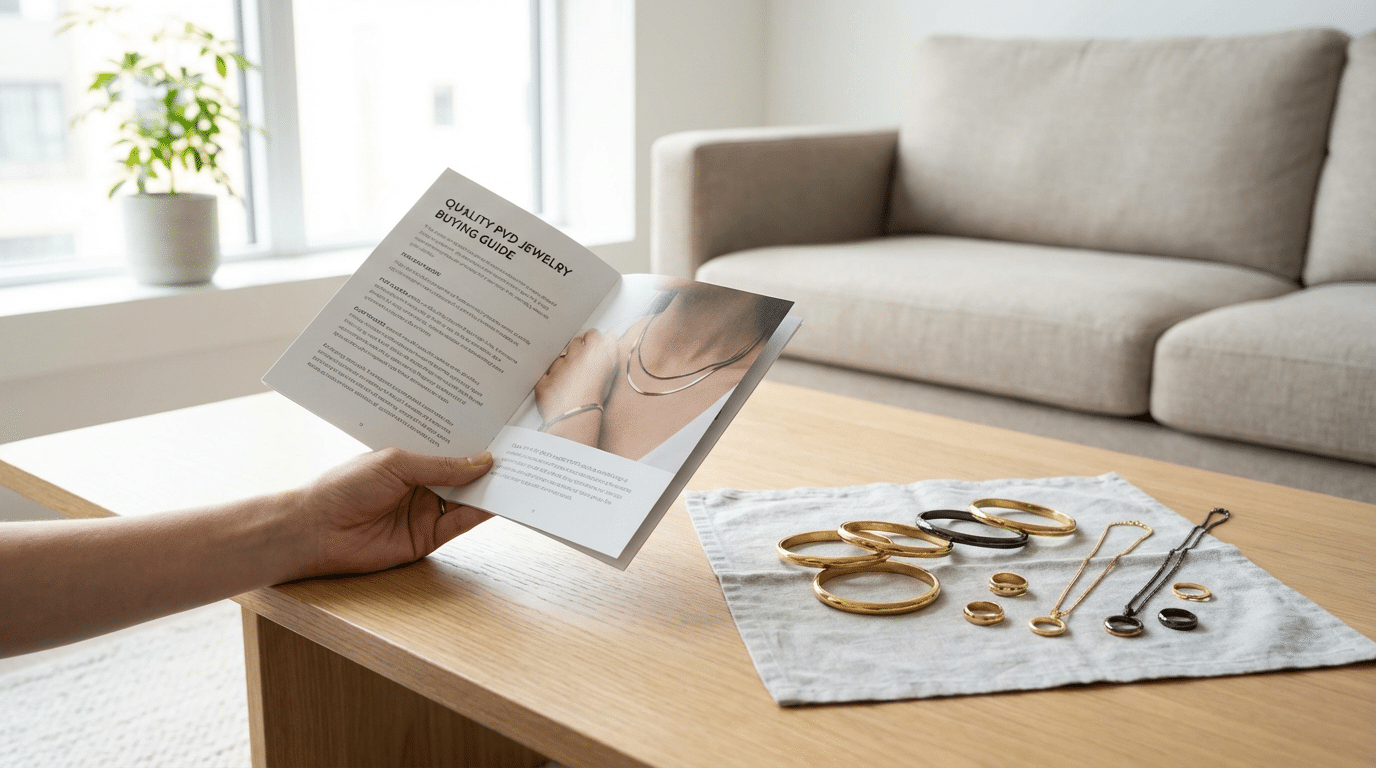
You can spot quality PVD jewelry fast by checking:
- Color:
- Good PVD: rich, even color, no patchiness, no “yellow-orange” fake gold tone
- Cheap plating: too bright, too yellow, or slightly greenish
- Finish:
- Good PVD: smooth surface, no bubbles, no peeling at edges
- Cheap plating: rough feel, visible flakes or worn edges on new pieces
- Weight & feel:
- Quality pieces feel solid, not hollow or “toy-like”
Key Specs to Look For
For long-lasting PVD jewelry, I always look for these specs:
- Base metal:
- Best: 316L stainless steel (surgical-grade, hypoallergenic) – you can see how we use it across our 316L stainless steel jewelry collection.
- Avoid: unknown base metals, cheap brass without clear info.
- Coating type:
- Clearly labeled PVD (Physical Vapor Deposition) or vacuum plated stainless steel
- Mentions like “18K gold PVD plating” or black PVD jewelry finish
- Finish options:
- 18K/14K gold PVD, rose gold, black PVD, silver tone
- Consistent shade across ring, chain, clasp, and findings
Questions to Ask Brands or Suppliers
Before you buy, ask:
- What base metal do you use? Is it 316L stainless steel?
- Is this real PVD coating or standard electroplating?
- How thick is the coating? (Look for “thick PVD” / “enhanced PVD” – avoid ultra-thin flash plating.)
- Is the jewelry waterproof and sweatproof for daily wear?
- Is it nickel-free / hypoallergenic?
If they can’t answer clearly, I walk away.
Typical Price Ranges for Decent PVD Jewelry
Use this as a rough global guide (retail prices):
| Item Type | Reasonable PVD Price Range* |
|---|---|
| Simple PVD ring | $15 – $40 |
| PVD chain / necklace | $25 – $80 |
| PVD bracelet / bangle | $20 – $60 |
| PVD hoop / stud earrings | $15 – $50 |
*Prices vary by design, thickness, brand, and region.
If it’s much cheaper than this and still claims “high quality PVD”, be careful.
Red Flags and Misleading Claims
I treat these as warning signs:
- “PVD” but no mention of stainless steel or base metal at all
- Ultra-cheap sets (e.g., “10 pieces for $10” with “PVD gold” claim)
- Vague wording: “gold color PVD style”, “PVD-like plating”
- Sellers promising “never fades ever, lifetime guarantee no matter what” – no coating is indestructible
- No clear policy on nickel-free or hypoallergenic
Stick with suppliers who are transparent about materials, coating process, and specs. That’s how you build a daily-wear collection that actually lasts.
Wholesale and Custom PVD Jewelry Options
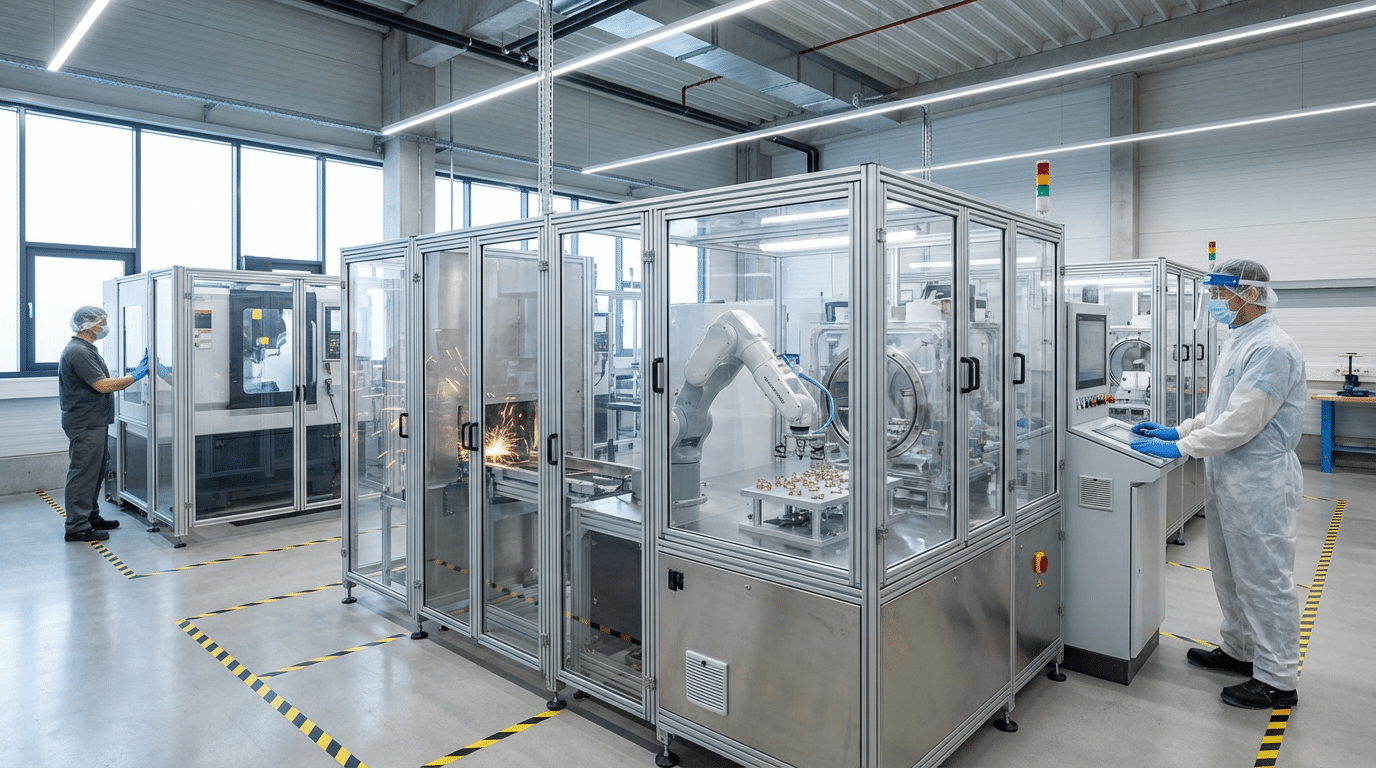
Why brands are moving to PVD jewelry coating
Retailers and DTC brands are switching to physical vapor deposition jewelry because it simply performs better than cheap plating at scale:
- Far fewer returns for tarnish, fading, and “green skin”
- Consistent color across big batches (key for global drops)
- Waterproof, sweatproof, non tarnish stainless steel jewelry that fits modern, active customers
- Strong margins without going to solid gold pricing
For private-label, PVD lets you offer “everyday, wear-it-24/7” jewelry that still hits an accessible price point.
Benefits of PVD for bulk and private-label lines
Why PVD makes sense for wholesale:
- Durability: scratch resistant PVD rings, chains, and bracelets that hold color for years
- Brand positioning: “long lasting gold color jewelry” feels premium but stays affordable
- Fewer complaints: waterproof PVD gold and sweatproof everyday jewelry reduce customer service issues
- Eco angle: eco friendly jewelry coating process with lower waste vs traditional electroplating
You can build full collections—rings, chains, earrings, watches—with one unified finish and color tone.
Custom color, finish, and design options
With vacuum plated stainless steel (especially 316L), we can tune:
- Colors: 18K gold PVD plating, rose gold PVD necklace finishes, silver tones, black PVD jewelry finish
- Finishes: high polish, matte, brushed, two-tone, partial PVD accents
- Designs: logo tags, custom clasps, unique links, branded charms
If you want to go deeper into materials like titanium nitride for high-wear pieces, check our detailed breakdown of titanium nitride PVD jewelry applications.
MOQ, lead times, and process (typical)
Every factory is different, but here’s a realistic structure I use:
| Item | Typical Range (reference) |
|---|---|
| MOQ (per style/color) | 100–300 pcs |
| Development (sampling) | 10–20 days after design confirmation |
| Mass production | 25–35 days after sample approval |
| Coating type | 18K gold PVD, rose gold, black, silver PVD |
| Base metal | 316L stainless steel as default |
We keep MOQs reasonable so brands can test new PVD jewelry trends without huge risk.
How to work with a PVD jewelry manufacturer
To make a smooth project from idea to launch:
- Share clear input
- Sketches / 3D files / reference photos
- Target market (US, EU, Middle East, etc.) and price point
- Required finishes (e.g. hypoallergenic PVD jewelry in 18K gold tone)
- Lock specs early
- Base metal (316L stainless steel is my default for non tarnish pieces)
- Coating color and thickness
- Branding details: logo, engraving, packaging
- Sample first, then scale
- Approve color, weight, and fit on small runs
- Stress test: water, sweat, gym, daily wear
- Plan for reorders
- Keep finish codes and plating recipes fixed to guarantee consistent color on future batches
- Align on long-term pricing for scaling
If you need full-service OEM/ODM support—from design to finished private-label collections—our team handles that end to end. For custom concepts, you can start by sending your ideas through our jewellery manufacturer for custom designs page at HonHo Jewelry.
Why Choose Dongguan HonHo for PVD Jewelry
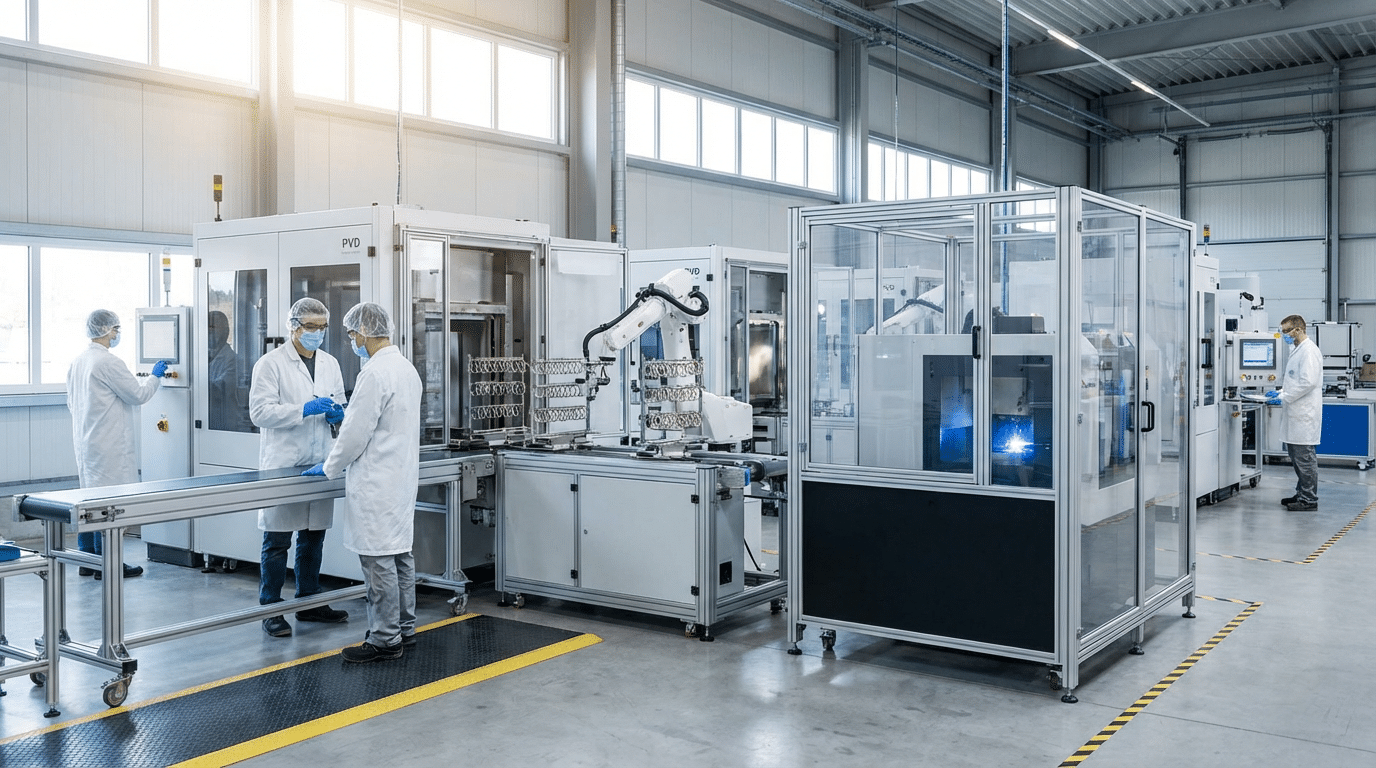
When it comes to PVD jewelry, I don’t cut corners. At Dongguan HonHo Jewelry, we build pieces for real life – gyms, beaches, airports, and long workdays – not just for photos.
Thick, High-Quality PVD on Surgical-Grade Steel
We use:
- 316L surgical-grade stainless steel as our standard base
- Thick PVD coatings (not “flash” or mystery plating) for strong adhesion
- Consistent color: 18K gold PVD, black PVD, rose gold, and silver tones
Result: waterproof, sweatproof, non tarnish stainless steel jewelry that holds color and finish for the long haul.
| Feature | Cheap Plating | Our PVD Jewelry |
|---|---|---|
| Base metal | Mixed / unknown | 316L surgical-grade stainless steel |
| Coating process | Basic electroplate | Physical Vapor Deposition (vacuum plated) |
| Coating thickness | Very thin | Thick, engineered layers |
| Everyday durability | Low | High – built for daily wear |
OEM/ODM, Low MOQs, Fast Turnaround
We support brands at different stages:
- OEM/ODM: you bring an idea or sketch, we handle design, molds, and production
- Low MOQs: ideal for new brands, test collections, and niche drops
- Fast lead times: we keep PVD lines and 316L materials ready to move
If you’re working on pricing and margins, our experience with wholesale jewelry pricing helps you hit your target without killing quality.
Global Shipping, Certifications, Eco-Minded Production
- Global shipping to North America, Europe, Middle East, and beyond
- Compliance-focused: nickel-safe, lead-safe materials; test reports available on request
- Eco-conscious coating: PVD is a low-waste, solvent-free process compared with traditional plating
You get durable, sweatproof everyday jewelry with a cleaner coating method.
What PVD Jewelry We Specialize In
We focus on high-demand, daily-wear pieces:
- PVD rings – wedding bands, stackable sets, minimalist and bold signets
- Chains & necklaces – Cuban, rope, paperclip, tennis, pendant chains
- Bracelets & bangles – cuffs, link bracelets, men’s and women’s styles
- Earrings – hoops, huggies, studs, statement designs
- Watch cases & bands – black PVD, gold PVD, two-tone looks
All built as scratch resistant PVD accessories designed for repeat orders and long-term stocking.
Real-World Performance & Client Feedback
What we see from long-term clients:
- 3–5+ years of solid color retention on 18K gold PVD plating with normal daily wear
- Strong repeat orders once stores test PVD vs basic gold plated stock
- Fewer returns related to tarnish, color fading, or skin reactions
Many of our wholesale and brand partners started by asking basic questions like “What does S925 mean on jewelry?” and have since grown into full PVD collections with us. (If you’re still comparing metals, this breakdown of gold purity levels is a useful reference when picking PVD colors.)
If you need PVD jewelry that can survive actual daily wear, protect your brand reputation, and still hit realistic price points, this is exactly what we build at Dongguan HonHo Jewelry.
Common Questions About PVD Jewelry
Is PVD jewelry waterproof and sweatproof?
Yes. Quality PVD jewelry coating on 316L stainless steel is waterproof and sweatproof. You can wear it:
- In the shower
- At the gym
- In humid, hot climates
As long as the piece is genuine PVD on stainless steel, water won’t strip the color the way cheap electroplating does.
Does PVD gold tarnish or turn skin green?
In normal use, 18K gold PVD plating on stainless steel does not tarnish or turn skin green.
Green marks usually come from:
- Copper-heavy base metals (like brass)
- Thin, low‑quality plating
With stainless steel + PVD, you avoid those issues and get non tarnish stainless steel jewelry that stays clean against the skin.
Can you shower, swim, or work out in PVD jewelry?
You can, and that’s exactly what sweatproof everyday jewelry is made for. A few tips:
- Rinse with fresh water after the ocean or pool
- Wipe dry after heavy sweat sessions
- Avoid long exposure to harsh spa chemicals or strong detergents
Handled like this, waterproof PVD gold holds up very well.
Is PVD better than gold plated for daily wear?
For daily wear, PVD beats standard gold plating in almost every practical way:
- Stronger bond to the metal
- More scratch resistant
- Better color retention
- Less likely to fade or patch
If you’re choosing between cheap plating and physical vapor deposition jewelry for everyday use, go PVD.
Is PVD jewelry hypoallergenic and safe for sensitive skin?
When we use 316L surgical stainless steel with PVD, it’s generally:
- Nickel-safe / low‑allergy
- Comfortable for most sensitive skin
- A solid option if you can’t tolerate brass or mixed alloys
If you have extreme metal allergies, test with one piece first and confirm the base metal is 316L.
Can PVD jewelry be resized or repaired?
There are limits:
- Rings: major resizing can crack or thin the PVD coating
- Chains/bracelets: adding or removing links is usually fine if done carefully
- Repairs: big structural repairs might need re‑PVD coating after work
For new custom runs or bulk pieces, we handle sizing at the manufacturing stage to avoid heavy alterations later. If you’re sourcing your own line, check how the jewelry manufacturing process is set up with your supplier, or work with a specialist like us that builds around PVD from day one: professional jewelry manufacturing services.
How to clean and refresh PVD jewelry at home
Keep it simple:
- Wash with mild soap + lukewarm water
- Wipe with a soft, non‑abrasive cloth
- Avoid polishing pastes, harsh chemicals, ultrasonic cleaners, and rough brushes
After workouts or swimming:
- Rinse off sweat/chlorine/salt
- Pat dry with a soft towel
This keeps your scratch resistant PVD rings and tarnish resistant PVD accessories looking fresh without stripping the finish.
Ready to Build Your PVD Jewelry Brand?
The jewelry market in 2026 demands durability. Customers are tired of throwaway fashion pieces; they want waterproof, sweatproof, and life-proof jewelry that looks premium without the premium price tag. PVD on stainless steel is the solution that delivers exactly that.
Whether you are launching a new streetwear line, a minimalist daily-wear collection, or just upgrading your current stock to reduce returns, Dongguan HonHo Jewelry is ready to be your manufacturing partner. We don’t just sell jewelry; we engineer durability into every ring, chain, and bracelet we produce.
Stop settling for plating that fades in a month. Contact us today for a quote or to start sampling your custom PVD collection. Let’s create jewelry your customers will never want to take off.
Top 5 Gold Filled Jewelry Manufacturers in China 2026
What Is Gold Filled Jewelry? Gold filled jewelry meaning When I say gold filled jewelry,
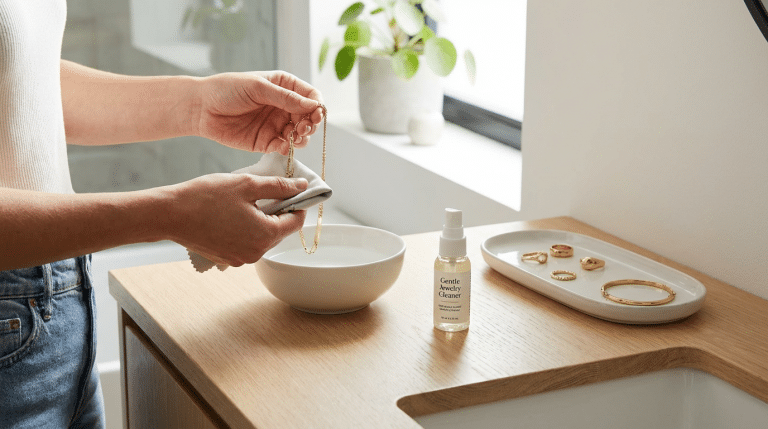
How to Clean Gold Plated Jewelry Safely at Home
If your gold-plated jewelry has started to look dull, dark, or even a bit green,
Does Brass Jewelry Tarnish? Care Prevention and Cleaning Tips
Wondering “Does brass jewelry tarnish?” Or if that gorgeous brass ring will turn your skin