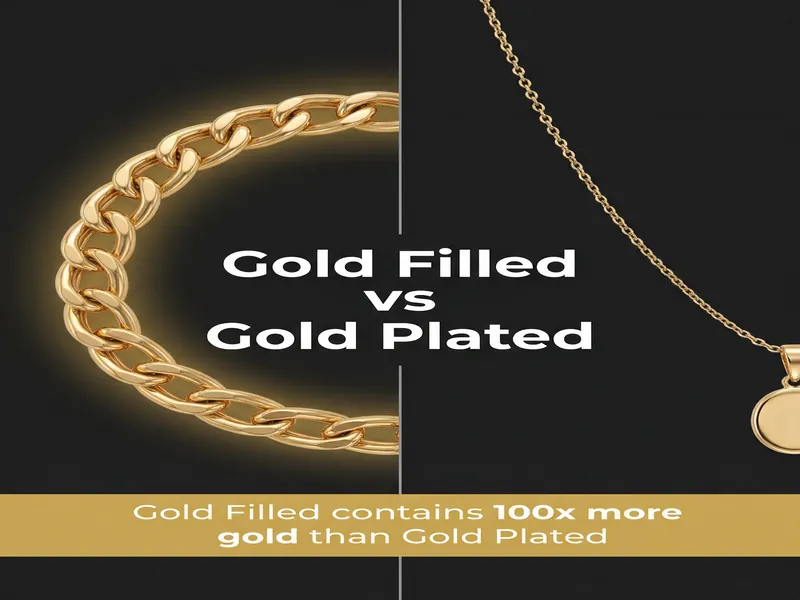
Gold filled vs gold plated — two phrases that are easy to confuse on a product listing, but they can mean vastly different things when it comes to quality and lifespan of your jewelry and your customers’ experience. This is important to know (and manufacturers need to tell you) because as a jewelry brand, boutique owner or the average consumer who wants to shop smart — you don’t want to make costly mistakes.
The confusion is understandable. Both types appear to be solid gold. Both use real gold. But one of them has as much as 100 times more gold than the other. One is meant to last decades. The other is for rare wear. And one of them is under the regulation of the US Federal Trade Commission — while the other is pretty much unregulated as far as thickness goes.
For years, HonHo Jewelry has been producing custom gold filled and gold plated jewelry for brands across the globe. In this guide, we’ll split out every major difference — even the nerdy stuff that most blog posts conveniently gloss over.
Quick Summary:
- Gold filled = thick layer of gold (≥5% of total weight) bonded with heat and pressure, lasts 10–30 years, hypollergenic are FTC regulated.
- Gold plated = thin layer of electroplated gold (<0.05% of total weight), low cost, limited lifespan and unlimited design freedom
- Nor is “solid gold” — but gold filled is as close a second, providing everyday durability at a fraction of the cost.
1. What Is Gold Filled Jewelry?
Gold filled jewelry — also referred to as “rolled gold” — consists of a thick sheet or layer of genuine gold that is permanently bonded onto a base metal heart, typically brass. Not to mention it bonds the two metals on a molecular basis — not just some surface coating, using pressure and heat.
According to the US FTC, a piece of gold filled jewelry must contain no less than 1/20th (5%) of its total metal weight in gold by law. That gold layer is usually made of 12-karat or 14-karat gold. You’ll frequently see items stamped “1/20 14K GF” or even just “14KGF.”
Unlike other methods, this mechanical bonding process ensures that gold filled pieces have a layer of gold in the structure of their jewelry — not simply a coating on top. This is what makes it that much more resilient than traditional plating.
Things to know about gold filled jewelry:
- Gold layer thickness: usually 10–100 microns (0.175–2.5 microns for plated)
- US law: min. 5% of total weight = gold content
- Base metal: typically brass (occasionally copper)
- Main: crunchen load — frecipe, no chemofilms needed
- Stamp: “1/20 14K GF” or “14KGF” or “1/20 12K GF”
- Average life span: 10 to 30 years with good care
“Gold filled jewelry has 100x more real gold than gold plated. That’s not marketing — it’s a legal requirement baked into the manufacturing standard.”
— HonHo Jewelry Production Team
2. What Is Gold Plated Jewelry?
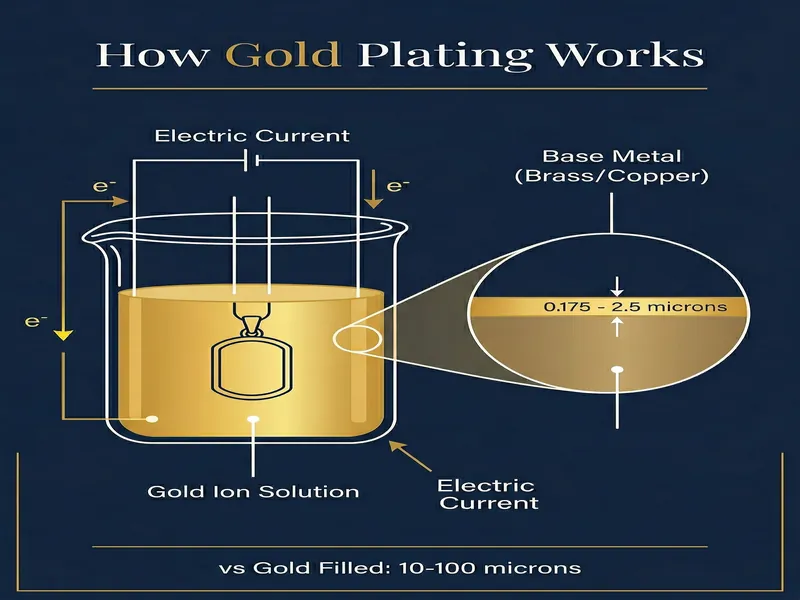
Gold plated jewelry is made using a technique called electroplating: an electric current adheres a very thin coating of gold to a base metal, usually brass or copper (and sometimes nickel). The piece is then immersed in a chemical bath that contains dissolved ions of gold, and the application of electricity induces the gold to adhere to the surface.
There is no minimum thickness requirement for US gold plating as there is with gold filled. A standard gold plated item will have a minimal gold content of less than 0.05% of total weight. The FTC has scant guidelines (bare minimum 0.5 microns for “gold plated,” at least), there’s a lack of enforcement, and many fast-fashion pieces are as thin as 0.175 microns layered on top of one another.
Key facts about gold plated jewelry:
- Gold layer thickness: 0.175–2.5 microns (fast-fashion staples: less than 0.5 microns)
- Less than 0.05% of total weight is gold content
- Base metal: aluminium, brass, copper, nickel and zinc alloy (widely varies)
- Process: chemical baths for electroplating with electrical current
- No hallmark for standard plated pieces is required
- Average lifespan: months to 2 years, depending on how much you wear it and the thickness of plating
⚠️ A note on “18K gold plated”: When a label states that something is “18K gold plated,” it informs you only of the karat of the gold used in that thin layer — not how thick that layer is. A low-end item can be “18K gold plated” and have the thinnest layer, invisible to the naked eye, that wears off after a matter of weeks. Micron thickness, not just karat Ask about this beyond the karat.
3. Gold Filled vs Gold Plated: Key Differences at a Glance
Here’s a head-to-head comparison of the most important factors:
| Feature | Gold Filled | Gold Plated |
|---|---|---|
| Gold content | ≥5% of total weight (1/20) | <0.05% of total weight |
| Gold layer thickness | 10–100 microns | 0.175–2.5 microns |
| Manufacturing method | Heat & pressure bonding | Electroplating (chemical bath) |
| Durability | Excellent — 10–30 years | Moderate — months to 2 years |
| Tarnish resistance | High | Low to moderate |
| Skin sensitivity | Generally hypoallergenic | May cause irritation |
| US FTC regulation | Yes — strictly regulated | Minimal regulation on thickness |
| Design freedom | Limited (no casting) | High (any shape possible) |
| Price per piece | Higher | Lower |
| Best for | Daily wear, keepsakes | Trend-driven, occasional wear |
| Hallmark stamp | 1/20 14K GF, 14KGF | GP, GEP, or none |
| Salt spray test (NSS) | 168+ hours | 24–48 hours (standard plating) |
4. The Micron Thickness Nobody Talks About
One of the biggest — and least talked about — differences is the actual thickness of their gold layer measured by microns (µm). A micron is one-thousandth of a millimeter. To put that in perspective: a human hair is approximately 70 microns thick.
Here’s how gold type breaks down by layer thickness, from thinnest to thickest:
| Gold Type | Layer Thickness | Regulation |
|---|---|---|
| Gold Flashed / Gold Washed | <0.175 µm | No minimum — cosmetic only |
| Gold Electroplate (GEP) | ≥0.175 µm | US FTC minimum for “electroplated” |
| Gold Plated (GP) | ≥0.5 µm | US FTC for “gold plated” term |
| Heavy Gold Electroplate (HGE) | ≥2.5 µm | US FTC “heavy” classification |
| Gold Vermeil | ≥2.5 µm on sterling silver | 925 silver base required |
| Gold Filled (GF) | 10–100 µm | ≥5% total weight (1/20 min.) |
Side by side, the numbers make it impossible to deny the difference. A “gold plated” piece at 0.5 microns can also be up to 200 times thinner than a gold filled one. This is why gold filled jewelry can be worn daily for years while a plated piece begins to show wear in months.
And this is also why some XRF (X-Ray Fluorescence) test machines sometimes identify gold filled pieces as solid — the layer of gold thick enough that it registers on the machine as a high-karat gold alloy, without detecting the brass beneath. Professional jewelers use this data and cross reference the XRF reading with the base metal peak (zinc and copper peaks indicate a brass core) to accurately identify rings.
5. US FTC Regulations: What the Stamps Actually Mean
The Federal Trade Commission (FTC) regulates compliance in the United States under 16 CFR Part 23. These rules are meant to keep consumers safe from misleading claims — but they go into much more detail than most people realize.
Gold Filled (GF):
By law, such “gold” must include a layer at least 1/20th (5%) of the total metal weight. The fraction and the karat must be stamped: “1/20 14K GF.” If the article only reaches 1/40 (2.5%) it must be marked as being “Gold Overlay” or “Rolled Gold Plate (RGP)” — and not gold filled!
Gold Plated:
According to the FTC, “gold plated” must be no less than 0.5 microns thick, while “gold electroplate” must be at least 0.175 microns thick. But there’s no mandated weight percentage — which means enforcement is lax and the term is used widely even for quite thin coatings.
Terms to watch out for:
- “Gold bonded” — a sales term, not a legal standard. Typically in reference to heavier plating or vermeil-style materials.
- “18K HGE” — Heavy Gold Electroplate, minimum 2.5 microns of gold. Above normal plating, however not gold filled.
- “Gold washed” or “gold flashed” — the absolute thinnest veneer, purely cosmetic.
- “14K gold” — doesn’t come with “filled” or “plated” after it — should indicate solid 14K gold. Exercise caution if the price appears to be too low.
✅ Pro Tip for Buyers: Always request your supplier for the stamp marking and FTC compliance documentation before purchasing a wholesale order. Manufacturers like HonHo Jewelry will offer certificates of materials and US FTC standards labeling on all custom orders, as well.
6. Durability and Lifespan: How Long Does Each Type Really Last?
This is one of the most frequently asked questions we receive, with an answer that really depends on a few factors: layer thickness, base metal quality, the way in which the piece is worn and how well it’s taken care of.
Gold Filled Durability:
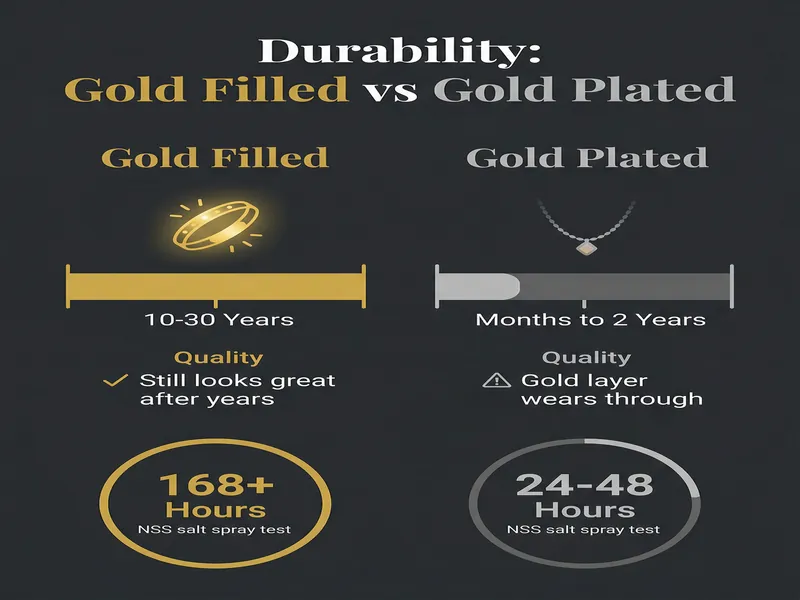
Gold Fill Jewelry: Gold filled jewelry has the potential to last anywhere from 10 up to 30 years with proper care. Certain items — vintage gold filled watch chains and brooches in particular — have been discovered intact after 50+ years. The thick, mechanically bonded layer of gold is vastly more resistant to both physical abrasion and chemical attack than electroplating.
At the atomic level, this endurance stems from a process called diffusion. Metallurgy research has shown that copper atoms, from a brass base, start diffusing upward toward the surface of the gold over time (this is what ultimately makes an otherwise gold-coated piece change color). In a typical 0.5-micron plated part, copper makes it to the surface within months. For a gold filled article with 10–100 microns of gold, the diffusion path is so long that under normal conditions, it takes decades for this process to happen.
Gold Plated Durability:
Most gold plated jewelry wears off visibly in 6 months to 2 years depending on how often you wear it and the thickness of the coating. Thicker coating (2.5 microns — Heavy Gold Electroplate) pieces can effectively last: Thin “fashion plated” components used in fast-fashion jewelry can quickly appear dull or show the base metal underneath within weeks of daily wear.
Industry test data:
- Salt spray test (NSS): Conventional gold plated comes through this for 24–48 hours. The substance will last for 168+ hours with no onset of metal corrosion.
- This is a friction test: Gold filled jewellery lasts far longer than any plated counterpart.
7. Skin Sensitivity, Allergies, and the Green Skin Problem
One of the complaints most often heard about jewelry — particularly from those with sensitive skin — is redness, itching or the dreaded green ring around a digit. Here’s what’s going on, and why gold filled vs gold plated are so different.
Why skin turns green:
Skin staining occurs when your sweat (which is slightly acidic, pH 4–6) reacts with the base metal under the gold layer. Copper is the main offender — when copper oxidizes, it forms copper chloride or copper sulfate compounds that can leave a greenish mark on skin. This is totally harmless but nonetheless annoying.
During normal use, this is very unlikely to happen with gold filled jewelry. The thick gold coating keeps your skin from ever being in direct contact with the brass core — at least for several years. Gold plated jewelry is the most susceptible, because it will tarnish faster due to its thin layer wearing away and exposing the copper or brass base directly to your skin.
Nickel allergy — a bigger concern:
Dermatology studies have reported that about 10–15% of the population is affected by nickel allergy. If the base metal in a gold plated piece contains nickel (and a lot of inexpensive base metals do), and if the gold plating wears through, skin contact with nickel can cause an actual allergy — not just cosmetic discoloration.
Most gold filled jewelry uses a brass (copper + zinc) base — no nickel. And as long as the gold layer stays intact, it’s typically safe for sensitive skin. When buying gold filled jewelry for someone who has known metal allergies, consult with your manufacturer specifically regarding the base metal content.
✅ For sensitive skin customers: Gold filled is the safer choice. It’s also worth noting that 925 sterling silver base (vermeil) is another excellent option for people with nickel sensitivity. At HonHo Jewelry, we manufacture with copper, brass, and 925 silver bases — and we never use nickel in our base metals.
8. How Each Type Is Made: The Manufacturing Process
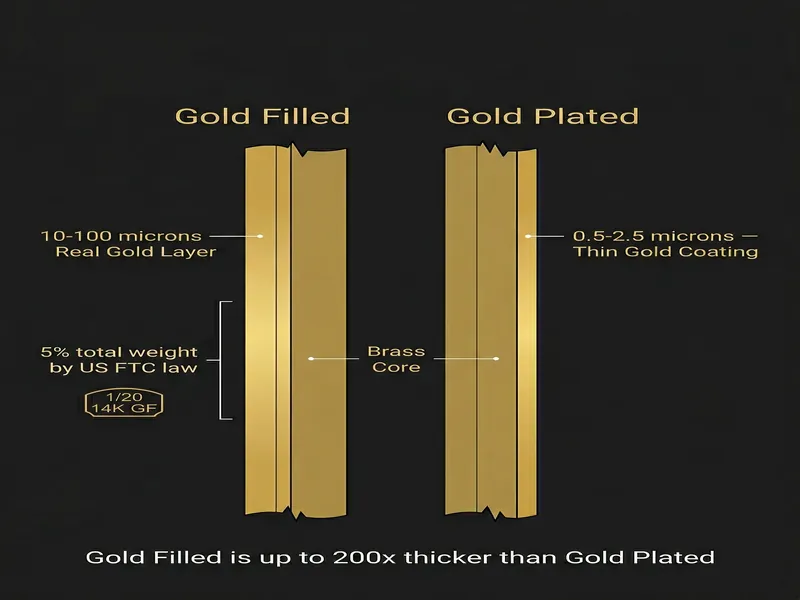
How each of these kinds are produced has a lot to do with why they perform so differently in real life.
How Gold Filled Is Made:
Gold filled production is done with sheets or coils of base metal (brass in most cases) and solid gold sheets (14K or 12K). They are cleaned and lined up — gold above, brass below — then fed through a rolling mill under intense heat and pressure. The heat forms a molecular bond at the junction between the two metals, so in essence it welds them together into one material. The result is a composite metal that retains the workability of the base metal but offers a real gold surface.
This bonded sheet or wire is then industrially formed into the other components of jewelry: chains, wires, ear hooks, clasps, tube beads and many molded items.
How Gold Plated Is Made:
Gold plating uses electrochemistry. Cleaned and sometimes pre-plated with a nickel barrier layer, the base metal piece (now in its final shape) is dipped into a chemical bath filled with dissolved gold ions. The surface of the piece attracts gold ions, which are deposited when an electrical current is passed through the solution.
The concentration of the bath, current level and time in the bath determines how thick the deposited gold is. This process enables gold to plate three-dimensional structures that have already been formed — including cast components with complicated geometry.
9. Design Limitations Most Articles Never Mention
This is something that rarely if ever shows up in the mainstream blog articles on gold filled vs gold plated jewelry, but that is critically important for anyone designing or ordering custom jewelry:
Gold filled cannot be cast.
Gold filled material is not eligible for lost-wax casting (the technique of melting metal and pouring it into a mold to form shapes in 3D). This is because the casting heat (700°C+) destroys the layering. This would result in a mixed metal, with the gold layer alloying with the brass core resembling neither filled nor solid gold.
What that means is gold filled jewelry can only be made in certain w
- Wire forming and wrapping
- Stamping and die-cutting flat shapes
- Chain making and linking
- Tube and bead forming
Any design that requires complex three-dimensional shapes, hollow forms, or fine details only achieved by casting must be produced in gold-plated metal (cast first and plated later) or solid gold.
Gold filled has another issue — it needs to be carefully soldered. When you solder gold filled elements, the flame needs to be consistently further away than 800°C — hit that temperature and anything in your join will instantly become what jewelers refer to as “gold sunk” — i.e., the gold layer alloys with the brass underneath and permanent dark spots appear at the joint which can’t be polished out. You have to work with soft solder (low melting point solder) created for gold filled job.
Why this matters to wholesale and OEM buyers:
- Simple, clean geometric designs → gold filled is awesome
- Intricate sculptural or textured cast pieces → gold plated is your only option (aside from solid gold)
- Rings requiring resizing → no gold filled; cutting and reforming will damage the outer layer of gold and expose the base metal at cut points
10. How Heat, Sweat, Chlorine, and Perfume Affect Each Type
Even where your jewelry resides has a major effect on its longevity. Gold filled. Gold plated. Both are impacted by the same enemies — but vastly differently.
Sweat (pH 4–6, slightly acidic):
Sweat is slightly acidic and has chloride ions. For gold plated jewelry, the frequent exposure to sweat helps speed up electrochemical corrosion of the thin layer of gold — at micro-cracks and scratches in particular. Gold filled jewelry protects against sweat much better due to the thick gold layer creating a longer-lasting barrier.
Chlorine (pool water, cleaning products):
Chlorine is aggressive and attacks gold-coated jewelry quickly. Even gold filled pieces should be removed before swimming in chlorinated pools. For gold plated, chlorine can strip the gold layer noticeably after just a few exposures.
Salt water:
Like chlorine — salt and minerals found in seawater corrode any bare metal. Marine environments tend to dull and wear out gold plated pieces quickly.
Perfume, hairspray, and lotions:
Perfumed alcohol and chemical compound in perfumes and cosmetics are leading causes of your gold plated jewelry start of tarnishing early. [ Perfume and lotion go on first, followed by your jewelry — never the other way around. Both types are susceptible, but plated pieces are more so.
Body heat and temperature cycling:
As the body temperature is increased, atomic diffusion of course occurs more quickly between the gold layer and base metal. In the long run, this speeds up the “natural aging” process. For gold plated pieces, this happens quickly; for gold filled it is negligible over a normal human life span.
11. Gold Filled vs Gold Plated for Wholesale and OEM Custom Jewelry Orders
You might be a jewelry brand owner, boutique owner or an Amazon/Etsy seller looking at your supply chain considerations: the decision of gold filled or gold plated affects how you positioned your products (inclusive of pricing), level of customer satisfaction as well as return rates.
When to choose gold filled for wholesale:
- Your brand promise is quality and durability (“jewelry that lasts”)
- Your products sit in the $30—$150+ retail space
- You’re chain based, your wire formed, you use stamped flat components
- Your customers have jewelry on every day and are concerned with skin safety
When to choose gold plated for wholesale:
- Your brand is doing fast fashion, (that is new designs every season)
- Your products were priced between $5–$30 retail
- Your designs feature casting pieces, 3D complex shapes, or fine detail
- Your consumers purchase occasionally or for an event.
- You require lower minimum order quantity (MOQ) and per-unit cost
A note on minimum order quantities (MOQ):
Gold filled orders require higher MOQs (min 50–100 pieces per style) because the coiled wire, pre-cut sheet/gold materials are manufactured in chunk sizes and the fabrication process is less flexible compared to casting + plating. As Gold plated orders comes with low MOQs, which can be quickly customized.
What about “gold bonded” and PVD gold?
These are common terms you may come across when sourcing from suppliers:
- Gold Bonded: A marketing term normally used for thick heavy gold electroplate on a sterling silver base — better than standard plating but less than gold filled. FTC does not regulate as standard term.
- PVD Gold (Physical Vapor Deposition): a more resistant gold coating (0.5–2.5 microns thick) that coats in a vacuum chamber — ideally built to last longer Far more complex than electroplating, and much more scratch-resistant — great for stainless steel parts. For some applications, PVD is a higher quality than gold filled, but it should not be confused with the latter. At HonHo Jewelry, we have plenty of stainless steel pieces with PVD finishing as a more affordable but durable mid-range alternative.
Ready to Order Custom Gold Filled or Gold Plated Jewelry?
China professional custom jewelry manufacturer_HonHo jewelry We collaborate with brands, boutiques and wholesale purchasers to manufacture us FTC complied gold filled and gold plated pieces, material certification available. Get a Free Quote →
12. How to Tell the Difference When Shopping
Whether you’re purchasing retail or sourcing wholesale, here are some handy ways to differentiate gold filled from gold plated.
1. Look for the hallmark stamp:
Gold filled jewelry must bear a stamp (in the United States) indicating the fraction and karat: 12KGF, 14K GF, 1/20 12K GF. Gold plated components may have stamps such as “GP,” “GEP” (gold electroplate) and “HGE” (heavy gold electroplate) — or no stamp whatsoever.
2. Check the construction:
Gold filled jewelry is made of separate components: wires, chains, tubes, ear hooks and clasps. If all components are constructed from wire-formed or stamped pieces, it is probably gold filled. Many gold plated pieces are cast as one piece — a smooth, seamless, three-dimensional shape that could never have been made from wire or sheet alone.
3. Check the price (with caution):
Gold filled jewelry generally cost more than gold plated due to high content of gold. But price alone is not foolproof, since some vendors charge too much for a plated piece. Price should be used as a signal and not confirmation.
4. Ask about the micron thickness:
If you purchase wholesale, ask your supplier — “What is the gold plating thickness in microns?” A trusted supplier should be able to provide you with the answer. Standard fashion pieces: 0.3–0.5µm Good quality plated jewelry: 1–2µm Gold filled: 10–100µm If they can’t tell you the thickness, it’s a red
5. The wear test (for used pieces):
For worn pieces, check for flaking, peeling or color change at high-friction areas (backs of rings, clasp areas, insides of bracelets). Signs of wear will appear much earlier with gold plated jewelry. Normal wear can cause gold filled creations to be appear a bit dull over time but they should not flake or peel.
6. XRF testing (professional method):
Metal composition is identified using XRF (X-Ray Fluorescence) analyzers, which are used by recyclers and jewelers. Keep in mind that XRF can be misleading for gold filled items — the thick layer of gold can lead the machine to read “14K gold” if its core is brass. A professional reads the entire spectrum, and searches for unusual zinc/copper peaks signifying a brass core. If the gold reading is good but then you also get high zinc levels, it’s probably not solid gold, but rather gold filled.
13. Care Tips to Make Your Jewelry Last as Long as Possible
Whether you select gold filled or gold plated, the appropriate care practices significantly prolong the functional life of your pieces.
For both types:
- After perfume, lotion and hairspray have dried: Put jewelry on last
- Remove it first — prior to handwashing, showering, swimming or exercising
- Store separately — in soft pouches or individual compartments to avoid scratching
- Gentle clean — soft dry cloth; for deeper clean, small drop of mild dish soap mixed with lukewarm water and pressed on a soft cloth, after which dry immediately and fully
- Do not use ultrasonic cleaners and steam cleaners — these can damage the bond in filled pieces between gold and base metal, and strip thin plating rapidly
Specific to gold filled:
- Gold filled has water resistance, but take it off before hitting the pool or sea
- If a gold filled piece gets a light scratch, the base metal is still protected due to its thick layer — no need to panic
- Do not use rough polishing cloths intended for solid gold; just a soft jewelerycloth.
Specific to gold plated:
- Treat each piece as though the gold might wear off — with thin coatings, it will
- The less water, acids and friction contact between plating, the longer it lasts
- If a plated piece is tarnishing on the base metal (green or dark spots), stop wearing it against bare skin as this causes irritation
- Re-plating is possible — a jeweler can remove the old plating and re-plate the piece, but that makes it more expensive to maintain, and in general, unless high-value pieces are involved not worth doing.
14. Gold Filled vs Gold Plated vs Gold Vermeil vs Solid Gold
You’ll often see four types of gold jewelry mentioned together. Here’s where they all fit on the quality spectrum:
| Type | Base Metal | Gold Layer | Durability | Price Range | Best For |
|---|---|---|---|---|---|
| Gold Plated | Brass, copper, nickel | 0.175–2.5µm | Low–Moderate | $ | Trend pieces, fashion wear |
| Gold Vermeil | Sterling silver (925) | ≥2.5µm | Moderate | $$ | Fashion + hypoallergenic |
| Gold Filled | Brass | 10–100µm (≥5% weight) | High | $$ | Everyday wear, keepsakes |
| Solid Gold (14K) | N/A — all gold alloy | Entire piece | Permanent | $$$$ | Fine jewelry, investment |
Gold vermeil is special: it’s a step up from gold plated but below gold filled. Its advantage over ordinary gold plated is that the base metal is sterling silver — so if, and when, the plating wear through, the silver underneath is much skin-friendlier (and more valuable) than brass or copper. In the US, it is regulated to have at least 2.5 microns of gold plated on top of 925 silver.
For an in-depth comparison of gold vermeil vs gold filled, visit our jewelry materials guide at HonHo Jewelry.
For authoritative information on FTC gold labeling requirements, you can also refer to the FTC Jewelry Guides directly.
15. Which One Should You Choose?
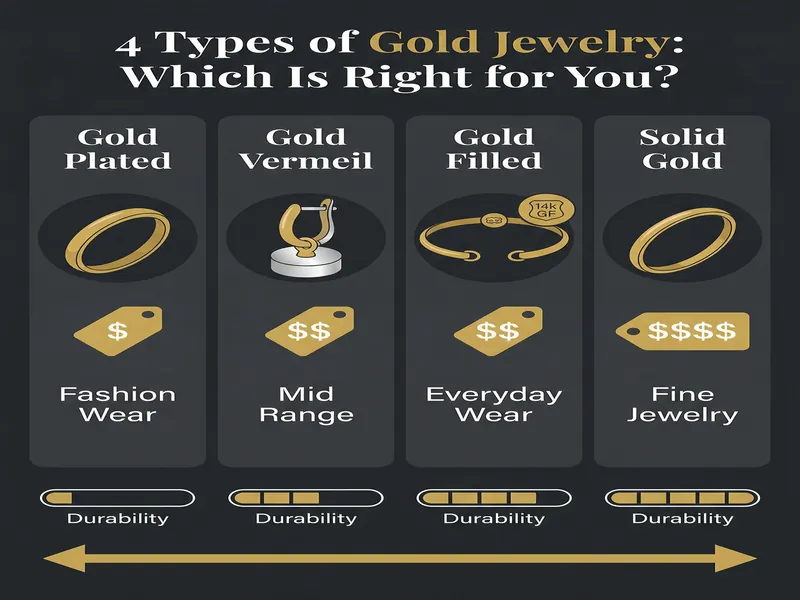
There’s no one-size-fits-all — what you should use depends on your use case. Here’s a simple decision guide:
Choose gold filled if:
- You prefer jewelry that you can wear every day without worrying.
- You or your customers have sensitive skin or allergy to metal
- You are making keepsake, personalized or gift jewelry that needs to work for years
- You need it in wire, chain, stamped or tube forms
- Your price point enables you to have a higher per-unit cost
- You appreciate a sustainable narrative for your brand
Choose gold plated if:
- You are sourcing fast fashion jewelry that evolves with trends
- Your customers are buying at lower price points and wearing pieces once in a while
- You designs need castings, complex 3D shapes or textures
- You want low MOQ and extreme flexibility in your design
- You’re trying out new styles, before committing to better-quality production
Choose gold vermeil if:
- You want a higher level than base plating without the expense of gold filled
- You have customers with sensitive skin and you need a silver safety net under the gold
- Your brand values fit at higher material quality for mid-range prices
Successful jewelry brands tend to use a combination: gold filled for their core everyday collection, gold plated for seasonal/trend-driven pieces and solid gold for their premium line. This layered structure allows you to deliver on different customer segments without compromising the quality promise.
Frequently Asked Questions About Gold Filled vs Gold Plated
Is gold filled better than gold plated?
Yes — for durability, longevity and skin safety. Gold filled contains at least 5% gold by total weight, which is about 100 times more than normal gold plated (which only has a microscopic layer)ϲ. With careful maintenance, the thick mechanically bonded layer lasts 10–30 years. When it comes to everyday wear or things you want to stand the test of time, gold filled is a big winner—by a long shot. If, though, cost or design complexity or trend flexibility is priority then gold plated is a better option.
If white gold or gold plated is mentioned and in contrast to their own, how long does gold filled jewelry last?
Gold filled jewelry can last for 10–30 years with proper care. Some antique gold filled (watch chains, brooches etc.) has been in perfect condition for 50+ years. Standard gold plated jewelry would noticeably wear out within 6 months to 2 years but this is subjective depending on tone of the plating and how you wear it. Heavy gold electroplated products (2.5+ microns) with proper care can also last between 3 to 5 years.
Does gold filled jewelry turn your skin green?
It is highly unlikely to turn your skin green while wearing gold filled jewelry. The thick gold coating serves as a barrier between your skin and the brass underneath. Gold plated jewelry is much more sensitive — once that thin plating wears off, the copper in the base metal reacts with sweat to form green compounds that temporarily stain your skin. This is harmless but annoying and it is the most common complaint about low-quality gold plated pieces.
What does 1/20 14K GF mean on jewelry?
This is the hallmark stamp for gold filled jewelry required by the US FTC. It translates to: 1/20 = the gold layer is 1/20th (5%) of the overall metal weight; 14K = the gold contained is 14-karat gold; GF = gold filled. This stamp indicates that the piece meets the minimum standard in legally using gold filled label in United States.
Is Gold Filled Or Gold Plated Better For Sensitive Skin?
Gold filled is much safer for sensitive skin. Its thick bonded layer maintains its structure during normal wear for years, separating your skin from the brass core. Gold plated jewelry irritates only after the coating wears off and base metal (which may contain nickel or copper) contacts your skin. If you or your clients have nickel allergies, consider gold vermeil (925 silver base) or solid gold as other optio
Can I shower or swim with gold filled jewelry?
While gold filled handles rare exposure to water much better than gold plated, as with any pieces of jewelry we recommend always removing your gold before swimming in a chlorinated pool, the ocean or hot tubs. Salt water and chlorine are corrosive, and a thick layer of gold will deteriorate over time. Short rinses or light rain are generally OK with gold filled pieces — they won’t cause quick damage.
How do I tell if my jewelry is gold filled or gold plated?
Look for a stamp. Gold filled items are required to be marked “1/20 14K GF,” “14KGF,” or other equivalent marking. Gold plated pieces might be marked “GP,” “GEP,” or “HGE” or may not have a marking at all. Also scrutinize the construction: gold filled pieces are typically wire-formed or built with components (chains, hooks, tubes), while plated pieces are often seamless cast shapes. If a piece appears old and damaged, peeling or flaking is evidence of plating, whereas dulling without peeling offers more evidence that it’s gold filled.
Is gold filled jewelry worth buying for wholesale or OEM orders?
Yes — for the right product category. Gold filled is wonderful for casual wear collections, keepsake pieces, and brands focused on quality. It also commands a higher retail price and gets fewer complaints about tarnishing or skin irritation. Care should be taken as the primary restraints are design limitations (no casting) with higher MOQ. When it comes to fashionable or trend-driven collections that need cast shapes and the most design flexibility, gold plated (especially quality heavy gold electroplate) is frequently the more sensible wholesale option. Both are included in the product mix of many brands. For wholesale prices for both options, please contact HonHo Jewelry.
What is the difference between gold filled and gold bonded?
“Gold bonded” is not a term regulated by FTC guidelines. It is primarily a marketing term for thick gold electroplate — typically on sterling silver base metal — that provides better than standard wearing durability but which does not meet the 5% weight minimum required to qualify as “gold filled.” When reviewing a “gold bonded” item, be sure to ask the supplier for the specific thickness (usually in microns) and percentage of gold weight.
Can gold plated jewelry be re-plated?
Yes. A jeweler can remove the worn gold plating and re-plate the piece. Re-plating costs vary, generally $15–$60 per piece depending on size and complexity. It’s most economical for more expensive pieces, where the underlying work of art is worth saving. For fashion items purchased in the $15–30 retail range, the expense of re-plating may be greater than the worth of the item itself.
The Bottom Line
There may not be a single right answer to the question of gold filled vs gold plated — but there is a right answer for you. If you are looking at durability, safety on the skin and long-term quality of back to a price difference worth every penny for gold filled. If your priorities are design, lower cost and trend-led production then a high-quality gold plated (with a decent micron thickness) is a very practical and legitimate option.
The key thing is that you know exactly what it is you’re buying or selling — understand the stamps, ask about the micron thickness, and go with a manufacturer who’ll give you documentation on their materials. That transparency is what distinguishes a great jewelry brand from one you forget.
And this is exactly what we’ve been helping global jewelry brands navigate at HonHo Jewelry, for years! From gold filled / fauceted chain collection at FTC-compliant stamps, casted gold plated pendant line with weighty HGE coating or a pvd stainless steel series capable for hitting the ground running.
Gem + Tonic — Custom Jewelry Find Your Muse Check out HonHo Jewelry and send us your inquiry (our team replies within 24 hours).
Custom Necklace: The Complete Guide to Ordering Wholesale for Your Brand
If you have ever looked up a custom necklace manufacturer and found yourself more baffled
How to Clean Stainless Steel Jewelry: 7 Methods That Actually Work
Learning how to clean stainless steel jewelry is essential if your favorite necklace has started
Best Costume Jewelry in 2026: Brands, Materials & Care Guide
HonHo Jewelry is a custom jewelry manufacturer based in Dongguan, China, with 15+ years of