
More Than a Closure: Choosing the Right Clasp for Your Jewelry Brand
You’re finalizing a new necklace or bracelet line. The plating spec is approved, chain samples look right, packaging is nearly done, and then the clasp becomes a last-minute decision. That’s where many product problems start.
The clasp is the most-handled part of any piece. Customers touch it every time they put jewelry on, take it off, adjust it, or ask for help with it. If it feels flimsy, jams, catches hair, or opens too easily, the rest of the product quality gets judged through that tiny component.
From a manufacturing standpoint, clasp choice affects more than wearability. It influences assembly speed, sourcing consistency, return rates, replacement parts, plating performance, and how premium the finished piece feels in hand. It also changes what kind of customer the piece works best for. A clasp that looks elegant on a sample board may become a service issue once it reaches daily wear.
A poor choice can lead to returns, damaged brand reputation, and lost revenue. A good one supports both margin and customer satisfaction.
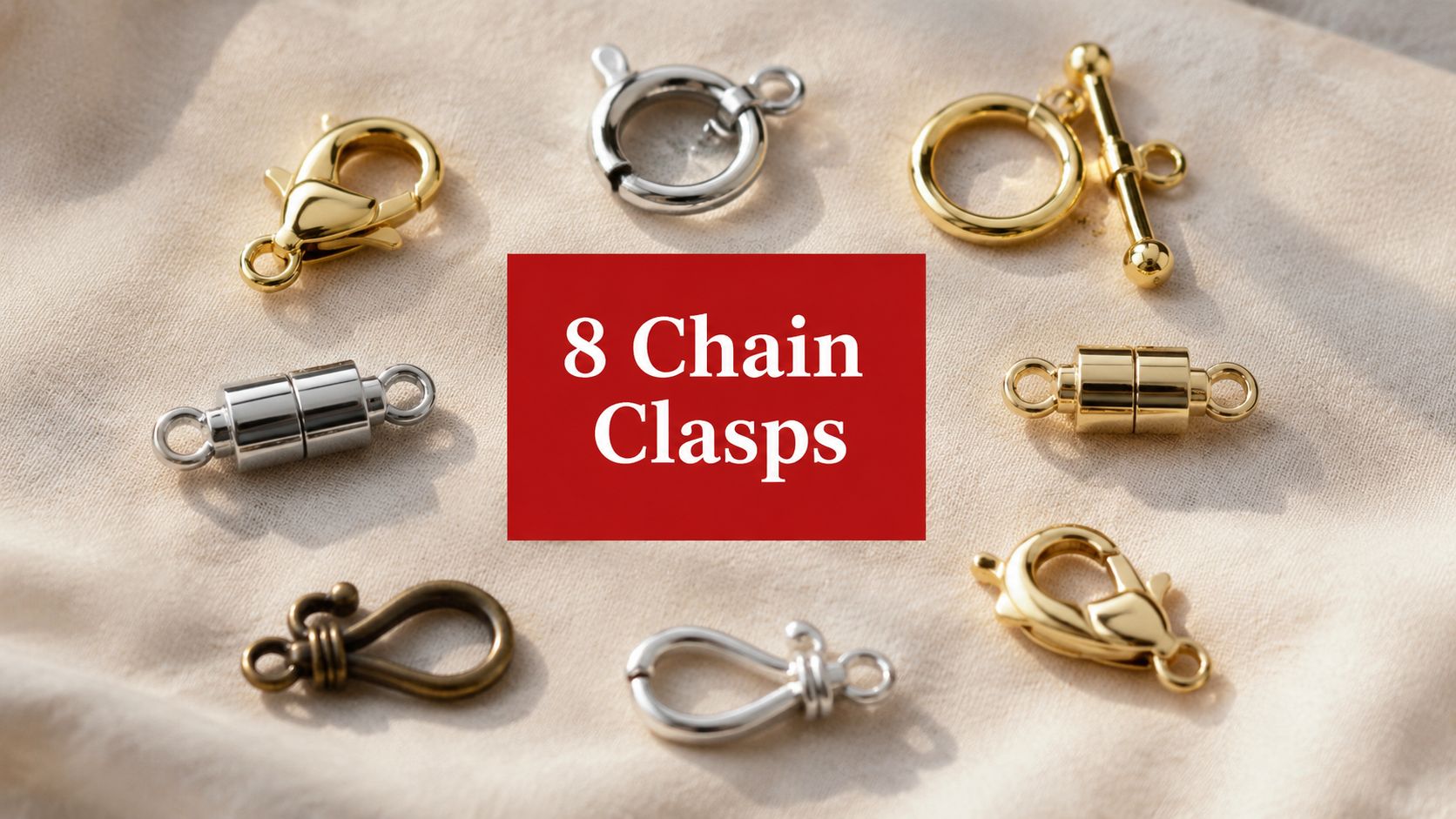
This guide breaks down 8 common types of chain clasps from a manufacturer’s perspective. The focus isn’t just on what each clasp is. It’s on where each one works, where it doesn’t, and what buyers, brands, and distributors should confirm before moving into wholesale jewelry production, private label development, or OEM customization.
A buyer approves a necklace sample because the chain weight, finish, and price all work. Three months later, customer service starts seeing the same complaint. The piece looks good, but the clasp feels small, stiff, or unreliable in daily use. That pattern is one reason lobster clasps stay in production so often. They solve a lot of problems before they reach retail.
A lobster clasp is a spring-loaded hinged closure that opens with a lever and closes onto a jump ring or end ring. For many necklace and bracelet programs, it remains the safest starting point because it balances security, unit cost, and assembly efficiency better than most alternatives.

You see it across commercial price points for a reason. Charm bracelets, fine-plated fashion necklaces, sterling silver basics, and many private label collections all use lobster clasps because they are familiar to customers and straightforward for factories to source in volume. They also pair well with many common chain constructions, especially the styles covered in this guide to jewelry chain types and applications.
Lobster clasps are usually the most forgiving option on the assembly floor. They fit standard production methods, work across stainless steel and sterling programs, and rarely force a redesign of the chain end structure. That lowers sampling time and helps keep rework under control.
The trade-off is size and user comfort. A very small lobster clasp looks refined on a delicate chain, but it is harder to open, especially for customers with long nails, limited dexterity, or larger fingers. A larger clasp improves usability and perceived security, but it changes the visual balance of the piece and adds hardware cost.
In OEM development, those details matter more than brands often expect. A clasp that passes visual review can still fail in the market if the spring tension is inconsistent, the lever feels sharp, or the jump ring wears too quickly against the clasp throat.
A few production checks make a noticeable difference:
For brands sourcing jewelry findings for OEM production, lobster clasps are often the benchmark part. If this clasp cannot meet your target for feel, finish, and durability, the rest of the hardware program usually needs a closer quality review.
A customer buys a tennis bracelet because the line of stones looks clean from end to end. If the clasp sits high, catches hair, or takes two attempts to close, that clean design loses value fast. Box clasps are used to protect that visual continuity while keeping the closure compact and relatively secure.
The mechanism is straightforward. A spring tongue slides into a box housing and clicks into place. On the finished piece, the clasp reads as part of the bracelet or necklace instead of a separate finding, which is why box clasps show up so often on tennis bracelets, gemstone line necklaces, and refined sterling silver programs.

That polished look comes with tighter manufacturing tolerance than many brands expect. A lobster clasp can hide small inconsistencies better. A box clasp cannot. If the tongue angle, catch position, or insertion depth is slightly off, the problem shows up immediately in hand feel.
For OEM and ODM production, this clasp deserves more front-end engineering than its size suggests. Ask for detailed dimensions, locking structure, insertion depth, spring alignment, and the intended chain or bracelet weight range. If the clasp is integrated into a stone setting or decorative end cap, review assembly drawings early because repairs become more difficult once the design is locked.
A few production decisions usually determine whether a box clasp feels premium or turns into a service issue:
Brands developing integrated necklaces should also consider how clasp profile interacts with chain style. A chain style selection guide for jewelry development is useful here because some links visually support a hidden box clasp better than others.
A well-made box clasp can make a collection look more expensive. That only holds if the click feels precise, the surface finish stays clean, and the clasp still closes confidently after months of wear.
Toggle clasps are part hardware, part design feature. The system uses a bar and a ring. The bar passes through the ring, then rotates to hold under tension. In the right piece, that visible closure adds character instead of trying to disappear.
That’s why toggle clasps show up so often in artisanal collections, contemporary statement necklaces, leather-and-chain hybrids, and branded bracelets where the clasp is meant to be seen. Ralph Lauren style references, independent designer capsule lines, and hand-cast artisan jewelry all use toggles this way.

Toggles work best when the jewelry has enough body to keep the bar seated. On a substantial bracelet or a necklace with balanced weight, they’re easy to use and visually strong. On a very light chain, they can feel risky because movement reduces tension.
Manufacturing teams shouldn’t treat toggle design as decoration only. Bar length, ring diameter, and chain weight need to work together. If the tolerances are sloppy, the piece may pass visual approval and still fail in wear testing.
A few practical decisions improve outcomes:
For sensitive-skin collections, finish and coating choices matter just as much as form. Brands making plated or skin-contact pieces should review a nickel-free jewelry manufacturing guide before approving toggle hardware for volume production.
Toggle clasps are a good example of why types of chain clasps shouldn’t be chosen from a catalog image alone. The design can be beautiful and still be mechanically wrong for the chain.
A customer trying to fasten a bracelet one-handed usually decides within seconds whether the product feels thoughtful or frustrating. Magnetic clasps solve that problem well. The two ends guide themselves into place, which makes them useful for accessibility-focused designs, minimalist chains, and gift lines where ease of use helps conversion.
They also create a clean visual finish. On the right piece, the clasp feels integrated instead of added on. That benefit comes with a manufacturing trade-off: convenience is high, but security depends heavily on magnet grade, housing design, and chain weight. A magnetic clasp that feels strong in a sample tray can still separate too easily during daily wear if the spec is too light.
Here’s a quick look at the mechanism in action:
Magnetic clasps need tighter sourcing discipline than many brands expect. The magnet itself is only part of the job. The shell material, wall thickness, adhesive or mechanical retention method, plating sequence, and final assembly tolerance all affect performance.
In production, I look at four points first. Retention strength under real chain load. Plating impact after finishing. Consistency between magnet batches. Clear warnings for customers who use medical devices.
A practical QC checklist should include:
Magnetic hardware is usually a selective choice, not a default clasp standard across a full collection. It works best when the brand priority is accessibility, clean styling, or a specific product story. For collections built around wellness positioning, this guide to magnetic bracelet benefits and product considerations can help shape customer education and merchandising.
Approve magnetic clasps only after wear testing, plating review, and batch-level supplier checks. That is where margins are protected.
Hook and eye clasps are old, simple, and still useful. One end is a hook. The other is a fixed eye or loop. The hook slides through and stays in place through shape, tension, and gravity.
This is one of the most practical clasp types for handmade, vintage-inspired, and lower-complexity collections. It’s common in artisanal jewelry, heritage looks, and prototypes where brands want to test a silhouette before investing in more complex hardware. It also keeps assembly straightforward, which can help during early sampling.
The hook and eye clasp works when the product story values craftsmanship, rustic styling, or visible hand-finished details. It doesn’t try to look hidden or technical. On the right bracelet or necklace, that honesty is part of the appeal.
But this clasp needs careful shaping. If the hook curve is too open, security drops. If it’s too tight, the user struggles to open it. If the tip isn’t polished properly, it catches hair, fabric, or knits.
A smart manufacturing review should include:
This clasp is also useful when brands are building samples fast. If a collection is still evolving, hook and eye hardware can validate style direction before your factory commits to custom molds for more specialized findings.
The spring ring clasp is compact, traditional, and still widely used in delicate jewelry. Mechanically, it’s a hollow circular ring with a small spring-loaded section that opens when the lever is pulled and snaps closed when released.
It also has deep manufacturing history. The spring ring was invented in the early 1900s and remains the world’s most used clasp type in jewelry manufacturing, particularly on women’s jewelry featuring lighter, thinner chains where the mechanism is most effective, according to Icecartel’s overview of chain clasp types.
If your line includes fine 24K gold necklaces, slim silver chains, layering pieces, or minimal pendants, spring rings still make sense. They’re visually discreet and don’t overpower the chain. That’s their advantage.
Their weakness is usability. Small levers are harder for many customers to operate, especially on bracelets. That means the spring ring is often a good aesthetic choice, but not always the best user-experience choice.
For custom necklace production, keep the controls tight:
For brands developing pendant and layering programs, a custom necklace manufacturing guide is the right place to align clasp choice with chain gauge, pendant weight, and production method.
Spring rings look elegant on refined pieces. They don’t forgive poor assembly or loose ring sizing.
Barrel clasps are a screw system. One side threads into the other, creating a cylindrical closure that’s compact, secure, and visually understated. In fine jewelry and certain premium fashion pieces, that threaded action gives customers a stronger sense of closure than a simple hook or magnetic join.
This clasp rewards precision and punishes shortcuts. Thread alignment, metal hardness, and finishing quality matter a lot more here than in simpler clasp types. If the threading is rough, the user feels friction immediately. If the material is too soft, the clasp wears out much earlier than expected.
This is one of the most overlooked sourcing issues in jewelry manufacturing. Many articles list barrel clasps but don’t explain how material affects lifespan in real production. One sourcing reference highlights that stainless steel is ideal for screw and barrel clasp applications because of its precision and hardness, while brass is unsuitable for long-term use in barrel clasp applications due to softness, according to JingSourcing’s clasp materials discussion.
That same source also notes that 70% of entry-level jewelry failures stem from clasp wear in this category of discussion. For plated or costume jewelry, that makes barrel clasp material selection a margin issue, not just an engineering detail.
In practice, brands should:
Barrel clasps can feel premium and discreet. They just need the right metal and the right machining discipline to stay that way.
A customer tries on a handmade necklace, loves the front design, then notices the clasp is part of the look instead of something hidden at the back. That is where an S-hook earns its place. It closes the piece, but it also acts as visible hardware, which makes it useful for brands selling bohemian, artisan, and design-led collections.
An S-hook clasp is a shaped metal hook that catches onto a ring or loop at the other end of the chain. The concept is simple. Production is not always simple. Small changes in wire gauge, bend radius, and end finishing can shift the clasp from easy to use to frustrating, or from decorative to too easy to dislodge during wear.
Security depends on geometry more than buyers often expect. A hook with a wide opening is faster to fasten, but it can release under movement. A tighter return curve holds better, but customers with longer nails or limited dexterity may find it annoying. For OEM development, that trade-off should be tested early with actual sample chains, not approved from a flat sketch.
Surface quality matters just as much. Any rough point on the tip or inner curve can catch knitwear, hair, or plated jump rings. In factory review, I look closely at four details:
S-hooks also give brands more room for customization than many standard findings. The hook can be forged, cast, or wire-formed. It can carry hammer texture, a branded stamp, decorative ball ends, or a hand-finished profile that supports a higher retail price. That makes it attractive for smaller collections that need visible differentiation without the tooling cost of a more complex clasp.
The limitation is clear. S-hooks are usually a style-first closure with moderate security. They work best on pieces where aesthetics, grip comfort, and brand character matter more than maximum retention. For activewear jewelry, children’s products, or fine chains with high replacement cost, I would usually steer a brand toward a more secure clasp type.
| Clasp Type | 🔄 Implementation Complexity | ⚡ Resource Requirements | 📊 Expected Outcomes | 💡 Ideal Use Cases | ⭐ Key Advantages |
|---|---|---|---|---|---|
| Lobster Claw Clasp | Moderate, standard spring hinge, mass-producible | Low–Medium, common components, standard plating, fast fulfillment | Reliable, secure closure with broad consumer familiarity | DTC brands, wholesalers, everyday chains & bracelets (500+ units) | Secure, affordable, versatile across finishes |
| Box Clasp | High, precision tooling and spring tongue alignment | Medium–High, custom molds, tighter QC, thicker plating (≥0.8 μm) | Flush, elegant finish with premium perceived value | Luxury/minimalist lines, branded closures (200+ units) | Seamless look, engraving/customization |
| Toggle Clasp | High, custom shapes and tight fit tolerances | Medium–High, bespoke molds, longer sampling (10–20 days) | Decorative focal point with durable, spring-free function | Independent designers, artisanal/luxury collections (100+ units) | Distinctive design, durable, highly customizable |
| Magnetic Clasp | High, specialized magnet sourcing and plating protocols | High, rare-earth magnets, testing, medical liability measures | Invisible, one-handed ease but with device/health constraints | Premium tech-forward brands, contemporary collections (50+ units) | Effortless use, minimalist aesthetics, great for limited dexterity |
| Hook and Eye Clasp | Low, simple two-piece manufacturing | Low, minimal tooling, rapid sampling (3–7 days) | Durable, low-cost, vintage/handmade appearance with moderate security | Artisanal/maker lines, vintage-inspired collections (100+ units) | Very durable, repairable, economical |
| Spring Ring Clasp | Moderate, small spring with tight tolerances | Medium, precision stamping, spring testing, plating | Compact and discreet for delicate pieces; less ideal for heavy use | Fine jewelry, delicate necklaces and pendants (200+ units) | Compact, lightweight, minimally visible |
| Barrel Clasp | Very High, precision threading and CNC machining | Very High, specialized equipment, long sampling (14–20 days) | Extremely secure, premium finish; screw operation may require user care | Luxury/heirloom pieces, high-value collections (50+ units) | Exceptional security, long lifespan, premium perception |
| S-Hook Clasp | Medium, curve optimization and finishing for safety | Medium, custom shaping/prototyping, sampling (10–18 days) | Decorative statement piece with moderate security and artisanal appeal | Bohemian, lifestyle, contemporary artisan brands (100+ units) | Visually distinctive, no springs, highly customizable |
Selecting among different types of chain clasps is a design decision, but it’s also a sourcing decision, a quality control decision, and a customer retention decision. The clasp affects how a piece feels in hand, how often it comes back for repair, how easily your team can standardize production, and whether the finished product matches the promise your brand makes online.
In practice, the best clasp usually isn’t the most complex one. It’s the one that fits the product category, target customer, base material, and margin structure. A lobster clasp may be the smartest choice for an everyday stainless steel bracelet line. A spring ring may be better for delicate layered necklaces. A box clasp may be worth the added development work if your collection depends on an integrated profile. A barrel clasp may justify a premium position, but only if the threading and material are right.
From the factory side, most avoidable problems come from mismatch. Heavy chain with light-duty hardware. Soft base metal in precision-thread applications. Decorative closures approved without enough wear testing. Plating specs written for visual color only, not for moving parts. These issues don’t look dramatic in the sample room, but they create real friction once wholesale jewelry orders ship and customer service starts hearing the same complaint.
That’s where a capable OEM/ODM partner adds value. HonHo Jewelry supports the full process, from clasp sourcing and component matching to CAD development, sampling, plating, assembly, quality assurance, and private label execution. For brands building custom jewelry collections, that matters because clasp selection can’t be separated from chain construction, metal choice, surface finishing, compliance requirements, and replenishment planning.
A strong manufacturing partner should help you answer practical questions early. Should this clasp be cast or sourced as a stocked finding? Does the design need a custom mold or can it use a standard part from an existing findings library? Will the plating process affect spring performance? Is the clasp easy enough for the end user? Can replacement parts be stocked with bulk orders? Those answers protect both lead time and profitability.
HonHo Jewelry’s production model is built for that kind of coordination. With custom jewelry production, OEM/ODM services, in-house plating support, quality control testing, private label options, and responsive wholesale development, the goal is simple. Build jewelry that looks right, wears well, and scales cleanly.
If you’re also refining packaging, freight timing, and fulfillment planning, Snappycrate’s e-commerce logistics guide is a useful companion resource for the downstream side of launch preparation.
If you’re developing a new collection and need help choosing the right clasp, HonHo Jewelry can support the full process, from CAD and sampling to findings selection, plating, quality control, private label production, and global fulfillment. Share your target market, metal, chain style, and price point, and the team can help turn those requirements into a production-ready jewelry line.
You’re pricing a new collection, and the sample tray is already split down the middle. The 316L surgical steel pieces look cleaner on cost and daily wear, the
You probably have a launch already in motion, a supplier sample on your desk, and one uncomfortable question underneath it all, will this gold color still look clean
You’re refining a ring design, the stone looks right, the setting is approved, and the band still feels like a detail you can solve later. That’s where many