
Choosing between 100pcs vs 500pcs for your next custom jewelry order is more than just a volume decision—it’s a margin decision.
Whether you’re an emerging designer testing the market or a scaling brand ready for growth, understanding how jewelry production economies of scale work is the key to profitability. Most brands find that moving from 100 to 500 pieces can slash the per-unit cost by 20% to 40% simply by optimizing mold fee amortization and batch efficiency.
In this guide, I’ll break down the real numbers behind fixed vs variable costs, reveal the hidden fees often buried in quotes, and show you exactly how to choose the right volume for your current stage.
Let’s dive into the data so you can stop guessing and start scaling with factory-direct precision.
Key Cost Components in Custom Jewelry Production
When I analyze the custom jewelry cost for a new collection, I break it down into specific financial pillars. Understanding these variables is the only way to accurately forecast your margins before committing to a production run.
CAD Design and Mold Fees
- CAD Design Fee: Every unique concept requires a digital blueprint. This is a one-time investment to ensure technical precision and structural integrity.
- Mold Fee: This covers the physical tooling used for casting. Since this is a fixed expense, it is the primary factor that makes small-batch orders more expensive per unit.
Raw Materials and Labor
- Stainless Steel vs. 925 Silver: Stainless steel jewelry production costs offer more stability and durability. In contrast, 925 silver custom order pricing is subject to daily market fluctuations, requiring a more flexible budget.
- Manufacturing Labor: This includes the casting, assembly, and manual polishing required to bring a design to life. Intricate details or stone setting will naturally increase the jewelry production cost per piece.
Plating, QC, and Logistics
- Plating Batch Efficiency: Achieving a high-quality finish depends on jewelry plating batch efficiency. Larger runs allow us to maximize the capacity of PVD coating tanks, lowering the cost per item.
- Quality Control Standards: I factor in overhead for rigorous multi-stage inspections. This ensures that every piece meets retail standards before it leaves the factory floor.
- Shipping and Logistics: expenses are determined by total shipment weight, volume, and applicable international import duties. Consolidating larger orders typically reduces the impact of these fees on your bottom line.
Fixed vs Variable Costs: Your Budget Impact
Understanding fixed vs variable costs in custom jewelry is the first step to maximizing your margins. When comparing custom jewelry cost: 100pcs vs 500pcs, the main difference lies in how one-time fees are distributed across your inventory.
Why Fixed Costs Dominate at 100pcs
On a small 100-piece run, your “startup” expenses—like CAD design and mold fees—weigh heavily on each item. These are “fixed” because they don’t change based on how many pieces you order.
- High Unit Impact: A $200 mold fee adds $2.00 to every piece in a 100pc run.
- Setup Inefficiency: Machine calibration and design time remain the same, regardless of volume.
- Pricing Pressure: High initial overhead makes the custom jewelry manufacturing cost per piece much higher for emerging brands.
Amortizing Setup Fees at 500pcs
This is where jewelry production economies of scale kick in. By spreading the setup costs over 500 units, the per unit cost for 100 vs 500 pieces drops significantly.
- Mold Fee Amortization: That same $200 fee now only adds $0.40 per piece, instantly saving you $1.60 in profit margin per item.
- Batch Efficiency: Labor and plating become more streamlined, reducing waste and time per unit.
- Variable Cost Gains: Material suppliers offer better rates for larger volumes of stainless steel or silver, lowering your base production cost.
If you’re still weighing your options, our wholesale custom jewelry manufacturer guide breaks down how these tiers affect your bottom line and overall brand growth.
Head-to-Head Cost Comparison: 100pcs vs 500pcs
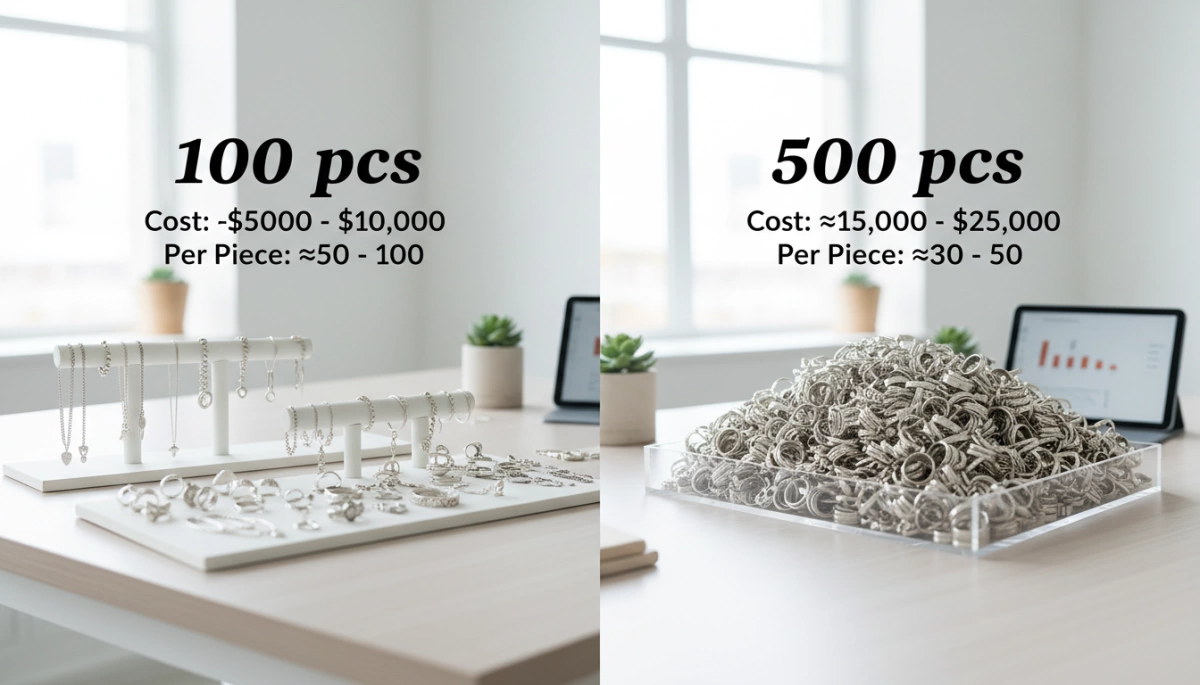
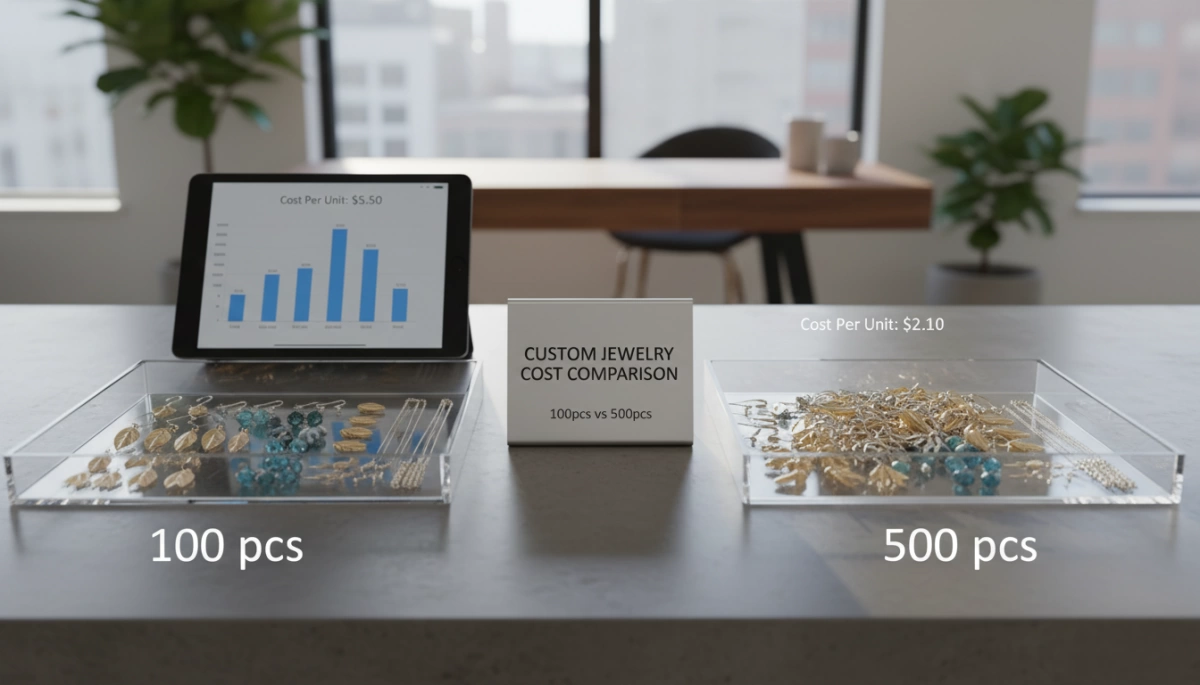
When comparing the per unit cost 100 vs 500 pieces, the price difference is usually the deciding factor for our clients. A 100-piece order is great for testing the waters, but 500 pieces is where you actually unlock volume discount jewelry manufacturing. By jumping to a mid-sized run, the custom jewelry manufacturing cost per piece often drops by nearly half because the labor and setup are spread across more units.
Per-Unit Pricing and Savings Breakdown
The table below shows how the wholesale custom jewelry pricing shifts based on volume for standard designs:
| Jewelry Type | 100pcs Price (Per Unit) | 500pcs Price (Per Unit) | Percentage Savings |
|---|---|---|---|
| Stainless Steel Ring | $5.50 – $7.50 | $3.00 – $4.00 | ~45% |
| 925 Silver Necklace | $14.00 – $18.00 | $8.50 – $11.00 | ~40% |
| PVD Plated Earrings | $6.00 – $8.00 | $3.25 – $4.50 | ~45% |
Total Order Value and Breakeven Analysis
For entrepreneurs learning how to start a jewelry business step-by-step, understanding the total budget is vital.
- 100pcs Run: You might spend $700 total. Your cost is high, leaving less room for marketing.
- 500pcs Run: You might spend $1,800 total. While the upfront investment is higher, you receive 5x the inventory for only ~2.5x the total cost.
- The Profit Gap: Selling a ring at a $35 MSRP gives you a $27.50 profit at 100pcs, but a $31.50 profit at 500pcs. Over a full batch~45% |
| 925 Silver Necklace | $14.00 – $18.00 | $8.50 – $11.00 | ~40% |
| — | — | — | — |
| PVD Plated Earrings | $6.00 – $8.00 | $3.25 – $4.50 | ~45%** |
Total Order Value and Breakeven Analysis
For entrepreneurs learning how to start a jewelry business step-by-step, understanding the total budget is vital.
- 100pcs Run: You might spend $700 total. Your cost is high, leaving less room for marketing.
- 500pcs Run: You might spend $1,800 total. While the upfront investment is higher, you receive 5x the inventory for only ~2.5x the total cost.
- The Profit Gap: Selling a ring at a $35 MSRP gives you a $27.50 profit at 100pcs, but a *$31.50 profit* at 500pcs. Over a full batch, that is an extra $2,000 in your pocket.
Consulting a [jewelry wholesale suppliers guide](https://www.honhojewelry~45% |
| 925 Silver Necklace | $14.00 – $18.00 | $8.50 – $11.00 | ~40% |
| — | — | — | — |
| PVD Plated Earrings | $6.00 – $8.00 | $3.25 – $4.50 | ~45%** |
Total Order Value and Breakeven Analysis
For entrepreneurs learning how to start a jewelry business step-by-step, understanding the total budget is vital.
- 100pcs Run: You might spend $700 total. Your cost is high, leaving less room for marketing.
- 500pcs Run: You might spend $1,800 total. While the upfront investment is higher, you receive 5x the inventory for only ~2.5x the total cost.
- The Profit Gap: Selling a ring at a $35 MSRP gives you a $27.50 profit at 100pcs, but a $31.50 profit at 500pcs. Over a full batch, that is an extra $2,000 in your pocket.
Consulting a jewelry wholesale suppliers guide confirms that the “sweet spot” for emerging brands is often 500 units. This volume hits the perfect balance between manageable inventory and high enough margins to sustain paid ads and retail overhead.
What Changes at 500pcs: Production Efficiency Gains
Scaling from 100 to 500 pieces is where the real jewelry production economies of scale kick in. I’ve seen firsthand how this jump changes the math for our clients. At 500 pieces, we aren’t just making more jewelry; we’re optimizing the entire floor for speed and precision.
Why the 500-Piece Mark Lowers Costs
- Bulk Material Pricing: When we source raw metals or high-quality waterproof jewelry materials, buying for 500 pieces allows us to negotiate better rates and significantly reduce scrap waste.
- Optimized PVD Plating Batches: PVD plating is a batch process. A tank that holds 500 pieces costs nearly the same to run as one with 100. By hitting that 500-unit mark, the jewelry plating batch efficiency skyrockets, slashing your per-unit cost.
- Improved Labor Flow: Manufacturing is about rhythm. At 500 pieces, our team hits a “flow state” where the setup time is a smaller fraction of the total work, making labor and manufacturing costs much more manageable.
- QC Predictability: Higher volumes allow for more standardized Quality Control. We can identify and fix minor variations early in the run, ensuring a more consistent final product than in smaller, fragmented batches.
- Shipping Consolidation: Instead of multiple small, expensive air shipments, 500 pieces allow for consolidated freight. This move alone can drastically reduce the total custom jewelry cost: 100pcs vs 500pcs comparison.
By hitting these efficiencies, we pass the savings directly to you, turning a small brand into a high-margin competitor.
Hidden Costs & Pitfalls in Jewelry Production
Every entrepreneur knows the quoted price isn’t always the final price. When calculating your custom jewelry cost, failing to account for “invisible” expenses can quickly eat into your margins. Whether you are running 100 or 500 pieces, you need to watch for these specific traps.
The True Price of Small vs. Large Batches
- Rework Fees on Small Runs: Many factories charge high flat fees for re-polishing or fixing defects on 100-piece orders. Since the volume is low, they can’t absorb the labor time as easily as they do with larger runs.
- High Defect Impact: At 100 pieces, just 5 defective items result in a 5% loss. At 500 pieces, those same 5 items are statistically insignificant, making your quality control (QC) much more predictable.
- Storage and Holding Costs: While 500 pieces offer a better unit price, they require physical space. You must factor in the cost of secure storage and the “opportunity cost” of tying up your capital in unsold inventory for months.
- Import Duties and Tariffs: For U.S. brands, international shipping triggers customs duties. Larger shipments often face stricter scrutiny, so it is vital to work with top jewelry manufacturers who understand HTS codes to avoid overpaying on taxes.
Managing Quality Risks
Quality issues often surface after the sale. For example, if you don’t vet your plating process, you might find customers asking does gold plated jewelry tarnish within weeks of purchase. On a 500-piece order, a plating failure becomes a catastrophic financial hit compared to a 100-piece “test run.”
| Potential Pitfall | Impact at 100pcs | Impact at 500pcs |
|---|---|---|
| Defective Items | High margin killer | Low statistical impact |
| Shipping Fees | High per-unit cost | Low per-unit cost |
| Customs/Tariffs | Often negligible | Significant budget line item |
| Rework/Fixes | Expensive & slow | Often included in service |
Understanding these wholesale custom jewelry pricing nuances ensures you aren’t blindsided by a bill that exceeds your initial budget. Balancing the risk of “dead stock” at 500 pieces against the high “per-unit friction” of 100 pieces is the core of smart jewelry scaling.
Why Dongguan HonHo Jewelry Supports Your Growth
We understand that balancing custom jewelry cost with high-end quality is the biggest challenge for growing brands. We’ve designed our operations to act as an extension of your team, providing the infrastructure of a large-scale factory with the flexibility of a boutique partner. As one of the most reliable wholesale jewelry manufacturers, we focus on removing the financial barriers that typically stall new collections.
Low MOQ for Realistic Market Testing
You shouldn’t have to risk your entire total budget on an unproven design. We offer a factory direct jewelry MOQ as low as 30 pieces, allowing you to validate new concepts with minimal risk before scaling to larger volumes.
In-House Precision and Speed
Our facility is optimized for efficiency, ensuring that your unit price remains competitive even on smaller runs. We provide:
- 1-Hour Quotations: We respect your timeline and provide rapid pricing so you can make informed business decisions quickly.
- In-house PVD Plating: Our specialized plating comes with a 24-month warranty, a standard that sets us apart from other personalized jewelry manufacturers.
- Factory-Direct Savings: By working directly with us, you eliminate middleman markups and reduce the impact of the initial mold fee on your bottom line.
- Rapid Sampling: We move your designs from CAD to physical samples faster, helping you stay ahead of fast-moving jewelry trends.
By keeping everything in-house, we maintain strict quality control standards that ensure every piece—from the 1st to the 500th—meets your brand’s specific requirements.
Custom Jewelry Cost: 100pcs vs 500pcs
Deciding on your order volume is a strategic balance between risk and reward. I’ve seen many brands find success by matching their production scale directly to their current growth phase.
When to Start at 100pcs for Validation
If you are dropping a new concept or a trendy seasonal item, 100 pieces is the sweet spot. It allows you to test the waters with a manageable total budget. While the custom jewelry manufacturing cost per piece is naturally higher at this level, it protects your cash flow and prevents “dead stock.”
At this stage, your priority is proving market demand. It is better to sell out of 100 pieces and create “sold out” hype than to sit on 500 pieces that aren’t moving. During this phase, maintaining strict custom jewelry quality assurance is vital to ensure your first batch builds the brand trust necessary to scale.
Scaling to 500pcs for Better Profit Margins
Once you have a proven winner, jumping to 500 pieces is how you build a sustainable business. The per unit cost 100 vs 500 pieces comparison usually shows a significant drop because fixed setup fees and mold costs are amortized over a much larger run.
This is the level where wholesale custom jewelry pricing starts to work in your favor, giving you the margin room to offer promotions or even wholesale your own brand to smaller boutiques. Scaling to 500 pieces is also a great time to consider transitioning to premium materials like sterling silver wholesale jewelry to elevate your brand’s perceived value while keeping your margins healthy.
Tips for Sales Forecasting and Factory Negotiation
To navigate the jump in volume effectively, keep these points in mind:
- Analyze Real Data: Use pre-order data, website traffic, or social media engagement to forecast demand before committing to a 500-piece run.
- Be Transparent with the Factory: Tell us your roadmap. If you plan to scale from 100 to 500 pieces quickly, we can often negotiate the mold fee or setup costs to favor your long-term growth.
- Leverage Volume Discounts: Always ask for a tiered pricing breakdown. Understanding the volume discount jewelry manufacturing offers at different levels helps you find your “sweet spot” for maximum ROI.
- Prioritize Consistency: As volume increases, the risk of variance grows. Ensure your factory has the infrastructure to maintain the same finish quality on piece #500 as they did on piece #1.
Related Sources
https://bamina.co/blog/cost-of-jewelry-manufacturing
https://nakassi.com/blog/mold-charges-in-jewelry-manufacturing
https://www.starharvestcn.com/News/blog/silver-vs-stainless-steel-for-jewelry-casting.html
https://smartbuy.alibaba.com/buyingguides/jewelry-making-18k-pvd
https://financialmodelslab.com/blogs/kpi-metrics/jewelry-making
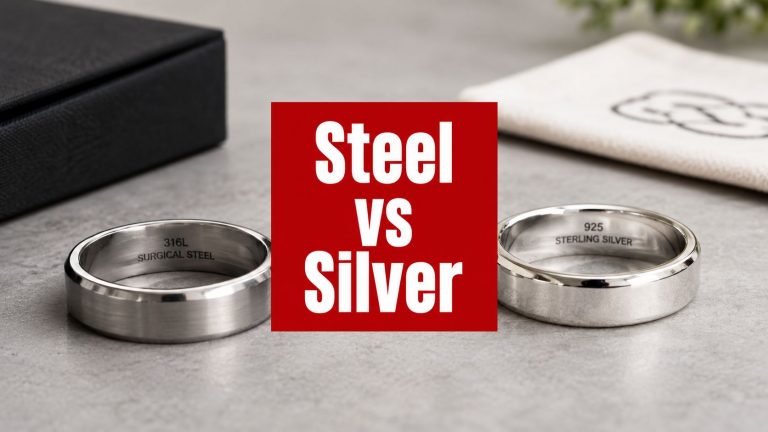
Surgical Steel vs Sterling Silver: Buyer Guide
You’re pricing a new collection, and the sample tray is already split down the middle.
How to Gold Plated Jewelry the Right Way for Lasting Color
You probably have a launch already in motion, a supplier sample on your desk, and
What Is a Shank on a Ring: Guide to Design & Durability
You’re refining a ring design, the stone looks right, the setting is approved, and the