If you have ever looked up a custom necklace manufacturer and found yourself more baffled than before, you are not alone.
Most clients already know what they want — something beautiful, made well and delivered on time. But with the right metal, minimum order quantity and ensuring that your designs never become part of someone else’s catalog, it can feel like a lot to handle.
This guide cuts through the noise. Whether you are a boutiques owner ordering your first 50 pieces or an established brand pursuing to scale your jewelry line, here’s what you actually need to know when ordering personalized necklace wholesale from a professional manufacturer.
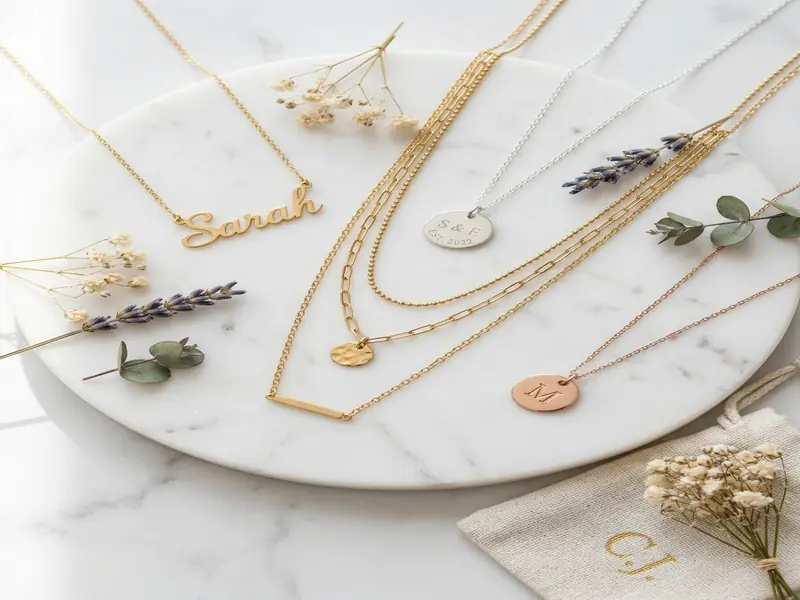
A range of custom necklaces — name plates, pendant designs and layered chains — offered via bulk OEM manufacturing.
What Is a Custom Necklace? (And Why It Matters for Your Brand)
A custom necklace is any necklace made to a buyer’s specific design, material, size, or branding requirements — as opposed to a stock piece pulled from a shelf. This includes personalized name necklaces, engraved pendants, logo-stamped chains, birthstone pieces, and fully bespoke silhouettes created from scratch.
For brands, custom necklaces are not just products. They are a direct extension of your brand identity. When done right, they build loyalty, drive repeat purchases, and create that emotional connection with your customer that no generic piece ever could.
The global personalized jewelry market is growing fast. Searches for “custom necklace” in the United States have remained consistently high year after year, driven by gifting culture, self-expression trends, and the rise of DTC (direct-to-consumer) jewelry brands. If you’re not offering a custom option, you’re likely leaving money on the table.
The Most Popular Types of Custom Necklaces in 2026
So before you reach out to a manufacturer, it helps if you have an idea of the type and specific styles of custom necklace that you want to offer. These are the styles that are trending hard in 2026 — and consistently convert:
Personalized Name Necklaces
So, of personalized jewelry the best sale. Customers enjoy seeing their name, a loved one’s name or even the name of a pet in metal products. Script typefaces remain popular, but bold block letters and mixed-font designs are being adopted among blood types in 2026.”
Pendant Necklaces with Custom Engraving
A pendant necklace allows you to change out the focal piece, while keeping the chain — making it especially versatile for collections. Brands are providing laser-engraved coordinates, dates, fingerprints and handwritten messages etched on flat oval, bar and disc pendants.
Layered Chain Necklaces
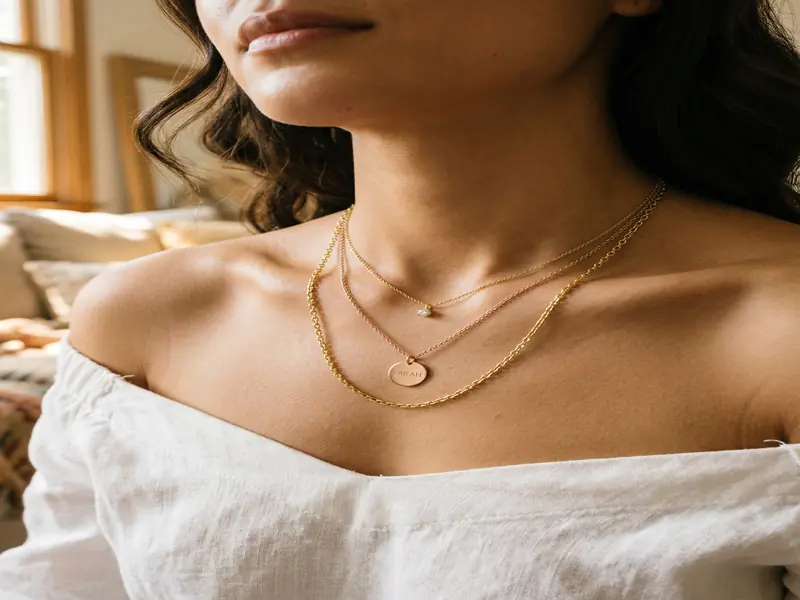
The layered look is all over social media. Customers are purchasing groups of 2–3 chains in varying lengths to layer. By selling a matching set of custom chains in varying textures (box chain, cable chain, rope chain) as a brand you can have a considerable increase in average order value.
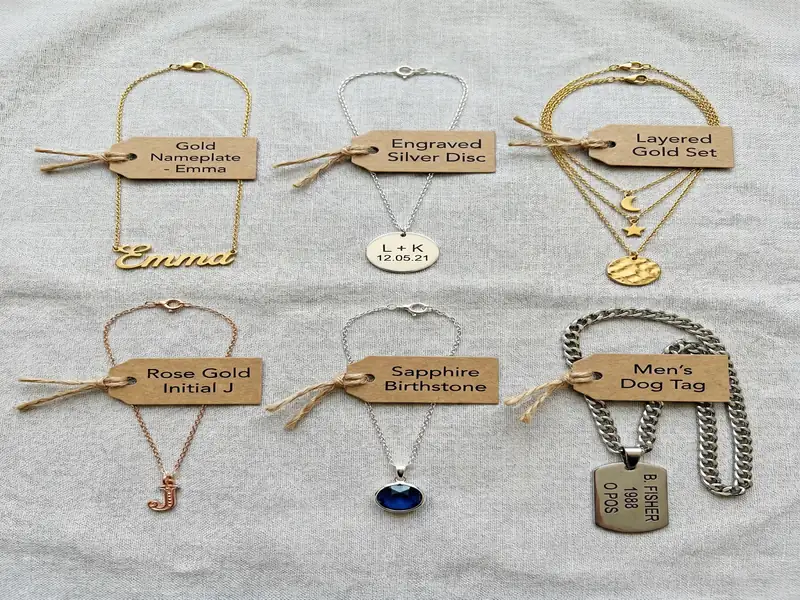
Trending styles of custom necklaces in 2026: name plates, pendant necklaces, layered chain necklace, initial charm necklaces on chain and men’s short & long chain.
Initial and Monogram Necklaces
Simple, timeless, and universally giftable. Small gold and silver initial pendants on delicate chains remain particularly strong as gifting items during holidays and birthdays.
Birthstone Necklaces
Personalized birthstone pendants are a perennial favorite gift. The combination of a GRS-certified gemstone and an engraving done specifically for the person purchasing it establishes a high-quality item worth much higher price points.
Men’s Custom Necklaces
An under-recognized category with massive upside. On the coming attraction list for men’s jewelry brands: thick rope chains, dog tag encrusted pendants and skinny-bar type necklaces with personalized engravings.
Selecting a Custom Necklace based on Material
This is where 99% of brand owners trip up — and why a great manufacturer can save you a ton of headache. The material that you’ll choose will have a direct impact on the durability of your product, how much it would cost for you to produce, and what we can charge our customers.
Nevertheless, here’s a comparison table of the three most frequent materials for wholesale custom necklaces:
Stainless Steel (316L Grade)
Stainless steel — especially 316L surgical grade — is the bread and butter of fashion jewelry, and with good reason:
- Incredibly tough: It won’t blemish from scrapes, dings and regular use nearly as easily as silver or brass.
- Tarnish-proof: Stainless steel does not oxidize like sterling silver. It retains its color without polishing.
- Hypoallergenic: Most skins are nickel-safe — making 316L steel perfect for sensitive-skin customers.
- Cheaper in bulk: Material cost (and therefore retail price) lower commonplace
- PVD Coating Compatible: Physical Vapor Deposition (PVD) enables the smooth metal to be coated with gold, rose gold and black finishes that adhere at a molecular level — an upgrade over traditional electroplating.
Best for: Fashion brands, everyday wear lines, men’s jewelry and price-sensitive markets.
925 Sterling Silver
Sterling silver is 92.5% pure silver blended with 7.5% other metals (usually copper) for added strength. It occupies a middle ground between fashion jewelry and fine jewelry:
- Noticed value — Customers associate sterling silver with quality, giving them a better experience for their spend.
- Workability: Silversmiths can work to make extremely fine detail — which is a must, for intricate name scripts and filigree designs.
- Tarnishing: Though sterling silver tarnishes over time, it needs occasional polishing. For some brands, this is an actual customer service challenge.
- Memory: 8 to 24 GB − Higher raw materials costs but justifies a higher retail price point
- Best fits: High-end gifting brands, bridal collections, luxe personalized pieces
Brass / Copper Alloy
- Brass is a good material for casting detail and what most know as its natural color is warm like gold:
- Great for detail work: Perfect for fine patterns and filigree or stamped designs.
- To silver: Trend & seasonal collections.
- Necessitating plating: Bare brass tarnishes and is not great for skin contact. It requires a placative plating always.
- Eco-Brass alternatives: Lead-free brasses are used in the EU and USA to meet safety standards for jewelry.
Best for: Vintage-style designs, boho jewelry, intricate artisan pieces.
3 types of materials comparison next to each other; 316L stainless steel (Left side), 925 sterling silver (middle) and brass (Right-side).g silver (center), and brass (right).
Pro Tip: At HonHo Jewelry, we work with all three materials — stainless steel, 925 silver, and copper/brass — paired with GRS-certified gemstones. This means you’re not locked into a single material choice, and our team can help you select the best match for your brand’s price point and aesthetic.
What Is GRS Certification and Why Does It Matter for Gemstone Necklaces?
If you plan to include gemstones in your custom necklace collection, this section is critical reading.
GRS (GemResearch Swisslab) is one of the world’s leading gemological laboratories, specializing in colored gemstone certification — including rubies, sapphires, emeralds, and more. A GRS certificate tells you:
- The gemstone’s origin (country of mining)
- Its natural vs. treated status
- Its color, clarity, and quality grade
- That it has been independently verified by expert gemologists
For brands selling at a premium price point, GRS-certified stones are a significant trust signal. Customers buying a birthstone necklace or a sapphire pendant want proof that the stone is real and its quality is what they’re paying for.
At HonHo Jewelry’s custom necklace page, all gemstones used in jewelry production are sourced with GRS certification — an unusual commitment for a wholesale manufacturer, and one that directly protects your brand’s reputation.
The OEM/ODM Custom Necklace Process: What Actually Happens After You Submit Your Design
Most jewelry brand owners have no idea what goes on between sending a sketch to a manufacturer and If you want to use gemstones in your custom necklace collection then this is a must-read section.
GemResearch Swisslab (GRS) is one of the world leaders in gemological laboratories, especially for colored stones — rubies, sapphires, emeralds and many more. A GRS certificate tells you:
- Country of mining (i.e., the gemstone’s origin)
- Its natural vs. treated status
- Its color, clarity and quality grade
- That expert gemologists have verified it independently
For premium-priced brands, GRS-certified stones become an incredibly strong trust signal. Customers who are purchasing a birthstone necklace or a sapphire pendant want proof the stone is authentic and its quality matches what they’re paying for.
At HonHo Jewelry’s custom necklace page, every single piece of jewelry is made with GRS certified gemstones — an uncommon promise for a wholesale manufacturer to make, and one that directly keeps your brand doors from taking a hit.
What Happens After You Submit Your Design: The OEM/ODM Custom Necklace Process
Most jewelry brand owners are clueless about what happens between emailing a sketch to a manufacturer and receiving their finished goods. This transparency gap is among the most common sources of frustration — and costly mistakes.
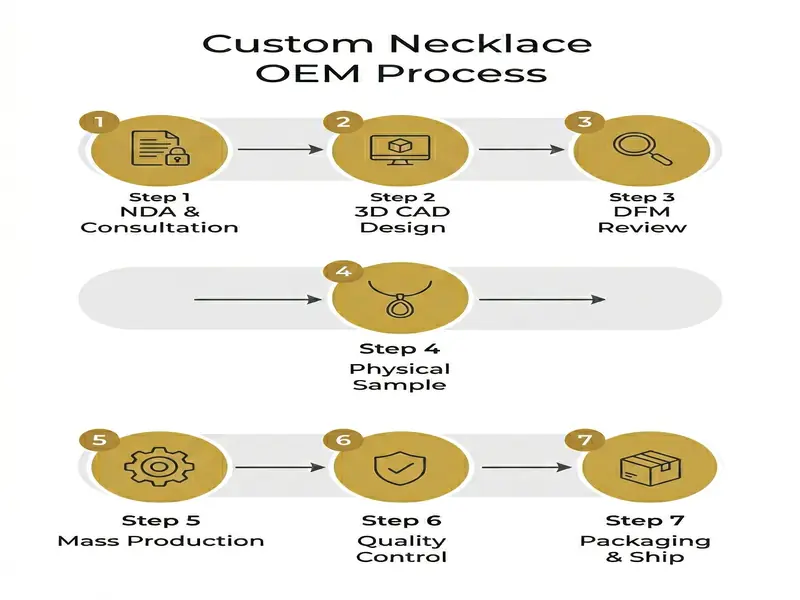
For example, here is how a professional OEM (Original Equipment Manufacturer) process of making custom necklaces goes:
Step 1: The NDA and Initial Consultation
A reputable manufacturer should sign a Non-Disclosure Agreement (NDA) before you send over any design files, sketches or moodboards. This legally protects your creative work from being copied or shared with—and sold to—other clients. If a manufacturer won’t sign an NDA, leave.
Step 2 : Design Brief & 3D CAD Modeling
This is as a 3D CAD (Computer-Aided Design) digital model, where your design concept — be it hand sketch or reference photo or vector file or detailed tech pack — gets melted into the virtual. This will take 1–3 days for most designs. You will then receive a digital rendering to approve before anything physical is created.
So join me for a quick journey through the process of taking your designs from concept to fruition:
Step 3: Design for Manufacturability (DFM) Review
This step is seldom discussed — and it’s where fledgling manufacturers let down their clients. A DFM review means the factory engineers will look at your design for structural problems prior to production. Specifically for necklaces, this entails verifying:
- If the chain links are thick enough for the pendant’s weight
- If the stones are set securely (prong, bezel or flush — not glue)
- Whether the clasp style suits the chain gauge
- The potential for plating to be applied uniformly across the entire design
A DFM review can help prevent you receiving 500 necklaces with a design flaw that might have been corrected during the CAD stage at no cost.
Step 4: Physical Sample (Prototype)
After approving the 3D CAD, the factory will make a physical sample — 7–10 days typically. You look over the sample, make any changes you want, and give the green light for mass production. Never skip this step.
Step 5: Mass Production
Once a sample is approved, production commences. For 50–500 pieces, anticipate 15–25 days to go through the custom casting process (in-house), CNC finishing, multi-step polishing and simulated PVD plating or traditional electroplating. Legitimate factories give photo or video updates at important production milestones.
Step 6: Quality Check (AQL 2.5 Standard)
Finished pieces are inspected against the AQL (Acceptance Quality Limit) 2.5 standard — a common industrial benchmark that sets the maximum rate of acceptable defects in a batch of production goods — before they ship out. Batching 500 necklaces means with AQL 2.5, inspectors will sample check statistically valid samples and reject the batch if exceeds threshold of defects found in the sampling.
Step 7: Packaging and Shipment
Custom branded packaging — boxes, pouches, display cards with your logo — is put together and shipped out to you via DHL, FedEx or UPS that usually arrives in 3–5 business days (express international shipping).
OEM 7 Steps Custom Necklace Process: From NDA, 3D CAD Design to Quality Control & Ship All Over The World
Do You Know PVD Plating vs. Traditional Electroplating?
Gold plating is something that most jewelry brands are aware of. Fewer still know the difference between PVD plating and standard electroplating — and that difference impacts how long their products last.
Traditional Electroplating
Using an electrical current in a chemical bath, a thin layer of gold (or rose gold, silver etc.) is deposited on the base metal. This coating is usually between 0.5–2 microns in thickness. It’s stunning at first but wears, fades and peels — especially at contact points such as clasps and pendant bails — after 6 to 12 months of normal wear.
PVD (Physical Vapor Deposition) Plating
In a vacuum chamber, identical material (like titanium nitride for gold tones) is vaporized into plasma which then instantly bonds with the surface of the metal at a molecular level. The outcome is a 2–5 micron thick coating that can be:
- 3–5x harder than traditional electroplating
- Scratch-resistant under normal wear conditions
- Non-toxic, and does not involve the use of electroplating bath chemicals
- Color stable: PVD gold will keep its color much longer than plated gold
While PVD coating would be a little more expensive in production, if your custom necklace product is marketed as something with “lasting quality,” it should reap the benefits for a slightly higher initial production cost. It’s the tech behind a lot of high-end and semi-fancy jewelry brand.
Explore the plating options available for your next order on HonHo Jewelry’s necklace manufacturing page, which covers gold, rose gold, silver, black rhodium, and vintage patina finishes.
MOQ Explained: How Low Can You Go with Custom Necklace Orders?
Minimum Order Quantity (MOQ) is among the first questions every brand owner asks — and one of the most misunderstood numbers in wholesale jewelry.
In short: MOQ is a thing because custom manufacturing has setup costs. With each new design comes the need for a mold, a CAD file, a plating bath setup and then the quality control pass. These fixed costs must be divided by a certain minimum number of units in order to make the factory economically viable.
Now, here’s what MOQs usually are for custom necklaces:
- Big factories with high volume minimums: 500–2,000 pieces per design. Great for major brands, infeasible for the majority of startups.
- Flexible MOQ, 50–200 pieces per design-Mid-size OEM factories. The sweet spot for emerging jewelry brands.
- ProsEtsy/handmade sellers — no MOQ, but super high per-unit price and limited scalability
HonHo Jewelry specializes in working with brands at a low MOQ starting point — perfect for brands who want to test out new designs without committing to large runs. It allows you to test a design with a small batch, and then scale up once you know it sells.
The 2026 Custom Necklace Trends Every Brand Should Know
In order for your collection to feel on trend and bring in organic search traffic, designing around trends is important. So what do the data and market indicators point to for 2026?
Mixed Metal Designs
Gold and silver together in a single piece of neck adornment — whether as a two-tone chain, a mixed-metal pendant or a layered group that knowingly matches warm and cool metals — is one of the biggest aesthetic trends of 2026. It comes across as contemporary and deliberate, not jarring.
Sustainable and Ethical Material Sourcing
Buyers have begun to increasingly inquire where their jewelry originates. Brands that can meaningfully market “recycled metals,” or “conflict-free stones” or “GRS-certified gemstones” have a clear marketing advantage, especially with millennial and Gen-Z shoppers. This isn’t merely a values statement — it’s a sales driver.
Vintage and Art Deco-Inspired Silhouettes
Geometric patterns, filigree settings and Art Deco-era motifs are popular in custom pendant and chain necklaces. These designs pair nicely both with modern and vintage aesthetics and photograph really well for social media.
Stackable and Layered Sets
Selling just a necklace is good. It is much better to sell a triplet of three layered necklaces. Brands are increasingly creating bespoke necklace collections that function as coordinated stacking systems — different chain lengths, textures and focal points intended to be worn in concert.
Minimalist Fine-Style Pieces at Fashion Price Points
The “demi-fine” jewelry category — fashion-jewelry that looks like fine-jewelry — keeps booming. Thin, delicate chains bearing tiny gemstone pendants, unobtrusive engravings and clean silhouettes hit that sweet spot of “looks expensive, isn’t.
The 2026 layered necklace trend: contrasting multiple chain lengths, textures and mixed metal finishes for an editorial look that screams bespoke.
How to Choose the Right Custom Necklace Manufacturer: 7 Questions to Ask
Not all manufacturers are equal. Here’s a shortlist of questions that will be the difference between a great long-term partner and a factory that will cause you headaches:
- Can you sign an NDA before I show my designs? — Non-negotiable. Your designs are your IP.
- Do you offer 3D CAD Design, or do I need to provide production-ready files? — A factory with in-house CAD capability is vastly more flexible and usually quicker.
- How does your DFM (Design for Manufacturability) review process look? — If they’re not familiar with the term DFM, that’s a red flag.
- Question: What is your MOQ for custom necklace designs? Can we mix designs in one order?
- Read more on what quality control standards you use? — AQL 2.5 or similar documentation
- Is PVD coating available, and how long can your plating be expected to last?
- Do you provide scheduled visits to your company, or a live video tour of my production run? — Being open about what happens on the factory floor is a powerful trust indicator.
The members of HonHo Jewelry, a factory located in Dongguan, China, answer all seven questions with yes. Drawing on more than 10 years worth of OEM/ODM experience in stainless steel, 925 silver, and brass jewelry, they have created a transparent, end-to-end manufacturing process built around the needs of international jewelry brands.
Custom Necklace Packaging: The Detail That Completes Your Brand Story
Here’s something most guides don’t cover: packaging is usually the first physical contact your customer gets with you. They are making an impression of your brand well before they have even seen the necklace.
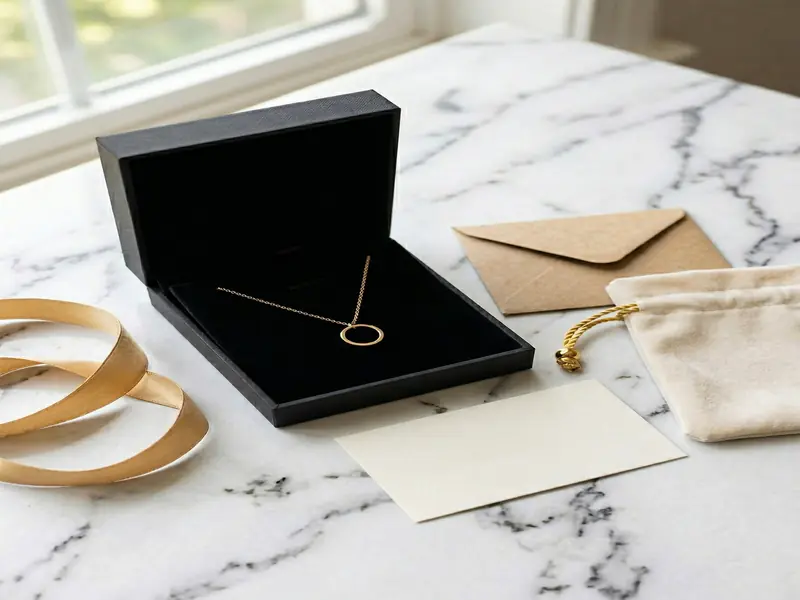
Custom necklace packaging options include:
- Logo debossing or foil stamping on rigid gift boxes
- Velvet pouches with custom-printed tags
- Brand story insert cards, care instructions or QR codes
- Cards of display for placement on the retail hooks
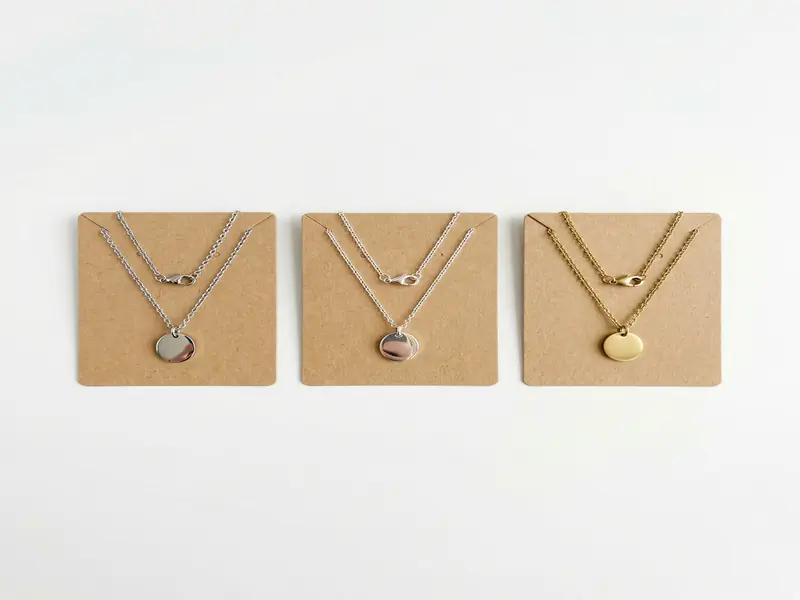
- Sustainable brands love this kraft paper packaging
When ordering custom necklaces on wholesale, packaging can be designed at the same time as the jewelry itself — so you get a cohesive brand experience starting from the first moment that your customer unboxes. Find out more about their jewelry packaging options here
Real Costs: What to Budget for a Custom Necklace Wholesale Order
Pricing in custom jewelry manufacturing is not one-size-fits-all, but here’s a realistic framework to work with when planning your budget:
| Cost Component | Typical Range | Notes |
|---|---|---|
| 3D CAD Design (if needed) | Free – $100 | Many OEM factories include this in service |
| Mold/Tooling Fee | $50 – $300 per design | One-time cost; mold stored for future reorders |
| Sample Production | $30 – $150 per sample | Usually credited against bulk order |
| Unit Cost (stainless steel, 50pcs) | $2 – $8 per piece | Depends on complexity, size, plating |
| Unit Cost (925 silver, 50pcs) | $8 – $25 per piece | Depends on weight and gemstone settings |
| Custom Packaging | $0.50 – $3 per set | Box, pouch, insert card |
| Express International Shipping | $50 – $200 per shipment | DHL/FedEx, 3–5 days delivery |
Note: Prices vary based on design complexity, material choice, quantity, and current raw material costs. Request a detailed quote from your manufacturer before finalizing your budget.
Premium custom necklace packaging: rigid gift box with velvet interior, brand insert card, and velvet pouch — all customizable with your logo.
Why Work with a China-Based Custom Necklace Manufacturer?
The most developed jewelry manufacturing ecosystem in the world is in China — and particularly the eastern Guangdong manufacturing corridor, which includes Dongguan and Shenzhen. There is no other region in the world where specialized suppliers, skilled craftspeople and advanced technology are so concentrated.
For an international jewelry brand, this means:
- Full supply chain access in a single place — Melt, melt and drill metals are all available close by; lead times at each stage of the process are lower as well as coordination overhead.
- Scale, competition and manufacturing efficiency give you competitive pricing — without sacrificing quality if you pick the right partner.
- Technical capability for complex designs, including CAD modeling and CNC milling, vacuum casting and PVD coating — technologies that virtually no Western small-batch manufacturer has in-house.
- And working knowledge of international compliance — whether EU REACH regulations, US CPSC standards or Prop 65 requirements for jewelry sold in California.
The trick lies in a manufacturer who marries these competencies with the communication skills and transparency that global brands require. That’s precisely the positioning of HonHo Jewelry in Dongguan — a factory built around serving global jewelry brands with professional English communication
How to Get Started with Your First Custom Necklace Order
Well, just ready to go from idea to product? Here’s a simple action plan:
- Define your design brief. Even a rough sketch, reference image or Pinterest board provides a manufacturer with something to work off of. Just note what material, size, plating and any text/personalization pieces you want
- Decide on your target quantity. For a initial design, begin with the minimum 50–100 pieces. This allows you to test the waters without overcommitting inventory.
- Ask for a full breakdown when you request a quote. Request that the mold fee, unit price, sample cost and packaging cost be itemized so you know exactly what you are paying for.
- Review the sample carefully. Inspect weight, quality of finish, the clasp holds securely, engraving is sharp—everything must be signed off before proceeding to bulk production.
- Plan your launch timeline. For a first order, budget 4–6 weeks — 1 week for design, 1–2 weeks for sampling, and 3–4 weeks of production time (not including shipping) from initial contact to delivery.
If you are ready to take that first step, contact HonHo Jewelry for a free, no-obligation consultation and quote. The team gets back within 24 hours on business days.
Frequently Asked Questions About Custom Necklaces
How many necklaces do I need to purchase at a time?
MOQ varies by manufacturer. With big factories, a typical unit would need 500–2,000 pieces per design. Patio can sometimes be within the range of easier work for OEMs, especially if they specialize in developing brands like HonHo Jewelry does, because their minimums usually start at about 50 pieces per design.
What is the lead-time for bulk custom necklace orders?
From design to production, a regular timeline goes like this : 3D CAD Design (1–3 days) → Sample (7–10 days) → Mass Production (15-25 days for pieces 50-500) → International Express Shipping(3-5days). Allow 4–6 weeks total for your first order and a little less for reorders, since the mold is already made.
What Is The Difference Between OEM and ODM Jewelry Manufacture?
OEM (The Original Equipment Manufacturer) means that you design, the factory produces. ODM (Original design Manufacturer) Is when the factory designs the piece and you brand it. OEM is optimal for product line design that is truly your own and proprietary. ODM is quicker, simpler but carries the risk other brands may churn out similar designs.
Which is better for a custom necklace: stainless steel or 925 silver?
Brands were taking very different positions. Stainless steel (316L) is less fragile, resistant to tarnish, and cheaper — perfect for everyday wear and fashion jewelry. 925 silver is more valuable, allows for finer detail and a higher retail price point, but it tarnishes and needs maintenance. They’re both great options; that will depend on your client and price point.
What Is PVD Plating And How Is It Better Than Gold Plating?
PVD (Physical Vapor Deposition) plating secures a metallic coating to the base metal in a vacuum chamber at a molecular level. The effect is a harder, thicker, and more durable finish than straight-up electroplating — typically with 3–5 times the durability under normal wear. If one of your brand promises is durability, PVD is worth the minuscule additional cost.
Can I use GRS-certified gems in a custom necklace?
Yes. Gemstone manufacturers able to source GRS-certified gems can offer certified rubies, sapphires, emeralds and other stones as components of your bespoke designs. A GRS certification gives you independent assurance that the stone has an accurate origin, quality and is natural, which serves as an important trust factor in gemstone jewelry purchases at higher price points. All gemstone orders are sourced from GRS-certified stone suppliers by HonHo Jewelry.
What kind of packaging can custom necklaces get for wholesale orders?
As add-on services, most Original Equipment Manufacturer (OEM) jewelry manufacturers provide custom packaging. This can include rigid gift boxes (debossed or foil printing logo), velvet pouches, insert cards,display cards, and kraft paper environmentally friendly packaging. The initial cost of custom packaging usually means adding $0.50–$3 per unit to the order price.
Where to find a reliable custom necklace supplier in China?
Engagement with manufacturers that: Is willing to sign NDA prior to sharing designs;Have 3D CAD capabilities;Can conduct a DFM review;Can send you physical samples before mass production goes ahead as well as a quote (you don’t have to pay for sampling up front);Meet specified quality standards (for example using AQL 2.5 as standard);Are keen for you to take a tour of the factory or provide an online video walkthrough. The major jewelry manufacturing areas in China are Dongguan, Shenzhen, and Guangzhou. HonHo Jewelry, located in Dongguan, provides comprehensive OEM/ODM service for various international brands.
Are there full dubs per lot scroll customs that I can order and get shipped?
Yes — unlike some manufacturers, most do allow multiple designs on their permits, with each design observing its own individual MOQ. The designs can be combined in one shipment to reduce freight costs. This allows the manufacturer to provide a composite quote up front for your complete list of designs.
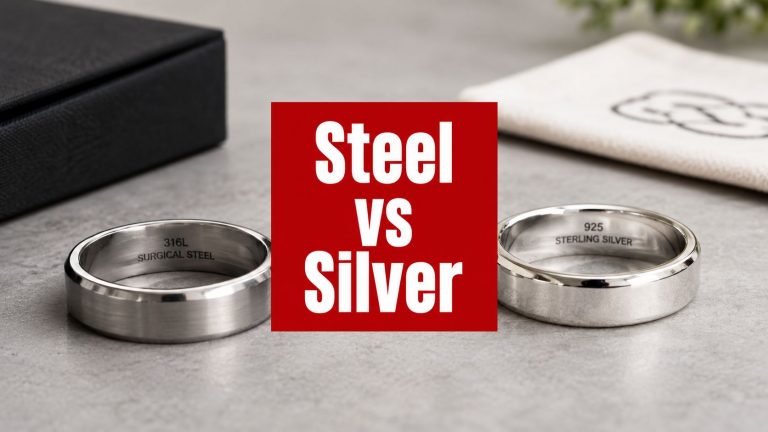
Surgical Steel vs Sterling Silver: Buyer Guide
You’re pricing a new collection, and the sample tray is already split down the middle.
How to Gold Plated Jewelry the Right Way for Lasting Color
You probably have a launch already in motion, a supplier sample on your desk, and
What Is a Shank on a Ring: Guide to Design & Durability
You’re refining a ring design, the stone looks right, the setting is approved, and the