You’re not the only one looking to add brass jewelry wholesale to their inventory and finding yourself overwhelmed with suppliers, MOQs that make your business feel vague as well as quality claims that seem questionable at best. Every week, new boutique owners, Amazon sellers and jewelry brand founders come to ask the same questions.
Why is brass better than zinc alloy? How can I prevent my customers from complaining about green skin? What is the required plating thickness that I really should be specifying? And how do I tell a real factory apart from a trading company masquerading as one?
This guide has all those answers — and more than most. Technical information that you rarely see in a buyer’s post, like a real micron comparison for plating and more associated breakdowns — such as the simple rundown of the E-coating process, our perpetual experiment that anyone can do on any brass sample before committing to an order (complete with process details), and visualizations detailing how pricing from within a Dongguan factory shopfloor works.
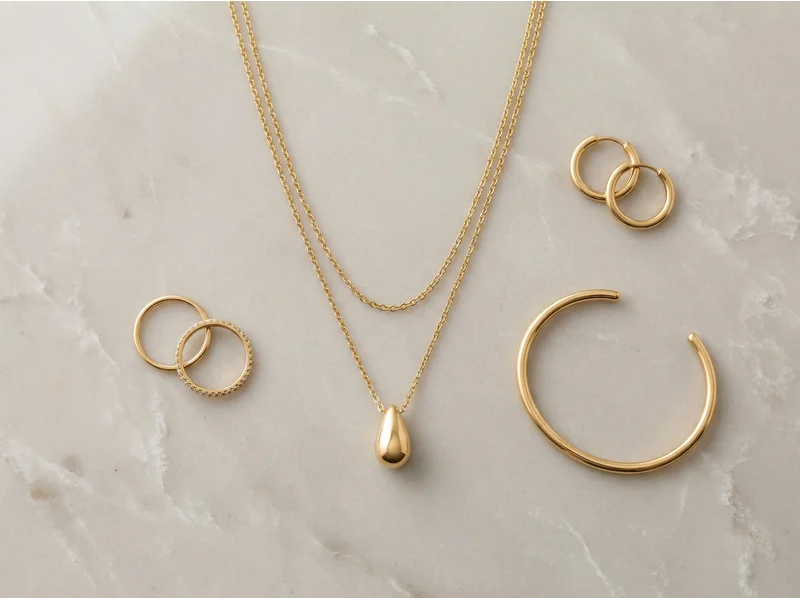
A curation of wholesale brass jewelry — rings, necklaces, earrings, and bracelets are ready for OEM/ODM customization.
1. Why Brass Is the Smart Choice for Wholesale Jewelry
Brass is an alloy — primarily of copper and zinc. That combination creates a sweet spot that few other metals can claim for wholesale fashion jewelry manufacturing.
Here’s the honest picture:
Weight That Feels Expensive
A good piece of brass jewelry is noticeably dense when you pick it up. It’s not hollow and cheap feeling the way aluminum or light zinc alloys do. That physical weight gives an instant perception of quality in the palm of your customer’s hand — and that counts at the point of sale, online or in a boutique. The specific gravity of brass is about 8.4–8.7 g/cm³, comparable to bronze and much denser than zinc alloy (~6.6 g/cm³).
Other-metals can’t offer design flexibility.
Brass is highly malleable. It can be shaped into fine, delicate forms — filigree, slender chain links, detailed pendants — without getting brittle. That means your design options at high levels of detail are pretty much limitless — something zinc alloy has a hard time with, and stainless steel makes cost-prohibitively difficult.
The Economics Add Up at the Wholesale Level
For brands that need a little sparkle but also have to obey the law of diminishing returns, brass is the perfect compromise:
| Material | Relative Cost (same design) | Design Flexibility | Plating Compatibility | Best For |
|---|---|---|---|---|
| Zinc Alloy | 1x (lowest) | Good | Fair (shorter plating life) | Very low-cost fashion |
| Brass | 1.2–1.5x | Excellent | Excellent | Fashion to demi-fine wholesale |
| Stainless Steel | 1.3–1.8x | Moderate (harder to cast finely) | Good (PVD preferred) | Durable everyday jewelry |
| 925 Sterling Silver | 3–4x | Excellent | Excellent | Mid-to-high end brands |
To most wholesale brass jewelry buyers — boutiques, Amazon FBA sellers, Etsy suppliers, and new line’s — the benefits of brass balances between a cost and appearance well and production strength.
Industry Insider: Many wholesale buyers frequenting the r/jewelrymaking community on Reddit have reported that when it comes to fashion collections priced at $15–$45 retail, brass jewelry has consistently offered the best perceived value-to-cost ratio. It’s a nice weight to make it feel high-end without being sterling silver, which is expensive.
2. How Brass Jewelry Is Actually Made
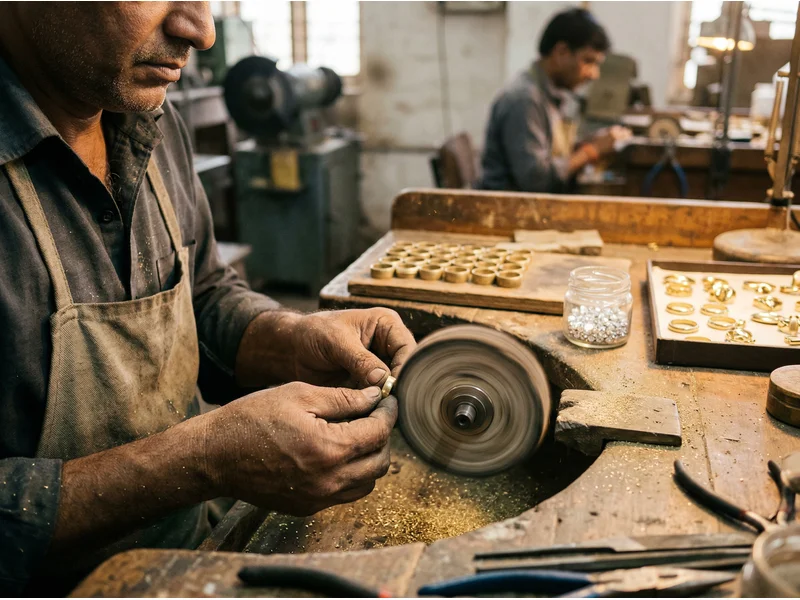
Because you understand the process of each topic, you can ask better questions and identify shortcuts that sacrifice quality.
How Brass Jewelry is Made: From Wax Mold Casting, Hand-polished to Electroplating.
Process 1 — Designing and CAD modeling
All custom brass jewelry begins as a digital 3D model (CAD file). The design informs everything downstream: how the mold is cut, where stones sit within it, how much material will be needed and how long polishing will take. Well-designed CAD files save hours of cost and revisions.
Step 2 — Wax Injection & Casting
The master model is used to create a rubber or silicone mold. Wax patterns are formed by injecting wax into this mold, which are then assembled on a “tree” (a central wax rod). The entire assembly is then cast in plaster, heated to incinerate the wax, and molten brass poured into the void. This is known as lost-wax casting — the industry standard for complex pieces of fine-detail jewelry.
Step 3 — Cut, Grind, and Polish
Raw cast pieces are rough. They are subjected to multiple polishing stages — rough grinding, medium polishing and finally fine polishing for a mirror-like base. This is the step that determines how well the plating sticks and how long it stays. Plating will flake and chip off more quickly if the base is uneven or pitted.
Step 4 — Stone Setting
Setting of pieces set with cubic zirconia (CZ), lab-created gemstones, or natural stones are done at either hand or semi-automatic. Micro-pavé settings (where many tiny stones are used) require skilled craftspeople, and therefore added meaningful labor time and cost.
Step 5 — Electroplating
Electroplating baths in which polished brass pieces are submerged. The gold, rose gold, silver, rhodium or other finish is deposited here. This layer will make or break the longevity of your jewelry, more so than any other single factor. (We detail this in the following section.)
Step 6 — E-Coating (Not Required but Suggested)
An electrical current delivers a protective clear nano-polymer coating — this locks in the plating layer and significantly increases the longevity of the piece. Not every factory provides such services; those that do tend to create noticeably longer-lasting jewelry.
Step 7 — QC Process and Packaging
Final inspections checks uniformity of plating, stone are secure in the setting and does the clasp function properly, weight tolerance (±5%) & finish. Pieces are then individually bagged — in an ideal world: anti-tarnish (anti-oxidation) bags, not plain OPP bags, and boxing and shipping.
3. The Plating Guide No One Talks About (Micron Levels Explained)
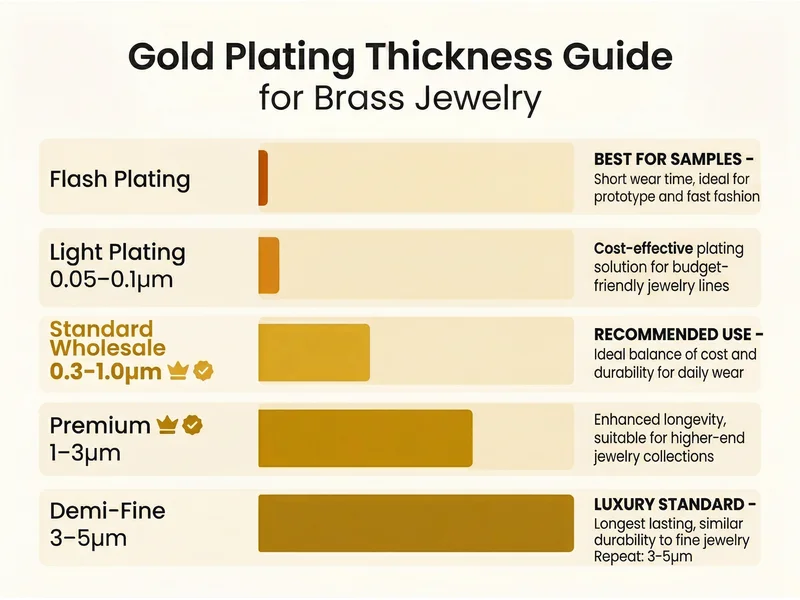
This is probably the most technically important section in this entire guide — and one almost no competitor article covers in any real depth. Most listings just say “18K gold plated” and leave it there. But that phrase alone tells you almost nothing about actual quality.
The number that matters is plating thickness, measured in microns (μm). One micron = one millionth of a meter. Here’s how the different levels compare:
Plating thickness comparison: flash plating vs. quality wholesale standard vs. premium demi-fine grade.
| Plating Level | Thickness | Typical Wear Life | Best For |
|---|---|---|---|
| Flash Plating | Under 0.05 μm | Days to 4 weeks | Disposable trend pieces, display samples |
| Light Plating | 0.05–0.1 μm | 1–3 months | Very low-price online marketplaces |
| Standard Wholesale | 0.3–1.0 μm | 6–12 months | Most fashion wholesale brass jewelry |
| Premium Wholesale | 1.0–3.0 μm | 12–24 months | Demi-fine, boutique, Amazon brands |
| Demi-Fine Grade | 3.0–5.0 μm | 2–4 years | Luxury fashion positioning |
THE “18K GOLD PLATED” TRAP — You can call any piece “18K gold plated,” regardless of if the layer is 0.02 μm or 2.0 μm thick! The “18K” relates to the purity of the gold alloy in which it’s then bathed — not how much is applied. Never except plating thickness in mils always ask for it in microns. If a supplier can’t or won’t tell you, that’s an ominous red flag.
What E-Coating Actually Does (and Why It Matters More Than Most People Realize)
E-coating — or electrophoretic lacquer coating, if you want to be all fancy-pants about it — is a furthermore clear coat protective treatment that comes after electroplating. The part is dunked in a bath of nano-polymer particles, and then, when an electric current runs through the medium, those particles migrate to bond directly with the metal surface forming an almost imperceptible ceramic-like barrier. This is significant as even top-notch electroplated metals will develop micro-abrasions over time.
This is important because even the best electroplated metals can form micro-abrasions with time. Each time jewelry rubs against skin, fabric or other surfaces, tiny patch of plating can thin out. E-coating fills in those micro-gaps and seals the layer below.
Practical benefits for wholesale buyers:
- Increases plating life by about 2–3x compared with uncoated components of equal plating thickness
- Significantly lessens likelihood of skin going green (the oxidation-from-sweat reaction needs oxygen to reach the copper — E-coating prevents this)
- Keeps jewelry safe from perfume, lotion and humidity
- Lowers customer complaints and return rates
- Not every supplier offers E-coating. Ask specifically. It’s one of the best signs up a factory that wants to put high quality.
Not every supplier offers E-coating. Ask specifically. It’s one of the clearest markers of a quality-focused factory.
Nickel Underplating vs. Copper Underplating
Here’s something that almost nobody talks about: many factories do a base “underplating” sub layer before the gold plating in order to help it bond better and look brighter. Nickel is the cheap way to do this. This is the correct way, with pure copper.
Nickel is an established allergen — it accounts for the vast majority of skin reactions to jewelry reported in the US and EU. Nickel underplating, for example, whether brass jewelry is plated or not, creates an allergy risk. Instead, the best wholesale brass jewelry manufacturers will actually fit a layer of copper underplating instead to avoid this risk altogether.
If you are sourcing for US or EU markets, find a way to ask specifically: “Does your brass jewelry have a nickel underplating layer — or copper?” This should easily be answered by any reputable factory.
4. The Green Skin Problem — What Really Causes It and How to Prevent It
Green skin is arguably the number one buyer concern about brass jewelry wholesale. It’s worth untangling the science, because online common advice is getting it wrong a lot.
What Actually Happens
Brass contains copper. When copper meets the acid in human sweat (something of a mild mixture of lactic acid, acetic acid and others), it creates a chemical reaction that forms copper salts — chiefly copper carbonate and copper chloride. These compounds are green.
It’s the same reaction that turns pennies green and makes the Statue of Liberty its eponymous shade. It’s not toxic. It’s not an allergic reaction. It’s pure chemistry, and it rinses from skin readily.
Quick Reality Check: If your customer claims brass jewelry “gave them an allergic reaction,” the real culprit is most likely a nickel layer in the plating stack — not the brass or copper itself. True copper allergies are very uncommon. A lot of the green skin and allergy concerns drop away when sourcing jewelry without nickel underplating (copper-underplated and nickel-free certified).
How to Prevent Green Skin at the Manufacturing Level
The research has shown up to three reliable prevention methods, best wholesale brass jewelry suppliers use all three at once:
- Sufficient plating thickness (minimum 0.5 μm): A sufficiently thick layer of plating prevents contact with the brass base at all. Flash-plated pieces very quickly wear through and expose the brass.
- E-coat (Electrophoretic lacquer): As mentioned above this seals the plating from moisture and acids significantly extending the barrier.
- Anti-tarnish storage bags: A detail that’s hardly ever mentioned in buyer guides — the style of bag used for packaging makes a difference. Anti-tarnish bags (also known as anti-oxidation bags) have a special liner that absorbs volatile compounds, preventing oxidation during transport and storage. If you happen to be using plain OPP bags, then there is no protection. If your supplier uses plain poly bags as shipping containers for long ocean freight runs, you might end up with tarnished inventory.
What to Tell Your End Customers
Despite the best manufacturing precautions, proper care dramatically extends jewelry life. Tell your customers:
- After wearing, wipe pieces with a soft dry cloth to remove sweat and oils
- Keep in an airtight bag or box rather than loose in a drawer
- Do not come into contact with perfume, hairspray, lotion or chlorinated water
- Do not shower or swim in plated brass jewelry
5. MOQ and Pricing: A Real Breakdown From a Dongguan Factory
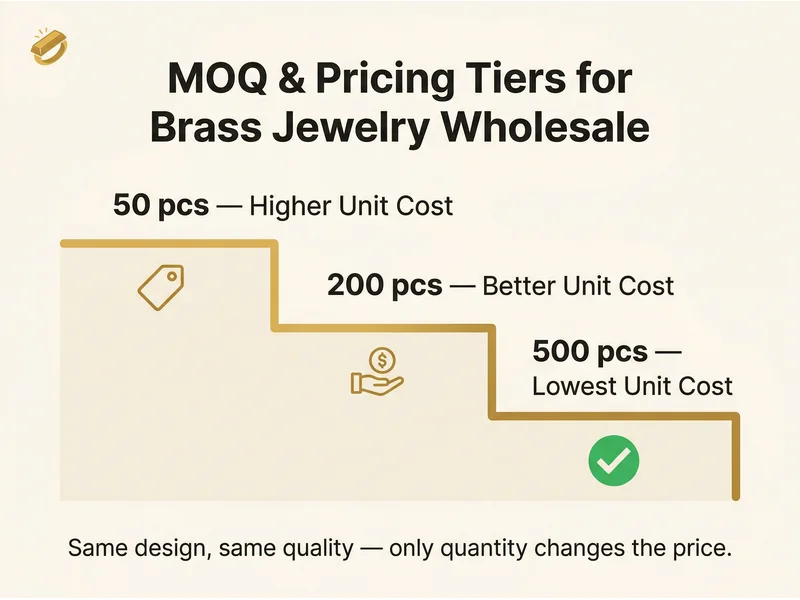
Pricing confusion is one of the most frustrating factors to new wholesale buyers. The same design can get vastly different price quotes depending on the supplier — and you often don’t really have an idea whether a lower quote means a better deal or inferior quality.
The per-piece cost impact of MOQ: the math behind wholesale brass jewelry pricing tiers
How Factory Pricing Is Built
This brass jewelry factory has a cut-and-dry formula for your unit price:
The Unit price = (Metal + Stones + Findings) + Labor + Plating + Overhead+ Factory Margin
Material costs usually contribute 60–80% of the factory pricing. And this is why the weight of your metal or number of stones can make a huge difference to the quoted price. It also explains why requesting a transparent cost sheet (open costing) is so beneficial — you know exactly what you’re paying for and can negotiate for specific items instead of esoteric packages.
Typical Price Ranges for Brass Jewelry Wholesale (2025)
| Jewelry Type | Factory-Direct Price Range | Typical MOQ |
|---|---|---|
| Simple brass earrings (stud or small hoop) | $0.80 – $2.50 per pair | 100–200 pairs |
| Brass ring (plain or single CZ stone) | $1.20 – $3.50 each | 100–200 pcs |
| Brass pendant + chain necklace | $1.80 – $5.00 each | 100 pcs |
| Brass bracelet (chain or cuff) | $2.00 – $6.00 each | 100 pcs |
| Complex statement piece (multi-stone, layered) | $4.00 – $12.00 each | 50–100 pcs |
Note: These are factory-direct FOB prices from Dongguan, China for 1–3 micron gold plating. Flash plating will be lower. Prices exclude one-time mold fees.
The MOQ Math: Why Volume Changes Your Cost
When you understand the logic behind MOQ pricing, its actually quite simple. Manufacturers incur one-time setup costs to produce each style — CAD design, mold making, machine setup, line scheduling. These costs remain the same whether you order 50 pieces or 500 pieces. And so the more you order, the lower per-unit fixed cost.
Here’s a real example:
| Order Quantity | Mold/Setup Cost per Piece | Variable Cost per Piece | Total Unit Price |
|---|---|---|---|
| 50 pcs | $2.40 | $4.80 | ≈ $7.20 |
| 200 pcs | $0.60 | $4.80 | ≈ $5.40 |
| 500 pcs | $0.24 | $4.80 | ≈ $5.04 |
The design and quality remained the same — only the quantity changed. That’s why a 50-piece test order will always seem pricey in comparison to your subsequent bulk orders.
How to Reach Better Prices Without Over-Ordering
- Bundle structure families: You can use the same base mold and order various colorways or stone variations, you split the cost of the mold between different SKUs.
- Combine plating runs: Plate yellow gold, rose gold and silver-plated styles together on one production run to lower per-unit plating cost.
- Choose existing catalog designs as a priority: There is no mold fee if ready-made molds are available. Test market demand, then switch to custom when you have sales data.
- Plan quarterly collections: Having one well-planned order each season is going to be far more cash-efficient than a handful of small, last-minute rush orders.
6. China’s Jewelry Sourcing Regions Compared
Not all Chinese jewelry manufacturing is the same. Different regions specialize in different types of production — and knowing this helps you target the right supplier for your needs.
| Region | Specialization | Typical Price Level | MOQ | Best For |
|---|---|---|---|---|
| Yiwu, Zhejiang | Fast-fashion, alloy accessories, high volume | Very low | Low (often mixed lots) | Budget retail, rapid trend testing |
| Panyu, Guangzhou | Fine jewelry, gold, gemstone-set pieces | Mid-to-high | Higher | Fine jewelry brands, gold pieces |
| Dongguan | Precision manufacturing, brass/stainless/925 silver, OEM/ODM | Mid (factory-direct) | Flexible (100–300 pcs) | Fashion-to-demi-fine brands, custom wholesale |
| Shenzhen | High-end craftsmanship, international brand supply | Mid-to-high | Moderate | Premium brands, complex designs |
Dongguan has arguably emerged as the best sourcing hub for wholesale brass jewelry buyers who want a perfect blend of quality, customizability and competitive pricing. There are so many specialty suppliers — casting houses, stone providers, plating facilities, etc. — racially close to each other in the city that it hastens production and keeps costs lower than those of Guangzhou or Shenzhen for roughly the same quality.
HonHo Jewelry is situated in Dongguan, with complete and fully in-house production capabilities that encompasses design, casting, polishing, stone setting, plating and packaging — no middleman, no quality gap between suppliers.
7. Three Simple Tests to Verify Brass Quality Before You Order
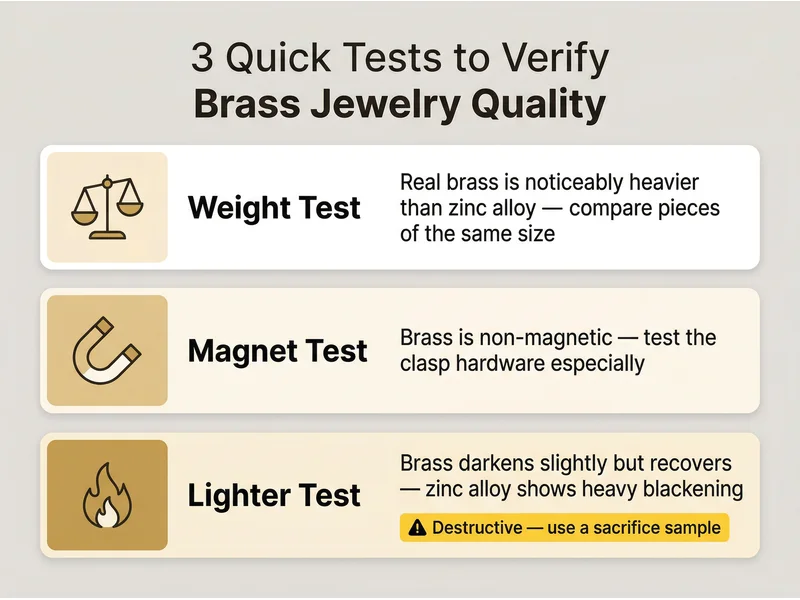
These physical tests arise from the sourcing professionals and factory buyers who are actively working right on production floors — knowledge that travels through sourcing YouTube channels and TikTok videos but rarely makes its way else into written buyer’s guides. Request a sample to send and do it before committing.
Before making a wholesale order, there are 3 practical quality tests you can make on any brass jewelry sample.
Test 1 — The Weight Check
Brass is about 8.4–8.7 in specific gravity. Zinc alloy is around 6.6. A true brass piece, for instance, is going to be significantly heavier than a similarly sized zinc alloy replacement. When a supplier says their part is “brass,” but it feels unusually light, request the material certification or SGS test report. Some of the suppliers use zinc alloy and misleadingly describe it as “brass-colored.”
Test 2 — The Magnet Test
Brass is non-magnetic. Pass a strong neodymium magnet over the piece — there should be absolutely no attraction whatsoever. Focus especially on the clasp hardware (lobster clasps, spring rings, box clasps). If the clasp responds with any magnetic force, it is likely made of iron or steel and will corrode over time. Quality shortcut like this is very common but the buyers overlook it since they do test only the main body of the piece.
Test 3 — The Lighter Test (Destructive — Request a Sacrifice Sample)
Light the piece in a small, discreet area with a lighter for 3-5 seconds and allow to cool. Brass will tarnish a bit but come back pretty close to original color. Zinc alloy will have much more serious oxidation and blackening. Alloys of inferior quality might also melt at low temperature. There are experienced sourcing agents using this test to check the claims about the material, and it is one of the most trustworthy quick checks available.
Sourcing Pro tip: Always ask for the sample to be filmed in natural light with no filters, in addition to the standard product shots. Supplier photographs are also highly retouched. A quick phone-camera video in normal lighting will give you a lot more information about real color, finish quality and texture than any studio photo.
8. What to Ask a Supplier Before You Place Your First Order
These are questions taken from actual buyer experiences in wholesale sourcing communities and which help distinguish reliable manufacturers from middlemen and low-quality operators.
Production Transparency Questions
- “Are your factory operations in-house for casting, polishing, plating and packaging — or do you outsource any of these stages?”
- “Plating thickness (microns) you utilize for regular wholesale orders?”
- “Do you apply nickel or copper underplating?”
- “Do you offer E-coating? Is that included or an extra cost?”
- “Do you have any recent SGS or third-party test reports for nickel and lead content?
Order and Logistics Questions
- “Also, what is your regular lead for sample and production?”
- “What is included in your MOQ — per design, per colorway or per order?
- “Are you refunding mold fees or applying them against bulk orders?
- “We pack in anti-tarnish bags or regular OPP bags?”
- “What Incoterm do you quote, EXW, FOB, or DDP?”
Red Flags to Watch For
| Red Flag | What It Usually Means |
|---|---|
| Can’t answer plating thickness in microns | Likely a trading company, not a factory |
| Price is 40%+ below other quotes for same specs | Flash plating, zinc alloy base, or missing quality steps |
| Refuses to share material test reports | Potential compliance issues (nickel, lead, cadmium) |
| No sample before bulk order | No quality control process in place |
| Very low MOQ (under 20 pcs) on custom designs | Often a sourcing agent with no real factory capacity |
9. OEM vs ODM — Which One Is Right for Your Brand?
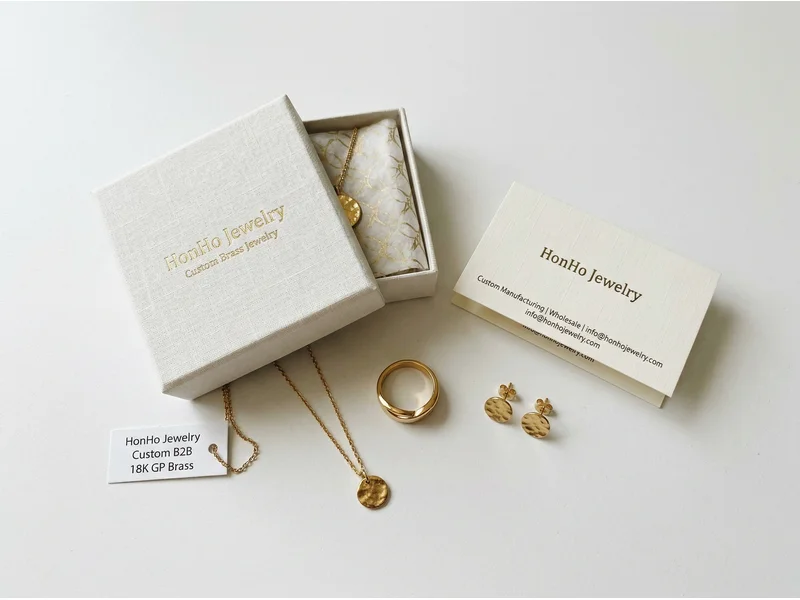
Understanding the difference between OEM and ODM manufacturing is important if you want to build a wholesale brass jewelry business beyond simply selling catalog pieces.
OEM (Original Equipment Manufacturing)
You supply the design — sketches, reference images, CAD files or a physical sample — and the factory manufactures it to precisely your specifications. This also gives you total control over the design but requires you to pay for all aspects of design development (CAD, molds, sampling).
Best for: Brands with in-house designers, brands recreating a certain pre-existing style, or companies wanting their collections to be 100% original.
ODM (Original Design Manufacturing)
You select from the factory’s standard design library and slap your brand name or logo on the items. The factory already has all the molds — so you save on development cost, and lead time is much shorter.
Best for: New brands that want to test the market, businesses that need a fast turnaround or retailers seeking to quickly fill out a collection without a heavy upfront investment.
The Custom Brass Jewelry Production Process (Step by Step)
- Observation: upload design idea, reference photos or sketched ideas
- Confirm design details: Choose material, plating color, type and size of stone, and finish
- CAD modeling: Factory generates a 3D digital model to obtain your confirmation
- Molding and first sample: Physical wax mold created, first brasses made
- Approval of swipe sample: Review, and request tweaks — you give final sign-off
- Payment and bulk production: Mass-producing begins
- Quality inspection: Full batch before shipment QC check
- Balance payment and shipment
At HonHo Jewelry, we do everything in-house — CAD design and laser engraving, casting, polishing, plating and custom packaging. With no third-party handoffs, you have tighter quality control at every stage.
HonHo Jewelry’s in-house OEM/ODM production line in Dongguan — from initial design brief to finished packaged piece.
10. Shipping, Customs, and HS Codes for Brass Jewelry
Getting your brass jewelry wholesale order from a Chinese factory to your door involves a few important decisions. Mistakes here can mean unexpected costs or customs delays.
Shipping Methods Compared
| Method | Typical Transit Time (China to USA) | Cost Level | Best For |
|---|---|---|---|
| Air Express (DHL, FedEx, UPS) | 3–7 days | High | Samples, urgent small orders, first orders |
| Air Freight | 7–14 days | Medium-High | Mid-size orders (10–100 kg) |
| Sea Freight (LCL) | 25–35 days | Low | Bulk orders (50 kg+) |
| Sea Freight (FCL) | 25–35 days | Lowest per kg | Very large bulk shipments |
Incoterms You’ll Encounter
- EXW (Ex Works): You pay all costs and risk from factory door. They give you the lowest quoted price, however you do everything including local trucking and export clearance.
- FOB (Free On Board): The supplier delivers goods to the port to have them loaded on the vessel. From then on, the risk is on you. Most common for experienced importers.
- DDP (Delivered Duty Paid): The supplier takes care of everything, including import duties and customs. Best price quoted, but least hassle. Recommended for first-time importers.
HS Codes for US Customs
It is crucial for accurate duty calculation to use the correct Harmonized System (HS) code. For all brass jewelry importing into the United States:
- 7117.19.90 — Imitation and processed jewelry (other base metals, not silver/gold/platinum), which many brass fashion jewelry falls under
- 7113.20.00 — Jewelry of precious metals (if gold-plated is considered fine) — confirm with your customs broker
Contact a licensed customs broker or refer to the USITC HTS database directly for the latest tariff rates and Section 301 implications. Tariff classification of products may change and for large volumes, we recommend consulting a professional, whose services would pay for itself.
Documentation You Need
- Commercial Invoice (correct declared value — never lowball; customs penalties are real)
- Packing List
- This could be Bill of Lading (sea) or Airway Bill (air).
- Certificate of origin (where tariff preferences are being claimed)
- SGS/Test Report (may be needed to demonstrate REACH/CPSC compliance)
Ready to source quality brass jewelry wholesale from a trusted Dongguan factory?Request a Free Quote from HonHo Jewelry →
11. Why HonHo Jewelry for Your Brass Wholesale Needs
There are many hundreds of brass jewelry suppliers in China. Here’s what the experience of working with an in-house Dongguan manufacturer focused on your project level is like compared to a typical wholesale, turn-key process:
Full In-House Production
HonHo Jewelry does all of the production in-house, under one roof in Dongguan — design and CAD, casting, surface finishing, stone setting, electroplating (including plated finishes of gold/gold yellow/rose gold-black rhodium/vintage patina) as well as custom packaging. It is not a trading company that sources from many workshops. Factory one, quality standard one, point of accountability.
Materials We Work With
Therefore you will have noticed that whilst our main materials are stainless steel and 925 sterling silver, we also work a lot with copper and brass for fashion wholesale clients who desire the design versatility and weight of brass at competitive price points. All materials are lead-free, nickel-free and cadmium-free as standard.
Custom Design Capabilities
ttern creation and variable surface finishes — hammered, brushed, sandblasted, mirror-polished or satin — the team at HonHo can pull off just about any design concept. We allow sketch briefings, CAD files, reference images or physical samples.
Flexible Packaging Solutions
We know that your packaging is part of your narrative. Custom packaging can include boxes, pouches, display cards and anti-tarnish bags so you’ll have the unboxing experience your customers want — these products are available with branding including logo and specific brand colors.
GRS-Certified Gemstones
Our stones are GRS-certified (Gem Research Swisslab), so for clients who desire gemstone-set brass jewelry, we have documented quality standards — a benefit for brands that need verified claims about their materials.
To explore our current collection or start a custom order conversation, visit www.honhojewelry.com.
Further Reading
- How Wholesale Jewelry Pricing Works — A Complete Breakdown
- Why Jewelry Turns Your Skin Green (Halstead — Independent Resource)
- US International Trade Commission HTS Database (HS Code Lookup)
Frequently Asked Questions About Brass Jewelry Wholesale
What is the typical MOQ for brass jewelry wholesale from China?
If you are looking for ready-made (catalog) designs, reputable Dongguan factories will usually require an MOQ of 50-100 pieces per style. For fully custom OEM style (i.e. your own molds), usual MOQ is 100–300 pcs / style A few factories will have lower MOQs based on mixed styles, but very low MOQs (including less than 20 pieces custom) typically mean you’re finally dealing with a sourcing agent rather than an actual manufacturer.
Why does brass jewelry turn skin green, and can it be prevented?
The green color comes from the copper in the brass reacting with dryness in foam and, ultimately, sweat to form copper salts — that’s similar chemistry to what gives pennies vintage patina action and a bright hue like the Statue of Liberty. It’s completely harmless. It’s preventable with sufficient plating thickness (at least 0.5 microns), E-coating (electrophoretic lacquer) and proper care (wiping dry after wearing, storing in airtight pouches). When you buy from a factory that employs quality standards like these, green skin becomes obsolete for your customers.
How long does gold plating on brass jewelry last?
It’s entirely dependent on the thickness of plating. Flash plating (below 0.05 microns) can wear off within days to weeks. The average life span of standard wholesale quality (0.5–1.0 microns) that sees normal wear and tear with proper care is 6–12 months. With E-coating used in the base layer, premium plating (1.0–3.0 microns) quality will last 12–24 months. Before placing an order, always ask your supplier what the plating thickness is in microns — not the vague “18K gold plated.”
What is the difference between OEM and ODM for brass jewelry?
OEM = Original Equipment Manufacturing – In this model, you provide your own unique design and the factory manufactures it to your requirements. ODM (Original Design Manufacturing): You choose from one of the designs already created by these factories and then slap your brand on it. OEM provides you full design exclusivity but also demands a greater upfront commitment on CAD, molds and sampling. ODM Startup is Cheaper and Quicker but Your Designs will not be Exclusive! Most scaling brands use ODM to test the market and later graduate to OEM.
Is brass jewelry hypoallergenic?
Raw brass can trigger reactions in those with copper sensitivity (rare) or nickel sensitivity if an underplating layer of nickel is used as part of the plating process. Many quality wholesale brass jewelry manufacturers even utilize copper underplating as opposed to nickel, so the pieces are truly hypoallergenic for most people who wear them. Keep in mind to always check your suppliers plating stack (especially if nickel is used anywhere) and get a nickel-release test report according to either the EU EN 1811 or US CPSC standards you will be selling to.
What certifications should I ask for when sourcing brass jewelry wholesale?
At a minimum, ask for an SGS test report or other third-party lab test confirming the piece is lead-free (≤90 ppm per US CPSIA), nickel-free (per EU REACH Annex XVII) and cadmium-free. If you’re selling in the US market, making sure you meet CPSC requirements is critical. For the EU, compliance is a must under REACH regulation. Reliable factories, such as HonHo Jewelry, keep these test reports always and offer them at request.
What plating options are available for brass jewelry wholesale?
The popular plating options are yellow gold (14K or 18K), rose gold, silver/rhodium, black rhodium (gunmetal), and vintage/antique brass patina. You can also select surface textures — hammered, brushed, sandblasted or mirror-polished — which add a unique personality to each style, beyond just color. To increase durability, many of these finishes can then be coated with e-coat.
How do I verify that a Chinese supplier is a real factory and not a trading company?
Request a video tour of the production floor — specifically request to see the casting room, polishing area and plating tanks. You can see all three in the real factories. Also inquire about which production steps are done in-house versus outsourced. Request their business license (营业执照) — the type of business should be listed as manufacturing (制造业), not import/export trading. A trading company may offer vague responses on production processes and be unable to tell you plating thickness in microns.
Can I order both brass and stainless steel jewelry from the same factory?
Most Dongguan quality factories — including HonHo Jewelry — produce products in brass and stainless steel, as well as 925 silver. With a multi-material factory, you can place orders in bulk with them to reduce logistics complexity while also developing a wider spectrum of products from the same trusted partner. This tends to be more efficient than running separate factories for different materials.
Have questions about your first brass jewelry wholesale order?
HonHo Jewelry’s team in Dongguan is ready to help — from first sample to bulk shipment.Contact HonHo Jewelry Now — Factory Direct →
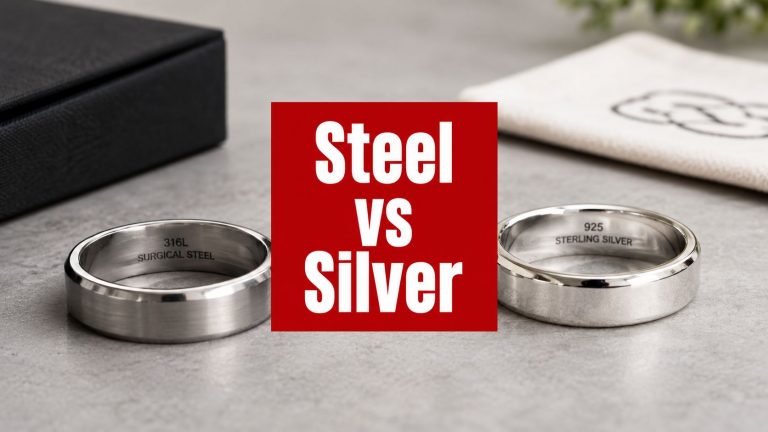
Surgical Steel vs Sterling Silver: Buyer Guide
You’re pricing a new collection, and the sample tray is already split down the middle.
How to Gold Plated Jewelry the Right Way for Lasting Color
You probably have a launch already in motion, a supplier sample on your desk, and
What Is a Shank on a Ring: Guide to Design & Durability
You’re refining a ring design, the stone looks right, the setting is approved, and the