The Ultimate Guide to Factory Jewelry Direct: Sourcing Secrets and Avoiding Pitfalls

If you are reading this statement then I believe that you have more or less got the idea of it. Two rings, nearly identical. Selling on a boutique site for $45 each. The other that is shipped straight from the factory costs $12.
And that gap is there, that is more than just quality. It’s all about how many times did the jewelry exchanged hands before it ended up in your fashion statement.
There are two sides to the whole factory jewelry direct thing, and it’s one of the smartest moves a brand owner, boutique buyer or serious reseller can make — provided you do it correctly. This guide covers everything: how factory-direct pricing really works, what to look for in a real manufacturer and the questions most buyers will never think to ask you until it is far too late.
What does factory jewelry direct imply?
Production from the raw material to jewelry at the factory — no middlemen.
That might sound simple, but the word is used incorrectly all the time. Factory direct: by buying from the actual place where your jewelry is cutting, casting, polishing and plating this means you are buying directly from factory without any trading company, agent or 3rd party distributor between them.
Why it matters:
Each layer between you and the factory takes a markup. Importers typically add 15–30%. Distributors stack another 20–40%. However, by the time a piece hits a retail outlet, the end price can be 3–5× that of the factory price.
By purchasing jewelry directly from the factory, you cut that chain down. You are bargaining with those who make the product, aka:
- Lower unit prices — usually 40–60% lower than retailing through distributors
- Full control of customization: materials, plating, packaging, branding
- Faster turnaround because there isn’t a third party that needs to relay your requests
- Test reports, certificates and real production photos
The catch? This you have to do as not every seller labeling themselves as “factory” actually is. Identifying between the two is half the battle.
Factory vs. Trading Company: A Guide to Classifying a Company
This is the question most buyers do not ask until after they have already put down a deposit. Trading companies do just that: they buy from factories and resell — no production. They usually have fancy-looking websites, quick replies and sample catalogs that match factory suppliers. So how do you know?
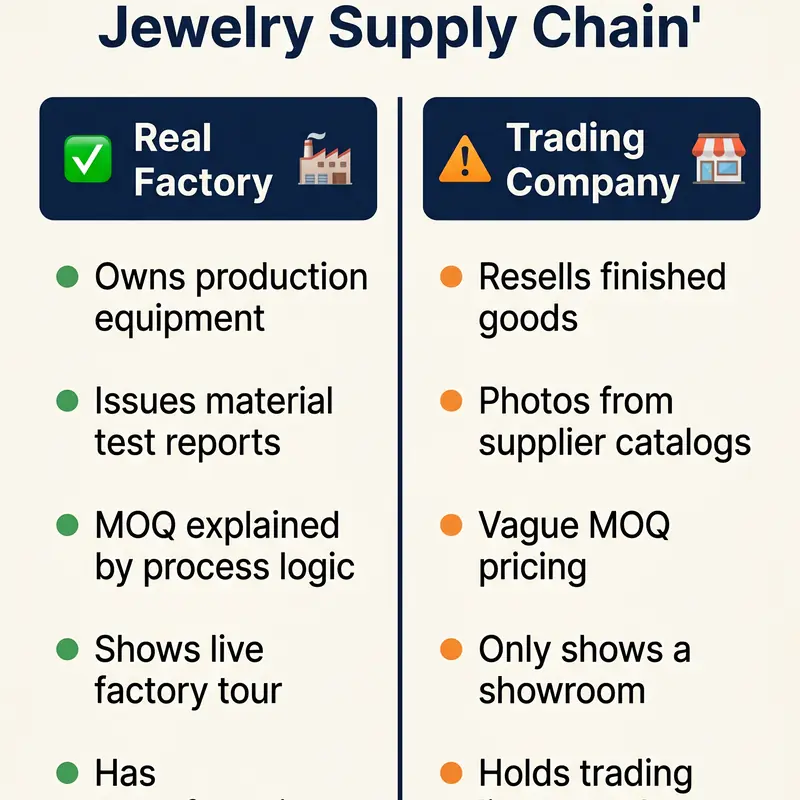
BEFORE YOU PAY A DEPOSIT: 4 Differences Between a Real Jewelry Factory and A Trading Company
1. Request Factory Business License
Manufacturing Business License is set up by genuine Chinese manufacture. This company has a commercial/trading business license. The translation of the Chinese text on these papers is different — this can be confirmed by any translator within seconds. You may want to skip this step for larger orders.
2. Request a Live Video Tour
A genuine factory will show you around production lines, plating tanks, polishing rooms and quality inspection areas on video call without batting an eye. If they change the subject, provide pictures instead or show you something that resembles a showroom — that’s not a good sign either. In real factories, there is noise, people on the ground and things happen a little chaotically. They do not look like shops.
3. Check Their MOQ Logic
Factory minimum order quantities are based on production economics: pouroves cost of casting molds, vacuums chamber capacity for PVD bombards different batches polishing. If you’re quoting “5 pieces minimum” on every custom item with no reasons given, then they are likely getting it sourced from somewhere else. A genuine factory will then tell you how their MOQ is what it is.
4. Look for Third-Party Certifications
BSCI / ISO 9001 / SMETA and REACH certification requires all audits of factories performed by independent, accredited entities such as SGS or Bureau Veritas for e.g. Sometimes even these will be acquired by trading companies, but the audit reports will quote the trading address rather than a production one. Always request a copy of the actual audit report, not just a cert image.
For example, at HonHo Jewelry the factory is ISO 9001, SMETA, BSCI and REACH certified and they can supply full audit documentation showing the manufacturing address in Dongguan not a trading office.
The Real Cost Analysis: Skipping the Middleman
Now, let’s put some real-world numbers behind it. Let us say you want to order 200 stainless steel rings with PVD gold Plating.
| Supply Chain Step | Estimated Cost Per Unit | Markup Added |
| Factory production cost | $3.50 | — |
| Trading company margin | $5.25 | +50% |
| Importer / distributor | $7.35 | +40% |
| Wholesale platform fee | $9.20 | +25% |
| Retail price (typical boutique) | $35–$55 | Final markup |
When you buy factory direct on a 200-piece order at $3.50/unit, your only have to go from the tier of dealing with a trading company to going direct and that nets you savings of $370 — simply on that one SKU. This adds up quick for brands ordering tens of styles deep.
PVD vs Standard Gold Plating: Changing Everything with Coating Tech
For many, price and design are the driving consideration. Another small minority ask about coating technology — and that is the starting point of quality problems.
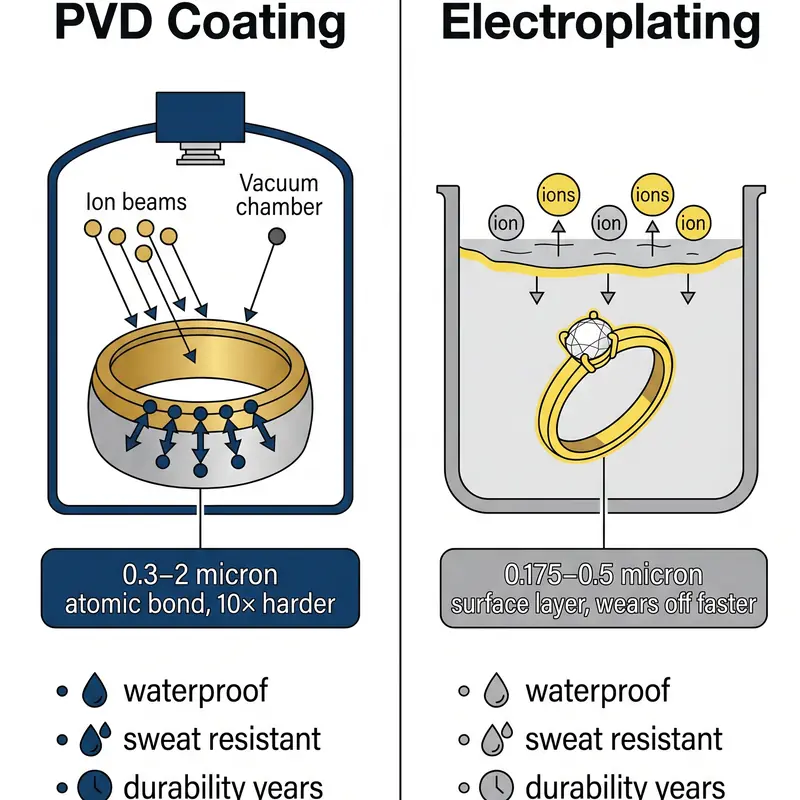
Compared to conventional electroplating, PVD establishes a bond 10× harder at the atomic level—and you can see it in actual wear.
Two Ways to Apply Gold, Rose Gold or Black Finishes:
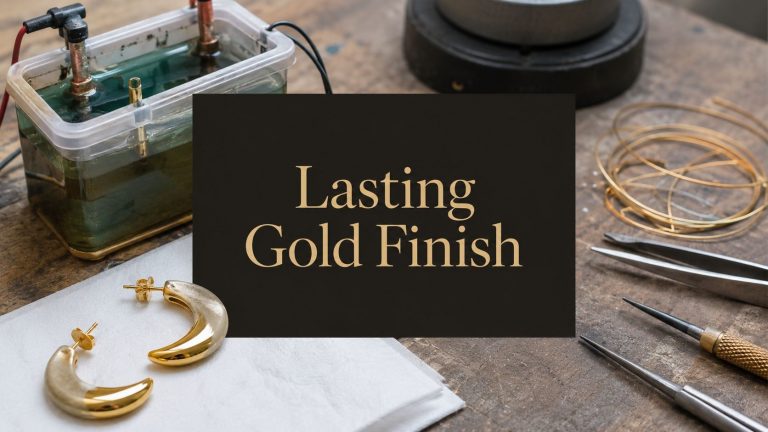
Traditional Electroplating
Or rather, the piece is submerged into a bath of chemical. A thin layer of gold will be deposited onto its surface by means of an electric current. It typically consists of a layer which is 0.03-0.1 microns thick. It looks beautiful immediately. Sweating, salt water and daily friction destroy it — sometimes sending a low-grade piece to the bin within weeks.
PVD (Physical Vapor Deposition)
The part is singularly enclosed in a vacuum chamber. Through the vaporization of solid metal targets (alloy made from titanium nitride or gold); they become a plasma state. They bond directly into the atom level of the metal surface. The result is a somewhat less scrape layer (0.03–0.1 microns) that bonds to so tightly it’s probably 10× tougher than the traditional coating process of electroplating and sputtering.
In practical terms for buyers:
- Professional grade PVD jewelry usually can pass 48 to 168 hour ASTM B117 / ISO 9227 salt spray tests. Electroplating norm with 24–48 hours.
- PVD finishes are also waterproof and sweat-proof in normal day-to-day wear (an important selling point for “active lifestyle” jewelry brands).
- Color uniformity on larger batches will be far more consistent.
- Factories experience a 70–80% drop-off in customer complaints related to quality when moving from electroplating to PVD on stainless steel bases.
Buyer tip: Not every factory has a PVD vacuum chamber. HonHo Jewelry facility has full in-house PVD equipment, enabling you to specify coating thickness from 0.03 to 2.5 microns depending on the application.
Material Selection: What Factory-Direct Buyers Should Specify
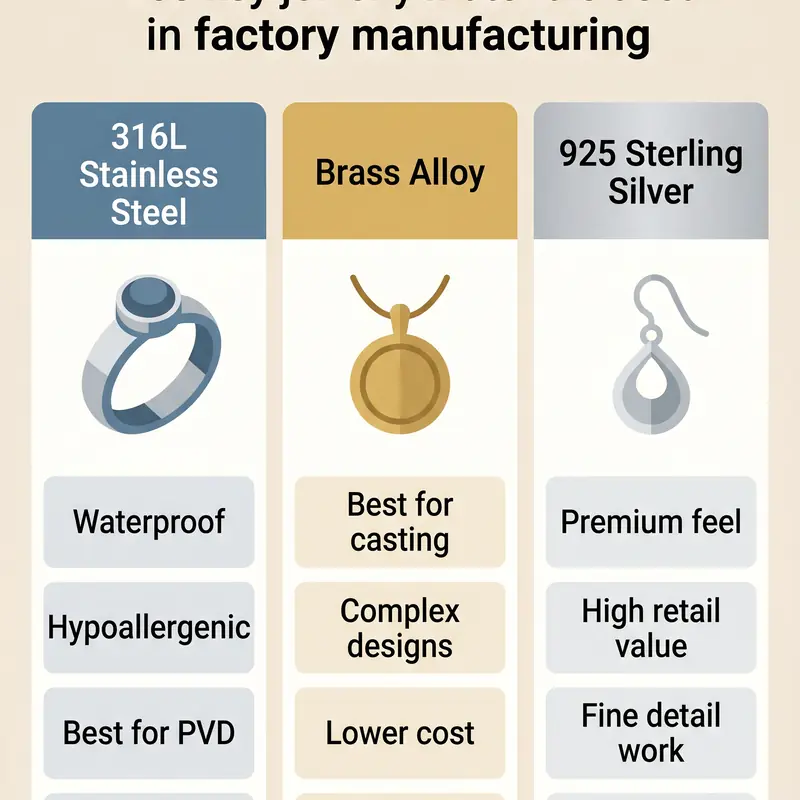
Vague specs can bleed you money when ordering factory jewelry direct.
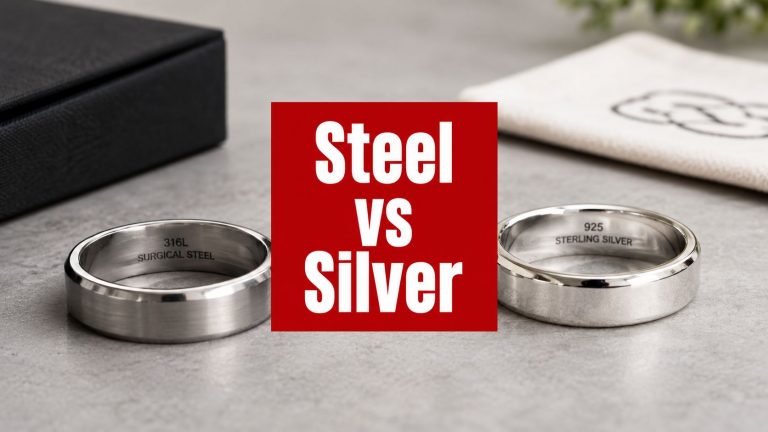
1. 316L Stainless Steel
Waterproof + hypoallergenic, go to every day wear jewelry.
- Specify: “316L not 201 and 304”. You will find cheaper mills that use 201 or 304 stainless, with less chromium content, and faster to corrode.
2. Brass (Copper Alloy)
A traditional base for jewelry castings with high details. Useful for standard electroplating.
- Specify: “Lead-free, nickel-free brass.” Lead and nickel are restricted under EU REACH and U.S. CPSC regulations.
3. 925 Sterling Silver
92.5% silver, 7.5% copper alloy. Great for high-value perceived pieces.
- IMPORTANT: Please remember to write “925 stamped with nickel free solder“. Explicitly ask for silver work soldering spec.
The Real Cost of MOQ: What Low Minimums Actually Costs You
Myth no 1 in factory-direct buying: lower MOQ is always better.
Here’s the actual math. In manufacture of a small run, setup costs are allocated to fewer parts. The per-unit cost goes up. A 100-piece order of a custom ring might cost $4.50/piece, whereas a 30-piece order of the same ring may be $8/piece.
What this means in practice:
- Low MOQ (30–50 pcs per style): Perfect for new brands testing the market. Spend a little extra to cut down on the risk of being out of stock.
- Established brands: Larger volume orders (200+) cap off much better per-unit pricing.
- Product development: Sample orders of 1–5 pcs are the norm.
Quality Checks All Factory-Direct Buyers Should Ask
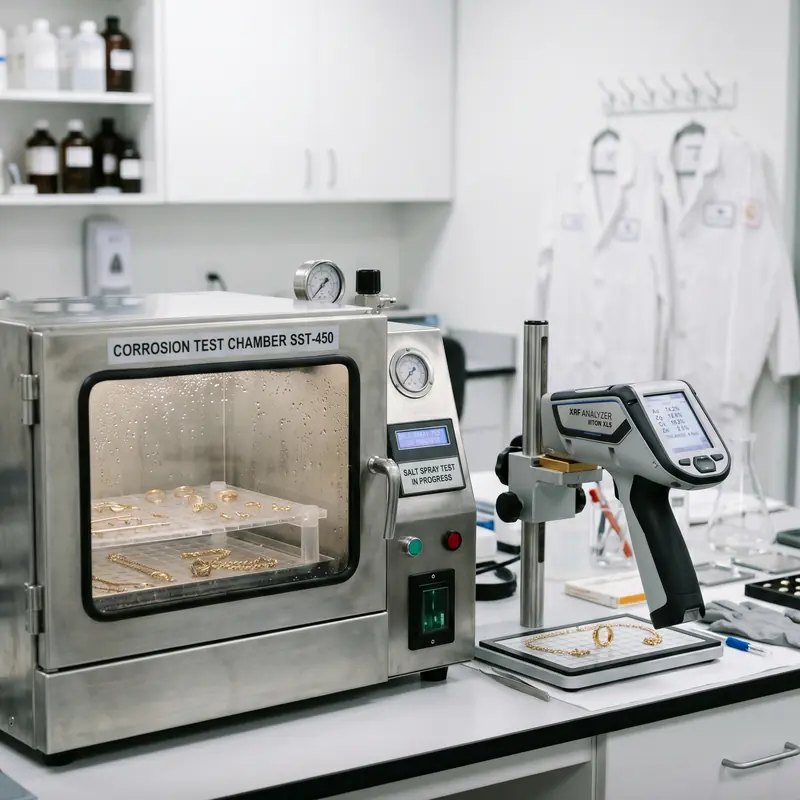
1. Salt Spray Test (NSS)
Industry standard: 48 hours for standard electroplating, 72–168 hours for PVD coated stainless steel. Request the test report stating the duration and standard (ASTM B117 or ISO 9227).
2. Plating Thickness Test (XRF)
XRF analyzers quantify the real thickness of gold layer in microns. For PVD jewelry, you want at least 0.3 microns on decorative pieces and 0.5–1.0 microns for high-wear items.
3. European Standard EN 1811: Nickel Release Test
Every sale made in EU or markets in the US should be tested. A compliant factory should provide recent SGS or Bureau Veritas test reports.
How to Structure Your First Factory-Direct Order
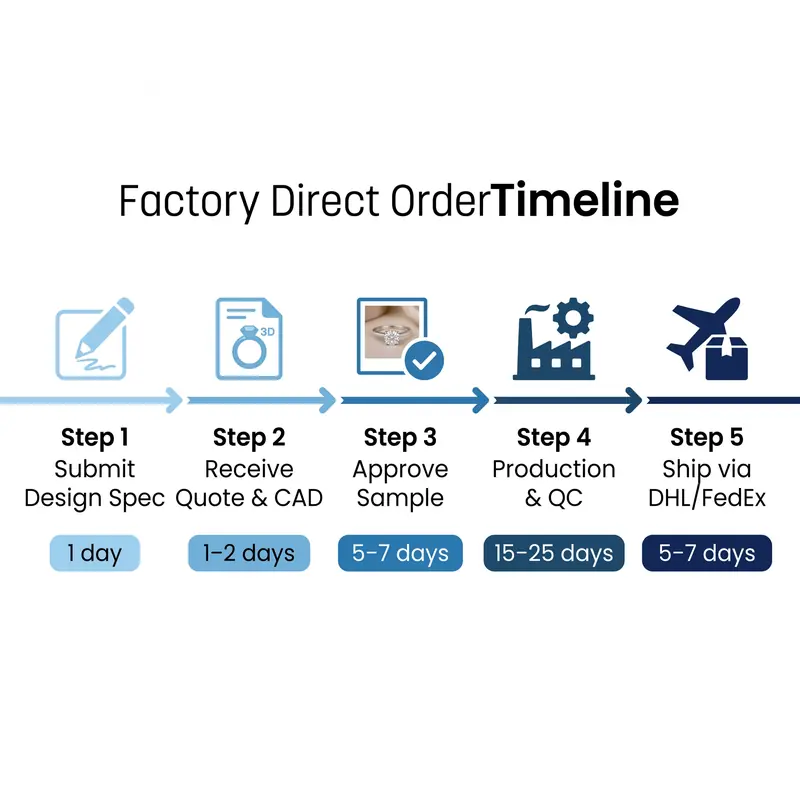
- VOICE YOUR SPECS: Material, Size, Plating Color & Finish, and Custom Elements (Logo, Stone settings, Packaging).
- Ask for itemised cost: Mold fee, unit price, packaging, and shipping.
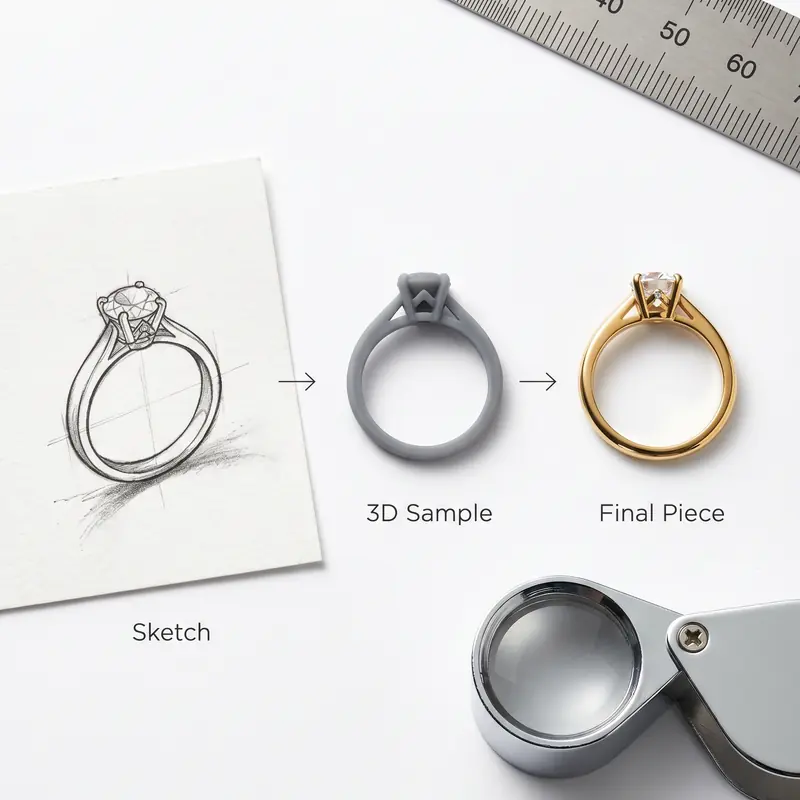
- Paid sample order: $30 – $80/piece. A sample serves as your quality benchmark.
- Approve of the sample in writing: Email confirmation with photos and special notes.
- Validate production timeline: Confirm the start date, end date, and inspection service before shipping.
Factory Direct Jewelry Red Flags
- No mold fee transparency: If they can’t clarify mold application or ownership.
- Exact same catalog to 20 other suppliers: Indicates a trading company reselling stock.
- Prices are too low: Legitimate factories ask for 30–50% deposit; 100% upfront with a new supplier is a huge risk.
- Failure to provide test reports: REACH, nickel release, and thickness documentation should be available.
- Incredibly quick delivery: Custom pieces realistically take 25–45 days. 7 days is a major red flag.
7 Most Common Questions About Factory Jewelry Direct
1. What is the minimum MOQ for factory jewelry direct?
Generally — 30–100 pieces per style for custom work. No minimum on simple stock designs.
2. How much cheaper is factory jewelry direct than a distributor?
Usually 30–60% lower price. The more intermediaries you remove, the more you save.
3. How to make sure a supplier is an actual factory?
Request manufacturing business license, seek a live video tour, and verify third-party certifications (ISO 9001, BSCI, SMETA) mention a production address.
4. Which certifications should a good jewelry factory have?
REACH compliance, ISO 9001, nickel release reports (EN 1811), and BSCI/SMETA audits.
5. When should I choose Brass or 316L stainless steel?
316L is best for waterproof, long-lasting everyday wear. Brass is better for trend-focused, complex-shaped components at lower costs.
6. What is PVD coating?
A vacuum plating process bonding metal ions at an atomic level. It is 10× harder than standard electroplating.
7. How long should a custom jewelry factory order take?
Custom orders: 25–45 days (CAD, molding, sampling, production). Re-orders: 10–15 days.
Ready to Source Smarter?
Purchasing factory jewellery direct is not difficult — but it does require asking the right questions.
With 16+ years of experience, HonHo Jewelry provides in-house PVD coating, full material certifications (ISO 9001, SMETA, REACH), and free CAD design services with low minimums starting at 30 pieces. They provide complete quote breakdowns with no hidden fees.
In the jewelry business, buyers are rewarded for establishing direct connections with whatever makers were actually doing the making. Start building yours.