Like many of you, every month that comes with its own gemstone — A tiny piece of the earth linked to your date of birth for centuries. We have all heard of birthstones: beautiful pieces of rock, but more than just that. They tell stories, show science and symbolize what most jewelry types barely skim the deep end of.
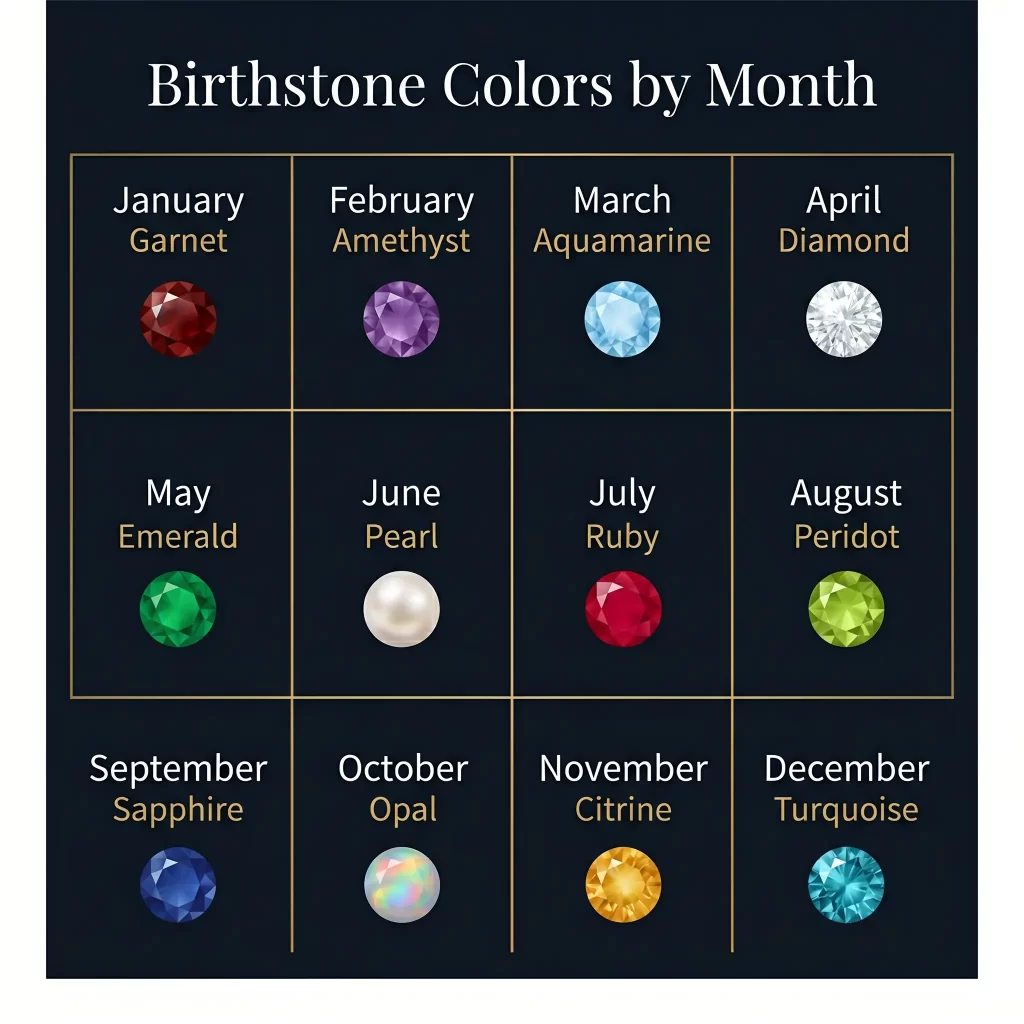
This is the full guide to the colors and meanings of every birthstone by month. But it gets even deeper: you’ll understand what stones are sturdy enough to stand as daily wear, which metals beautifully accentuate each gem’s color the best and how to actually buy — or order — custom birthstone jewelry that doesn’t deteriorate over time.
The Origin of Birthstones: A Brief History
The concept of a gemstone associated with each month of the year can be followed back to the Book of Exodus, and to a priestly ceremonial garment called “the Breastplate of Aaron,” which was adorned with twelve stones (each representing one of Israel’s twelve tribes). These stones were later linked to the twelve months and zodiac signs by the 1st-century Jewish historian Josephus.
The lists differed by culture and region for centuries. In 1912 everything changed when the American National Retail Jewelers Association (now called Jewelers of America) released the first official birthstone list in America. It was a pragmatic goal: concentrate on commercially available gems That was followed in 1937 by Britain, and updates have been made since then. This listing was joined by Tanzanite in 2002, December. Japan’s national birthstone list was just heightened in 2021.
Something every guide is missing: until 1912 color was king and gem type be damned. They were so similar that a red garnet could sometimes be mistaken for a red ruby. Which is why a few months still have the two or three official options they do now lead to today — and why, picking whichever stone speaks your name personally is always true.
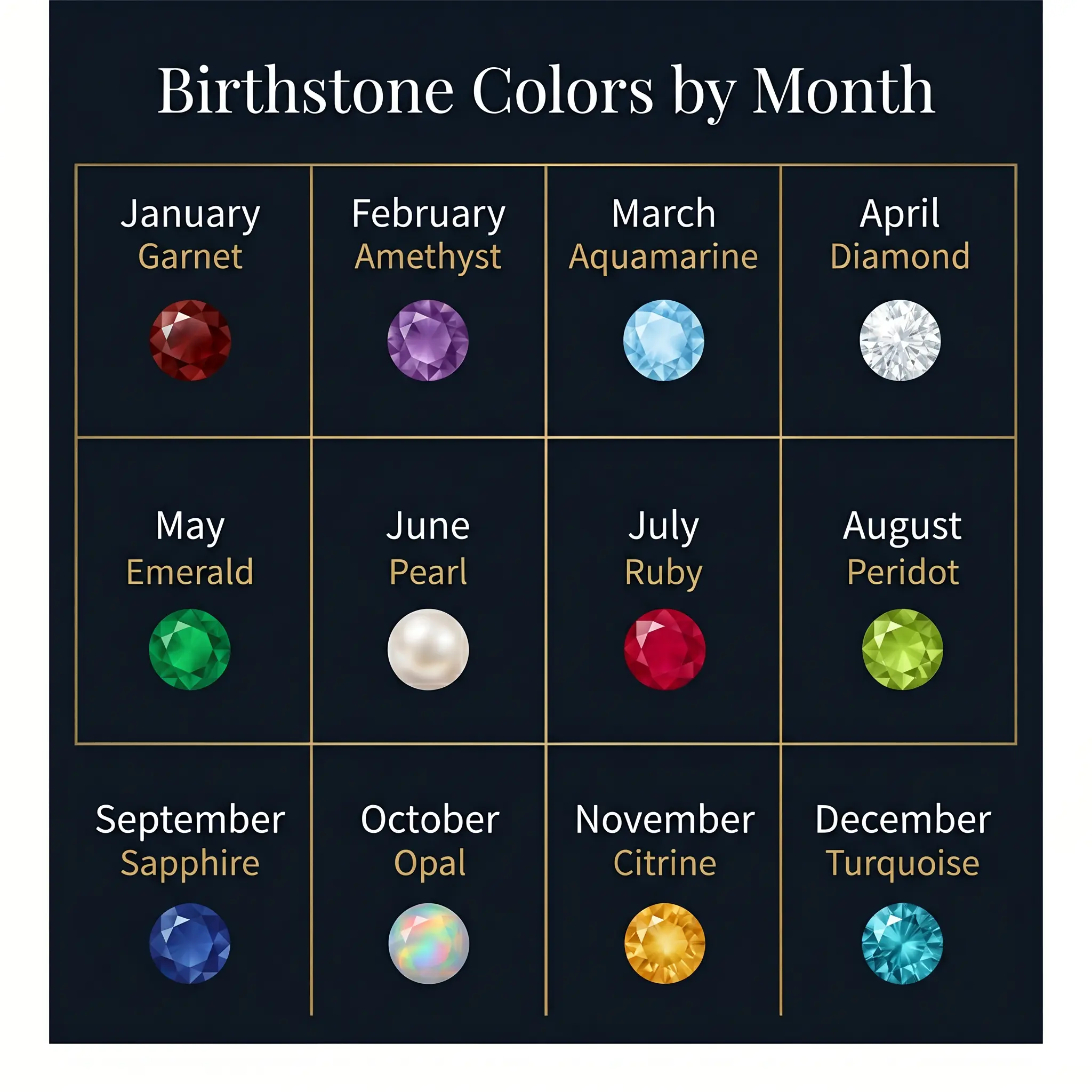
The Full Birthstone Colors and Their Meanings by Month guide
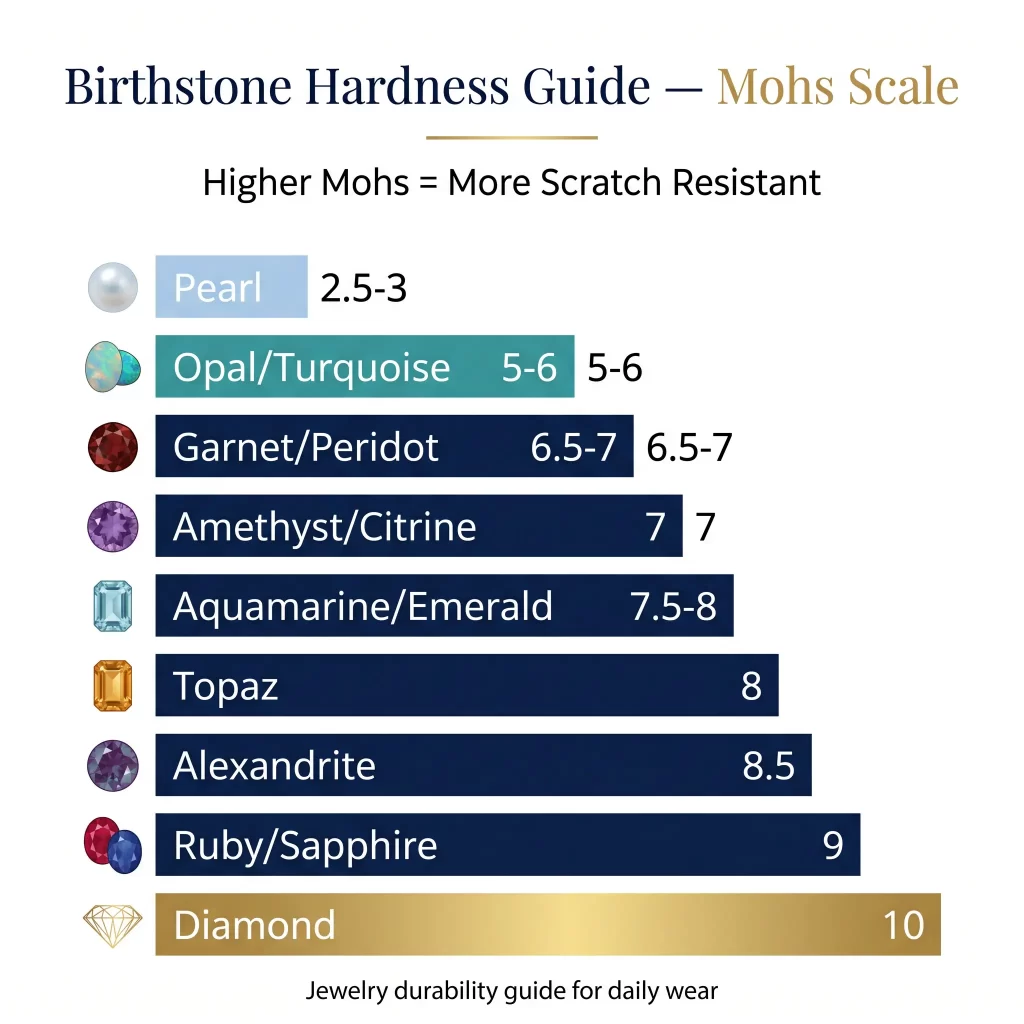
Here is the full month-by-month breakdown. The entries provide the birthstone color, symbolic meaning, Mohs hardness score (a handy reference for how well it stands up to wearing as jewelry) and the associated tones of metal that best complement them — features often omitted from the majority of birthstone charts.
January — Garnet (Deep Red, Mohs 6.5–7.5)
Color: From deep red through reddish-orange — but garnets are also found in brilliant green, yellow and orange forms that most people never even realize exist.
Meaning: Safety, journey, trust and companionship. Legend moves it that ancient warriors wore garnets into battle as a protector of harm. The term garnet originally derives from the Latin granatum —meaning pomegranate— due to similarities of the gemstone with a tranquillization of the rind or seeds of a pomegranate.
Wearability: Garnet is very suitable for use in necklaces and earrings, and as an occasional-wear ring with a hardness of Mohs 6.5–7.5. If an everyday ring, opt for a bezel or channel set to avoid any hard knocks on the stone.
Minimum Requirement for Metal Lovers :: Top metal pairing: Warm yellow gold enhances warm tones of this red garnet. This durable, long-lasting alternative to genuine rose gold is made from PVD-plated 316L stainless steel — a high-quality finish that withstands daily wear.
February — Amethyst (Purple, Mohs 7)
Color: Light lavender to dark purple-red.
Meaning: Clarity, courage, and sobriety. It derives its name from the Greek amethystos — “unintoxicated.” Amethyst was thought by the ancient Greeks to be an antidote to drunkenness, and therefore amethyst goblets were a feature of banquets. Amethyst was one of the few purple gemstones affordable to the ruling classes and thus its association with royalty was so.
Wear: Not Tougher than a 7 on the Mohs scale, amethyst provides decent scratch resistance — an ideal-for everyday pendants forecast.
Best metal pairing: Silver and white gold will reflect the cool violet tones against your hand. Modern, edgy pieces are brought to bold life with blackened steel.
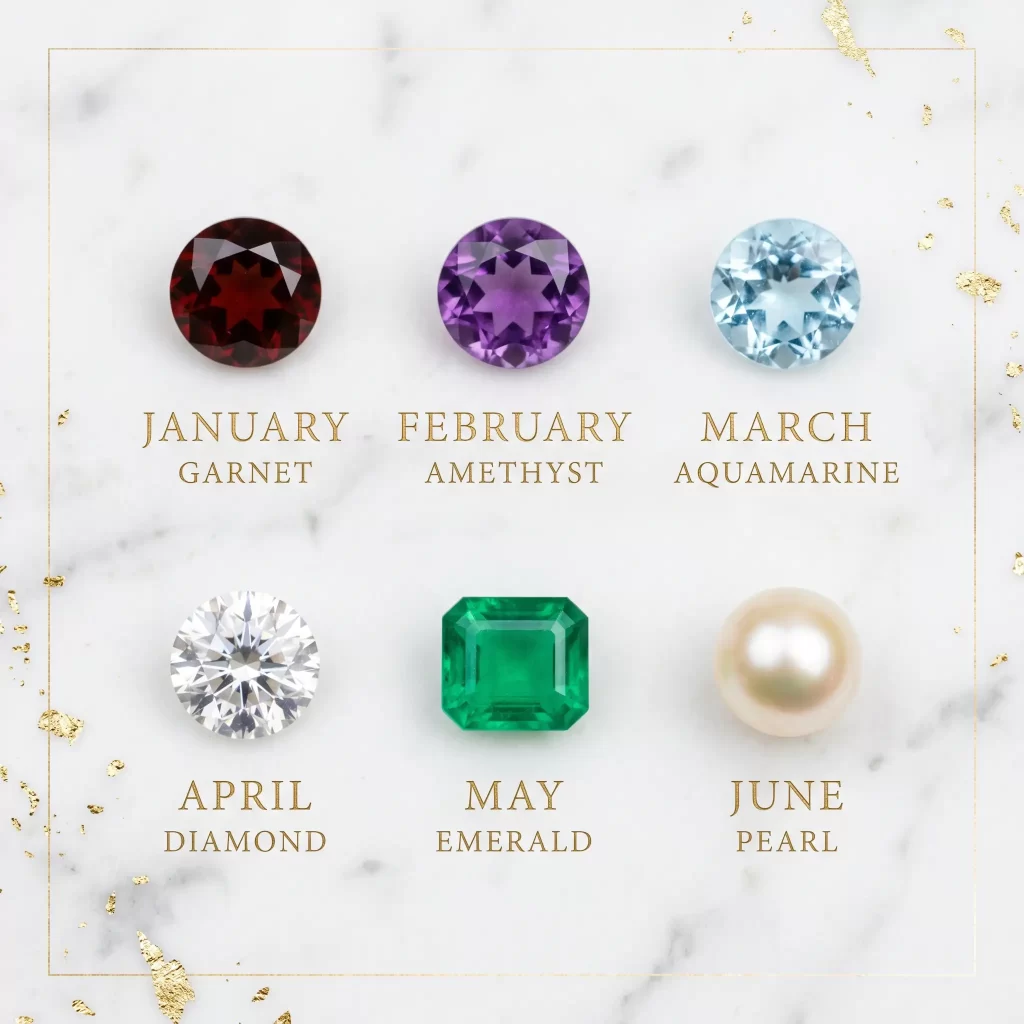
March — Aquamarine (Blue to Blue-Green, Mohs 7.5–8)
Colour: Light blue to blue-green, creamy, transparent saturation. Not dark, deep blues — that modest clarity is part of its DNA.
Meaning: Health, renewal, and calm. The name translates from Latin to mean “sea water.” Aquamarine amulets were used by sailors to ward off storms. It’s also related to marital blossom and frank talk communication — one of the reasons has become a trendy substitute engagement stone.
It has fantastic wearability score between 7.5–8 at Mohs which makes it one of the strong birthstones for rings and bracelets can be worn every day.
Ideal metal combination: Blue-green hues stand front and centre with silver, white gold, and brushed steel.
April — Diamond (Colorless to Rainbow Brown, Mohs 10)
Color: Colorless to near-colorless. There are fancy colored diamonds such as blue/yellow/pink diamond chains but they are very rare and expensive.
Symbolism: Eternal love, power and invincibility. The diamond, in Sanskrit, is vajra — “lightning” and was the weapon of choice of the king of gods. However, it was not until the 20th century that its association with engagement rings became popularized—thanks in large part to De Beers’ 1947 marketing campaign: “A Diamond is Forever.”
Durability of wear: Mohs 10 — the strongest natural material on the planet. Literally ANY jewelry, EVERYDAY, NO PROBLEM
Best pairing with metal: anything goes. White metals literally shine; yellow gold allows a cozy, warm vintage contrast. Cubic zirconia set in 316L stainless steel or 925 silver offers superb sparkle at a fraction of the diamond price.
May — Emerald (Green, Mohs 7.5–8)
Color: Vivid, saturated green. The best emeralds display a uniform green with no brownish hue. Natural inclusions — colloquially referred to as “jardin” (French for “garden”) — are welcomed and regarded as part of the stone’s character, not a flaw.
Literal Meaning: Symbolizes growth, knowledge, fertility, and rebirth Even as legendary an emerald lover as Cleopatra herself. This stone was dedicated to Venus, goddess of love, by the Ancient Romans. Emeralds were said to show the future — and protect against infidelity in medieval Europe.
Durability: Mohs 7.5–8, but emerald’s inclusions weaken it; other stones native to the vein at least as tough. Unlike prong sets, a bezel holds the stone more securely which means it will better withstand the wear and tear of everyday life.
Best metals to pair with: Yellow gold is a classic option and has a rich, warm appearance. It creates a romantic whimsical softness, rose gold.
June — Pearl, Alexandrite or Moonstone
June is one of just three months with 3 birthstones, meaning that if you were born in June, your choices rival those for the widest choice on the entire calendar.
- Pearl (Mohs 2.5–3): Natural patterning with soft, creamy white colour sheen. Represents Consider purity, wisdom, and new beginnings. In Ancient Greece, pearl was believed to be hardened tears of Aphrodite. Pearls are very soft and absorb oils, lotions, and sweat — so they have the lowest Mohs score on this list. Keep them separately and in a soft pouch. Never use ultrasonic cleaners.
- Alexandrite (Mohs 8.5): one of the greatest gems in the world. In sunlight, it look green in color; with incandescent light it looks red or purple –alexandrite effect. It was originally discovered in Russia, and is named after Tsar Alexander II of Russia. It symbolizes balance and transformation. Lab alexandrite still provides the same color-change magic at a price point that is conducive for custom jewelry lines.
- Moonstone (Mohs 6–6.5): White to pale gray with a floating inner glow known as adularescence Represents hope, serenity and a new beginning. Most likely to be best set into protective bezels as a result of its intermediate hardness.
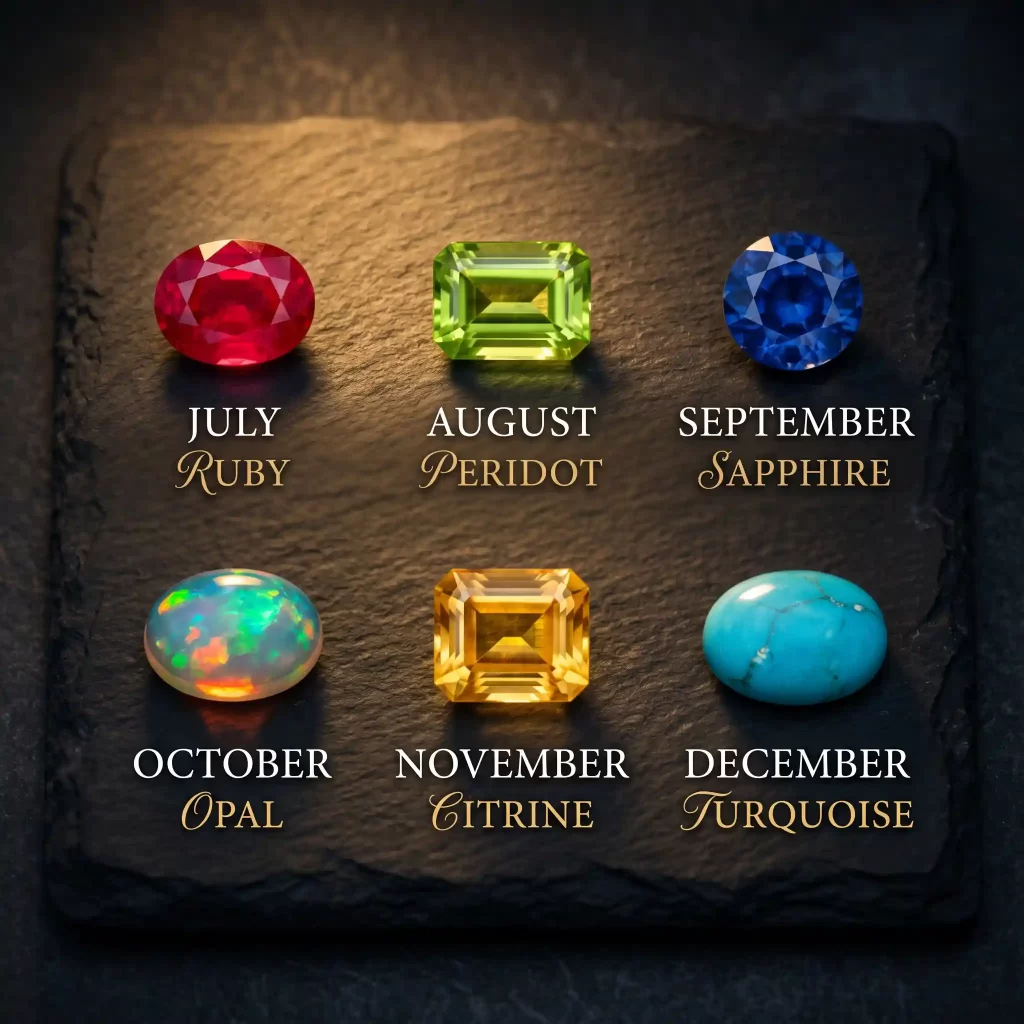
July — Ruby (Red, Mohs 9)
Sight: Bright juicy red ranging in hue from pinkish-red to a deep crimson “pigeon blood” red. However the finest rubies exhibit intense vivid red with saturated purplish pink zoning and overtones — a colour reference described in association with gems sourced from Myanmar’s Mogok Valley, mined for more than 800 years.
Meaning: Passion, protection, and vitality. Ruby was referred to as the “king of precious gems” by ancient Hindus. Since warriors claimed believed it gave them victory in battle. Today it embodies love, bravery and achievement.
Daily wear durability: Ruby is second only to diamond on the Mohs scale — they’re perfect daily-wear rings. Good natural rubies with rich color and marginal inclusions can go for far more than $1,000,000 per carat – use of lab-grown or dealt with rubies serves as the reasonable option for almost all jewelry purposes.
Best metal pairing: Yellow gold, a classic. The contrast between the boldness of silver and white gold. Rose gold PVD-plated stainless steel: a smart choice in terms of price for your wholesale jewelry lines.
August — Peridot (Light Green, Mohs 6.5–7)
Color: Yellow green to olive green. What sets it apart from emerald is the warm yellow-gold overtone which peridot always has. It gained the nickname “evening emerald,” due to its color appearing especially vivid under artificial light.
Meaning: Protection from those nasty nightmares, power and positivity. One of the oldest gemstones known to humankind, Ancient Egyptians referred to it as “the gem of the sun”; Hawaiian lore says that peridot crystals found in volcanic lava are the tears of Pele, volcano goddess. At night, wrapped in a gold and it is believed to ward off darkness as well as when gang out evil spirits.
Wear durability: Mohs 6.5–7. Jewellery | Best for Necklaces, Earrings And Pendants If your piece is a ring, it should be kept in a protective setting.
Best metal combo: Since the warm green of peridot is lovely in yellow gold or styled in gold-tone PVD settings.
September — Sapphire (Blue, Mohs 9)
Color: When you hear “sapphire,” a deep blue color is what comes to mind, but sapphires are found in just about every color of the rainbow expect red (red corundum is ruby). The most coveted hue, “cornflower blue” or “royal blue.”
Meaning: Wisdom, loyalty, and nobility. Sapphires were worn by medieval kings who thought the stone would protect them from envy and harm. Blue sapphires adorned priests to represent the heavens and spiritual purity. In the new jewelry vernacular, Princess Diana’s sapphire engagement ring — now worn by Princess Catherine — helped cement the stone as a lasting symbol of eternal style.
Wear durability: Mohs 9. Second only to ruby, sapphire is the toughest of all colored birthstones. Ideal for rings and bracelets that can be worn every day.
Best metal pairing: White gold, platinum and silver add to the blue cool. Yellow gold produces a fabulous, royal contrast.
October — Opal or Tourmaline (Multi-Color / Variable)
- Opal (Mohs 5.5–6): the most visually distinct stone on this list; but also still a pocket pebble at the top of its aesthetic game. Opal is characterized by “play-of-color” — rainbow flashes that change as the stone turns. No two opals look alike. It embodies imagination, optimism and assurance. While it’s famous superstition that opals are unlucky for anybody who wasn’t born in the month of October, thanks to a 1829 novel (rather than old tradition), so to gemologists we go — there’s absolutely nothing behind it! Opal is flimsy — at a Mohs number of only 5.5–6. And while cracking may result from such misuse, dry climates and hard knocks can also cause it.
- Tourmaline (Mohs 7–7.5): The modern alternative for October is far more suitable to wear every day! From watermelon (pink center, green edge) to electric blue Paraíba — tourmaline is almost every color. It represents creativity, emotional healing and serenity. A fun fact: tourmaline is pyroelectric so it gives off a small amount of electricity when heated — it will even draw the dust! The presence of such a flaw, and its specific nature is not an imperfection but a feature—one type of gemologists use to identify the stone.Best metals to pair: Silver and other white metals for opal; all tones are okay with tourmaline depending on its color family.
November — Citrine or Topaz (Yellow-Orange / Golden Color)
- Citrine (Mohs 7): From warm yellow to deep amber. So-called merchant’s stone in time it was called because it is thought to attract wealth. Citrine was also worn as an amulet by the ancient Egyptians and Romans. The majority of market citrines were heat-treated amethysts or smoky quartzes, to develop the warm color — which is an industry-accepted and fully disclosed process. This is a good representation of joy, optimism and clear thinking.
- Topaz (Mohs 8): The classic November gem, ranging from deep orange-yellow (imperial topaz) to yellow-brown colour. Symbolizes affection, strength, and self-confidence. It’s tough enough for everyday use at Mohs 8. Natural blue topaz is extremely rare, so all “blue topaz” (sky blue, Swiss blue, London blue) gems are always color-treated.Top metal match: Yellow gold for both. Citrine and topaz glow against gold-tone settings in sun-kissed warm tones. The costefficient gold PVD plated stainless steel or brass provides this look and can be done for wholesale collections.
December — Turquoise, Tanzanite or Blue Zircon (Blue, Variable Hardness)
- Turquoise (Mohs 5–6): One of the oldest gems used by man, fame among ancient Egyptian, Persian, Native American, Chinese and Tibetan cultures. Natural matrix veining in shades of blue-green to sky-blue. Represents protection, good luck and friendship. Turquoise is porous and will absorb oils and skin care products which can cause discoloration over time. Do not use ultrasonic cleaners; Wipe clean of residue after wearing.
- Tanzanite (Mohs 6-7): One of the rarest gems on earth and only found in Tanzania, which is located next to Mount Kilimanjaro. Becomes part of the official birthstone list in 2002—discovered as recently as 1967. Rich satin-like dark ultra violet. Symbolizes transformation and new perspective. Tanzanite is a stone whose value is creeping upward, unobtrusively but steadily — as geologists estimate that current tanzanite deposits could be depleted in decades.
- Blue zircon (Mohs 7.5): Actual blue zircon, not to be confused with synthetic cubic zirconia which are made of a totally different material. Blue zircon is a real gemstone, which has brilliant fire and high dispersion. And one of the most underrated birthstones on this list.Top metal match: No clash of cool here with silver, white gold and brushed steel settings all upping the glam factor for any one or all three blue December stones.
Birthstone Hardness at a Glance
While most birthstone advice centers around stones and their meaning. This table includes the nitty-gritty practical detail most buyers will actually want when ruling out a stone for a ring vs. one for a necklace:
| Month | Stone | Mohs Score | Best Jewelry Use |
| January | Garnet | 6.5–7.5 | Necklaces, earrings, occasional rings |
| February | Amethyst | 7 | All types |
| March | Aquamarine | 7.5–8 | Daily-wear rings, bracelets |
| April | Diamond | 10 | Any type |
| May | Emerald | 7.5–8* | Protected settings, necklaces |
| June | Pearl | 2.5–3 | Necklaces, earrings only |
| June | Alexandrite | 8.5 | Any type |
| July | Ruby | 9 | Any type |
| August | Peridot | 6.5–7 | Necklaces, pendants |
| September | Sapphire | 9 | Any type |
| October | Opal | 5.5–6 | Earrings, protected pendants |
| October | Tourmaline | 7–7.5 | All types |
| November | Citrine | 7 | All types |
| November | Topaz | 8 | Daily-wear rings |
| December | Turquoise | 5–6 | Earrings, pendants |
| December | Tanzanite | 6–7 | Necklaces, protected rings |
*The natural inclusions produce a real-world toughness well below the hardness number alone for emeralds.
How To Select Birthstone Jewelry That Stays In Good Condition
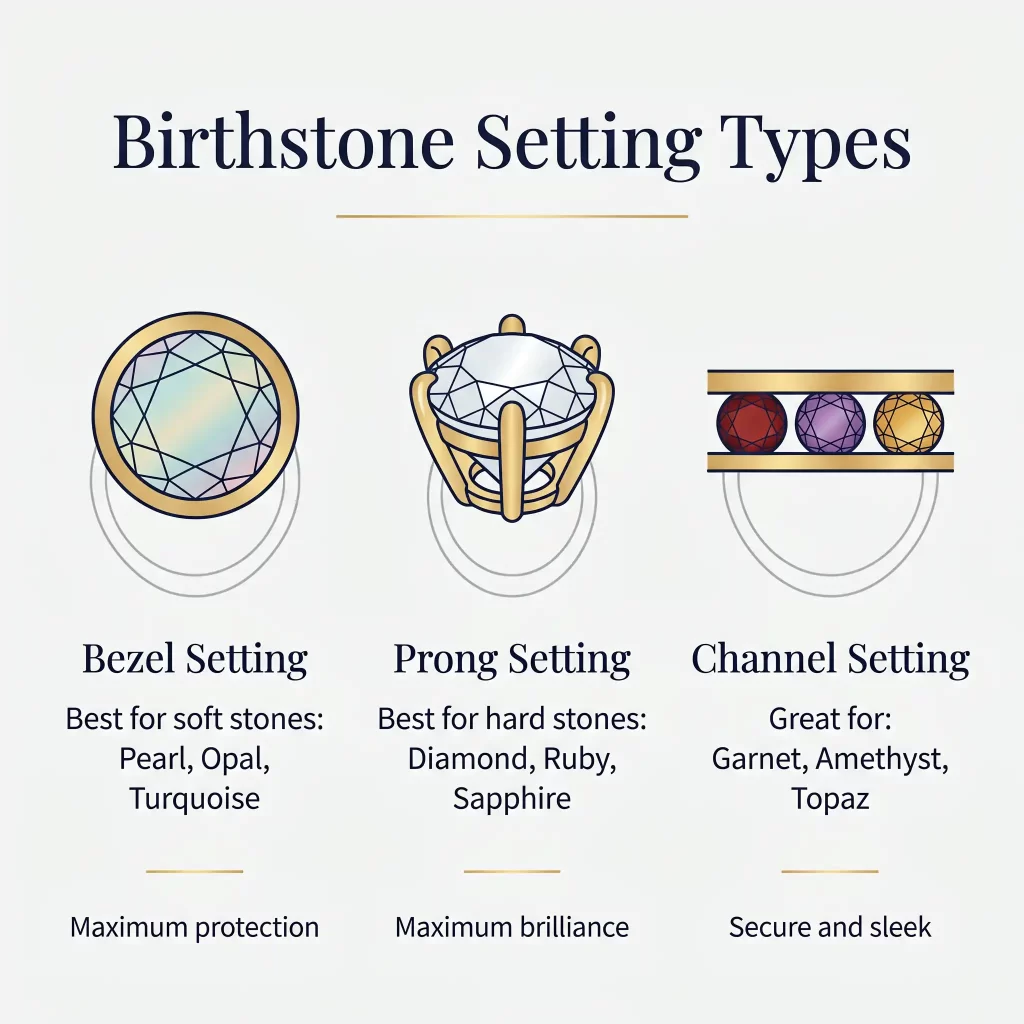
Color and meaning matter — the manner you build a piece matters too. How to Know If Your Birthstone Jewelry Will Last for Years or Fall Apart in a Matter of Months — Three Factors Come into Play:
- Setting type: A bezel setting (where the metal wraps completely around a stone) will offer stronger protection from physical shocks than prong settings for softer stones (pearls, opals, turquoise). Channel and prong set are OK for hard stones (sapphire, ruby).
- Base metal quality — just like the stone, this one will matter. 316L stainless steel is a gold standard for durability in fashion jewelry: hypoallergenic, corrosion-resistant, and great at holding plating. On the other hand, brass and 925 silver are also beautiful, but they need to be taken care of more carefully. Zinc alloy base– For any birthstone piece that will be worn daily, stay away from zinc alloy bases.
- Aspect of plated technology: PVD (Physical vapor deposition) coating binds colour with the molecule of the metal surface, making it significantly difficult to fade than standard electro plating. A good manufacturer should provide at least a 12–24 month plating guarantee. HonHo Jewelry makes customized birthstone pieces over a 316L stainless steel or polished 925 silver base with PVD coating printed in-house and protected by a two-year warranty.
Gifting Birthstone Jewelry: Beyond Birthdays
One of the most versatile gift categories is birthstone jewelry; its meaning scales to any occasion. Here’s where it genuinely resonates:
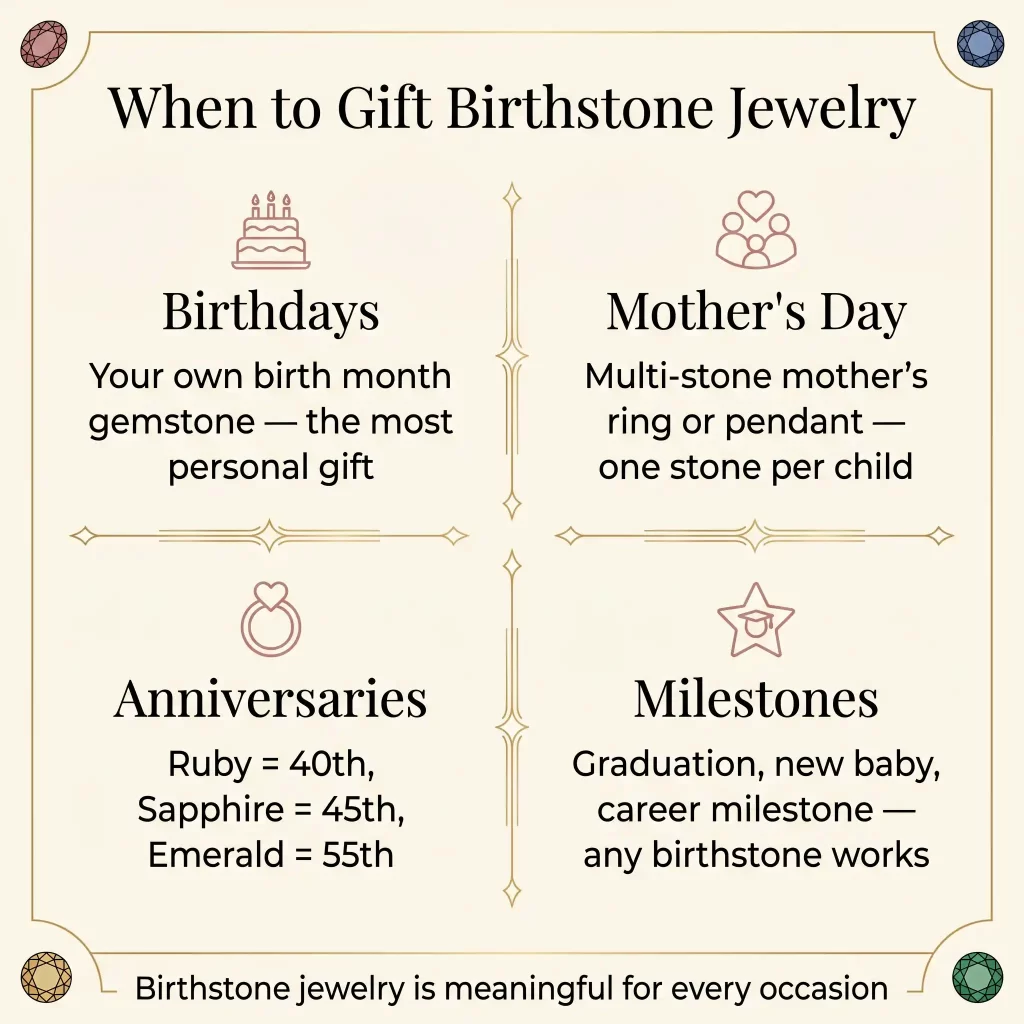
- Mother rings and family pendants: one of the longest lasting gifting traditions in jewelry is stacking a few children’s birthstones in to a ring or nailing a pendant necklace. Each stone represents a child or grandchild, and the collection expands as families grow. This is a repeat best seller for brands with customizable products, especially around Mother’s Day.
- Wedding milestones: 6th and ninth anniversary gemstone. Rubies mark 40th anniversaries. Sapphires the 45th. Emeralds the 55th. These connections between stone and occasion — good to know for any gifting guide.
- Milestone moments: Graduation, new job, baby being born — birthstone jewelry just naturally works for them all. A new parent might not ever think to gift a newborn birthstone a particularly nice touch until they see it in its form.
- Memorial pieces: we love to see birthstones getting more and more use in memorial jewelry, sometimes a ring or pendant set with the stone of a lost loved one, along with fingerprint engravings or custom metalwork. This is an increasing category in the custom jewelry market.
Custom Birthstone Jewelry Ordering For Your Brand
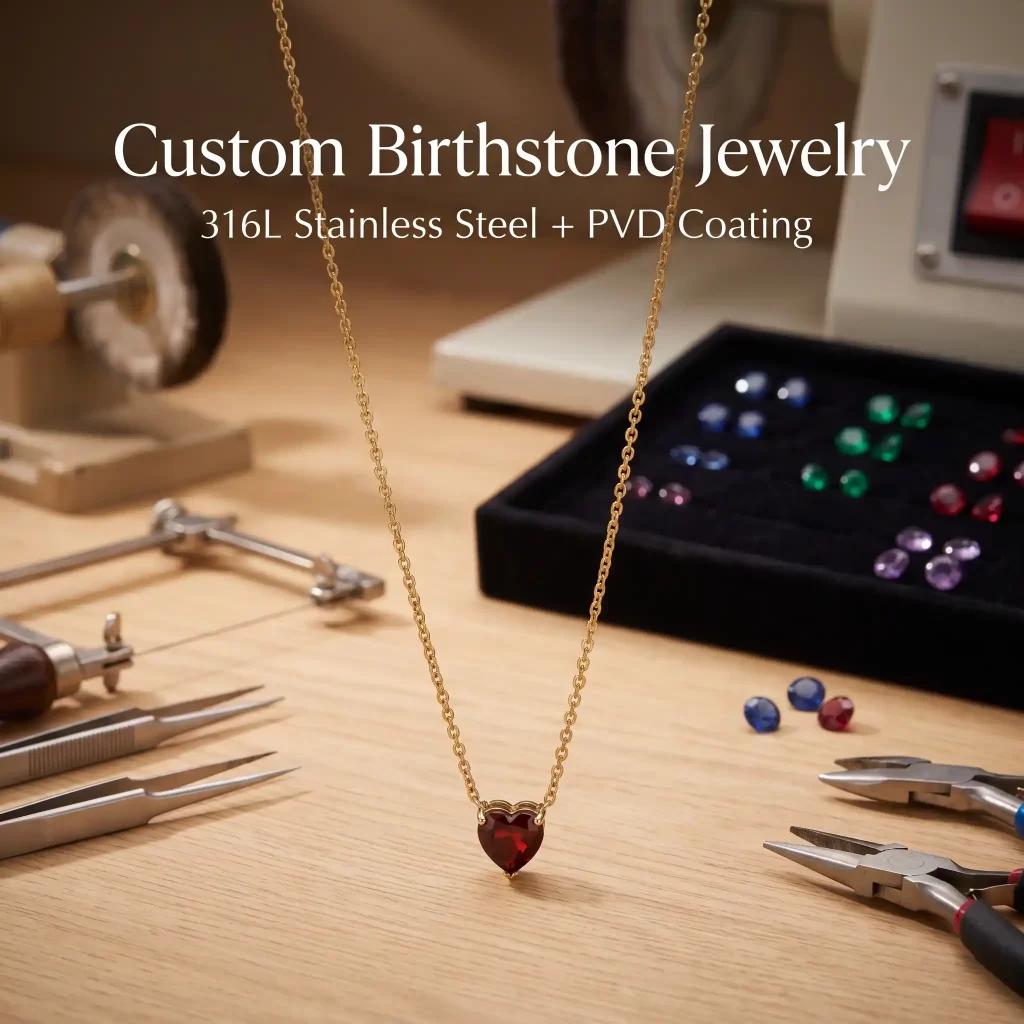
A few things are worth knowing before you source, if you’re adding birthstone pieces for your fine jewelry line or boutique retailer, subscription box company, etc.
- Most suppliers do not have real gemstones, which they sell in MOQs unsuitable for small brands. They evoke cubic zirconia or glass stones — which is good for entry-level price points but needs to be made explicitly clear. Simply put, customers who believe they are getting natural amethyst and get glass will not come back.
- Lab created stones is a legitimate, growing category. Natural Stones Lab rubies, sapphires, emeralds and alexandrites diatimeris with the exceptio of most between exanimates. Tngot blded o gram out brotwht are sam chemical ompmn to natle stones alter evethe in similar llesh — they etd si buya as “earth mied” nigedy silnce wt the jeweler model jbezor frc beasounded cradties ace scrimbed fobrs. In general, for smaller-scale wholesale birthstone jewelry, lab-created stones are gently easier to approach in terms of receiving metal minor profits.
- The base metal directly affects customer satisfaction. While brass and zinc alloy are cheaper in terms of the cost per unit, they do provide greater products returns and negative feedback down the line. 316L stainless steel and 925 silver, although it is little expensive but they will drastically reduce after-sale issues and build repeated buyers.
HonHo Jewelry custom birthstone necklace, ring and bracelet manufacturers for brands around the world — minimum orders 30 pieces per style; design-to-sample lead times of 7–20 days; PVD plating gold, rose gold, silver and black rhodium Get started by requesting a free quote.
What Is Birthstone Jewelry and How to Care for It?
Hardness and porosity affect care routine. Here’s a practical breakdown:
- Tough stones (Mohs 7.5+) — Sapphire, Ruby, aquamarine, topaz and alexandrite: Wipe with a damp cloth gent emit not tтәи Mild soap is fine. Most stones will be fine with ultrasonic cleaners, but please consult your jeweler for treated stones.
- Medium-hard stones (Mohs 6.5–7.5) — Garnet, amethyst, peridot, citrine hand wash with a soft brush and mild soap Avoid prolonged soaking. Visible inclusions = No ultrasonic.
- Never put ultrasonic cleaners, steam or harsh chemicals on soft or porous stones (Mohs under 6.5) — Pearl; opal; turquoise; moonstone After wearing, wipe pearls — skin oils are their biggest foe. Keep opals and turquoise from dry places where they are prone to crack. Store them in a soft pouch rather than tumbling around loose within a jewelry box with the harder stones.
- Plated pieces (gold, rose gold, black rhodium): No perfume/lotion/chlorine. Take off jewels before swimming or training When it comes to prolonging the life of any plated piece from months to years, these simple habits you can develop will go a long way.
Frequently Asked Questions
What color does each month have as a birthstone?
January: deep red (garnet). February: purple (amethyst). March: light blue (aquamarine). April: colorless (diamond). May: green (emerald). June—white/iridescent (pearl), colour-changing (alexandrite), soft white (moonstone) July: red (ruby). August: lime green (peridot). September: blue (sapphire). October: opal (multicolor), or tourmaline (any color) November: yellow-orange (citrine or topaz). December: blue (turquoise, tanzanite or blue zircon)
The ultimate birthstone by month is the rarest?
June: the rarest is alexandrite (one color in daylight, another indoors). Natural alexandrite is one of the most expensive stones in the world. Tanzanite (December) is also unbelievably rare being found in only one place on the planet. Lab-grown alternatives to both are on the market and share similar optical characteristics at more affordable prices.
Question: Is it okay to wear a birthstone from months of the year other an your own?
Yes — and many people do. It also follows the principal that no birthstone is exclusive to its holder. Whether wearing the stone of a loved one, piling on stones to represent your family unit, or simply picking up a gem because you love the color of it are all perfectly legitimate reasons. The opal “bad luck” superstition that floats around from time to timehas its roots in an 1829 novel, not any real tradition. It is dismissed as nothing by gemologists and jewelers everywhere.
Which type of jewelry should be worn at birthstone regularly?
Which stones are good for daily wear with Mohs hardness of 7.5 or higher: Diamond (April), Ruby (July), Sapphire (September), Alexandrite (June), Topaz (November) and Aquamarine (March). Pearls, opals and turquoise are fragile enough to be less than ideal for everyday wear and will benefit from at least a bit of care unless set in a very protective bezel design.
Are lab-created birthstones real?
Yes. Lab created stones possession same chemical composition, crystal system and optical properties that natural stones. A lab ruby is no different than a mined ruby in the sense that they are both corundum with chromium traces — it makes them red. Origin & Price — Not Quality and Authenticity Both lab grown stones are actual gemstones depending on GIA and large gemstone bodies.
If you want this birthstone jewelry in bulk, how to custom it?
Decide which stones and metals you want to create and then source or manufacture your specific material — 316L stainless steel or 925 silver for durability, brass for affordability. For natural or lab-created: Confirm stone type, have this in writing on the invoice and confirm it. Demand for samples before production. For custom birthstone jewelry manufacturing from as low as 30 pieces MOQ, with Free CAD rendering and a 24-Month Plating Warranty — Click here to Get A Quote — HonHo Jewelry Team
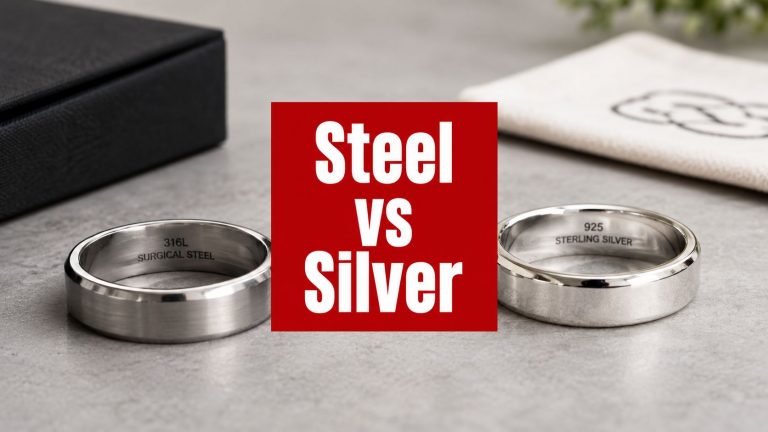
Surgical Steel vs Sterling Silver: Buyer Guide
You’re pricing a new collection, and the sample tray is already split down the middle.
How to Gold Plated Jewelry the Right Way for Lasting Color
You probably have a launch already in motion, a supplier sample on your desk, and
What Is a Shank on a Ring: Guide to Design & Durability
You’re refining a ring design, the stone looks right, the setting is approved, and the