A lot of new jewelry brands arrive at the same point. The first collection looked strong in samples, the photos converted well, early orders came in, and then the complaints started. A few customers say their necklace lost color too fast. A bracelet clasp shows base metal sooner than expected. Returns rise, reviews get cautious, and suddenly a finish decision made months earlier starts affecting margin, reputation, and repeat purchase behavior.
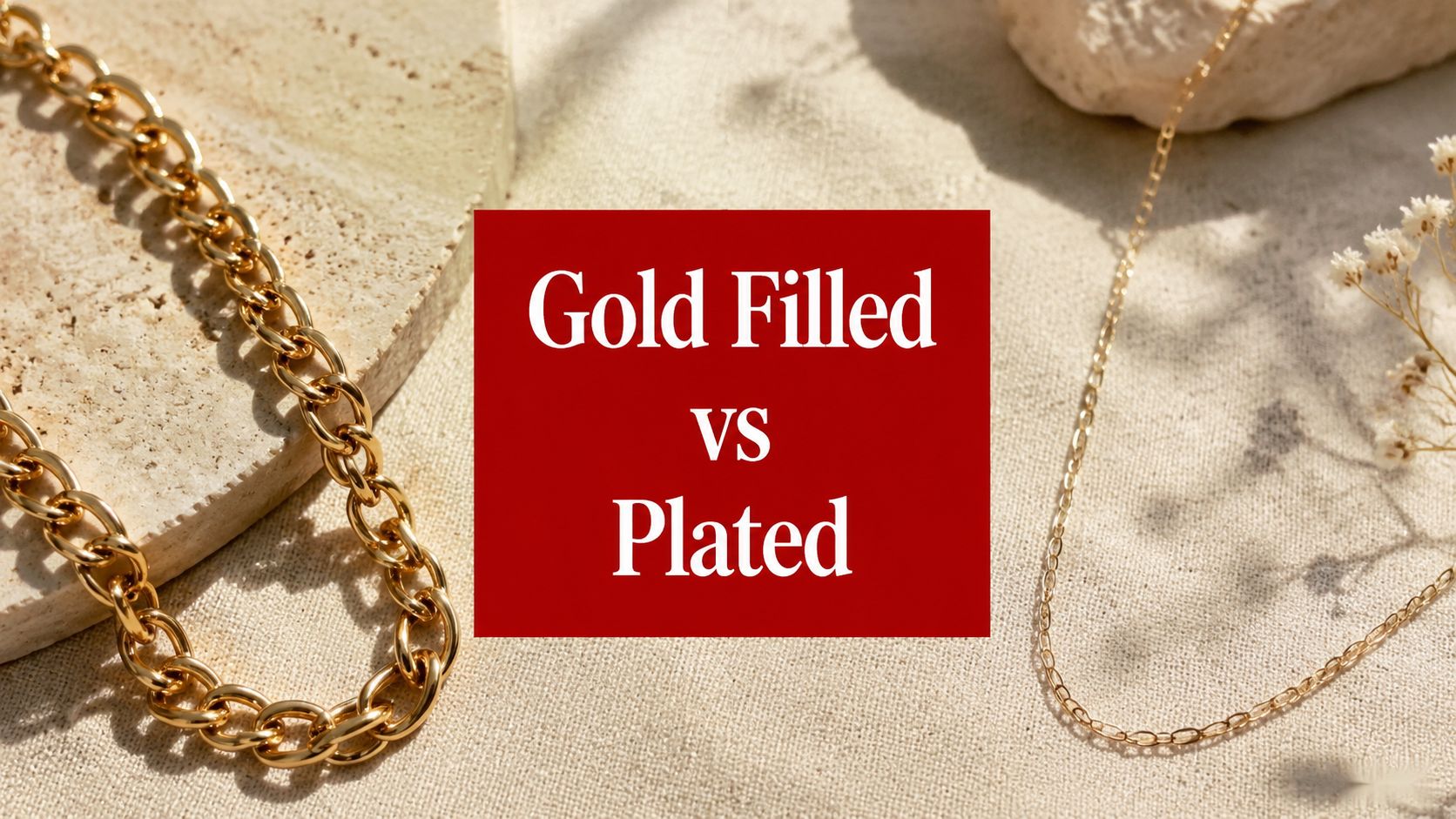
That’s why the gold filled vs gold plated question isn’t just a materials question. It’s a brand positioning decision. It shapes your retail pricing, your after-sales policy, your product descriptions, and how confidently your team can talk about durability.
For buyers, distributors, and private label brands, the right answer usually isn’t “always gold filled” or “always gold plated.” It’s choosing the finish that matches the product category, customer expectations, and manufacturing method behind it. In practice, the wrong match causes more trouble than the wrong design.
Choosing Your Gold Standard: A Strategic Decision for Jewelry Brands
A new brand often starts with one assumption: if a piece looks premium, customers will treat it like a premium product. That’s where problems begin. A thin decorative finish may be fine for a trend earring sold for occasional wear, but it won’t support the same customer expectation as an everyday chain, stack ring, or signature bracelet.
The sourcing decision gets harder because supplier language is often simplified for sales. “Long-lasting gold.” “Premium plating.” “Demi-fine quality.” Those phrases don’t tell you what the process was, how the gold was applied, or what kind of wear pattern you should expect in the market.
Practical rule: Don’t choose the finish first. Choose the use case first, then match the finish to the product.
For a brand manager, this changes the conversation. Instead of asking which material sounds better on a product page, ask a tighter set of questions:
- What’s the wear pattern: Is this piece meant for daily contact, water exposure, frequent clasp handling, or occasional styling?
- What’s the retail promise: Are you selling trend-led fashion jewelry, or are you building a core everyday line that customers expect to keep in rotation?
- What’s the replacement risk: If color loss shows up early, can your margin absorb replacements, refunds, and support time?
- What’s the base material strategy: Are you building around brass, stainless steel, sterling silver, or a mixed collection with different construction needs?
Brands that answer those questions early usually make cleaner line plans. They use gold filled where longevity supports the story and pricing. They use high-quality gold plating where design flexibility, cost control, and trend speed matter more.
Understanding the Manufacturing Process Bonded vs Coated Gold
The technical difference is simple once you strip away the marketing language. Gold filled is bonded. Gold plated is coated. That one distinction explains most of the downstream differences in durability, cost, repair behavior, and customer expectations.
A useful way to think about it is this. Gold filled is closer to building with a layered material. Gold plated is closer to applying a surface finish after the piece is made. Both have a place in jewelry manufacturing. They just behave differently in use.
Here’s a quick visual summary of the production difference.

How gold filled is made
Gold filled material starts with a core metal, typically jeweler’s brass, and a substantial outer layer of gold alloy. Those layers are mechanically bonded by heat and extreme pressure. Under U.S. standards, gold-filled jewelry must contain at least 5% (1/20) gold by weight, and the gold layer is approximately 100 times thicker than standard gold plating, often 20–35 microns in a 1mm sheet according to this gold-filled manufacturing explanation.
That process matters because the gold isn’t just sitting on the surface as a decorative flash. It becomes part of the working material the factory cuts, forms, solders, and assembles. For daily-wear products, that thicker bonded layer gives more room for real-life abrasion before the core metal becomes visible.
In production, that usually makes gold filled a strong fit for chains, clasps, jump rings, simple bands, and everyday silhouettes where wear concentrates in predictable contact areas.
How gold plating is made
Gold plated jewelry follows a different route. The base item is made first, then the factory deposits a thin gold layer onto the surface through electroplating. The result is a gold-colored finish on top of the substrate rather than a bonded gold sheet integrated into the material.
That distinction is why plated jewelry is more sensitive to variables such as base metal choice, pre-plating polishing, cleaning, activation, layer build-up, and final protective treatments. A plated piece can perform well, but only if the factory controls the process tightly.
For brands comparing coating technologies, this guide to PVD vs electroplating jewelry coating is useful because it frames plating as a production system, not just a color choice.
A supplier who can’t clearly explain the coating sequence usually can’t give you consistent wear performance either.
Later-stage durability often comes down to surface prep and process discipline. Poorly prepared castings, contamination before plating, or weak sealing layers can all shorten color life, even if the sample looked good.
To see the production difference in action, this short video is a helpful reference.
Why this process difference changes sourcing decisions
For a brand, bonded versus coated isn’t abstract factory language. It affects product planning.
- Construction limits: Gold filled works best in formats that suit mechanically bonded stock and component-based assembly.
- Design freedom: Plating is often easier for complex cast forms, sculptural shapes, and fashion-led surfaces.
- Wear pattern: Gold filled tends to thin gradually over time. Plated finishes are more vulnerable to visible breakthrough once the coating is compromised.
- Cost structure: Gold filled carries more material cost. Plated jewelry gives more room for entry price points and broad style counts.
If you’re sourcing custom jewelry or wholesale jewelry for a mixed collection, understanding the process first keeps you from comparing two materials as if they were interchangeable. They aren’t. They can both work. But they solve different production problems.
A Head-to-Head Comparison for Brand Sourcing
For B2B buyers, the comparison has to go beyond “better” and “worse.” The key question is which option fits your category, margin, and customer promise. A trend-driven capsule collection doesn’t need the same finish strategy as an everyday demi-fine line.
The table below is the framework many sourcing teams should use before locking materials for custom jewelry production.
| Criterion | Gold Filled | Gold Plated (High-Quality) |
|---|---|---|
| Manufacturing method | Mechanically bonded gold layer over a core metal | Surface coating deposited through plating process |
| Durability profile | Better suited to repeated daily wear and friction-heavy contact points | Better for controlled-use pieces, fashion lines, and products with a defined wear expectation |
| Base material direction | Commonly built around jeweler’s brass stock and components | Often paired with brass or stainless steel, depending on design and finish goals |
| Design flexibility | Best for categories that work with bonded material and assembled findings | Strong option for intricate castings, dimensional shapes, and broad style variation |
| Customer positioning | Fits everyday, signature, and demi-fine collections | Fits entry-price, seasonal, and trend-forward collections |
| Repair and aging behavior | Usually shows gradual wear over time | Usually shows more visible finish loss once surface coating breaks |
| Price architecture | Higher material cost and higher retail expectation | Lower entry cost and wider assortment flexibility |
| Compliance conversation | Depends on alloy and component choices from the manufacturer | Depends heavily on base metal, plating stack, and compliance controls |
| Best brand use | Core products customers expect to wear often | Volume sellers, style testing, gifting, and occasional-wear launches |
Durability isn’t the only buying criterion
Many new brands over-focus on durability and underweight assortment strategy. That can create a collection that is technically solid but commercially narrow. If every piece is built to maximize lifespan, your retail prices may rise faster than your target audience can accept.
A stronger approach is to separate products by usage tier. Signature necklaces, staple hoops, chain bracelets, and pieces marketed for everyday wear usually justify a more durable route. Statement earrings, trend charms, occasion styles, and high-SKU seasonal launches often perform better with high-quality plating because they let the brand move faster and hold lower opening price points.
Base metal changes the outcome
Base metal is one of the most overlooked parts of the gold filled vs gold plated decision. Gold filled typically centers on brass-based construction. Gold plating gives you more flexibility. In manufacturing, that often means choosing between brass for cost and forming behavior, or stainless steel for strength, skin-contact priorities, and corrosion resistance.
That matters because customers don’t experience “plating” by itself. They experience the whole stack. Surface finish, barrier layers, base metal stability, polishing quality, and assembly discipline all shape the final result.
If two suppliers both say “gold plated,” you still may be comparing two very different products.
One may be a basic decorative finish on a low-cost casting. Another may be a carefully controlled plated product with better substrate choice and tighter quality control. From a sourcing standpoint, those are not interchangeable.
Hypoallergenic and compliance questions
Experienced buyers ask sharper questions than beginners. Instead of asking whether a piece is “safe for skin,” ask what the base material is, whether the production is nickel free, and whether the manufacturer can support EU and US compliance requirements with documentation.
For wholesale jewelry and private label production, material claims need paperwork behind them. If a supplier can’t provide clear specifications for alloy, coating system, and compliance testing, the finish label alone doesn’t protect your brand.
A practical review checklist includes:
- Base metal confirmation: Ask whether the item is brass, stainless steel, sterling silver, or mixed-material construction.
- Plating specification: Ask for the nominal thickness target and whether barrier or protective layers are used.
- Wear testing: Ask how the factory checks color retention, corrosion, and abrasion resistance.
- Compliance file: Ask whether the supplier can support nickel free, lead free, cadmium free, and market-specific requirements.
Margin planning and retail storytelling
The finish also changes how you sell. Gold filled usually supports a stronger longevity story and a higher perceived-value position. High-quality plated jewelry supports breadth, trend responsiveness, and easier bundle pricing.
Brands that do this well don’t force one finish across every SKU. They build a material matrix. Core products get the finish that supports repeat wear. Fashion products get the finish that supports speed, variety, and cost control. That approach makes the collection easier to price, easier to explain, and easier to scale through manufacturing.
The Truth About Modern Plating and Durability
The phrase most buyers hear is that gold filled has “100x more gold.” That statement sounds decisive, but it can hide more than it reveals. In sourcing, weight percentage alone doesn’t tell you how a finished product will perform in real use.
What matters is the whole construction. That includes layer type, thickness, adhesion, base metal, surface preparation, and how the piece is likely to be worn. Modern plating technology has made that comparison more nuanced than many consumer guides suggest.

Where the old comparison falls short
A useful industry correction comes from this discussion of gold vermeil, gold plated, and gold filled, which notes that many “100 times more gold” comparisons rely on total weight percentage rather than modern plating standards. That same source also notes that high-quality PVD at 0.03–0.1 microns or thick electroplating up to 5 microns can offer color retention of 2+ years, which can rival older gold-filled standards in some applications.
That doesn’t mean plated jewelry suddenly replaces gold filled across the board. It means a well-made plated product shouldn’t be judged by the weakest examples in the market.
Why high-performance plating changed the conversation
Manufacturers that run in-house PVD and controlled electroplating know the difference between decorative flash plating and engineered surface finishing. With better process control, brands can use plated finishes more strategically.
Three factors usually matter most:
- Substrate choice: Stainless steel often gives plated products a more stable foundation than low-grade base metals.
- Layer control: Thickness targets and protective layers affect how long color remains acceptable in normal use.
- Product design: Flat surfaces, edge exposure, friction points, and clasp movement all change wear behavior.
For teams evaluating plating specs, this guide on the thickness of gold plating helps buyers read manufacturer claims with more precision.
Modern plating works best when the factory treats it like engineering, not decoration.
What works and what doesn’t
What works: using high-quality plating for fashion necklaces, statement earrings, charm concepts, and style-led pieces where lower cost and broader assortment matter. It also works well when the base material and protective layers are chosen deliberately.
What doesn’t: assuming any product described as “gold plated” will perform the same way. That’s where brands get into trouble. Basic electroplating on a weak substrate and advanced PVD on a well-prepared stainless steel item belong in different quality tiers, even though they share the same broad category name.
The practical takeaway is simple. Gold filled still holds a strong position for long-wear products. But if you’re sourcing with a capable manufacturer, modern plating deserves a more serious evaluation than many consumer-facing comparisons allow.
When to Choose Gold Filled vs Gold Plated
Most brands don’t need a single answer. They need a line strategy. The strongest assortments usually mix finishes according to price tier, design complexity, and how customers are expected to wear the piece.
A useful benchmark comes from this gold-filled and gold-plated trade guide, which describes gold filled as a durable “demi-fine” bridge between solid karat gold and costume-grade accessories. That framing is practical for merchandising because it gives each finish a clear role instead of treating one as premium and the other as disposable.

Choose gold filled for core line products
Gold filled makes the most sense when the product is central to the brand. Think signature chains, stackable bracelets, staple hoops, basic pendants, and giftable pieces meant to stay in daily rotation.
These are the products customers usually judge your quality by. If the finish wears poorly, they don’t blame the category. They blame the brand.
Good use cases include:
- Everyday jewelry: Pieces designed for frequent wear, repeat styling, and closer customer scrutiny.
- Higher-perceived-value items: Products that need a stronger quality story to justify retail pricing.
- Sensitive positioning: Collections marketed as a step above fashion jewelry, especially in the demi-fine space.
For brands building this tier, gold filled jewelry manufacturing options are worth reviewing because construction details matter as much as the label.
Choose high-quality gold plating for speed and flexibility
Plated jewelry works best when the collection needs breadth, trend responsiveness, or lower opening price points. This includes seasonal drops, bold statement shapes, fashion earrings, occasion-driven capsules, and categories where customers prioritize style over long-term wear.
It’s also often the better solution when the design itself is difficult to execute in bonded gold-filled material. Complex cast surfaces, sculptural forms, and broad style testing usually favor plating.
A practical fit looks like this:
- Trend collections: New silhouettes where the brand wants to test demand before investing deeper.
- Promotional or bundle products: Items intended to support gifting, upsell, or broad accessibility.
- Design-led pieces: Styles where shape, texture, and visual impact matter more than everyday abrasion resistance.
Build a two-tier assortment
Many brands improve sell-through and reduce finish complaints by splitting the collection into two clear groups rather than mixing messaging.
One group is the “keep forever” story. The other is the “wear now, style often” story. Both can be credible if the product page, merchandising, and after-sales expectations are honest.
Customers are usually reasonable about lifespan when the brand is clear about intended use.
That’s the strategic value in the gold filled vs gold plated decision. You’re not just picking a metal finish. You’re defining what each product promises and how your production process supports that promise.
How to Source and Verify Quality from Your Manufacturer
The hard part isn’t learning the difference between the two categories. The hard part is confirming that the supplier is producing what they say they’re producing.
That challenge is real because there isn’t a simple consumer-side shortcut. A discussion around gold-filled authenticity and verification points out that there is no reliable, non-destructive consumer method to distinguish between high-thickness electroplated items in the 3–5 micron range and true mechanically bonded gold-filled pieces. For buyers, that means documentation matters more than visual guesswork.
Ask for specifications before you ask for samples
A polished sample can hide weak process control. Start with paperwork.
Request:
- Material construction sheet: Ask for the exact base metal, coating method, and finish sequence.
- Thickness confirmation: Ask how the manufacturer verifies plating thickness and whether test reports are available.
- Compliance support: Ask for evidence tied to the markets where you sell, especially if you need nickel free or broader chemical compliance.
- Warranty terms: Ask what the supplier stands behind in normal wear and what conditions void the claim.
A reliable factory should answer those questions directly. If the reply stays vague, expect problems later.
Review the sample like a buyer, not a consumer
Sample approval shouldn’t focus only on color. It should focus on likely failure points.
Check clasp edges, jump rings, ring shanks, chain contact zones, solder joints, posts, and any raised corners where wear tends to show first. Also compare multiple units, not just one. A single good sample doesn’t tell you much about process consistency.
These questions usually expose weak suppliers fast:
- What is the exact substrate for this style?
- Is the finish PVD, electroplating, or a mixed process?
- What protective layers are included?
- Can you provide test reports tied to this finish standard?
- What defects are screened during final inspection?
For teams formalizing supplier review, this jewelry manufacturer vetting guide gives a practical checklist for sourcing conversations.
Don’t rely on stamps, appearance, or seller wording alone. Reliable verification starts with manufacturer transparency.
Build quality control into the purchase order
The best time to prevent disputes is before production starts. Put the critical items into the approved spec and purchase order: base metal, finish method, target appearance, sample reference, compliance needs, packaging standards, and inspection criteria.
That protects both sides. The factory knows what it must deliver. Your team has a documented reference if the shipment doesn’t match the approved standard.
In custom jewelry manufacturing, most quality issues come from assumptions left undocumented. Clear specs solve more problems than after-sales negotiation ever will.
Building Your Collection with a Reliable Manufacturing Partner
A good finish decision becomes much easier when the manufacturer can support more than one route. Brands rarely scale well with a supplier that only pushes one process, one metal, or one quality level. Collections grow faster when the factory can adapt the construction to the product instead of forcing the product into a narrow production system.
That matters most in OEM and ODM work. A growing brand may need stainless steel basics, brass fashion styles, 925 silver capsules, gold filled essentials, custom packaging, and branded finishing details under one production plan. If those pieces are spread across too many vendors, lead times stretch and quality becomes harder to manage.
What strong manufacturing support looks like
The most useful partner usually provides an end-to-end workflow:
- Design support: CAD development, rendering, and rapid prototyping that let teams validate construction before mass production.
- Finish flexibility: Access to PVD, electroplating, polishing, engraving, and selective finishing based on the style.
- Quality systems: Clear inspection standards, thickness testing, wear testing, and shipment checks tied to approved specs.
- Private label execution: Logo application, packaging coordination, and export handling without pushing the buyer into separate vendor chains.
Those capabilities matter because the gold filled vs gold plated decision often changes at the style level, not the collection level. One line may need bonded material for daily-wear chains. Another may need plated stainless steel for a fashion capsule.
Why response speed matters too
Technical skill matters, but so does operational speed. Buyers need fast CAD feedback, realistic sampling timelines, reliable updates, and clear communication when a design should be adjusted for finish performance.
A factory that responds early on construction risk can save a brand from expensive mistakes. For example, it may recommend changing an edge profile, adjusting a clasp geometry, or moving a style from one finish route to another before sampling costs multiply.
This kind of coordination is one of the clearest signs of a mature custom jewelry manufacturer.

Brands evaluating long-term suppliers can review this custom jewelry manufacturer profile to see what full-service production support should look like across design, sampling, plating, QC, private label, and fulfillment.
The practical conclusion
If you’re building a serious collection, the best answer usually isn’t choosing gold filled over gold plated in every case. It’s choosing the right finish for the right product and working with a manufacturer that can prove the specification, control the process, and keep quality consistent from sample to production.
That’s what protects your margin and your reputation. Materials matter. Process matters more. Supplier transparency matters most when customers start wearing the product every day.
If you’re comparing finishes for a new collection, HonHo Jewelry can help you evaluate the right production route for each SKU. The team supports custom jewelry development, OEM/ODM manufacturing, wholesale jewelry programs, plating and PVD options, quality control, private label packaging, and global fulfillment, with practical guidance from sampling through mass production.
Surgical Steel vs Sterling Silver: Buyer Guide
You’re pricing a new collection, and the sample tray is already split down the middle.
How to Gold Plated Jewelry the Right Way for Lasting Color
You probably have a launch already in motion, a supplier sample on your desk, and
What Is a Shank on a Ring: Guide to Design & Durability
You’re refining a ring design, the stone looks right, the setting is approved, and the