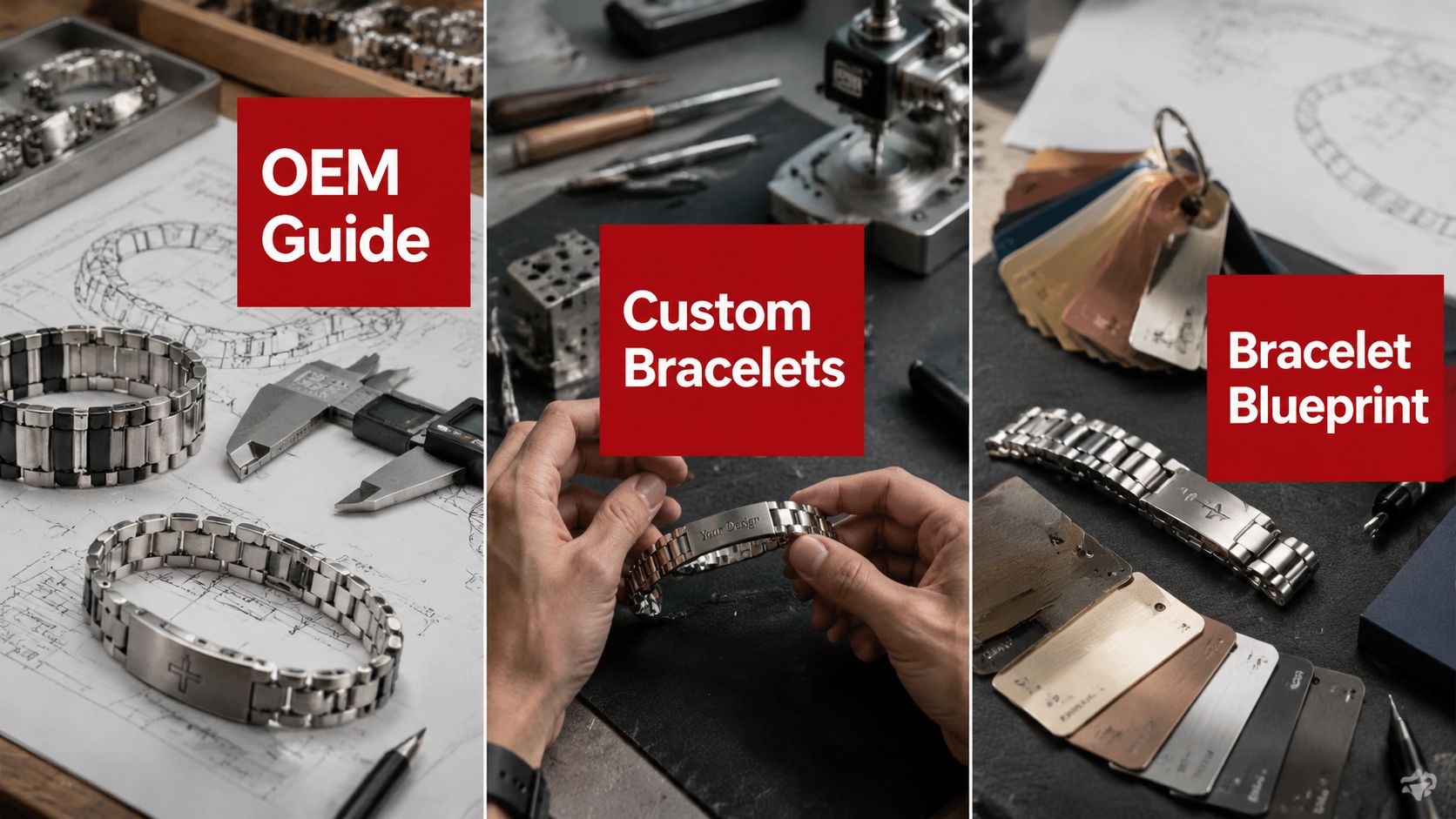
Custom Stainless Steel Bracelets a Buyer’s OEM Guide

A lot of new bracelet projects start the same way. A founder has a sketch, a mood board, a target price, and a launch date that already feels too close. The design looks clear on paper, but the manufacturing decisions underneath it are still open. That’s where most quality problems begin.
With custom stainless steel bracelets, the visible design is only part of the product. The hidden decisions matter just as much: steel grade, nickel release control, finish system, engraving method, clasp construction, hardness, testing, and inspection. If those aren’t specified early, two factories can produce pieces that look similar in photos and perform very differently in customers’ hands.
The commercial opportunity is real. Bracelets represent approximately 18% of the global stainless steel jewelry retail mix, and the stainless steel bracelet segment is projected to reach $2.4 billion USD by 2035 according to stainless steel jewelry market projections from Business Research Insights. That growth is tied to durability and buyer demand for affordable, hypoallergenic accessories. For a brand, that means the category is attractive. It also means competition is crowded, so avoidable quality issues get expensive fast.
A good OEM or ODM partner helps translate a concept into a production-ready specification, not just a sample that photographs well. That includes material verification, manufacturability review, sampling, finish selection, quality control, and shipment planning. Teams building online-first brands also need the commercial side to keep pace with production, which is why practical resources like ClipCreator.ai’s business growth advice can help founders think beyond product development and into launch execution.
From Concept to Collection An Introduction
A bracelet line usually fails before bulk production, not during it. It fails when the brand approves a vague spec sheet, accepts “surgical grade” without proof, or chooses a finish based only on color cards. Those shortcuts save time at the start and create returns later.
New buyers often focus on silhouette first. That’s natural. Curb chains, cuffs, ID bracelets, bangles, charm bracelets, and mixed-material styles all begin with a visual direction. But once the concept enters manufacturing, the conversation has to shift from “What should it look like?” to “What must it survive?”
The questions that matter early
Before any mold is built, lock down these points:
- Material grade: Is the base metal confirmed as 316L, or is the supplier using a lower grade unless told otherwise?
- Skin safety: What testing will verify hypoallergenic claims for your target markets?
- Finish system: Are you buying electroplating for lower entry cost, or PVD for longer color retention?
- Use case: Is the bracelet meant for daily wear, occasional fashion wear, gifting, or personalization?
- Tolerance control: How much variation in width, weight, engraving depth, and clasp feel is acceptable?
Practical rule: If a supplier can describe the design beautifully but can’t describe the test protocol, you still don’t know what you’re buying.
At this stage, the strongest brands treat their first collection like an engineering project with a fashion outcome. That doesn’t make the product less creative. It makes it launchable.
What a manufacturer should clarify before quoting
A serious quote for custom stainless steel bracelets should be based on more than a reference image. It should account for structure, clasp type, finish, logo method, packaging needs, and the approval path for samples. If those variables are still loose, the initial quote is only a placeholder.
For wholesale jewelry and private label programs, the early paperwork matters as much as the prototype. CAD drawings, finish callouts, logo placement files, and compliance expectations reduce rework. Reliable lead times also depend on this clarity. Factories can move quickly when the technical pack is complete. They lose time when assumptions have to be corrected after sampling.
Foundations of Quality Material and Design Specification
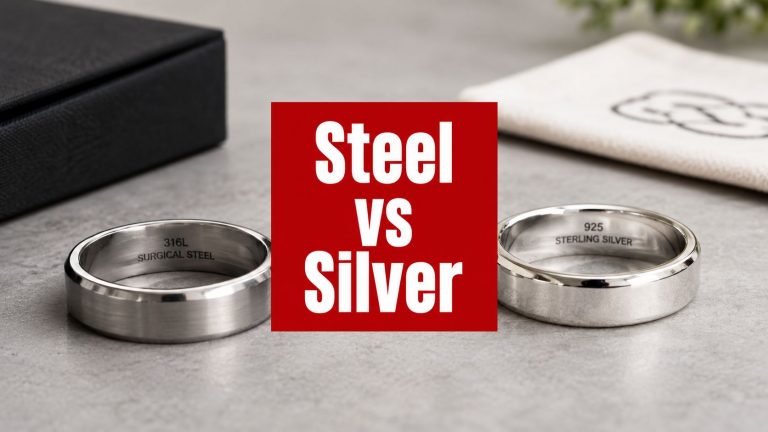
The first serious specification is the metal itself. Stainless steel is not one uniform category. For bracelets, the difference between 316L and unverified lower-grade material affects skin sensitivity, corrosion resistance, and legal compliance in regulated markets.

Why 316L needs verification
The most common mistake is accepting “surgical-grade stainless steel” as a marketing phrase instead of a verified production spec. In practice, buyers need documentation and testing, not a catalog claim. This 316L stainless steel jewelry guide is useful because it frames 316L as a technical standard to confirm, not just a label to repeat.
The regulatory benchmark is specific. EN 1811:2011 requires nickel release to remain below 0.5 µg/cm²/week for a product to be legally marketed as hypoallergenic in the EU, and manufacturers using certified 316L stainless steel achieve defect rates below 0.5% for skin-sensitivity issues, while untested 304 steel can reach 3–4% according to technical production details published by Samas.
That single gap changes the product in three ways:
| Specification point | What to demand | Why it matters |
|---|---|---|
| Base metal grade | 316L confirmation in supplier documents | Reduces substitution risk |
| Nickel release | Certified lab testing to EN 1811:2011 | Supports EU compliance |
| Material consistency | Batch-level verification, not one-time assurances | Prevents mixed production runs |
What goes into a production-ready design file
CAD isn’t just for presentation renders. It prevents interpretation errors. If your bracelet has removable links, integrated hinges, hidden magnets, stone seats, or a logo plaque, the CAD file should define dimensions, tolerances, and assembly logic clearly enough that a mold maker doesn’t need to guess.
A clean technical pack should include:
- Bracelet dimensions: Overall length, width, thickness, and any taper points.
- Construction method: Cast links, stamped plates, welded jump rings, or assembled findings.
- Clasp details: Lobster clasp, fold-over clasp, magnetic closure, toggle, or box clasp.
- Surface finish map: Mirror polish, brushed zones, satin areas, sandblasted surfaces, or selective plating.
- Branding positions: Laser logo, inner stamp, hang tag attachment point, or engraved message area.
Buyers should test nickel release themselves through a certified lab instead of relying only on supplier statements.
That’s especially important if your collection targets customers with sensitive skin. Hypoallergenic claims are easy to print on packaging. They’re harder to defend after complaints start.
Design choices that create manufacturing trouble
Some bracelet concepts look strong in a render and become unreliable in wear. Common examples include ultra-thin cuffs with high spring tension, oversized charm loads on weak chain links, and engraved plates with too little flat area for clean laser marking. Another recurring issue is mixing too many finishes on a single small bracelet, which complicates masking and consistency.
Good manufacturers flag those issues before tooling. They’ll suggest thicker weak points, cleaner engraving surfaces, safer corner radii, or a different clasp architecture. That isn’t resistance to the design. It’s what keeps the final product from feeling cheap or failing early.
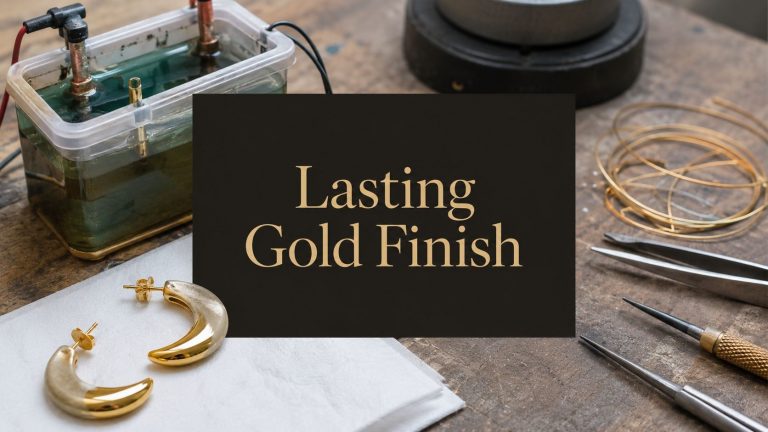
Choosing Your Finish PVD Plating vs Electroplating
Finishing is where many bracelet programs drift away from the brand promise. The sample looks excellent under studio lighting, but daily wear exposes the true difference between coating systems. If a brand plans to market color longevity, sweat resistance, or a tarnish-resistant finish, the finish spec has to support that claim.

The practical difference between the two systems
PVD and electroplating coating differences matter because the two methods solve different business problems.
Electroplating is often chosen when a brand needs a lower entry cost, a classic metallic appearance, or wider flexibility for fashion turnover. It can work well for trend collections, lower price points, and products not positioned as heavy daily-wear pieces.
PVD is the better fit when the bracelet is expected to keep its color longer under regular use. Industry data indicates that PVD vacuum plating typically offers a thickness of 0.03 to 0.1 microns, with protective TiN layers that are double or triple thicker than standard electroplating, resulting in multi-year color retention versus just months for many electroplated items according to Kesheen’s plating guidance.
How buyers should decide
Use the brand promise as the filter.
- Choose electroplating when your line is seasonal, cost-sensitive, or built around fast SKU turnover.
- Choose PVD when the bracelet is positioned for repeat daily wear, premium presentation, or lower post-sale complaints about fading.
- Ask about protective layers when a supplier claims long wear but avoids discussing TiN or layer structure.
Buyer note: Don’t approve a gold-tone sample until the supplier states the coating method in writing. “Gold color” is not a specification.
What to put in the finish brief
A useful finish brief includes more than “gold” or “black.” It should define color family, gloss level, whether the finish is full coverage or selective, and how much wear the item is expected to tolerate. For custom stainless steel bracelets, that level of detail prevents misunderstandings between design, production, and QC.
Here’s a simple comparison:
| Finish decision area | PVD plating | Electroplating |
|---|---|---|
| Color longevity | Better for long-term wear | Better for lower-cost fashion runs |
| Upfront cost | Higher | Lower |
| Scratch and corrosion resistance | Stronger overall | More limited |
| Best use case | Core collections and daily wear | Trend collections and budget tiers |
One manufacturer option in this space is HonHo Jewelry, which offers both in-house PVD and electroplating, allowing buyers to match the coating system to the target price point and wear expectation rather than forcing one process onto every design.
Where brands overpromise
The problem isn’t using electroplating. The problem is selling electroplated bracelets with language better suited to PVD production. If your product page suggests long-wear performance, your coating system, protective layers, and test protocol need to justify it. Otherwise, the finish becomes the first mismatch customers notice.
Scaling Personalization Engraving Charms and Details
Personalization sells, but it can also slow a production line if the artwork and workflow aren’t organized. That’s why custom bracelet programs need engraving and charm options designed for repeatability, not just sentiment.
The category is expanding quickly. The customized jewelry market is projected to reach $104.89 billion by 2032 at a 16.06% CAGR, and custom bracelets accounted for 15% of total global customized orders in 2023 according to customized jewelry market analysis from Research and Markets. That demand is one reason so many brands want engraved bars, initials, birthstone add-ons, and interchangeable charms in their stainless steel collections.
Personalization works best when the blank is designed for it
A bracelet plate meant for laser engraving needs a stable, readable surface. Curved, narrow, or heavily textured blanks often produce weak results, especially for fine script or small symbols. If the bracelet will carry names, dates, or coordinates, the plate should be designed around the engraving area first, then styled around it.
Useful prep rules include:
- Provide vector artwork: AI, SVG, or clean line files help maintain consistency.
- Define max character counts: This keeps text from becoming too small at production stage.
- State alignment clearly: Centered, left aligned, stacked, or edge anchored.
- Specify engraving depth and finish contrast: A polished plate with fine engraving reads differently from a matte plate with darker fill.
For teams evaluating suppliers, custom engraved jewelry manufacturing options can help translate design ideas into production methods that are realistic at wholesale scale.
Charms and findings need supply chain discipline
Charm bracelets and multi-part bracelets add another layer of complexity. Every extra component introduces fit, assembly, and inventory issues. A manufacturer with a large findings library can simplify this because clasp styles, jump rings, extenders, and chain options don’t need to be sourced from multiple vendors.
That matters for OEM jewelry production. If the main bracelet body is made in one facility and the charms, tags, and packaging come from separate vendors, timeline slippage becomes much more likely. Consolidated sourcing keeps approvals cleaner and reduces the chance that a late component delays shipment.
The easiest personalization program to scale is the one that limits variation at the component level and expands variation at the engraving file level.
What scales cleanly in bulk production
Some personalization formats are much easier to run in volume:
- Laser engraving on flat ID plates
- Standardized charm attachment points
- Preapproved icon libraries
- Interchangeable extender tags with brand logos
The least scalable versions are usually the most open-ended ones, such as unlimited layout changes, inconsistent font requests, or custom charm dimensions for every order batch. Personalization should feel special to the customer, but standardized to the factory.
The OEM Production Journey From Sample to Shipment
The biggest misunderstanding in OEM production is thinking the sample exists only to approve appearance. In reality, the sample is where a brand checks whether the bracelet feels right, closes properly, engraves cleanly, and reflects the right weight and finish before larger commitments are made.

Quoting starts with a usable brief
Factories can quote quickly, but not always accurately, from a mood board alone. A better quote comes from a technical packet with dimensions, target finish, clasp style, logo method, quantity expectations, and packaging needs. If the buyer is still deciding between polished silver, brushed gold-tone PVD, or mixed-finish black, pricing will stay provisional.
If you’re evaluating factories for this stage, guidance on how to find a jewelry manufacturer is useful because it highlights what a supplier should clarify before development starts.
Sampling is your main risk filter
Sampling usually includes CAD confirmation, mold development where required, and one or more rounds of physical prototypes. At this stage, emerging brands should slow down slightly and inspect like a retailer, not just a designer.
Check the sample for:
- Wear feel: Does it drape well, pinch, twist, or feel rigid?
- Clasp action: Is the closure smooth and secure?
- Weight balance: Does the bracelet feel substantial or hollow in the wrong way?
- Finish behavior: Are edges, holes, and inner curves coated consistently?
- Brand marks: Is the logo crisp and correctly placed?
HonHo Jewelry’s published production capabilities are relevant here because they include CAD in 1 to 2 days, sampling in 7 to 20 days, and typical production in 25 to 35 days, which gives buyers a realistic framework for planning launches without assuming every design moves at the same pace.
MOQ, revisions, and production approval
MOQ is often treated as a barrier, but it’s really a planning tool. The question isn’t only “What’s the minimum?” It’s “What production method supports this quantity without pushing unit cost too high?” Cast parts, custom molds, engraving variations, and special packaging all influence that decision.
A low-MOQ manufacturer can help newer brands test styles with less risk, but low quantity doesn’t remove the need for complete approvals. Before authorizing mass production, confirm:
- Final approved sample version
- Finish code and color reference
- Engraving file or logo file version
- Packaging specification
- Inspection standard and acceptable defect thresholds
Shipment gets easier when packaging is part of the same workflow
The handoff from production to logistics is smoother when bracelets, barcode labels, pouches, gift boxes, and outer cartons are coordinated in one schedule. If packaging approval happens late, finished bracelets often sit waiting, and that idle time can disrupt launch windows.
For wholesale jewelry buyers and private label brands, the cleanest process is one where the manufacturer can move from approved sample to bulk production, inspection, packaging, and export shipping without the project fragmenting across separate vendors. That’s usually where reliable lead times are won or lost.
Verifying Excellence Quality Control and Logistics
The final quality check shouldn’t start when cartons are ready to close. It should start when raw material arrives and continue through finishing, assembly, and packing. Brands that skip that discipline usually discover problems only after customer reviews do.

The checkpoints that actually protect your brand
For custom stainless steel bracelets, the core QC questions are straightforward. Is the metal hard enough for daily stress? Does the finish hold up under sweat exposure? Are clasps consistent? Do engraving and logos stay clean from piece to piece?
The ideal material hardness is 180–220 HV, and a critical QC step is submerging samples in artificial sweat at pH 4.7 for 72 hours. That protocol can reduce customer returns tied to tarnish or color fade by 15–20% within the first six months, according to Alibaba’s stainless steel bracelet buyer guidance.
A serious audit process should also cover factory systems, which is why a jewelry factory audit checklist is a useful tool before committing larger orders.
What good QC looks like in practice
Request evidence of these controls:
- Incoming material checks: Confirmation that the steel matches the approved specification.
- In-process finish checks: Visual and technical verification before full batch completion.
- Clasp cycle testing: Repeated opening and closing to catch weak springs or alignment issues.
- Corrosion testing: Salt spray or equivalent wear simulation on finished pieces.
- Final inspection: Piece-by-piece review for scratches, plating inconsistency, sharp edges, and logo defects.
If a factory says it inspects quality but can’t show how it records failures, the inspection process is probably too loose.
Logistics should be treated as part of quality
Packaging and shipping don’t sit outside quality control. They’re part of it. A polished bracelet that leaves the factory in poor protective packaging can arrive with avoidable scratches, tangled chains, or damaged presentation materials. For private label brands, that final impression matters almost as much as the product itself.
Strong manufacturers align packaging specs with the bracelet style. Mirror-polished cuffs may need different protection than charm bracelets or engraved plate bracelets. Export logistics also need clear carton labeling, stable packing counts, and courier coordination that matches the promised dispatch window. The fewer disconnected parties involved, the fewer last-minute surprises.
If you’re developing a stainless steel bracelet line and want a manufacturing partner that can support CAD, sampling, OEM/ODM production, finishing, QC, packaging, and global shipment in one workflow, HonHo Jewelry is one option to evaluate. The right next step is simple. Bring a reference image, target price, quantity range, and any design files you already have. A clear technical conversation at the start prevents most of the problems brands end up paying for later.