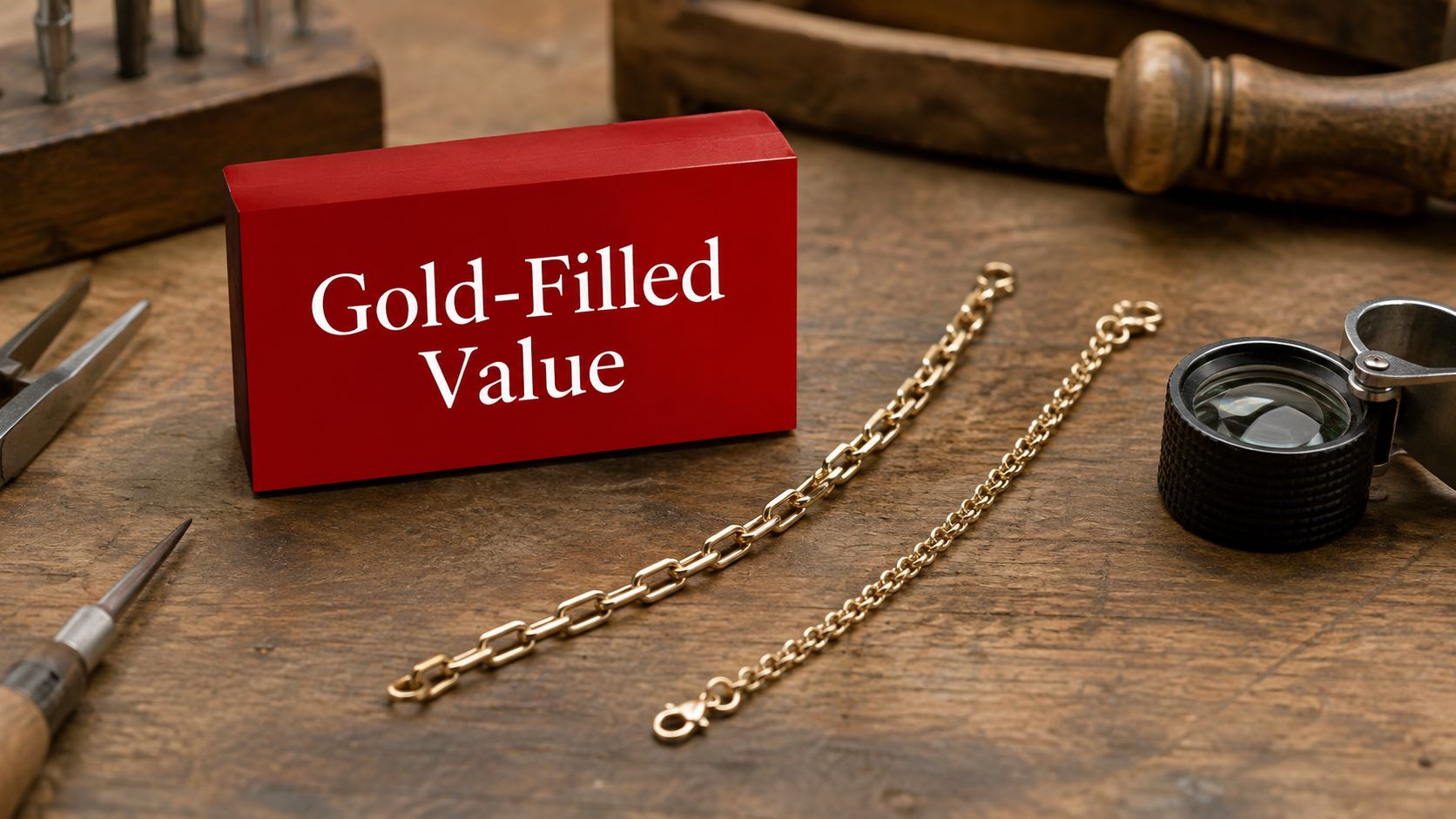
You’re staring at two chains that look nearly identical. One sits under fifty dollars, the other is priced far higher, and the label alone doesn’t make the gap feel logical. That’s where gold filled jewelry value gets misunderstood, because buyers often ask one question when they really need two, what does it cost to wear, and what can it bring back later?
The answer starts with construction, not marketing. Gold-filled jewelry is not a light coating with a fancy name, it’s a legally defined gold-alloy construction with a bonded layer of real gold, and common marks like 1/20 and 1/10 tell you how much of the item’s total weight is gold. In practical terms, 1/20 GF means about 5% gold by weight, while 1/10 GF means about 10%. That difference is why two similar-looking chains can have very different pricing, wear behavior, and recovery value.
For buyers and procurement teams, the key is to read the piece the way a manufacturer would. You want to know the karat stamp, the gold ratio, the base metal, and the expected wear path, because those details decide whether a chain is a long-life wardrobe staple or just a short-term fashion item. If you want a broader chain-level reference while comparing styles, the types of chains guide is useful for mapping construction to end use. For a useful parallel on how construction drives price in another market, the cinematic wedding budget breakdown shows the same principle, visible output doesn’t tell you what’s inside.
Why Two Similar Chains Can Cost Very Different Prices
A buyer picks up two gold-tone chains that look close enough to be cousins. One is tagged like an impulse purchase, the other is priced like a serious jewelry buy, and both can look convincing under display lighting. The gap isn’t just branding. It usually comes down to whether the piece is solid gold, gold-filled, or gold-plated.
Start with the construction, not the finish
Gold-filled jewelry is built with a real gold layer mechanically bonded to a base-metal core. U.S. rules require that the gold layer make up at least 1/20 of the item’s total weight, which is why a legitimate piece is often marked 1/20 14K GF or something similar. That marking is the first clue that you’re looking at measurable gold content, not just color.
Practical rule: if the seller can’t tell you the marking, the karat, and the construction, you’re buying appearance, not specification.
That matters because buyers often compare gold-filled against plated only by how it looks in photos. The right comparison is closer to procurement language, what is bonded, what is layered, and what is the actual gold weight. HonHo Jewelry’s gold-filled vs gold-plated comparison is a helpful reference point if you’re sourcing for retail or private label and need to separate finish claims from actual structure.
Why the middle category creates confusion
Gold-filled sits between plated fashion jewelry and solid gold, so it inherits both strengths and misunderstandings. It gives the wearer more durability and more intrinsic metal content than plating, but it still doesn’t behave like a solid gold alloy throughout. That’s why marketing language can sound similar across categories while the economics are very different.
For buyers, the comparison is straightforward:
- Solid gold carries value through the whole piece, because the entire item is an alloy.
- Gold-filled carries value in the bonded layer, which is substantial but still limited by the ratio and karat.
- Gold-plated carries very little recoverable gold at consumer scale, because the layer is thin.
The smartest purchase questions are simple. What is the marking, what is the karat, what is the base metal, and what kind of wear do I expect? Once you have those answers, the price starts making sense.
Gold Filled vs Gold Plated vs Solid Gold Compared

Solid gold, gold-filled, and gold-plated can all look warm and premium at first glance. The key difference lies under the surface, and that difference decides how the piece wears, how long it lasts, and how much value it keeps after purchase.
The structure tells you almost everything
Solid gold is an alloy throughout, so its value is built into the whole piece. Gold-filled uses a thick bonded layer of gold over a core metal, and that is why it holds up much better than plated jewelry under everyday friction. Gold-plated relies on a thin surface film, so its color is the easiest to lose once wear starts.
| Material | Gold Layer | Typical Lifespan | Price Position |
|---|---|---|---|
| Solid Gold | Solid alloy throughout | Long-lasting | Highest |
| Gold Filled | Thick bonded gold layer over a base-metal core | Durable with care | Middle |
| Gold Plated | Thin gold surface over base metal | Shorter under daily wear | Lowest |
That table is the cleanest way to explain why a gold-filled chain can cost far more than a plated one even when they appear similar on a product page. The gold-filled item contains far more real metal and is built for longer wear. The plated item is built for lower upfront cost.
What buyers notice in daily use
Sweat, water, and friction are where the difference becomes obvious. Solid gold is the most forgiving because the alloy is part of the piece itself. Gold-filled is also designed for regular wear, but it still depends on the integrity of the bonded layer, while plated jewelry can show base metal faster once the surface film thins.
The finish doesn’t tell you the whole story. The structure does.
For wholesale buyers, that means resale promise and production cost are not the same thing. A plated chain may be cheap to source, but a gold-filled chain can justify a higher ticket because the build is heavier, more durable, and closer to fine jewelry in use. In production terms, that’s the difference between a temporary surface treatment and a material choice that affects the entire product lifecycle.
Why this comparison matters for sourcing
If you’re buying for a brand, the construction decision should match the promise in the listing. Everyday wear collections usually need stronger retention and clearer specification, while trend-driven drops can live in plated categories. For a deeper buyer-side comparison, the understanding wholesale jewelry pricing guide is a good companion when you’re deciding where gold-filled belongs in your assortment.
The Real Factors That Drive Gold Filled Jewelry Value
The market value of gold-filled jewelry doesn’t come from one number. It comes from several inputs that a refiner, scrap buyer, or resale platform looks at together. If you know those inputs, you can estimate value without getting trapped by retail presentation.
The mark and the karat are the first two filters
The most important technical variable is the marked ratio, because U.S. rules require at least 1/20 (5%) of the item’s total weight to be karat gold bonded to a base-metal core, and the karat stamp tells you the purity of that gold layer. A 1/20 14K GF piece is about 2.92% pure gold by total weight, which is why it has real intrinsic value but still sits far below solid gold at retail. As noted in Specialty Metals’ refining guidance, a pound of mixed 1/20 14K gold-filled material can contain roughly 13 grams of fine gold, worth about US $1,725 at a Q4 2025 gold price near US $4,135 per troy ounce. That same source noted the contained gold value was roughly US $565 at 2020 prices, which shows how tightly gold-filled value tracks bullion prices. The source is here.
The practical point is simple. The fraction stamp tells you how much gold is present, and the karat tells you how pure that gold is. Together they determine the fine-gold content, which is what matters in scrap and refining.
Weight, base metal, maker, and condition change the outcome
A heavier piece contains more total material, so two items with the same stamp won’t recover the same value if one weighs much more than the other. The base metal also matters, because the core affects how refiners handle the lot and how durable the item feels in use. Brand and maker names matter more on the resale side than the melt side, especially for vintage or collectible pieces.
Condition is the last major filter. Tarnish can often be cleaned, but dents, worn-through spots, and exposed core metal reduce the practical value quickly. Antique-market coverage notes that well-preserved gold-filled pieces can keep useful longevity for 5 to 30 years depending on wear, and that some higher-quality antique examples with thicker layers can price similarly to solid 10k gold. That historical note comes from Monoli’s gold-filled overview.
Buyer’s shortcut: when value looks unclear, ask whether you’re looking at metal recovery, collector demand, or just everyday wear value. Those are three different markets.
For procurement teams, production clarity pays off. A documented specification sheet lets you compare pieces on the same terms instead of guessing from polish or color.
How to Identify and Test Gold Filled Pieces
A stamp is the easiest place to start, but it’s not the only check you should trust. Buyers who learn a few simple tests can avoid mis-marked stock, especially when a listing sounds better than the metal structure supports.
Read the hallmark first
The most common marks are 1/20 14K GF and 1/10 12K GF. The fraction tells you the gold share of the whole piece, and the karat tells you the purity of the bonded layer. A piece marked clearly, with no vague wording, gives you a much better starting point than an unmarked chain.
If the item says only “gold tone” or “gold color,” treat that as a styling description, not a construction claim. The jewelry hallmarks meaning guide is useful if you need a quick refresher on what common stamps usually signal in real-world buying.
Use non-destructive checks before anything more aggressive
A magnet test can help you screen out ferrous base metals, although it won’t prove gold-filled construction on its own. Visual wear at clasp edges, jump rings, and high-friction points can also reveal whether the layer is thick enough to matter. If the finish looks uniform but you see dark or coppery exposure at stress points, you’re likely dealing with wear-through rather than true gold-filled durability.
Don’t confuse “not magnetic” with “gold.” It only narrows the field.
Move to professional testing when the lot is valuable
Nitric acid testing can help distinguish gold-filled from plated cores, but it should be handled by someone who knows how to read the result and protect the item. For precise layer measurement, X-ray fluorescence analysis is the better production-grade tool because it can measure composition more cleanly than casual at-home methods. That makes it useful for sourcing teams that need to verify supplier claims before approval.
For brand buyers, the goal isn’t to become a bench jeweler. It’s to verify that the supplied construction matches the paperwork before you commit to a PO. If the stamp, weight, and test result don’t line up, stop there.
Care and Longevity That Protect Your Investment
Gold-filled jewelry can stay attractive for years, but it doesn’t stay that way by accident. The wearer’s habits decide whether the bonded layer keeps its shine or loses surface quality early.

Daily wear habits matter more than most buyers think
Sweat, perfume, chlorine, and abrasive cloths all shorten the life of the finish. Those aren’t abstract risks, they’re the everyday things that wear through the surface faster, especially at clasps and chain friction points. A piece that’s meant to be worn often still needs a little discipline.
The practical care routine is simple:
- Avoid harsh chemicals: cleaning products and perfumes can dull the finish.
- Store separately: keep chains from rubbing against harder jewelry.
- Remove during activities: swimming, exercising, and showering all increase wear.
- Clean gently: use a soft cloth with mild soap and water.
- Inspect regularly: check high-friction areas before wear-through starts.
What lasts and what doesn’t
A well-cared-for gold-filled piece usually keeps its appearance far better than plated jewelry because the bonded layer is thicker and more durable. Neglected pieces still wear down, though, and once base metal starts showing, the value changes from wearable jewelry to damaged material. Surface tarnish is different from true wear-through, since tarnish can often be polished while exposed core metal signals that the gold layer is already compromised.
For teams building product data files, a good companion resource is NanoPIM’s product data sheet for omnichannel success, because the same habit of documenting specs and care notes reduces confusion after launch.
Ownership value comes from keeping the piece usable
Wearers often ask whether gold-filled jewelry “holds value,” but the more useful question is whether it keeps its function and appearance long enough to justify the purchase. The answer is usually yes if the piece is cared for properly, and no if it’s treated like a disposable accessory. That distinction matters because retained utility is often more important to the wearer than later liquidation.
What OEM and ODM Buyers Should Request on Production Specs
A brand can’t evaluate gold-filled jewelry value from a catalog photo alone. OEM and ODM buyers need a spec sheet that spells out the actual build, because vague terms like premium finish or luxury plating don’t protect anyone once quality questions start.
Ask for the exact construction, not just the finish name
For gold-filled items, request the gold layer ratio, the karat of the bonded layer, and the base-metal composition. If the piece is plated or PVD-finished instead, ask for the thickness in microns and the protective layers used to slow color loss. HonHo Jewelry, for example, publishes production capabilities that include in-house PVD and electroplating, along with documented quality assurance and custom jewelry quality assurance processes that buyers can use as a reference point when comparing suppliers.
That kind of documentation matters because different constructions serve different business goals. Gold-filled is about durable metal content, while engineered plating is about controlled color retention at lower cost. The buyer needs the exact spec, not a marketing adjective.
Build the checklist into your supplier brief
A good procurement sheet should ask for:
- Layer thickness: micron thickness for plated or PVD items.
- Bonded gold ratio: for gold-filled items, the stamped fraction.
- Karat standard: the purity of the gold layer.
- Core alloy: brass, copper, sterling silver, or stainless steel depending on the line.
- Protective top coating: if used, define it clearly.
- QC method: wear testing, corrosion testing, and inspection standard.
- Traceability: lot records, stamping format, and defect reporting.
Custom jewelry production becomes easier once the request is specific. Suppliers can quote against the same criteria instead of guessing what “premium” means. That helps with OEM/ODM comparison, and it helps retail teams avoid returns caused by unclear expectations.
Use standards that can be checked
Look for suppliers who can document tests and audits rather than just saying the line is high quality. REACH, ISO 9001:2015, and SMETA are useful signals when you’re reviewing factory discipline, and in-house testing for wear resistance or corrosion gives you more confidence than general promises. For multi-style wholesale jewelry orders, that clarity usually saves time during sampling and launch.
Realistic Expectations for Buyers, Sellers, and Brands
The buyer’s question and the seller’s question are not the same. A wearer wants to know whether the piece feels worth the price over time, while a seller wants to know what the market will pay later.
What the wearer gets at purchase
Retail pricing for gold-filled jewelry usually reflects design, size, and gold content, not just melt value. One jewelry industry source places many gold-filled pieces at about 20% to 40% of the price of a comparable solid-gold item, with a 14K gold-filled necklace around $50 to $150 versus a similar solid 14K necklace around $300 to $800 or more. The same source notes that simple gold-filled chains often fall around $30 to $100, while more elaborate gemstone-set pieces can reach $200 to $500. That reference is Tresor Jewelry’s value overview.
Those ranges help buyers avoid a common mistake. If a piece is still far cheaper than solid gold, that doesn’t mean it’s cheap jewelry in a negative sense, it means the construction is giving you wearability without full precious-metal pricing.
What the seller can recover later
Resale is a different market. Unless a piece is branded, vintage, or visually collectible, buyers on the secondary market often price it close to costume jewelry because they’re not paying retail sentiment. Scrap buyers and refiners will care more about the stamped ratio, total weight, and gold content than the original sales story. As noted earlier, gold-filled can carry measurable intrinsic value, but liquidation value depends on who is buying and why.
How brands should talk about it
Brands and independent designers should describe gold-filled as a durable gold-content construction, not as a stand-in for solid gold. That wording protects trust. It also helps customers understand that they’re paying for wearability, real gold content, and a more stable finish, while resale expectations should stay modest unless the design has collector appeal.
HonHo Jewelry works with gold-filled, stainless steel, brass, and 925 sterling silver across OEM and ODM jewelry production, so buyers can specify construction instead of relying on marketing language. If you’re building a line that needs clear specs, consistent quality control, and realistic pricing, visit HonHo Jewelry to review production options and discuss a private-label or wholesale program that matches your construction targets.
Surgical Steel vs Sterling Silver: Buyer Guide
You’re pricing a new collection, and the sample tray is already split down the middle.
How to Gold Plated Jewelry the Right Way for Lasting Color
You probably have a launch already in motion, a supplier sample on your desk, and
What Is a Shank on a Ring: Guide to Design & Durability
You’re refining a ring design, the stone looks right, the setting is approved, and the