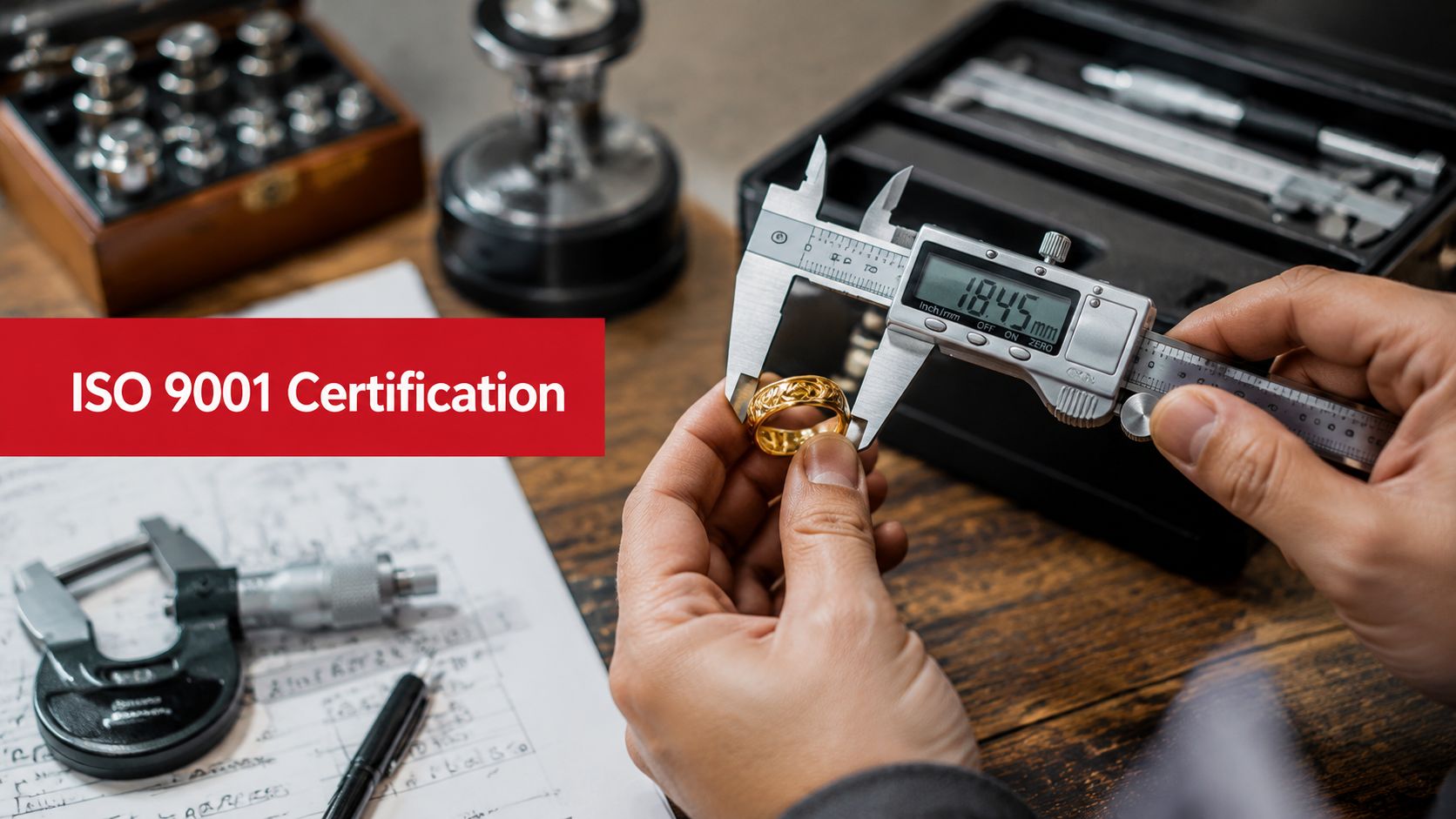
You’re comparing two factories and one sales rep keeps waving an ISO 9001 certificate like it settles everything. It doesn’t. The core question is simpler and more useful: does this supplier run a disciplined quality management system, or are they just good at paperwork?
For jewelry sourcing, that distinction matters. A certificate can tell you a factory has process controls, audits, and corrective actions in place, but it won’t tell you whether the plating will hold, whether the finish is consistent, or whether the supplier can handle custom jewelry production without chaos. If you’ve ever had a sample look clean and the production lot come back uneven, you already know why buyers need to read the certificate alongside the process, the test data, and the factory’s actual controls, not as a stand-alone badge. If you want a deeper sourcing lens on related material decisions, HonHo Jewelry’s guide on what stainless steel jewelry buyers really care about is a useful companion read.
Why Buyers Ask About ISO 9001 Before Placing an Order
A sourcing manager usually asks about ISO 9001 when the stakes are already real. One factory looks cheaper, another looks more organized, and both claim they can handle wholesale jewelry, OEM/ODM work, and private label production. The certificate becomes the first filter because buyers want to know whether the supplier has a repeatable system or just a polished pitch.
That instinct is right. ISO reported 1,474,118 valid ISO 9001 certificates worldwide in the ISO Survey 2024, with China holding 651,851 and Italy 101,426, which tells you how embedded the standard is in manufacturing and export supply chains. The 2024 count was also well above the 2023 figure of 837,978, and ISO’s survey history shows the certificate base rising from 916,842 in 2020 to 1,077,884 in 2021, 1,265,216 in 2022, and 1,474,118 in 2024. For sourcing teams, that scale matters because it makes ISO 9001 a familiar reference point when comparing suppliers across borders.
What buyers are really trying to avoid
A certificate can reduce uncertainty, but it doesn’t remove it. A plated ring can still fade, an earring can still trigger a complaint, and a batch of bracelets can still show finish variation if the factory’s product controls are weak. Buyers ask about ISO 9001 because they want to see whether the supplier has a documented way to catch problems before they become returns, chargebacks, or lost reorder trust.
Practical rule: treat ISO 9001 as a starting gate, not a finish line.
That’s why the rest of your supplier review needs to include the sampling file, the inspection records, and the production controls that sit behind the certificate. HonHo Jewelry’s jewelry manufacturing process is a good example of how buyers should think about the full chain, from CAD through plating and final inspection.
What ISO 9001 Actually Covers
A certificate on the wall does not tell you whether a jewelry factory ships clean product. ISO 9001 is a quality management system standard, and its scope is the process behind the product. ISO’s own explanation covers context, leadership, planning, support, operations, performance evaluation, and continual improvement. In plain language, it asks whether the factory runs quality in a controlled way, not whether every necklace or ring leaves the line flawless. That difference matters to buyers who care about repeatability, not decoration.
See also ISO 27001 certification requirements if you want a clean contrast between management-system standards in general.
Think like a kitchen, not a food critic
A good kitchen documents recipes, trains staff, checks temperatures, records substitutions, and corrects mistakes when a dish goes wrong. ISO 9001 does the same thing for a factory. It checks whether the kitchen has a disciplined system for getting consistent results, because consistency comes from control, not luck.
For jewelry production, that means the factory should be able to show you how CAD files move into sampling, how plating instructions are controlled, how final inspection happens, and how nonconforming pieces are handled. A supplier with a real QMS should produce written procedures quickly when you ask for them. If they stall, hand-wave, or say everything is “internal,” the certificate is probably doing more marketing than operational work.
What matters to buyers in practice
The practical value is process handoff. In custom jewelry and OEM/ODM production, defects often happen at the transitions, design to sample, sample to plating, plating to packing, packing to shipment. ISO 9001 is built to reduce that friction by forcing documented responsibility and traceability. That is why buyers should read a certificate alongside product-level controls like PVD thickness checks and salt-spray testing, not instead of them.
If you buy from multiple jewelry manufacturers, a supplier with a clear QMS is easier to qualify, easier to audit, and easier to scale with. If you want a broader manufacturing reference, HonHo Jewelry’s jewelry manufacturing process shows how factory discipline should connect CAD, plating, assembly, and final inspection.
How a Jewelry Factory Becomes ISO 9001 Certified
A certificate does not appear because a factory filled out a form and paid a fee. A real supplier has to run its QMS in daily operations, prove the system is being used, and then pass an audit that checks the system against the standard. Buyers who only look at the certificate date miss the point.
The sequence a serious supplier follows
Before the initial certification audit, the factory should be able to show that its QMS has been operational for at least three months, that it has completed a full cycle of internal audits, and that management has finished a documented review. That is the minimum proof that the system exists inside real production, not just in a binder. The NQA ISO 9001 guide explains that timing clearly.
The auditor then moves from document review to site verification. In a jewelry factory, that means checking sampling records, production instructions, inspection logs, and corrective actions, then matching them against what is happening on the floor. If the factory cannot show the same process across CAD, plating, assembly, and packing, the audit will expose the gaps quickly. Buyers should also ask how the factory keeps records tidy before audit day, because teams that automate workflows with DigiParser usually spend less time chasing missing files and more time proving control.
A supplier with mature operations does not stop production to perform for the auditor. The audit should run alongside active sampling and production, because that is where process control either holds or falls apart.
A certificate is easiest to fake on paper and hardest to fake in daily production.
Why the three-year cycle matters
Certification does not stop when the certificate is issued. It follows a three-year cycle, with surveillance audits in years one and two and a recertification audit in year three. That ongoing rhythm matters because it keeps the system active instead of letting the factory pass once and relax.
For sourcing teams, that cycle is a useful signal. A supplier that can keep certification intact over time is more likely to manage documentation, corrective action, and production discipline without constant buyer intervention. HonHo Jewelry’s jewelry factory capability belongs in that discussion because buyers should verify how the quality system supports actual production, not just how the certificate looks on the wall.
Documents and Records an Auditor Looks For
A real ISO 9001 file should feel boring in a good way. It should be complete, ordered, and easy to trace. If a factory sells you jewelry but cannot show the records behind the process, you are not looking at a controlled system. You are looking at a certificate with weak day-to-day discipline underneath it.
The paper trail behind process control
ISO 9001 requires documented information for product and service requirements review, design and development inputs and outputs, calibration records, internal audits, nonconforming outputs, management review, and corrective actions. That list is not bureaucracy for its own sake. It is the evidence that a factory can spot problems, track them, and stop them from repeating. The requirement summary from Citation Group is useful because it translates the standard into records buyers can request.
For jewelry, that paper trail has to match production reality. A calibration record for a plating thickness gauge tells you the factory is not guessing about finish control. A nonconforming output log shows how rejected pieces are separated and reviewed. A corrective action record proves the factory did not just replace a bad batch and move on. Buyers should compare those records with product-level controls such as custom jewelry quality assurance, because that is where ISO 9001 either supports the line or stays on paper.
What to request during supplier qualification
Ask for these items early, ideally during RFQ or sampling:
- Process flow charts: These show how a ring, bracelet, or necklace moves from design to shipment.
- Calibration records: Look for plating bath equipment, thickness measurement tools, and inspection devices.
- Work instructions: These should cover assembly, plating, polishing, inspection, and packing.
- Training records: If the operator is not trained, the process is not controlled.
- Incoming inspection logs: These tell you how the factory handles metal parts, chains, clasps, and findings before production.
- Corrective action registers: These show whether the supplier closes the loop after defects.
If the supplier answers quickly and sends real files, that is a maturity signal. If they deflect, delay, or send a certificate with nothing behind it, keep looking. A factory that keeps finance records clean with effective AP audit strategies usually understands why traceability matters, and the same discipline should show up in quality records.
What ISO 9001 Does Not Guarantee
A certificate can look reassuring on a supplier deck and still leave you exposed on the line. ISO 9001 audits the management system rather than individual products, so it does not guarantee defect-free items. The standard’s own explanation at ISO 9001 explained makes that distinction explicit.
Where the certificate stops
That limit matters in jewelry sourcing. A supplier can be ISO 9001 certified and still ship a batch with uneven polish if product controls are weak. It can still deliver plating that fades if thickness control is not enforced. It can still trigger skin-reaction complaints if the base material and coating stack are not managed properly.
Buyers should read the certificate as evidence of process discipline, then look for the controls that show the process is holding the line. In-house PVD with adjustable thickness, salt spray testing, and documented inspection are the kinds of product-level controls that tell you whether the factory is managing output at the SKU level. ISO 9001 supports that structure, but it does not replace it.
A certificate also says nothing about whether the factory applies the same discipline to every order. Some suppliers keep a clean QMS file and still let product-specific checks drift once production starts. Others can pass an audit and still cut corners on finish control, plating verification, or final inspection when schedules get tight.
The right way to read a certificate
Use the certificate to answer one question, does this factory run a controlled system? Then use the product file to answer the more important question, does this system protect my jewelry line?
Buyer rule: if the certificate is the only proof a supplier offers, you still do not know enough.
For custom jewelry, wholesale jewelry, and private-label programs, the strongest factories pair ISO 9001 with product-specific controls. That combination gives buyers confidence in finish consistency, repeatability, and the documentation needed when a complaint comes back later. If you want a tighter supplier screen, use this jewelry manufacturer vetting guide alongside the certificate review.
Buyer Checklist for Verifying a Supplier’s Certification
A certificate only helps if you verify it properly. Too many buyers glance at the logo, skip the scope, and assume the factory is covered for the exact product they want. That’s how teams get burned on misaligned certifications.
Here’s the checklist I use with buyers during supplier qualification.

Check the certificate like a sourcing manager
- Confirm the certifying body’s accreditation. A real certificate should be issued by a recognized body, not a self-made PDF.
- Verify the scope. The scope has to cover the site and the type of jewelry or manufacturing work you’re buying.
- Check the validity dates. Don’t assume a certificate is current because the sales team says so.
- Request the latest surveillance audit summary. You want to know whether the factory stayed stable after the initial audit.
- Confirm the site name and address. Multi-site suppliers sometimes show one location while producing at another.
Ask direct questions on the call
Ask who owns the QMS internally. Ask how often internal audits run. Ask how nonconformances are tracked and closed. Ask which processes are covered by the certificate and which ones are outside scope. The answers should come back fast, specific, and consistent with the documents.
If you want a practical model for how to review a supplier file, HonHo Jewelry’s jewelry manufacturer vetting guide is the right companion asset. The point isn’t to collect paper for its own sake, it’s to make sure the certification matches the exact jewelry line you’re sourcing.
Real Costs, Timelines, and Ongoing Maintenance
ISO 9001 is not free to the supplier, and it’s not a one-time event. BDC estimates certification can cost roughly US$5,000 to US$35,000 and take about six to twelve months depending on business complexity, while DQS notes that maintenance happens through surveillance audits and a full recertification on a three-year cycle. The BDC ISO 9001 glossary is a useful reference because it makes the maintenance burden plain.
What that cost should buy you
You’re not paying that bill directly as the buyer, but you should see the result in the supplier’s behavior. The factory should communicate clearly, keep sampling moving, and handle corrective actions without drama. That’s the true payoff of a maintained QMS.
In jewelry manufacturing, that discipline should show up in the production rhythm. Sampling should be organized, lead times should be stable, and the factory should be able to explain plating retention, inspection, and rework decisions without scrambling. If a supplier is ISO 9001 certified but still feels chaotic, the certificate is not doing enough work.
Read the investment against the output
A supplier that invests in certification is signaling that quality control is part of the business model. That doesn’t guarantee perfect wholesale jewelry, but it does usually mean better control over documentation, repeatability, and escalation when problems happen. For buyers of custom jewelry, that difference can save time in sampling and reduce surprises in production.
The right sourcing move is simple. Treat the certification cost and maintenance burden as a reason to expect operational discipline, then verify that discipline in the documents, the audits, and the product testing.
Frequent Buyer Questions on ISO 9001 Certification
How do I read the scope statement?
Read it like a contract, not a slogan. The scope should tell you which site, which processes, and which business activities are covered. If your product line sits outside the scope, the certificate does not protect that order flow, and you should treat it as irrelevant to your sourcing decision.
What if the certificate is close to expiry?
Ask whether the supplier is in recertification, and request the latest audit status. An expiring certificate can be a manageable administrative issue, but a supplier that cannot explain the renewal path is not ready for serious sourcing. If you also need a model for checking supplier records and approvals, effective AP audit strategies show the same kind of document discipline buyers should expect here.
Do multi-site factories need one certificate or several?
They need the right site covered by the right scope. Do not assume one location’s certificate covers every workshop, plating line, or warehouse. If the production site is different from the certificate site, stop and verify which facility runs your order.
How is ISO 9001 different from sector-specific standards?
ISO 9001 is broad and process-driven. Sector-specific standards can go deeper into product or industry requirements, but ISO 9001 is still the baseline I want to see before I trust a factory with custom jewelry or wholesale production. A supplier that cannot keep that baseline under control is not ready for tighter product requirements, whether you are checking CAD handoff, plating controls, or inspection records.
What should I check alongside the certificate?
Read the certificate alongside the supplier’s actual process controls. For jewelry, that means asking for the scope statement, the inspection routine, plating controls, and the product-level tests that match the order, such as PVD thickness checks or salt-spray testing where they are relevant. A certificate shows the factory has a management system. It does not prove the system is being used well on the line.
Should I trust a certificate if the samples still look inconsistent?
No. Inconsistent samples tell you the process control is weak, even if the certificate is current. Press the supplier on corrective actions, rework handling, and who signs off before release. If those answers stay vague, the certification is not translating into factory discipline.
What is the smartest buyer move?
Use ISO 9001 as a filter, not a finish line. Verify the scope, confirm the site, ask for the current audit status, and compare the certificate with product evidence. For a jewelry buyer, the test is whether the factory can keep quality stable from sample to shipment, not whether the paper looks impressive.
If you’re qualifying a jewelry factory and want a supplier that already works with CAD, sampling, plating, inspection, and export coordination under one roof, talk to HonHo Jewelry. We support OEM/ODM production, custom jewelry development, and documented quality control for buyers who need reliable lead times and a clear production file, not just a certificate on a wall.
Surgical Steel vs Sterling Silver: Buyer Guide
You’re pricing a new collection, and the sample tray is already split down the middle.
How to Gold Plated Jewelry the Right Way for Lasting Color
You probably have a launch already in motion, a supplier sample on your desk, and
What Is a Shank on a Ring: Guide to Design & Durability
You’re refining a ring design, the stone looks right, the setting is approved, and the