HonHo Jewelry is a custom jewelry manufacturer based in Dongguan, China, with 15+ years of experience producing fashion and costume jewelry for brands across North America, Europe, and Australia. Our team works with brass, 925 sterling silver, and 316L stainless steel daily — which means we know exactly what makes a piece last and what makes it fail. Learn more about us →
The Best Costume Jewelry in 2026: Brands, Materials, and Everything You Need to Know
If you’ve ever purchased a share of the best costume jewelry only to see it turn your skin green three days later, you are not alone. It’s one of fashion’s most ubiquitous frustrations — and most buying guides do not actually explain why it happens or how to evade it.
This guide is different. We are a jewelry manufacturer with over 15 years of experience in producing fashion/costume jewelry for brands based in the USA, Europe and Australia. We’ve walked inside the factories, put the plating to the test and heard directly from buyers what works — and what doesn’t. Everything in this article is informed by real manufacturing know-how and fact-checked research — not just a list of brands that paid us to give them ink.
By the time you’re finished reading this, you’ll know exactly how to spot top-quality costume jewelry; which brands deserve your money in 2026; and how to make your pieces last as long as possible.
Valued at approximately $39–47 billion in 2024–2025, the global costume jewelry market is growing at a compound annual rate of 5–8%, fueled by fast fashion, social media trends and a mounting willingness to pay less for something that would look as good, if not better than expensive accessories. Understanding how to navigate this market has never been more valuable.
1. What Is Costume Jewelry? Definition, History & Why It Still Matters
The Simple Definition
Costume jewelry — sometimes known as fashion jewelry or imitation jewelry — describes accessories crafted from non-precious base metals, such as brass, copper, zinc alloy or stainless steel, and usually plated with a thin layer of gold, silver or other metals. The stones are synthetic or semi-precious, rather than diamond or ruby.
But here is something you won’t find in most articles: the term costume does not mean cheap or tacky. It hails from the world of theater, where it originally referred to jewelry used as part of a costume or outfit — jewelry worn for its aesthetic effect, rather than its value in terms of material.
A Brief History: The Age of the Stage Prop Meets Coco Chanel
For most of civilization’s history, wearing non-precious jewelry was a marker of the lower classes. You were pretending to be something you weren’t if you wore a fake gem.” That changed almost overnight — and one woman was primarily to blame.
In the 1920s, Coco Chanel did a radical thing: She began wearing oversized pearl necklaces and gilded chains with her couture creations, and I made it glamorous. “Fashion jewelry,” she said, and insisted that it was the look, not the materials’ worth, that mattered. Chanel is often credited with banishing costume jewelry from the realm of stage prop to a fashion thing in its own right.
About the same time, Miriam Haskell opened her jewelry store in New York (1926) and with the designer Frank Hess produced artisanal costume pieces that became must-haves for Hollywood stars like Joan Crawford, Lucille Ball and the Duchess of Windsor. Haskell’s work is now classified as fine art and sells at major auction houses — witness that “costume jewelry” can have real cultural and monetary value.
The golden age of costume jewelry was from the 1930s through the ’60s, when designers like Hattie Carnegie, Trifari, Monet and Schiaparelli created designs that royalty and celebrities alike wore. Today, these signed vintage pieces are quite collectible.
Costume vs. Fashion vs. Fine vs. Demi-Fine: What’s the Difference?
| Type | Base Metal | Plating / Coating | Price Range | Expected Lifespan |
|---|---|---|---|---|
| Costume Jewelry | Brass, zinc alloy, stainless steel | Gold/silver plate (0.03–1 micron) | $5–$100 | 6 months – 3 years |
| Demi-Fine Jewelry | Sterling silver, gold vermeil | Thick gold plating (2.5+ microns) | $50–$400 | 2–10 years |
| Fine Jewelry | 14k–18k solid gold, platinum | No plating needed | $200–$10,000+ | Lifetime (heirloom) |
| Gold-Filled | Brass or copper core | Gold bonded by heat/pressure (100× thicker than plating) | $40–$200 | 10–30 years |
Most of what people call “costume jewelry” today falls in that first category. But the quality within that category varies enormously — which brings us to the single most important thing to understand before you buy anything.
2. The Materials Guide: What Actually Makes Costume Jewelry Last
This is the section most buying guides skip entirely, and it’s the most important one. Once you understand materials, you stop being fooled by pretty photos and marketing language.
The Base Metal: The Foundation of Everything
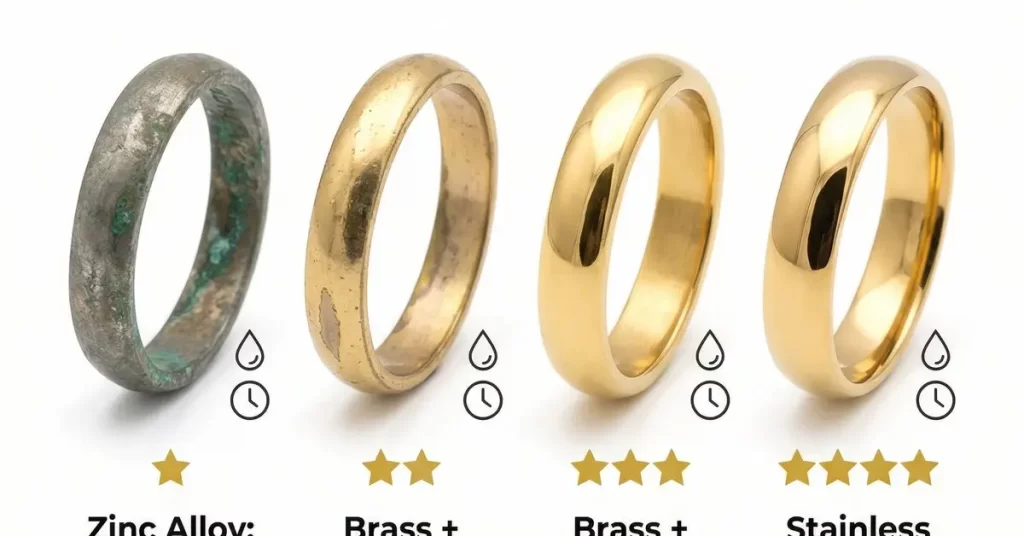
The base metal is the core of every piece. It determines how long the plating lasts, whether you’ll get a skin reaction, and how the piece holds up over time. Here’s how the most common materials stack up:
| Base Metal | Durability | Skin Safety | Tarnish Risk | Best For |
|---|---|---|---|---|
| 316L Stainless Steel | Excellent ⭐⭐⭐⭐⭐ | Excellent (low nickel release) | Very Low | Everyday wear, sensitive skin |
| Brass | Good ⭐⭐⭐ | Moderate (contains copper) | Medium | Fashion pieces with PVD plating |
| Zinc Alloy | Fair ⭐⭐ | Fair (may contain lead/nickel) | High | Decorative/occasional wear |
| Copper | Good ⭐⭐⭐ | Poor (causes green skin) | Medium–High | Rustic/artisan styles |
| 925 Sterling Silver | Very Good ⭐⭐⭐⭐ | Good (nickel-free options) | Medium (tarnishes with sulfur exposure) | Classic, timeless pieces |
💡 Manufacturer Tip: At HonHo Jewelry, we primarily work with 316L stainless steel, brass, and 925 sterling silver. Of these, 316L stainless steel with PVD coating consistently gives buyers the best combination of durability, skin safety, and visual quality.
The Plating: This Is the Source of Most Issues
Here is the dirty little secret of the costume jewelry industry: Two pieces can be visually identical and have 10x price differences, and the only thing different between them is how thickly they were plated. The vast majority of consumers don’t even know this number exists.
Plating Thickness: The Meaning behind Micron Numbers
Thickness is measured in microns (μm) for plating. One micron = 0.001 millimeter. Here’s how those varying thicknesses translate to actual wear:
| Plating Thickness | Quality Level | Expected Durability | Typical Use |
|---|---|---|---|
| Under 0.03 μm | Flash plating | Weeks to a few months | Ultra-cheap fast fashion |
| 0.03–0.05 μm | Standard commercial | 6–12 months (normal wear) | Most mass-market costume jewelry |
| 0.5–1 μm | Good quality | 1–2 years | Mid-range fashion brands |
| 2.5 μm+ | Gold vermeil standard | 2–5 years | Demi-fine brands (Mejuri, Missoma) |
| PVD coating | Premium | 2–5+ years | Quality stainless steel jewelry |
⚠️ Important: Even when a supplier specifies “1 micron,” production variance can be ±20%, meaning a piece could realistically have only 0.8 microns. This is why buying from manufacturers with verified quality control (ISO certification, XRF testing reports) matters — especially for wholesale buyers.
PVD Coating: The Technology That Changed Costume Jewelry
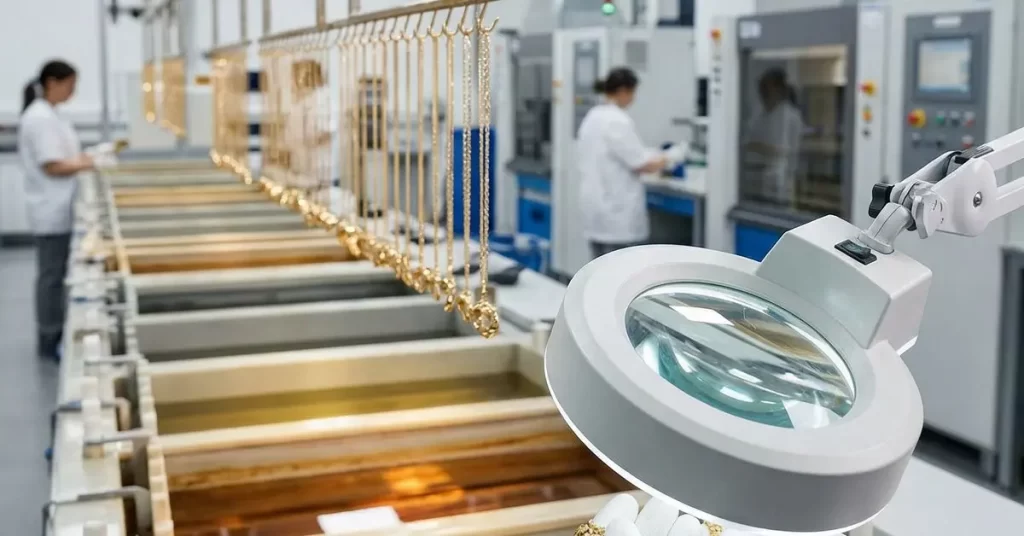
PVD — or Physical Vapor Deposition — has been used in a vacuum-chamber process originally designed for aerospace and medical applications. Whereas electroplated gold is deposited upon a surface from an aqueous bath, PVD utilizes vaporized metal particles with positive ions in a vacuum that bond at the molecular level.
What does this have to do with jewelry?
- The adhesion is much stronger: PVD coating does not peel or flake like electroplating. Instead, it wears out gradually and evenly.
- Improved resistance to corrosion: If applied to 316L stainless steel, PVD-coated jewelry will resist sweat, chlorine and daily wear that would ruin regular plating.
- No more harsh chemical baths: A more eco-friendly way to manufacture.
You’ll see PVD mentioned by brands like Hey Harper, BIBI & KIM, and — on the manufacturing side — at facilities like HonHo Jewelry, where we apply a 0.5-micron titanium nitride underlayer before the final gold PVD coat to maximize adhesion. This is significantly above the industry standard underlayer of 0.1–0.3 microns.
Why Does Costume Jewelry Turn Your Skin Green? (The Real Science)
This question is frequently asked on Reddit forums and TikTok comments, and most explanations go no further than “it’s copper.” Here’s the full picture.
When copper (found in brass, bronze and some silver alloys) interacts with moisture, sweat and organic compounds that are present in your skin, it undergoes oxidation — forming copper chlorides, sulfates and carbonates. It’s these compounds that are a greenish blue and temporarily stain your skin. It’s entirely non-toxic (yes, really) and wipes off with soap and water.
What makes it even worse or better:
- The pH of your skin: More acidic skin (lower pH) speeds up the reaction. This is why the same ring gives some people green stains and bothers nobody else.
- Climate and humidity: Hot humid climates accelerate oxidation. The salt in coastal air compounds the problem.
- Lotions, perfumes and soaps: These alter your skin’s surface chemistry, making tarnishing and staining speed up dramatically.
- The plating thickness: Once the plating wears through, the copper base is directly against your skin. Thicker, more robust plating slows this down.
The permanent solution? Choose costume jewelry with a stainless steel or sterling silver base. See our guide to nickel-free and skin-safe jewelry for detailed recommendations.
3. Best Costume Jewelry Brands by Category (2026)
Below is our curated overview of standout costume jewelry brands. Note that we aren’t affiliated with or paid by any of these consumer brands — this is based on research, industry knowledge, and publicly available information about their materials and quality standards.
Best Overall Costume Jewelry Brands
Ana Luisa
Material: Gold-plated recycled brass | Price range: $35–$200 | Best for: Everyday stands
Ana Luisa has consistently received high marks for tarnish resistance, and they’be up front about their recycled brass construction; these are people who try to limit their environmental impact. Several editors report that the pieces remain tarnish-free even when worn daily in the shower — an indicator of plating quality that’s above average. Eco-friendly brand known for clean yet simple aesthetics.
PAVOI
Base metal: Gold-plated brass, gold vermeil | Price range: $13–$50 | Best for: Budget-minded trend-seekers
Perhaps the best value proposition in the costume jewelry space. PAVOI has an incredible assortment of trendy styles at refreshingly low prices. Not investment-level durability, but perfect for trying out trends or building a travel jewelry stash in which you aren’t worried about loss or damage.
BaubleBar
Base material: 14K gold a& brass, rhodium a& brass | Price range: $25–$300 | Best for: Statement pieces, special occasions
BaubleBar is the destination for statement jewelry — oversized earrings, crystal-encrusted necklaces, chunky cuffs. Feedback about its quality is mixed (some pieces fade quickly, others wear well), indicating variation across their products. Best for moments when impact is worth the longevity, such as wedding guest looks or parties.
Best for Sensitive Skin
Hey Harper
Base material: PVD-coated stainless steel | Price range: $40–$150 | Best for: Sensitive skin, active lifestyles
Hey Harper is one of the most material-intensive costume jewelry brands on offer. The pieces are made from PVD-coated stainless steel, which is extremely tarnish-resistant and very safe for nickel sensitive skin. A great option if you are looking for “put it on and forget it” jewelry that you can wear through workouts and showers.
Maison Miru
Base material: Medical-grade titanium, implant-grade steel | Price range: $50–$200 | Best for: The most sensitive skin
Maison Miru, founded by a Stanford engineer, makes truly hypoallergenic jewelry with materials more typical of medical devices than fashion. If you’ve responded to all the other brands, this is where to check. Their earrings, in particular, have received rave reviews from migraineurs and those with chronic metal contact dermatitis.
Best Tarnish-Resistant Costume Jewelry
Gorjana
Base material: 18K gold-plated brass, gold-filled | Price range: $35–$200 | Best for: Everyday layering
Gorjana occupies a sweet spot between costume and demi-fine. Their gold-filled range (not just plated) provides significantly better longevity than most costume jewelry brands. Popular for building layered necklace and bracelet stacks that can be worn together daily without looking overdone.
Astrid & Miyu
Base material: 18K gold-plated recycled sterling silver, rhodium-plated silver | Price range: $40–$200 | Best for: Gift-giving, everyday classics
British brand Astrid & Miyu uses recycled sterling silver as a base, which is a significant step up from brass in terms of tarnish resistance and skin safety. Pieces are described by users as lasting years of near-daily wear. Strong reputation for packaging and gifting presentation.
Best Vintage & Collectible Costume Jewelry Brands
These are brands whose signed vintage items hold actual collectible and monetary value. For best pickings, shop estate sales, auction houses, Etsy vintage or 1stDibs rather than retail stores.
- Miriam Haskell— Renowned work using Russian gold findings and seed pearls. 1950s–1970s works might fetch at auction for $150–$2,000+.
- Hattie Carnegie — A Hollywood star favorite, 1940s–1960s. Check for signature on the clasp or the back.
- Trifari & Coro — Refined and seriously collectible entry pieces. Cheaper than Haskell but still registered and traceable. Excellent for beginning a collection.
- Chanel, Dior, Givenchy (vintage runway pieces) — High end; runway items can go for more than $5,000. Only recommend by reputable dealers with authentication.
4. How to Choose the Right Metal Color for Your Skin Tone
This is something no other costume jewelry buying guide seems to cover — and it’s one of the most practical things to know when shopping.
Your skin’s undertone (the subtle color beneath the surface) strongly influences which metal shades will look most harmonious against your skin.
| Skin Undertone | How to Identify | Best Metal Colors | Avoid |
|---|---|---|---|
| Warm (yellow/golden/peachy) | Veins look greenish; gold jewelry is always flattering | Yellow gold, rose gold, bronze, copper | Silver (can look harsh against warm skin) |
| Cool (pink/blue/red) | Veins look bluish-purple; silver jewelry is always flattering | Silver, white gold, platinum, rhodium | Yellow gold (can make skin look sallow) |
| Neutral (mix of warm and cool) | Can’t easily tell; both silver and gold work | Any metal — you’re the lucky ones | Nothing! |
| Deep/Rich tones | Strong contrast with metals creates striking looks | High-contrast gold (22K–24K yellow), bold statement pieces | Subtle/delicate pieces can get lost |
💡 Quick test: Look at the inside of your wrist in natural daylight. If your veins appear blue or purple, you have cool undertones. If they look green, you have warm undertones. If you can’t tell, you’re neutral.
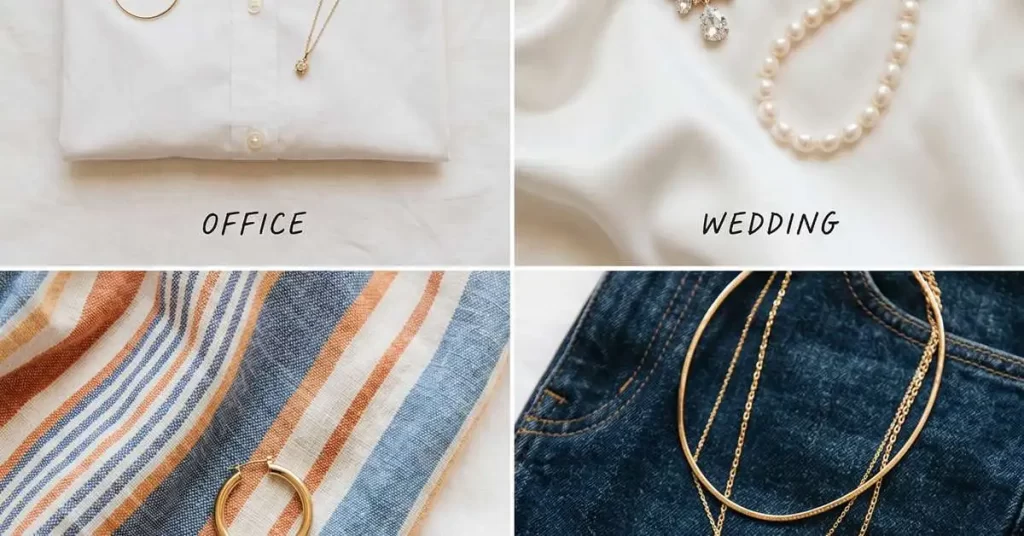
5. Best Costume Jewelry by Occasion
The majority of guides categorize jewelry by brand. But what you really need to know is: What will work for my particular set of circumstances?
Office / Professional Settings
You want jewelry that communicates “polished” not “look at me.” Small hoops, thin stacking rings, a simple pendant necklace or dainty studs. Metal color should be consistent throughout your outfit — too many metals can look amateur and messy in professional contexts.
Best materials: Gold-filled or gold vermeil jewelry (longer-lasting for everyday wear) or PVD-coated stainless steel.
For Weddings & Special Events
This is the time for statement pieces, and you’re only wearing them once (or a few times), so longevity matters less. Crystal-embedded earrings, pearl necklaces and stacked cuff bracelets all beworked. The budget doesn’t have to be high — a $50 set from BaubleBar or Nadri can photograph beautifully, just like $500 demi-fine pieces.
For Vacation & Beach Wear
Water is the enemy of most plated jewelry. For beach vacations, you have two options: (1) bring jewelry you don’t mind sacrificing to salt and sand, or (2) invest in genuine 316L stainless steel or titanium pieces that can handle saltwater. We actually wrote a comprehensive guide on whether stainless steel jewelry is waterproof — the short answer is: 316L is excellent for this purpose, but 304 stainless is not.
For Everyday Casual Wear
This is where material quality comes into play big-time, because you’re wearing pieces day on top of day. Seek out: good base metal (stainless steel or solid brass), enough plating thickness (1+ micron, PVD) and shapes/finishes that don’t snag on clothes. Building a “capsule jewelry wardrobe” around 5–8 versatile pieces of gold, silver, or rose gold will take you much farther than a drawer full of inexpensive pieces that you never wear together.
6. How to Care for Costume Jewelry: The Complete Guide
The right care alone can increase the life of your jewelry by 2–3 times. Here’s what really works — according to both manufacturing know-how and the accumulated wisdom of the people on Reddit and TikTok, along with pro jewelers.
The Golden Rule: Last On, First Off
This single habit will do more to ensure your costume jewelry lasts longer than anything else:
- Last on: Add your jewelry AFTER you’ve dressed and put on perfume, lotions, hairspray, and makeup.
- First off: Take your jewelry OFF BEFORE showering, washing hands, swimming, exercising or doing housework.
The chemicals found in beauty products speed up the breakdown of plating more than nearly anything else. Even a spritz of perfume sprayed directly onto a gold-plated piece can gradually dull the finish.
Cleaning by Material Type
| Material | How to Clean | What to Avoid |
|---|---|---|
| Gold-plated brass | Soft microfiber cloth, barely damp. Pat dry immediately. | Ultrasonic cleaners, polishing cloths (will remove plating), running water |
| Sterling silver | Silver polishing cloth, or warm water + mild dish soap + soft toothbrush. Rinse and dry thoroughly. | Toothpaste (too abrasive), chlorine, wool storage (accelerates tarnish) |
| Stainless steel | Warm water and mild soap, rinse well. Very resilient. | Bleach or harsh chemical cleaners (damages PVD coating) |
| Rhinestones / foil-backed crystals | Dry soft brush only. NEVER submerge in water. | Water (causes foil to cloud), ultrasonic cleaners, steam cleaners |
| Enamel pieces | Damp cloth, gentle pressure. Dry immediately. | Harsh chemicals, ultrasonic cleaners (can crack enamel) |
Reviving Tarnished Pieces: Does the Clear Nail Polish Trick Work?
It’s among the most viral topics in the costume jewelry realm — videos on TikTok showing people covering their jewelry with clear nail polish to avoid tarnishing have received hundreds of thousands of views. Here’s the honest breakdown:
- Clear polish on the inside of rings/bracelets: Fairly effective barrier between copper-containing metal and your skin. It lasts a few weeks until you need it again.
- Using it on the entire outer surface of a piece: Can dull the finish, and will yellow over time. Not recommended for visible surfaces.
- Better option: ProtectaClear (on Amazon) — a jewelry-specific clear coat that’s more durable than nail polish and less likely to yellow. Users say it lasts 2–3 months of daily wear.
- For heavy-duty protection: Renaissance Wax — the museum conservation choice for metal objects. When applied very thin, it’s virtually undetectable and can protect against tarnish as well as green skin stains.
Storage Best Practices
How you store your jewelry when you’re not wearing it is nearly as important as how you care for it while on:
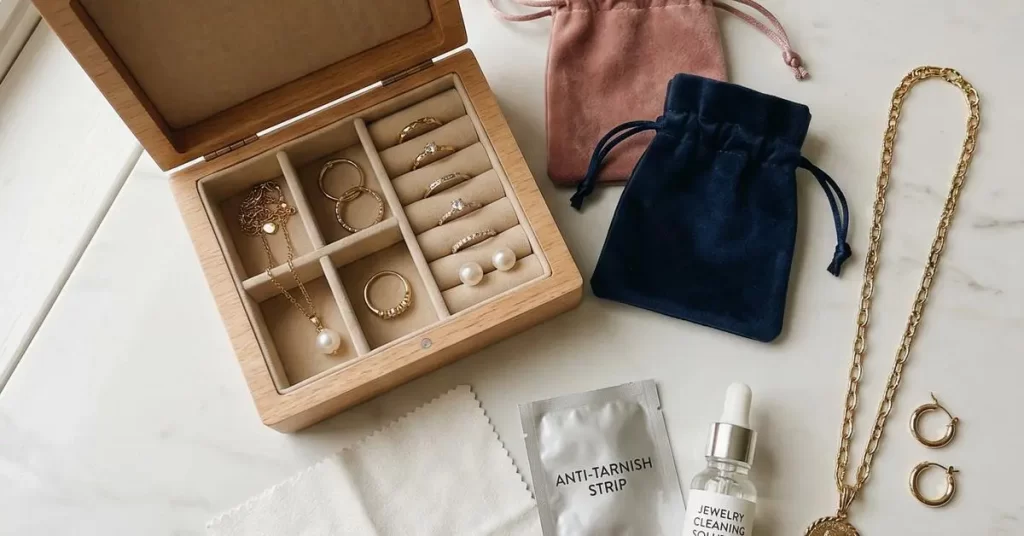
- Keep pieces packaged individually in soft cloth pouches (velvet or cotton) or in a jewelry box with divided compartments. Plating wear is only accelerated by scratches caused by metal-on-metal contact.
- Stay out of bathrooms — humidity is the biggest accelerant of tarnish. Store it in a bedroom or closet instead.
- For silver pieces in particular: Anti-tarnish strips put inside the storage box absorb sulfur compounds in the atmosphere, greatly retarding tarnishing. Read more in our article if silver tarnishes and how to remedy it.
- Say no to plastic bags containing PVC: PVC emits plasticizers that react with metal and speed tarnishing. Instead, use polyethylene bags or cotton pouches.
- To avoid kinking and tangling — which can cause mechanical damage to plated surfaces — lay necklaces flat or hang them individually.
7. Where to Buy Costume Jewelry: Every Channel Explained
Most guides merely link to Amazon or brand websites. Here’s a full picture of where to actually buy costume jewelry — at every price point and quality level.
Direct-to-Consumer Brands (Great for Reliable Quality)
Ana Luisa, Hey Harper and Gorjana, for example, sell directly on their own sites. You tend to get the best price-to-quality ratio here, with vetted materials and simple return policies. They are also generally more transparent about materials than department stores.
Amazon & Etsy (Best for Value Variety)
Amazon has a lot, but the quality is all over the place. Stick to brands that have 1,000 or more reviews, look for specific information about the type of material used in the listing, and be wary of terms like “18K gold plated” (which means it will eventually tarnish) without a further explanation. Etsy is a great place to shop for handmade and small-batch or vintage pieces, especially from independent designers, who tend to share a lot about what they use.
Department Stores & Multi-Brand Retailers
Mid-to-high-end costume and demi-fine jewelry can be found on Nordstrom, Revolve, Shopbop and Moda Operandi. You’ll likely pay a premium for the retail markup, but you get simpler returns and an opportunity to experience pieces you love in person.
90– Vintage & Secondhand Channels (Perfect for Collectibles)
- eBay: Huge range of vintage costume jewelry. Look for pieces that are signed, using the brand name (e.g., “Miriam Haskell signed brooch”). Always carefully scrutinize photographs and inquire about condition.
- Etsy Vintage: Generally curated better than eBay, and seller descriptions are more likely to include details. Best for purchasing from dealers focused on certain eras or brands.
- 1stDibs: Luxury marketplace for collectible vintage items. Here, authentication standards are stronger — but prices higher.
- Depop & Poshmark: “Great for more recent-vintage pieces (1980s–2000s) at accessible prices. Of less expert curation, therefore buyer knowledge is more important.
- Estate sales & flea markets: Best way to score underpriced for treasure if you know what to look for. Provide a loupe for inspecting signatures and stone settings.
For Brands & Wholesale Buyers
If you’re a boutique owner, jewelry brand, or retailer looking to source costume jewelry in bulk — quality control and supply chain reliability are everything. At HonHo Jewelry, we specialize in OEM and ODM production for international brands, starting from 50–100 pieces per style. We work with 316L stainless steel, brass, and 925 silver, and our quality assurance includes 15 inspection checkpoints and ISO 9001 certification. You can request a quote or sample here.
8. Vintage & Collectible Costume Jewelry: A Starter Guide
Most people don’t realize that some costume jewelry — the kind you might find in a grandparent’s jewelry box — can be worth serious money. Understanding what to look for turns a hobby into a smart investment.
How to Identify Quality Vintage Costume Jewelry
- Look for signatures: Turn the piece over. Quality vintage costume jewelry is almost always signed by the designer or manufacturer on the clasp or back. Common signatures to know: Trifari, Coro, Miriam Haskell, Hattie Carnegie, Lisner, Monet, Napier, and Weiss.
- Check the setting style: High-quality vintage pieces used prong (claw) settings for stones, similar to fine jewelry. Glued-in stones are a sign of lower quality.
- Examine the metal finish: Rhodium-plated pieces (silvery and very reflective) are generally more valuable than chrome-plated ones. Rhodium is a platinum-group metal and was used by quality manufacturers.
- Look for condition: Missing stones, broken clasps, and replaced parts all reduce value significantly. Buy pieces that are complete and functional.
- Research the era: 1940s–1960s pieces are generally the most collectible. The post-war period produced exceptional quality as manufacturers competed for the luxury market.
Which Vintage Pieces Have Investment Potential?
According to experts like Barbara Berger (quoted in Harper’s Bazaar), these categories have shown consistent appreciation:
- Signed Miriam Haskell pieces (especially 1960s–1970s with intact Russian gold-filled findings and seed pearls)
- Runway pieces from Chanel, Dior, Givenchy, and Saint Laurent (particularly 1980s–1990s)
- Limited-edition and exhibition pieces from any major designer house
- Pieces with unusual materials or exceptional craftsmanship that stand out from the period’s standard output
9. Inside the Factory: What Separates Good Costume Jewelry from Bad
As a manufacturer, we see things that consumers never see. Here’s what actually separates quality costume jewelry from the disposable kind — and how to spot the difference without opening the piece up.
The Plating Thickness Test: How to Ask the Right Questions
When buying in bulk or from a wholesale supplier, always ask for XRF (X-ray fluorescence) test reports on plating thickness. Any reputable manufacturer should be able to provide these. The key number you’re looking for:
- For everyday wear pieces: minimum 0.5 microns
- For pieces claiming gold vermeil: minimum 2.5 microns over sterling silver (this is required by US law for vermeil designation)
- For PVD-coated stainless steel: look for a documented TiN underlayer
The Five Quality Signals You Can See Without Any Equipment
- Weight: Quality pieces generally feel substantial. Very light pieces often have thin metal bases that tarnish quickly.
- Stone setting: Prong-set stones (held by small metal claws) are more durable than glued settings. Try very gently pushing on a stone — if it moves, it’s glued and will eventually fall out.
- Clasp quality: The clasp is usually where a piece fails first. Lobster clasps should have a strong, positive snap. Spring rings should close firmly. Flimsy clasps on an otherwise nice-looking piece are a red flag.
- Surface finish uniformity: Run your finger along the surface. A quality piece will feel smooth and consistent. Rough patches, uneven coloring, or visible machine marks suggest corners were cut in production.
- Edge finish: Turn the piece over and look at the edges. Quality pieces are finished on all sides. Rough or unfinished backs are a sign of mass production shortcuts.
What Certifications Actually Matter
When a supplier or brand mentions certifications, here’s how to evaluate them:
| Certification | What It Means | Relevance |
|---|---|---|
| ISO 9001 | Quality management system standard | High — indicates documented quality control processes |
| REACH Compliance | EU regulation limiting hazardous chemicals (incl. nickel) | High for EU/US markets — means nickel release is tested and limited |
| BSCI | Business Social Compliance Initiative — labor & ethics audit | Medium — good for ethical sourcing, not directly about product quality |
| SGS / BV / Intertek | Third-party testing lab certification | High — independent verification carries weight |
| California Prop 65 | Warning label for products with lead, cadmium, etc. | High for US market — compliance means safer materials |
Looking for Wholesale Costume Jewelry for Your Brand?
At HonHo Jewelry, we’ve spent 15+ years helping brands across North America and Europe source high-quality private label and OEM costume jewelry with verified quality standards. We offer low MOQs, fast sampling, and ISO 9001-certified manufacturing in Dongguan, China.Request a Free Quote or Sample →
10. Frequently Asked Questions About Costume Jewelry
What is the difference between costume jewelry and fine jewelry?
Costume jewelry uses non-precious base metals like brass, zinc alloy, or stainless steel, often coated with gold or silver plating. Fine jewelry uses precious metals like 14k or 18k solid gold and platinum. Demi-fine jewelry sits in between, typically featuring sterling silver or gold-filled bases. Costume jewelry is designed to be fashionable and affordable, not as a long-term investment. For a deeper comparison, see our gold plated jewelry guide and our explanation of gold filled vs gold plated.
Why does costume jewelry turn my skin green?
Green skin is caused by copper in the base metal reacting with sweat, moisture, and chemicals to form copper chlorides and sulfates. This is a chemical reaction called oxidation — not a toxicity issue. The green stain washes off easily with soap and water. It’s more likely if your skin is naturally acidic, if you sweat heavily, or if you use lotions or perfume while wearing the jewelry. To prevent it permanently, choose pieces with a stainless steel base or 925 sterling silver base.
How long does costume jewelry last?
It depends on the plating quality and base metal. Standard gold-plated brass with 0.03-micron plating typically lasts 6–12 months with normal wear. Higher-quality pieces with 1+ micron plating or PVD coating on stainless steel can last 2–5 years or more. With excellent care (keeping pieces dry, storing them separately, avoiding chemicals), you can extend the life of even mid-range pieces significantly.
Can I shower with costume jewelry?
316L stainless steel and titanium pieces handle brief showers well. Gold-plated brass or zinc alloy pieces should always be removed before showering, swimming, or exercising. For more detail, read our full guide: Is Stainless Steel Jewelry Waterproof?
Is costume jewelry safe to wear?
Modern costume jewelry sold in the US and EU must comply with REACH regulations limiting nickel release to 0.5 μg/cm²/week, and California’s Prop 65 limits lead and cadmium. Quality pieces from reputable manufacturers are safe for regular wear. For sensitive skin, choose pieces explicitly labeled nickel-free or made from 316L stainless steel. Read our detailed guide on nickel-free jewelry for sensitive skin.
What is PVD coating and why does it matter?
PVD (Physical Vapor Deposition) is a vacuum-based coating technology that bonds metal particles to a base material at the molecular level. It’s far more durable than traditional electroplating — PVD-coated pieces resist tarnish, scratching, and daily wear significantly better than standard gold-plated jewelry. It’s the same technology used in aerospace components. Look for “PVD coating” as a quality indicator when shopping.
Can costume jewelry be collectible or valuable?
Absolutely. Signed vintage pieces from designers like Miriam Haskell, Hattie Carnegie, Trifari, and Schiaparelli regularly sell for hundreds to thousands of dollars. According to Harper’s Bazaar, 1940s–1960s pieces in excellent condition from quality designers consistently appreciate in value. Look for designer signatures on the back or clasp.
What metals are safest for sensitive skin?
In order from safest to least safe for nickel-allergic skin: solid titanium, 316L surgical stainless steel, solid platinum, solid 18k–24k gold, rhodium-plated 925 sterling silver. Avoid zinc alloys, cheap brass without a protective coating, and any unlabeled base metal. See our complete guide to nickel-free and hypoallergenic jewelry.
What’s the difference between gold-plated, gold vermeil, and gold-filled?
Quick breakdown: Gold-plated = very thin layer (0.03–0.5 microns) of gold over any base metal. Cheapest, least durable. Gold vermeil = at least 2.5 microns of gold over sterling silver. More durable; legally regulated in the US. Gold-filled = gold layer bonded by heat/pressure, roughly 100× thicker than regular plating. Lasts decades. Solid gold = no plating, most durable and most expensive. Our gold filled jewelry guide and gold vermeil guide cover these in full detail.
How do I stop costume jewelry from tarnishing?
Five key rules: (1) Follow “last on, first off” — jewelry goes on after lotions and perfume, and comes off before showering or washing hands. (2) Wipe each piece with a dry microfiber cloth after wearing. (3) Store pieces separately in soft pouches or a divided jewelry box. (4) Keep jewelry away from bathrooms and humid environments. (5) For plated rings and bracelets that contact skin, a thin coat of ProtectaClear or clear jewelry lacquer on the inner surface creates an effective barrier that lasts weeks to months. The tarnish guide from HonHo goes deeper on this.
The Bottom Line on the Best Costume Jewelry
After all this research and manufacturing experience, here’s what we know for certain:
- Material matters more than brand name. A $20 piece with a 316L stainless steel base and PVD coating will outlast a $80 piece with a thin-plated zinc alloy base.
- Ask about plating thickness. Any manufacturer or brand that can’t (or won’t) tell you their plating thickness in microns is probably not confident in their own quality.
- Green skin is not a destiny. It’s a chemistry problem with clear solutions: better base metal, thicker plating, or a simple physical barrier between metal and skin.
- Vintage costume jewelry can be a real investment if you know what to look for. The market for signed mid-century pieces is strong and growing.
- Care habits extend lifespan dramatically. Following “last on, first off” and proper storage can double or triple the life of even average-quality pieces.
Whether you’re a consumer looking for the perfect everyday accessory, a brand looking to source your next collection, or a collector hunting for hidden gems — we hope this guide has given you a genuinely useful foundation.
If you’re a brand or retailer interested in sourcing high-quality wholesale fashion jewelry, exploring our private label program, or learning about our OEM manufacturing services, we’d love to hear from you. Send us a message — we respond within 24 hours.
Related Reading from HonHo Jewelry
- What Is Gold Plated Jewelry and Why Is It So Popular?
- What Is 316L Stainless Steel Jewelry? A Complete Guide
- Nickel Free Jewelry: The Complete Guide for Sensitive Skin
- Does Silver Tarnish? The Complete Truth & Fix Guide
- Gold Filled Jewelry: Benefits, Durability, and Care
- Gold Vermeil Jewelry: What It Is and How It’s Made
- Is Stainless Steel Jewelry Waterproof? The Complete Truth
- How to Buy Jewelry Wholesale: Step-by-Step Guide 2026
- Jewelry Manufacturing: Trends and Best Practices
Sources & Further Reading
Silver Clay: The Complete Beginner’s Guide to Making Real Silver Jewelry at Home
All you need to turn your bare hands into real silver from scratch are a
Is Stainless Steel Good for Jewelry? The Full Guide (2026)
Is stainless steel good for jewelry? Walk into any jewelry store today — or scroll
How to Make Rings: Step-by-Step Guide for All Methods (2026)
Arguably, one of the most fulfilling things you can do as a jewelry lover, hobbyist