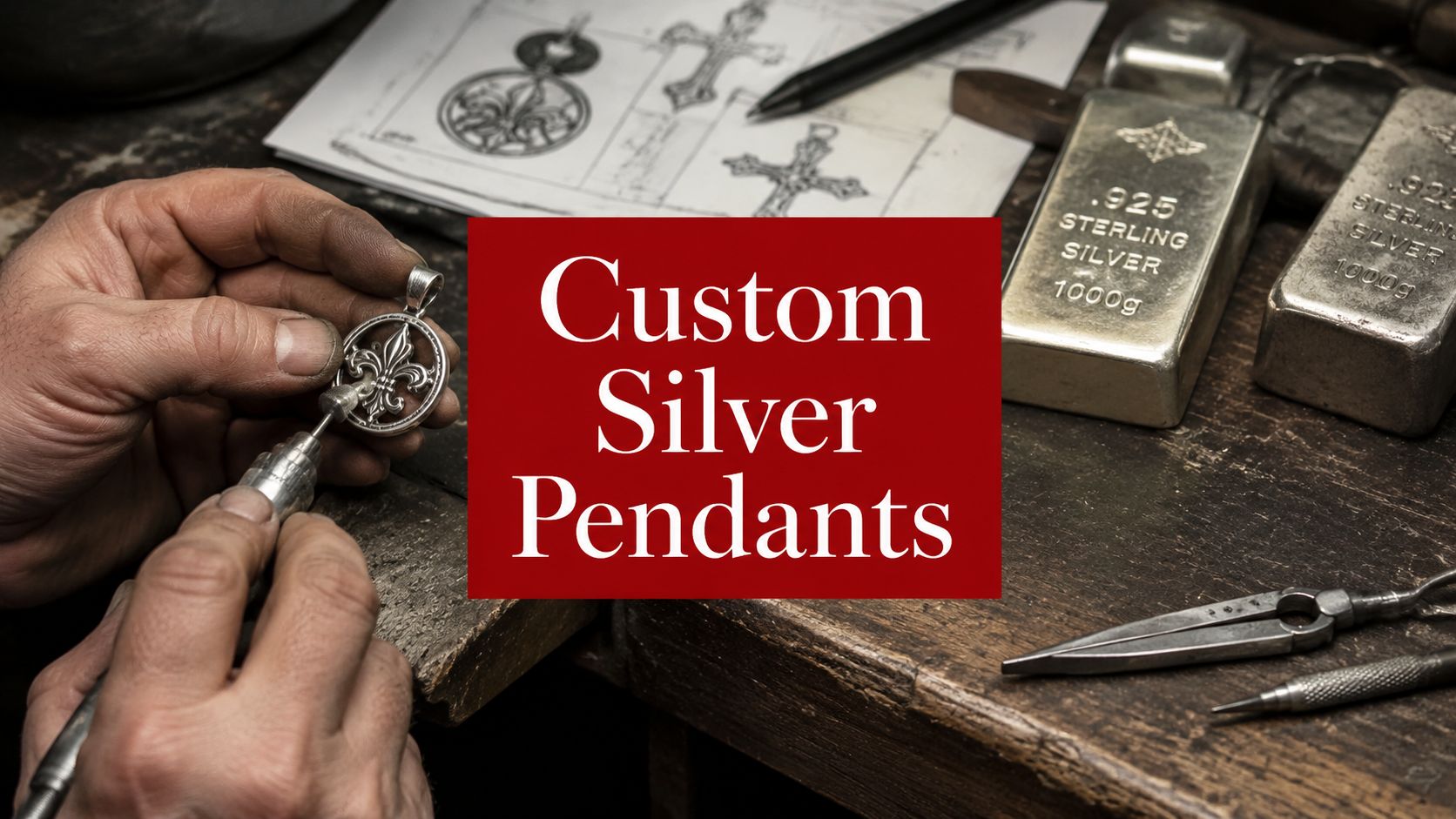
You have a pendant concept in your notes app, a rough sketch from your designer, or a reference image pulled from a competitor audit. You know the piece could anchor a collection, but manufacturing is where most first runs get messy. Metal choice affects durability. CAD details affect stone setting and chain balance. Finishing affects returns. Sampling affects launch timing.
That tension is real, and the business case is real too. The Customized Jewelry Market was valued at USD 42.25 billion in 2026 and is projected to reach USD 104.89 billion by 2032, expanding at a 16% CAGR, according to Research and Markets’ customized jewelry market data. Demand for made-to-order and brand-specific jewelry isn’t a niche trend anymore.
For new brands, the challenge isn’t whether customers want custom sterling silver pendants. It’s whether the design can move cleanly from concept to repeatable production without quality drift, avoidable revisions, or a sample that looks right in a render but fails in wear testing.
Bringing Your Custom Pendant Vision to Life
A pendant usually starts with a simple goal. You want a recognizable hero piece that customers can gift, layer, or personalize. That sounds straightforward until you start asking production questions: how heavy should it be, will the bail sit correctly on the chain, can the engraving stay legible after polishing, and is the silhouette castable at your target price.
The strongest launches start by locking the essential requirements first. Decide what the pendant must do before you decide how it should look. For example, a memorial pendant needs clean engraving space. A zodiac pendant needs shape clarity at small scale. A logo pendant needs sharp line separation and a production-ready file. If your mark is still low resolution, it helps to get crisp print-ready logos before a factory builds CAD around soft edges and inconsistent line weights.
Start with the commercial use case
Brands that source well don’t brief a factory with only inspiration images. They brief with use case, target customer, material preference, finish direction, chain style, and retail positioning.
A practical first brief includes:
- Core design intent. Is this a signature pendant, a gifting SKU, or a personalized item with name or date engraving?
- Expected wear pattern. Daily wear, occasional wear, layered styling, or event jewelry.
- Visual priority. High polish, brushed texture, stone accent, cutout logo, or layered plating effect.
- Sales format. Pendant only, pendant with chain, or a modular necklace program.
If you’re still shaping the concept stage, this custom necklace planning guide is a useful reference for narrowing specs before sampling starts.
A good factory brief reduces revisions more than a good mood board does.
What experienced buyers do differently
They don’t ask for “a nice sample.” They ask for a sample that proves the design can be manufactured consistently. That means checking proportions, backside finishing, connection points, plating compatibility, engraving depth, and how the pendant hangs when worn.
That’s the shift that saves time. You aren’t buying one beautiful prototype. You’re building a repeatable product.
Choosing Your Foundation Sterling Silver vs Plated Options
Material selection decides more than cost. It sets the ceiling for perceived value, product lifespan, finishing options, and the kind of complaints your customer service team will see later.

What 925 sterling silver actually solves
925 sterling silver isn’t just a marketing label. It’s an alloy of 92.5% pure silver and 7.5% copper, and that copper addition raises hardness from about 25 HV in pure silver to over 100 HV, which helps prevent warping and makes intricate pendant structures more practical, as explained in this sterling silver metallurgy reference.
That matters in production. A pendant with open filigree, fine cutouts, pavé-style stone setting, or a narrow bail needs enough structural strength to survive casting, finishing, transport, and daily wear. Pure silver is too soft for many of those applications. Sterling silver gives you a workable balance of strength, detail, and finish quality.
Where plated options fit
Plated jewelry has a place. If you’re building a trend-driven line, testing a new silhouette at lower risk, or targeting an entry price point, plated brass or other base metals can make sense. The mistake is treating plated product as interchangeable with solid sterling silver. It isn’t.
Here’s the practical comparison:
| Factor | Sterling silver | Plated options |
|---|---|---|
| Base material | Precious metal alloy | Base metal with surface coating |
| Durability | Better for long-term wear | More dependent on plating wear |
| Repair potential | Easier to refinish and replate | Often less forgiving once base metal shows |
| Customer perception | Higher intrinsic value | Better for fashion turnover |
| Design use | Strong for detailed custom work | Better for simpler, cost-sensitive programs |
For brands comparing metal categories more broadly, this sterling silver vs stainless steel jewelry guide helps frame where silver sits in a wider assortment strategy.
The trade-off buyers often miss
Sterling silver usually costs more up front, but it gives you more room to build a lasting product story. You can stamp it correctly, finish it to a finer standard, and support higher-value personalization.
Plated base metal lowers entry cost, but the product has less margin for wear, refinishing, and long-term customer satisfaction. If your brand promise is gifting, keepsake value, or collectible personalization, custom sterling silver pendants are usually the safer foundation.
Practical rule: If the pendant is meant to become a signature style, build it on the strongest material story you can defend after six months of wear, not just on launch day.
From Digital Dream to Physical Sample The Prototyping Workflow
The fastest way to lose time is to skip definition and rush straight to metal. Pendants look simple from the outside. In production, small details decide whether the sample hangs straight, engraves cleanly, and survives polishing without losing shape.

OEM and ODM are not the same brief
With OEM, you bring the design direction and the manufacturer executes it. That works well when you already have a finished sketch, a technical drawing, or a clear branded pendant concept.
With ODM, the manufacturer helps shape the design based on your references, functional needs, and target market. This works better when you know the style direction but haven’t resolved the proportions, structure, or production details.
Both can produce strong results. The important part is deciding who owns the design development work before sampling starts.
What the CAD stage should resolve
CAD isn’t only for making a render look polished. It’s where production problems should surface early. A solid CAD review checks whether the pendant thickness is realistic, whether internal corners are too sharp for casting, whether the bail opening matches the intended chain, and whether engraving fields are large enough to stay readable after finishing.
A typical pre-sample workflow looks like this:
- Concept intake
The factory receives sketches, dimensions, logo files, references, chain preferences, and finish notes. - CAD build
The design is translated into a manufacturable 3D model. Responsive partners often complete CAD quickly. HonHo Jewelry, for example, lists CAD turnaround in 1 to 2 days as part of its OEM/ODM workflow. - Render review
The render confirms proportion, visual balance, front and back details, and component pairing before tooling or printing starts. - Prototype output
A wax or resin model helps confirm physical form, depth, and detail retention.
A deeper look at what to check in this stage is covered in this jewelry CAD design guide.
This short walkthrough gives a useful visual of how custom jewelry moves from digital design into manufacturable form:
Why the physical sample is non-negotiable
A render can hide weight issues, edge sharpness, weak joints, or a bail that twists once the chain is attached. The physical sample exposes those problems.
Check these points during sample review:
- Hang and balance. The pendant should face forward naturally and sit flat enough on the body.
- Edge comfort. Sharp corners may need softening, especially on logo-driven shapes.
- Backside quality. Customers notice rough backs, uneven polishing, and visible porosity.
- Personalization clarity. Laser engraving, initials, dates, and logos should remain clean after finishing.
Sample approval should answer one question clearly: can this exact construction be repeated at scale without surprises?
The Art of Production Finishing Plating and Personalization
Finishing is where many pendants either become premium or start accumulating returns. Two samples can share the same CAD and casting, yet look completely different once polishing, plating, engraving, and assembly are done. That’s why finishing can’t be treated as an afterthought.

Surface finish changes the whole product feel
A mirror polish gives a pendant a clean, bright look and usually works well for initials, hearts, symbolic charms, and sleek logo shapes. Brushed and satin finishes reduce glare and can make broad flat surfaces feel more architectural. Hammered or micro-textured finishes add visual movement, but they also compete with engraving if you don’t reserve a smooth area for personalization.
On first runs, simple usually wins. Intricate surface texture looks attractive in concept decks, but it can complicate consistency across a batch. If your pendant relies on a message, monogram, or graphic detail, protect that area from over-texturing.
Rhodium plating for silver pendants
Sterling silver customers often worry about tarnish, and they should. The finish choice directly affects how the piece looks in real-world wear.
According to the plating data provided by Silvex Craft’s sterling silver treatment reference, white rhodium plating at 0.03 to 0.1 microns forms a non-reactive barrier that can keep a pendant color-stable for over 2 years under normal wear, while unplated sterling silver can discolor in 3 to 6 months.
That doesn’t mean every pendant must be rhodium plated. Some brands want the natural silver look and accept patina as part of the product story. But if you’re selling giftable or low-maintenance custom sterling silver pendants, rhodium usually reduces customer complaints.
If your buyer expects a bright white finish with low upkeep, specify rhodium in the quote instead of assuming the supplier includes it.
Gold plating and process choices
Gold-plated sterling silver can perform well, but the process matters. In professional manufacturing, plating on a sterling silver base is generally more durable than plating over softer base metals, and plating thickness can range from 0.03 microns up to 5 microns according to this plating process overview.
You also need to ask how the finish is applied. This PVD vs electroplating jewelry coating comparison is useful when you’re weighing color retention, finish look, and production suitability.
Use this checklist when approving a plated pendant:
- Color target. Bright silver, soft silver, yellow gold, rose gold, black rhodium, or vintage tone.
- Thickness expectation. Ask for documented plating thickness when durability matters.
- Barrier layers. Protective layers help preserve finish and delay base exposure.
- Use case. Daily wear and layered necklaces need stricter finishing standards than event pieces.
Personalization that holds up after finishing
Laser engraving is the most practical option for logos, names, dates, coordinates, and small symbols because it stays consistent across a batch. Hand-carved detailing can add character, but it’s slower and harder to standardize across production.
The best personalization programs are designed with finishing in mind. If the engraving area is too close to a curved edge, polishing can soften it. If the font is too fine, plating can visually close letter counters. If the bail, chain, or clasp feel cheaper than the pendant itself, the whole product loses credibility.
This is why experienced OEM/ODM teams review the full pendant system, not just the charm.
Sourcing Logistics Your Guide to Pricing QA and Compliance
Good sourcing decisions show up later as margin protection, fewer replacements, and smoother reorders. Poor ones usually look cheaper only at the quote stage.
The commercial opportunity is clear. The global sterling silver jewelry market is projected to reach USD 27.23 billion by 2035, and the necklaces segment held the largest product share at 34.2% in 2025, driven by customizable pendants, according to NextMSC’s sterling silver jewelry market report.

What actually drives pendant pricing
Per-piece cost usually moves with four main variables:
| Cost driver | What changes the quote |
|---|---|
| Metal usage | Pendant size, thickness, chain inclusion, and solid vs lighter construction |
| Complexity | Openwork, stone setting, moving parts, layered assembly, or detailed backs |
| Finishing | Rhodium, gold plating, selective plating, special textures, engraving |
| Order structure | Sample count, production quantity, packaging requirements, inspection scope |
If you’re building your own retail pricing model after factory costing, this breakdown of Next Point Digital’s product pricing methods is a practical outside reference for structuring your numbers.
For buyer-side budgeting, this custom jewelry cost guide helps translate technical specs into expected quote differences.
MOQ isn’t the problem buyers think it is
Minimum order quantity is a production efficiency tool, not a punishment. A factory has to allocate CAD time, molds, setup, plating prep, inspection labor, and packaging coordination even for a small run.
Flexible MOQ matters if you’re validating a design. For 925 silver programs, some manufacturers can start from a relatively low threshold. HonHo Jewelry states that it accepts MOQs starting from 30 pieces per style for 925 silver designs. That can be useful for DTC test launches, retailer capsule lines, and personalization pilots.
QA and compliance separate reliable suppliers from risky ones
A good quality system isn’t just “we check before shipping.” It should include process control, in-line inspection, and final inspection tied to approved standards.
Look for signs like these:
- Documented inspection practice. HonHo Jewelry states 100% inspection with documented defect rates below 0.5%.
- In-house testing. Wear resistance, plating thickness, and corrosion testing matter more than polished sales language.
- Compliance readiness. REACH, ISO 9001, and market-aligned material controls help reduce customs and retail onboarding issues.
- Packaging coordination. If your supplier also handles branded boxes, pouches, and label application, you’ll avoid handoff errors between multiple vendors.
A lower quote loses value fast if you need to sort defects, rework packaging, or explain missing compliance documents to a retailer.
Common Buyer Pitfalls and How to Avoid Them
Most production failures aren’t random. They come from a missed checkpoint, a vague specification, or a sample that was approved too quickly.
One of the clearest warning signs sits in development. A critical buyer concern is making sure a design is production-ready. According to Transparency Market Research’s customized jewelry market page, 70% of new DTC jewelry brands face delays from unoptimized sampling, while rapid prototyping and verification can reduce defect rates to below 0.5%.
Problem one, the sample looks good but the batch doesn’t
This usually happens when the approved sample isn’t tied to a real production standard. Maybe the sample was hand-finished by a senior technician, but the factory never documented polishing level, plating spec, engraving depth, or chain component.
Fix it by approving against a written sample record, not memory.
- Record finish standards. Include color tone, plating method, and texture reference.
- Lock component specs. Chain gauge, clasp type, jump ring size, and bail opening should all be fixed.
- Approve defects tolerance early. Surface marks, backside polish, and engraving placement should not be debated after mass production.
Problem two, the pendant tarnishes faster than expected
This is rarely solved by arguing after delivery. It is solved before production with a plating specification that matches the intended use.
Ask direct questions:
- Is the pendant plated or unplated?
- If plated, what finish is being applied?
- Is thickness documented?
- Is there corrosion or wear testing in-house?
Problem three, development drags on for weeks
Long development cycles often come from back-and-forth revisions on issues that should have been resolved in CAD or prototype review. Brands lose time when they send incomplete logo files, approve vague dimensions, or skip chain testing until after sample completion.
A faster workflow usually includes a clean brief, one decision-maker on the buyer side, and a structured review at each gate: CAD, prototype, finished sample.
Delays often start with unclear approvals, not with factory capacity.
Problem four, design security feels uncertain
This concern is valid, especially for logo pendants or brand-specific symbolic forms. Ask the supplier how design files are transferred, who can access them, and whether NDAs are standard practice.
A reliable OEM/ODM partner should be able to answer that without hesitation. If the response is vague, treat that as a sourcing signal.
Frequently Asked Questions About Sourcing Custom Pendants
How long does a custom pendant project usually take
Lead time depends on design complexity, revisions, stone setting, plating requirements, and packaging scope. In practice, the process usually breaks into three stages: CAD and render approval, sample development, then bulk production. The biggest delays often come from revision loops, not manufacturing itself, so clean approvals matter.
Should I choose OEM or ODM for my first run
Choose OEM if you already have a finished concept, clear artwork, and specific product direction. Choose ODM if you have a style idea but still need help refining shape, proportion, chain pairing, or technical details. First-time buyers often do better with some ODM support because small design errors are easier to fix before sampling than after launch.
Can I supply my own gemstones or special components
Yes, but only if the factory reviews them before confirming production. Supplied stones and components need to match the CAD, setting method, and finishing process. If a brand sends materials late or without agreed tolerances, the entire schedule can shift.
How do I verify that a pendant is really sterling silver
Start with the mark. The “925” stamp is a mandatory legal requirement for items labeled sterling silver in major markets, confirming that the piece meets the minimum millesimal fineness of 925, or 92.5% pure silver, rather than being merely silver-plated, as noted in this 925 silver quality reference.
Also ask for material confirmation in your production documentation, especially if you’re buying at wholesale scale or supplying retailers.
What’s the most common mistake on first pendant orders
Brands often focus on the front view and forget the full product system. Chain quality, clasp feel, backside finishing, packaging fit, and engraving placement all affect how customers judge the piece. A pendant doesn’t sell as a CAD file. It sells as a finished object in hand.
What should I approve before giving bulk production sign-off
Approve the final sample, plating or finish direction, engraving layout, chain and clasp specs, logo placement, packaging details, and inspection standard. If any of those are still being “finalized,” production isn’t ready.
If you’re planning a first run or tightening an existing pendant program, HonHo Jewelry can support OEM/ODM development for 925 sterling silver styles, including CAD, sampling, plating, quality control, private label packaging, and global fulfillment. The useful next step is simple: send a clear brief, confirm the material and finish requirements, and review the sample against production standards before you scale.
Surgical Steel vs Sterling Silver: Buyer Guide
You’re pricing a new collection, and the sample tray is already split down the middle.
How to Gold Plated Jewelry the Right Way for Lasting Color
You probably have a launch already in motion, a supplier sample on your desk, and
What Is a Shank on a Ring: Guide to Design & Durability
You’re refining a ring design, the stone looks right, the setting is approved, and the