
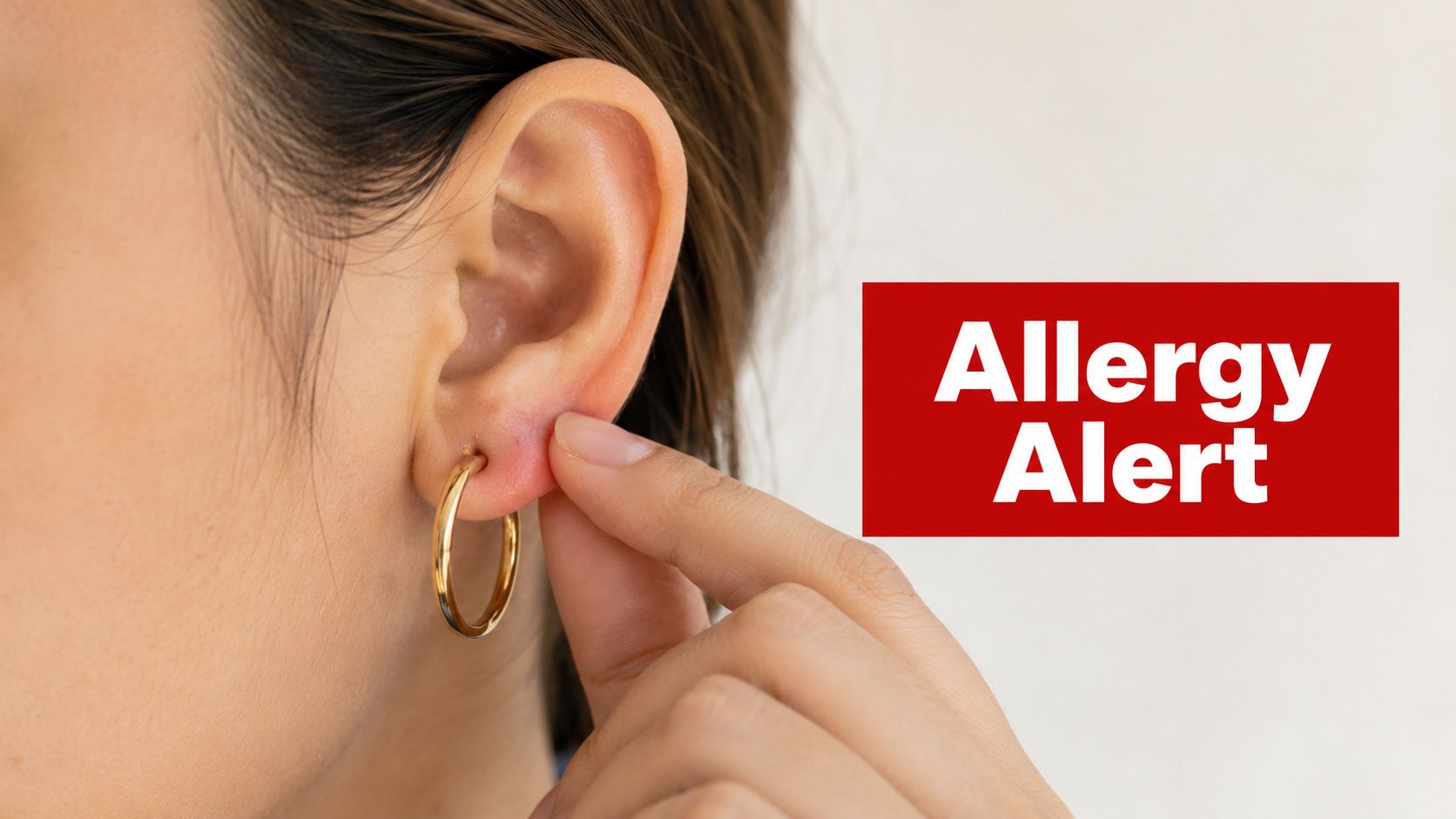
Jewelry allergies aren’t a niche customer-service issue. They sit at the intersection of product safety, material selection, plating quality, and brand trust. Jewelry allergies affect nearly 10% of the global population, with nickel allergies impacting up to 17% of women and 3% of men according to Short Hills Dermatology’s overview of jewelry allergy prevalence.
For brand owners and sourcing managers, that changes the conversation. A ring that causes itching, a pair of earrings that inflame pierced ears, or a necklace that triggers a rash doesn’t just create one unhappy customer. It raises questions about raw material control, coating durability, compliance, and whether your supplier understands the difference between a marketing claim and a product that can be worn comfortably.
In jewelry manufacturing, allergic reactions to jewelry are usually preventable. But prevention requires discipline at the design stage, the material stage, and the finishing stage. It also requires supplier vetting, because many of the biggest failures happen long before the product reaches your customer.
The Hidden Cost of Customer Allergic Reactions
The visible symptom is a rash. The hidden cost is broader.
When a customer reacts to a piece, they rarely separate the cause into alloy composition, nickel release, plating wear, or friction at a pierced site. They blame the brand. That’s understandable. The customer bought finished jewelry, not a metallurgical explanation.
For brands selling fashion jewelry, margins erode. Returns increase. Reorders drop. Customer support spends time on irritation complaints that could’ve been prevented during development. Sourcing teams then have to investigate whether the issue came from the base metal, thin plating, poor passivation, or inconsistent batch quality.
Why this becomes a sourcing problem fast
A supplier can say “hypoallergenic” and still leave critical details unanswered. What is the actual base metal? Is the stainless steel surgical grade or unspecified stock? Is the plating thick enough to act as a real barrier? Has nickel release been tested, or is the claim only based on the topcoat material?
These aren’t minor technicalities. They’re the practical line between a wearable collection and a customer complaint cycle.
Business reality: A jewelry allergy complaint is often a quality-control complaint in disguise.
Brands that treat skin sensitivity as part of product engineering usually perform better over time. They specify safer materials earlier, ask for test documentation earlier, and avoid the sourcing shortcuts that create expensive downstream problems. Teams reviewing supplier risk can use a practical framework like this guide to jewelry sourcing risks in China and mitigation to catch problems before production starts.
Where strong manufacturers add value
A capable OEM or ODM partner doesn’t just make the design. They help translate customer comfort into manufacturing specifications. That includes:
- Material disclosure: Clear identification of base metal, solder, findings, and plating layers.
- Process control: Defined plating methods, measurable thickness targets, and repeatable finishing steps.
- Verification: Test reports, corrosion checks, and batch consistency reviews.
- Product fit decisions: Different standards for earrings, rings, necklaces, and pieces intended for long skin contact.
That combination matters more than broad marketing language. In practice, hypoallergenic jewelry isn’t a trend claim. It’s a manufacturing discipline.
Why Jewelry Causes Skin Irritation
Most allergic reactions to jewelry come down to allergic contact dermatitis, and nickel is the main trigger. The important point for product teams is simple. A reaction doesn’t happen just because nickel exists somewhere in the metal. It happens when nickel is released from the item and reaches the skin.

A low-quality metal surface can behave a bit like a coating that slowly breaks down in sweat, friction, and daily wear. As that surface degrades, tiny amounts of nickel can move onto the skin. For a sensitized wearer, that can be enough to trigger redness, itching, or a rash.
Release rate matters more than label language
The science is important because it changes how you source. Nickel allergic contact dermatitis is triggered by the amount of nickel released to the skin, not just its presence in an alloy. To prevent reactions, nickel release must be below the European limit of 0.5 µg/cm²/week, as explained in the American Academy of Pediatrics discussion of nickel allergic contact dermatitis.
That means a product description saying “nickel-free look” or “sensitive skin friendly” doesn’t tell you enough. The engineering question is whether the finished piece keeps nickel release low enough during wear.
A practical overview of the manufacturing side sits in this nickel-free jewelry guide, especially if you’re reviewing product specs with a supplier.
Why some products cause delayed problems
A common sourcing mistake is assuming a piece is safe because early samples don’t trigger complaints. Early wear can be misleading.
If the plating is thin, porous, or poorly bonded, it may look fine at first and still fail in the field. Earrings are especially sensitive because they contact skin for long periods and often sit in areas with friction, skincare residue, or moisture. Clasps, posts, jump rings, and chain extenders also deserve attention because they often use different components than the visible decorative front.
Thin plating doesn’t fail all at once. It usually fails where wear is highest, then exposes the underlying metal in the exact spot that touches skin.
The main triggers manufacturers should monitor
For product development teams, the practical triggers usually include:
- Base metals with nickel content: Common in cost-driven fashion jewelry.
- Worn plating: Especially on rings, earring posts, and bracelet interiors.
- Mixed-component construction: Safe main body, reactive pin, clasp, or solder.
- Sweat and friction: Faster surface breakdown and higher ion transfer.
- Pierced skin contact: A more sensitive use case than general skin contact.
If you understand release, not just composition, you make better decisions. That’s the difference between jewelry that only looks compliant and jewelry that performs well after shipping.
Comparing Hypoallergenic and High-Allergen Materials
Material choice is where allergic-risk management becomes concrete. Designers often start with aesthetics and target cost. Sourcing managers have to add another filter. How likely is this material system to create skin problems after repeated wear?
Some metals are workable with the right barrier strategy. Others create unnecessary risk unless the product has a very specific market position and strong finishing controls. For wholesale jewelry and custom jewelry production, the best choice depends on wear time, body location, expected price point, and whether the item relies on plating.
Materials that create the most trouble
Nickel-containing alloys remain the obvious concern, but the manufacturing issue is broader. Brass, low-karat white gold, and unspecified stainless steel can all become problematic when the exact composition isn’t disclosed or when the skin contacts a plated surface that wears through.
Fast-fashion lines often use these materials because they’re easy to cast, affordable, and visually versatile. The trade-off is that they demand better coating discipline. If the barrier layer fails, the customer doesn’t care that the decorative top layer looked good in the showroom.
Materials that perform better for sensitive-skin collections
Among practical options, 316L surgical stainless steel is an excellent hypoallergenic choice because it releases only 0.02 micrograms of nickel per square centimeter per week, a rate more than 20 times lower than the European Union’s safety threshold, based on this overview of hypoallergenic earrings and 316L steel. For everyday product categories like hoops, chains, pendants, and men’s jewelry, 316L is often one of the strongest cost-to-performance choices.
Titanium is another strong option where low reactivity and corrosion resistance matter more than ease of casting. It can be more demanding in production, but it’s often worth the extra effort for piercing jewelry and highly sensitive-skin applications.
Sterling silver works well when purity and finishing are well controlled. High-karat yellow gold also performs well for customers prioritizing precious-metal comfort, though cost and softness can affect where it’s practical in a collection.
For teams reviewing regulatory context, the ReachLex Annex XVII overview is a useful reference when discussing restricted substances and market access requirements with suppliers.
Jewelry Material Comparison for Hypoallergenic Properties
| Material | Hypoallergenic Rating | Common Use | Notes for Brands |
|---|---|---|---|
| 316L surgical stainless steel | High | Earrings, chains, rings, men’s jewelry | Strong balance of durability, corrosion resistance, and cost. Better than unspecified stainless grades for sensitive-skin lines. |
| Titanium | Very high | Piercing jewelry, earrings, minimalist designs | Excellent for sensitive wearers. Harder to process than common fashion alloys, so supplier capability matters. |
| 925 sterling silver | High | Earrings, pendants, bracelets, fine-look fashion jewelry | Good option when alloy control and finishing are reliable. Best for brands that want precious-metal positioning without high-karat pricing. |
| 18K to 24K yellow gold | Very high | Premium earrings, rings, necklaces | Strong comfort profile, but price and softness affect commercial use. Better for premium or fine-jewelry-adjacent collections. |
| Brass | Low | Fashion jewelry bases, charms, statement pieces | Useful for design flexibility and cost targets, but usually needs a durable barrier layer to reduce skin-contact risk. |
| Low-karat white gold | Variable to low | Rings, fashion-fine crossover products | Can raise concerns for nickel-sensitive customers depending on alloy formulation. Requires explicit alloy disclosure. |
| Unspecified stainless steel | Variable | Budget earrings, chains, accessories | “Stainless steel” alone isn’t enough information. Grade disclosure is essential. |
| Nickel-rich alloy systems | Low | Cost-driven fashion components | Avoid for sensitive-skin positioning unless a robust, verified barrier system is part of the specification. |
A more detailed buyer-facing explanation appears in this guide to what hypoallergenic jewelry means, but the production takeaway is straightforward. If the collection will be worn daily, especially on pierced or high-friction body sites, material shortcuts usually cost more later.
The safest material on paper can still fail in market if the post, clasp, jump ring, or solder doesn’t match the rest of the piece.
How to make the trade-off decision
For brands building a new line, these rules keep decisions grounded:
- Use 316L when you need scale and durability: It’s a strong fit for wholesale jewelry programs that need broad appeal and stable production.
- Choose titanium for the most sensitive use cases: Especially when earrings or piercing-adjacent products are central to the collection.
- Use silver or high-karat gold when brand positioning supports it: These materials support a higher-value story, but they also demand tighter cost planning.
- Treat brass as a base, not a skin-contact promise: It can work in OEM jewelry production, but only when finishing and barrier layers are specified clearly.
- Reject vague material labels: “Stainless,” “alloy,” and “metal” don’t belong in a final sourcing spec.
Material selection is where quality, comfort, and margin start to align. If that decision is weak, plating has to work much harder to cover the risk.
How Plating Technology Prevents Allergies
Plating isn’t only about color. In many products, it’s the barrier that stands between the wearer’s skin and a reactive base metal. When that barrier is dense, stable, and thick enough, it can help prevent allergic reactions to jewelry. When it’s thin or inconsistent, the finish may still look acceptable at inspection and fail later in real wear.

Standard electroplating versus PVD
Traditional electroplating remains useful in jewelry manufacturing because it’s flexible, widely available, and can support many decorative finishes. But its performance depends heavily on surface preparation, bath control, adhesion, and thickness consistency. Thin electroplated layers can wear fastest on edges, posts, ring shanks, and clasp points.
PVD, or physical vapor deposition, usually creates a harder and more wear-resistant coating system. For brands selling pieces meant for daily wear, that durability matters because a more stable surface delays exposure of whatever sits underneath.
The process comparison becomes clearer when reviewing a technical production guide such as this PVD vs electroplating explanation for jewelry coating.
The coating detail that actually matters
The critical issue isn’t whether a factory says it uses plating. Every factory says that. The true question is whether the coating stack is built to function as a protective barrier.
For sensitive individuals, jewelry should be made from hypoallergenic materials or feature protective topcoats. Effective barriers include PVD TiN layers or electrodeposited palladium with a thickness of at least 0.03 µm to prevent nickel release and ensure compliance with safety standards, according to the ACS discussion of protective topcoats and nickel release control.
That thickness point matters because many irritation problems come from decorative plating that was never engineered for long-term skin contact. A flash layer may create the right initial color and still provide poor barrier performance.
Production rule: If the base metal has any allergy risk, the plating spec must be written as a protection system, not only as a color requirement.
A short video can help non-technical teams visualize how coating processes differ in practice.
What works and what doesn’t
What tends to work in production:
- Dense barrier layers: Especially where posts, inner ring surfaces, and clasp contact points touch skin.
- Controlled thickness: Enough to resist early wear, not just pass visual inspection.
- Compatible base metal and topcoat combinations: A good barrier performs better when the substrate is stable and well prepared.
- Wear-focused QA: Testing the actual contact zones, not only the decorative front.
What often fails:
- Very thin decorative flash plating
- Unknown underlayers
- Mixed hardware from multiple suppliers
- Assuming all gold-tone plating is equally skin-safe
A good plating program reduces two common causes of complaints at once. It lowers color-fade problems and lowers allergy risk. That’s why finishing isn’t a cosmetic afterthought in custom jewelry production. It’s part of the product’s safety performance.
A Brand’s Guide to Sourcing and Verifying Safe Jewelry
The word hypoallergenic sounds reassuring, but from a buyer’s perspective, it isn’t enough on its own. The term “hypoallergenic” is completely unregulated by the US FDA, meaning there is no legal standard defining what qualifies as such, as explained in this guide to hypoallergenic jewelry labeling and material verification. For sourcing teams, that means one thing. Verification has to replace assumption.

What to ask before placing an order
A reliable supplier should answer detailed questions without hesitation. If answers stay vague, that usually means the production file is vague too.
Use this checklist during supplier qualification:
- Ask for full material breakdowns: Base metal, post material, clasp material, solder points, and plating layers should all be identified.
- Ask how nickel safety is verified: For EU-bound products, the nickel release limit is a strict 0.5 µg/cm²/week under the EN 1811 standard, and B2B buyers require REACH-compliant certificates for market access, as noted in this summary of EN 1811 and REACH-compliant testing expectations.
- Ask for plating thickness specs: “Gold plated” is not a specification. Thickness and underlayer details are.
- Ask which components are outsourced: Ear posts, butterfly backs, chains, and jump rings often come from separate component suppliers.
- Ask what gets tested per batch: Material certificates alone don’t prove finished-product consistency.
What verification should look like in practice
A strong manufacturing partner should be able to support more than a certificate PDF. Buyers should expect a process.
That process usually includes incoming material checks, plating-thickness control, corrosion or wear evaluation, and final inspection against approved samples. If your team is comparing suppliers, this jewelry manufacturer vetting guide gives a practical framework for those conversations.
A compliant sample isn’t the same thing as a controlled production run. Ask how the supplier keeps batch two aligned with batch one.
The mistakes that create avoidable claims
The most common avoidable errors are operational, not theoretical:
- A brand approves a beautiful sample without checking the ear post alloy.
- The supplier changes a finding or clasp source during bulk production.
- The plating thickness in bulk is lower than in the sample.
- The product page says “hypoallergenic” but doesn’t disclose the actual material.
- No one requests test documentation until a retail buyer asks for it.
These issues are especially common in wholesale jewelry programs where speed matters and product development spans multiple SKUs. The answer isn’t to slow everything down. It’s to build a cleaner approval process.
A practical approval standard
For custom jewelry production, approval should include more than color and logo placement. It should include:
- A locked bill of materials
- Confirmed metal grades
- Defined coating stack
- Documented test requirements
- A rule for component substitutions
- Written customer-facing material language
That last point matters. If your product page says less than your internal spec file, the market will eventually find the gap.
Build Your Brand with Hypoallergenic Jewelry
Safe jewelry isn’t created by a single claim or a single coating. It comes from a chain of correct decisions. The base material has to make sense for the product. The plating system has to function as a barrier, not just a finish. The supplier has to prove consistency, not just promise it.
For brands, that creates a practical opportunity. If you build collections with verified materials, controlled production processes, and clear documentation, you reduce one of the most frustrating causes of returns and customer distrust. You also create a stronger product story for retail partners, distributors, and end customers who care about comfort as much as style.
In manufacturing terms, the path is straightforward. Specify the metal. Define the coating. Test the result. Lock the process. Repeat it across every batch.
That’s how hypoallergenic jewelry moves from vague marketing language into dependable product performance. And that’s why experienced sourcing teams treat allergic reactions to jewelry as a production issue they can solve, not a customer problem they have to manage after launch.
If you’re developing a sensitive-skin collection, upgrading an existing wholesale jewelry line, or need an OEM/ODM partner for custom jewelry production, HonHo Jewelry can help you move from concept to finished product with practical manufacturing support. The team offers custom development across stainless steel, brass, gold filled, and 925 sterling silver, with CAD design, sampling, plating, quality control, private label support, and global fulfillment. For buyers who need flexible MOQs, responsive communication, reliable lead times, and a production partner that understands hypoallergenic requirements in real manufacturing terms, HonHo Jewelry is ready to discuss your project.
Surgical Steel vs Sterling Silver: Buyer Guide
You’re pricing a new collection, and the sample tray is already split down the middle.
How to Gold Plated Jewelry the Right Way for Lasting Color
You probably have a launch already in motion, a supplier sample on your desk, and
What Is a Shank on a Ring: Guide to Design & Durability
You’re refining a ring design, the stone looks right, the setting is approved, and the