Understanding Gold Purity and Karats
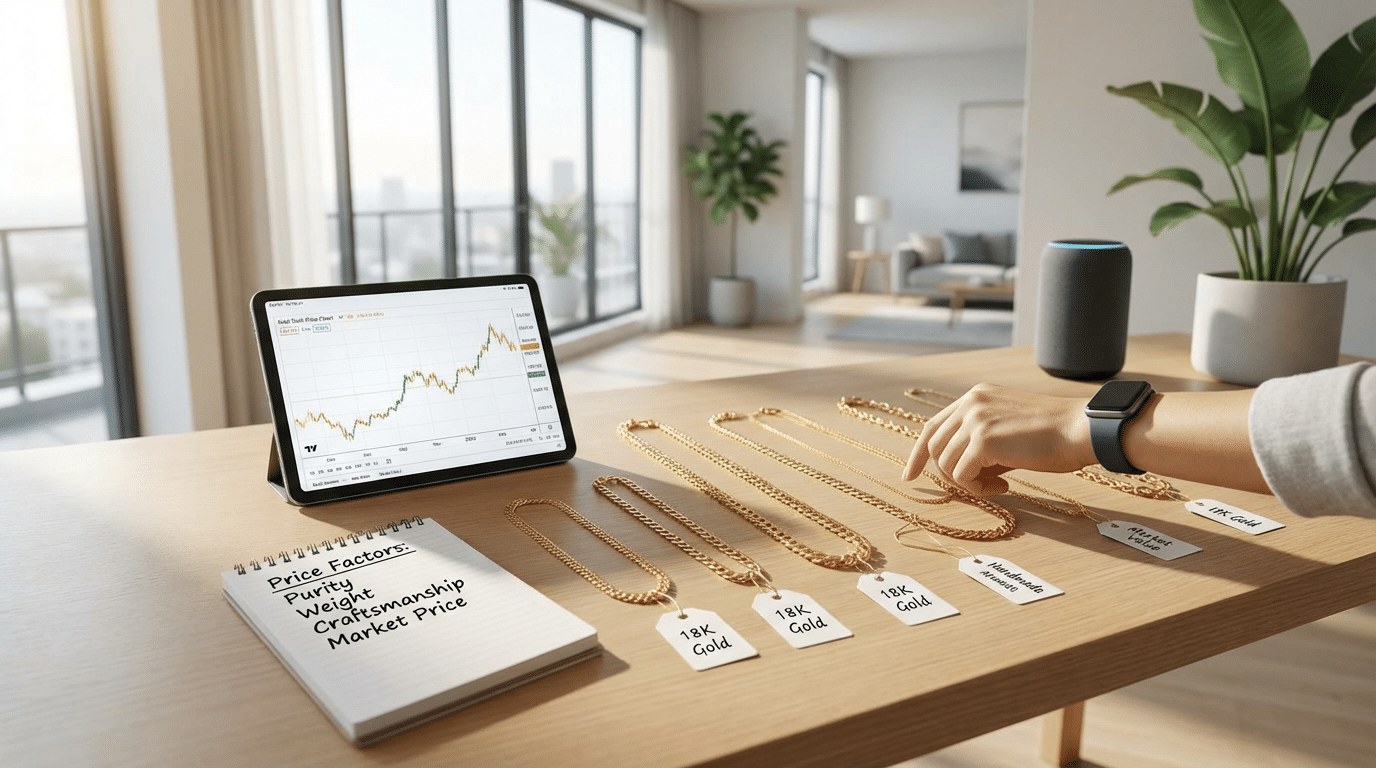
When people ask “how much for a gold necklace?”, the first thing I look at is karat. Karat tells you how much pure gold is in the necklace and explains a big part of the price difference.
Gold karat system explained
Here’s the basic gold karat comparison:
- 10K gold – 41.7% gold, 58.3% other metals
- 14K gold – 58.5% gold, 41.5% other metals
- 18K gold – 75% gold, 25% other metals
- 22K gold – 91.6% gold, 8.4% other metals
- 24K gold – 99.9% (or close to) pure gold
Higher karat = more pure gold = higher real gold necklace price per gram.
How purity changes necklace price
Gold is priced globally by spot price per gram. Jewelers then add:
- Material cost – based on purity (18K costs more than 14K for the same weight)
- Labor and design – craftsmanship, finishing, style
- Markup – brand, retailer margin, location
Example (same chain weight and style):
- A 10K gold chain will be the cheapest
- A 14K gold chain cost will be mid‑range
- An 18K gold necklace price will be noticeably higher
- 22K–24K moves into premium / luxury gold necklace price range
You pay more as purity goes up, but that doesn’t always mean it’s the best value for daily wear.
Durability vs value in everyday wear
Pure gold is soft. For everyday gold necklace use, you actually want a balance:
- 10K gold
- Most durable and scratch‑resistant
- More affordable real gold necklaces
- Color slightly less rich and warm
- 14K gold
- Strong enough for daily wear
- Warmer, richer color than 10K
- Good solid gold necklace value for the price
- 18K gold
- Deeper, more “luxury” gold look
- Softer than 10K/14K, but still wearable with care
- Higher gold necklace cost because of higher purity
- 22K–24K gold
- Very rich color, traditional in some markets
- Soft and easier to bend, not ideal for thin chains
- Typically used for investment or special occasion pieces
For men’s gold chains or everyday women’s gold necklaces, I generally recommend 14K or 18K for the best balance.
Why 14K and 18K gold are most popular
Most buyers looking for a real gold necklace price that feels fair end up choosing:
- 14K gold necklaces
- Great value for money
- Durable, practical, and still clearly “gold”
- Ideal for daily chains, paperclip styles, simple pendants
- 18K gold necklaces
- Premium feel without going all the way to 22K/24K
- Preferred for luxury gold necklace brands and fine jewelry
- Common choice for designer gold necklace price pieces, diamond and gemstone settings
From a manufacturer’s point of view, like we do in our own production in Dongguan, 14K and 18K give:
- Strong wearability
- Stable gold necklace price range
- Reliable long‑term value for global customers
If you’re starting your gold jewelry buying guide journey, understanding karats is the first step to knowing exactly how much a gold necklace should cost and what you’re really paying for.
Main Factors That Decide How Much a Gold Necklace Costs
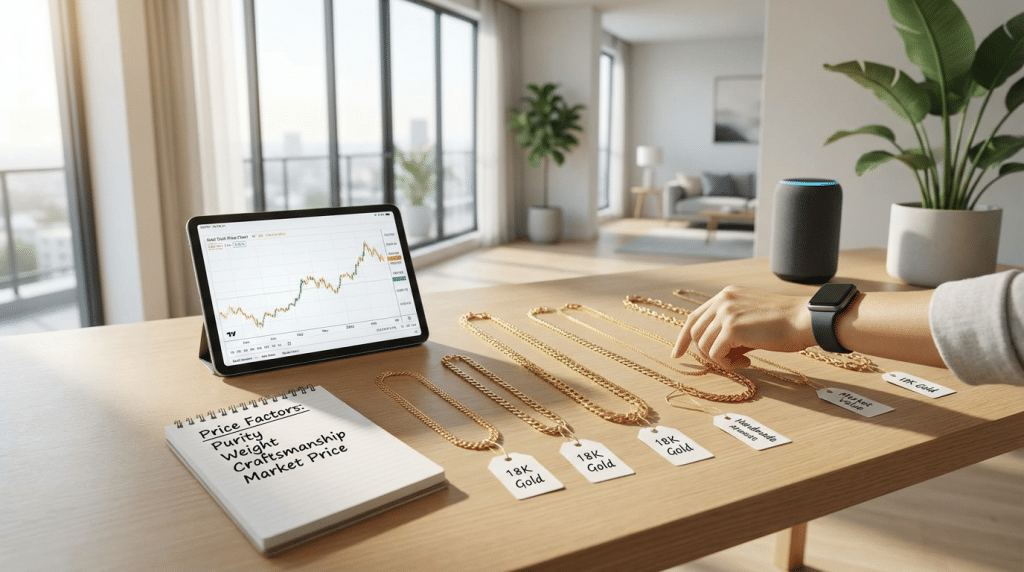
When someone asks “how much for a gold necklace?”, it always comes down to a few hard numbers: weight, karat, design, market price, and brand markup.
Gold weight and chain length
- Gold is priced by weight (grams), so heavier = more expensive.
- Longer chains (20–24 in / 50–60 cm) cost more than short ones (16–18 in / 40–45 cm) in the same style and karat.
- Men’s gold chains usually need more length and thickness, so the real gold necklace price increases quickly with every extra gram.
Simple chains vs detailed designs
- A plain cable, box, or Figaro chain is mostly gold value + basic labor.
- Detailed, chunky, or hollow designs (like some rope or Cuban styles) add more craftsmanship cost, sometimes more than the metal itself.
- Custom textures, handmade links, or complex clasps push the gold necklace cost into a higher range.
Gold market price (spot price)
- The daily gold market price (spot price per gram) is the base. Jewelers then add:
- Metal loss and refining
- Labor and design
- Their profit margin
- When gold spot goes up, gold chain weight and price go up, even if the design doesn’t change. That’s why average gold necklace price in 2026 shifts with the market.
Diamonds, gemstones, and pendants
- A plain chain is cheaper than a diamond gold necklace or one with gemstones. You pay separately for:
- Stone quality (cut, color, clarity, carat)
- Setting work
- Even a simple solid chain can double in price once you add a custom pendant, especially for gemstone gold necklace styles or name/initial pendants.
Brand, manufacturing, and retail markup
- Big designer names and luxury gold necklace brands add the highest brand markup. You pay for image and packaging, not just metal.
- Manufacturer-direct or wholesale jewelry suppliers like us keep prices closer to the true solid gold necklace value, with more room for custom orders. If you’re comparing options, checking a trusted wholesale custom jewelry supplier list like the one we share at Top 10 wholesale custom jewelry suppliers helps you benchmark fair pricing.
- Always factor in:
- Hallmarks and real gold verification
- Finish quality, clasp strength, and soldering
These small details separate affordable real gold necklaces from cheap pieces that won’t last.
Average Gold Necklace Price Ranges in 2026

Gold‑plated & gold‑filled necklace price range
If you’re just chasing the look, not full gold value:
- Gold‑plated necklaces:
- Rough guide: $10–$80 (fashion brands can push this higher)
- Plating is thin, so it’s more about style than long‑term value.
- Gold‑filled necklaces:
- Rough guide: $40–$200+ depending on thickness and design
- Much thicker gold layer than plating and better for daily wear.
- If you want a deeper dive into this category, I break it down further in my guide on gold‑filled jewelry manufacturers in China.
Entry‑level solid gold necklaces (10K–14K)
For people who want real gold on a budget:
- 10K simple chains (16–20 in, thin gauge): around $120–$350
- 14K simple chains (16–20 in, thin–medium): about $220–$600
These are usually basic cable, box, or curb chains without gemstones.
Mid‑range 14K–18K gold necklace price
Best sweet spot for most global buyers:
- 14K mid‑range chains (thicker or more stylish designs): $350–$1,000
- 18K chains (simple to moderately heavy): $600–$1,800
Here you’re paying for higher gold content, better finishing, and more weight.
Premium & luxury 18K+ necklace pricing
For people who want statement or heirloom pieces:
- 18K designer or heavier chains: usually $1,500–$5,000+
- High‑end 18K–22K sets or intricate pieces: can easily hit $5,000–$20,000+
Luxury brands add big markups for name, design, and marketing.
Price examples by common style (men’s & women’s)
- Simple cable/box chain, 14K, 18 in: about $220–$450
- Rope chain, 14K, 20 in: around $350–$900 (thickness drives price)
- Cuban link chain (men’s), 14K, 20–24 in: roughly $800–$4,000+ depending on weight
- Paperclip chain, 14K, 18 in: usually $300–$900
- Pendant necklace, 14K with small charm (no diamonds): about $180–$600
- Diamond pendant on 14K–18K chain: commonly $400–$3,000+, based on diamond quality and size
All numbers are typical 2026 retail ranges with normal jeweler markups and will move with the daily gold price and exchange rates.
Gold Necklace Styles and What They Usually Cost

Classic Chains: Cable, Figaro, Box
For classic everyday gold chains, the style doesn’t change the gold value, but it does change labor cost.
Typical 2026 price ranges for simple 16–20 inch chains (no stones, normal thickness, women’s / lighter men’s weight):
- 10K cable / box chain: $120–$280
- 14K cable / Figaro / box: $220–$550
- 18K cable / Figaro / box: $380–$900
What affects the final bill:
- Weight: thicker = more grams = higher gold necklace price
- Finish & clasp quality: better locks and smoother finishing cost more
- Men’s heavy Figaro or box chains (20–24 inch) easily jump to $700–$2,000+ in 14K because of weight.
Trendy Styles: Cuban, Rope, Paperclip (2026 Trends)
Trendy chains carry more labor and hype, so they’re usually pricier than a simple cable chain at the same weight.
Approx 2026 ranges for popular real gold necklace styles:
- Cuban link chain price (14K, 18–22 inch)
- Slim / unisex: $450–$1,200
- Heavy men’s Cuban: $1,500–$6,000+ depending on width and grams
- Rope chain necklace cost (10K–14K, 18–22 inch)
- Thin: $180–$450
- Medium: $450–$1,200
- Paperclip gold necklace price (usually 14K)
- Dainty: $220–$600
- Chunky designer style: $600–$1,500+
These prices move with the daily gold market price per gram, so the average gold necklace price in 2026 can swing month to month.
If you just want the look without the full gold cost, many buyers switch between solid and plated pieces and learn how long gold‑plated jewelry actually lasts before tarnishing.
Pendant Necklaces: How Pendants Change the Total Cost
With pendants, you’re paying for chain + pendant, and the pendant can easily cost more than the chain.
What pushes up pendant gold necklace prices:
- Solid gold pendant (nameplate, bar, cross): adds $80–$400+ depending on size and karat
- Gemstone gold necklace prices:
- Small colored stones: add $50–$300
- High‑quality stones: much more, depending on brand and cut
- Diamond gold necklace price:
- Tiny diamond accent: add $80–$250
- Larger diamond solitaire or multiple stones: $300–$2,000+
Rough 2026 ranges (chain + pendant, 14K):
- Simple bar / cross / disc: $260–$700
- Nameplates and custom designs: $350–$900
- Diamond or gemstone pendants: $450–$2,500+
Layered Gold Necklace Looks: Cost of Stacking
The layered necklace look costs more because you’re basically buying 2–4 necklaces instead of one.
How the cost stacks up:
- Two 14K simple chains (16″ + 18″): $400–$1,000 total
- Three‑layer mix (cable + paperclip + pendant): $650–$1,800+
- If you mix gold‑filled or gold‑plated with one solid 14K base chain, you can keep the stack under $300–$600 and still have one true solid gold necklace for long‑term value.
To get the best value, I usually suggest:
- 1 solid gold “forever” chain (14K or 18K)
- 1–2 fashion layers (gold‑plated or silver/stainless pieces) that you can swap out; comparing durability to metals like those in this guide on sterling silver vs stainless steel jewelry helps you build a smarter, long‑lasting stack.
Where to Buy a Gold Necklace for the Best Value

Buying Online vs In‑Store Jewelers
If you’re asking “how much for a gold necklace?” where you buy matters almost as much as the gold itself.
Online jewelers
- Usually better prices (lower overhead, more transparent weight and specs).
- Easy to compare 10K, 14K, 18K and different chain weights side by side.
- Make sure they show gram weight, karat, length, and clear photos.
In‑store jewelers
- You can see and feel the chain thickness and shine in person.
- Good if you’re new to gold and want a pro to explain karats and styles.
- Prices are usually higher because of rent, staff, and branding.
I usually tell buyers: compare a few online prices first, then check a local store so you actually feel the weight and see what looks good on your neck.
How to Check Quality: Hallmarks, Stamps, Certifications
Never skip this part if you care about real gold necklace price and value for money.
Look for these marks on the clasp or tag:
- 10K / 417, 14K / 585, 18K / 750, 22K / 916, 24K / 999
- A maker’s mark or brand stamp
- For diamonds or gemstones: a certificate (GIA/IGI for higher-value stones)
If there’s no karat stamp, no brand, and no paperwork, I’d walk away—especially if the “deal” seems too cheap for a solid gold chain.
Brand‑Name vs Manufacturer Direct
You’re basically paying for one of two things: hype or metal.
Brand‑name gold necklace
- Pros: Strong design identity, nice packaging, recognized logo, good resale for some luxury houses.
- Cons: You pay a big premium over the gold content. A 14K gold chain can cost 2–4x more than a similar non‑branded chain.
Manufacturer direct / factory direct
- Pros: Much closer to true gold necklace value (you pay for weight, karat, and craftsmanship, not marketing).
- Ideal if you’re price‑sensitive, buying multiple pieces, or want custom work.
- Many global buyers work directly with a wholesale custom jewelry manufacturer to keep margins low and quality high. For example, our own factory jewelry direct wholesale guide explains how cutting out middlemen impacts final gold necklace cost.
If your goal is flexing a logo, go branded. If your goal is maximum gold for your budget, go manufacturer direct.
Custom Gold Necklaces from Reliable Manufacturers
If you want a specific Cuban link length, a unique name pendant, or a certain paperclip thickness, custom is the way to go—but only with the right partner.
When you work with a reliable manufacturer (like our team in Dongguan), you should get:
- Clear quotes based on karat (10K/14K/18K), weight, and length.
- CAD design or drawings before production.
- Options for solid gold, gold‑filled, or high‑end anti‑tarnish plating depending on your budget. Our own experience as an anti‑tarnish jewelry manufacturer lets us offer pieces that stay good‑looking longer, even for everyday wear.
- Transparent lead times and warranty/repair policies.
Custom doesn’t have to mean “crazy expensive.” Done direct with the factory, it often just means you’re finally getting exactly the gold necklace you want without overpaying for branding.
Smart Tips to Budget and Save on a Gold Necklace
Estimate Value Using Weight + Gold Spot Price
If you want to know if a gold necklace price is fair, start with simple math:
- Check the gold karat: 10K, 14K, 18K, etc.
- Find the weight in grams (ask the seller or check the product details).
- Look up the current gold spot price per gram (24K/pure gold).
- Multiply:
- 10K ≈ 41.7% gold → spot price × 0.417
- 14K ≈ 58.5% gold → spot price × 0.585
- 18K ≈ 75% gold → spot price × 0.75
- Then multiply by necklace weight to get the raw gold value.
Anything you pay on top is labor + design + brand markup. A solid gold necklace price that’s 2–4× the raw gold value is common for real retail.
Avoid Overpaying for Brand or Hype
You’re often paying extra for logos and packaging, not better gold. To stay in budget:
- Compare gram price between brands, not just total price.
- Skip “trendy” collections if you’re on a tight budget; go for classic chains.
- Look at manufacturer-direct brands (like my own lines and other factory suppliers) that cut retail middlemen.
- Check similar gold chain specs on multiple sites to see who’s inflating prices.
For a detailed breakdown on pricing and markups, I’ve shared more on our own gold necklace cost guide on HonHo Jewelry at how much for a gold necklace.
Red Flags for Fake or Misrepresented Gold Necklaces
If a “real gold necklace price” looks too good to be true, it probably is. Watch out for:
- No hallmark stamp (e.g., 10K, 14K, 18K, 585, 750).
- Vague wording: “gold tone”, “gold color”, “premium finish” with no karat mention.
- Super heavy “18K gold” chains priced barely above gold-plated pieces.
- Sellers refusing to show certification, invoices, or testing reports.
- Magnetic chains sold as “solid gold” (real gold is not magnetic).
If you’re unsure, pay for a local jeweler or lab to test the piece before committing to big money.
Simple Care Tips to Keep Value Longer
A gold necklace holds value better when it still looks clean and isn’t damaged:
- Store it in a soft pouch or separate box to avoid scratches and tangles.
- Take it off before swimming, working out, or showering (chlorine and sweat can dull it).
- Clean gently with mild soap + warm water + soft cloth—no harsh chemicals.
- Get clasps and links checked if you wear it daily, so you don’t lose it.
Basic care keeps your gold chain looking new, which protects both resale value and daily wear value.
The Unseen Hero: Why Earring Backings Define Quality Jewelry
Every jewelry brand owner knows the sinking feeling. A customer calls, distraught. They’ve lost one
Choosing the Best Jewelry Stone Setting for Mass Production
Selecting the right jewelry stone setting is one of the most pivotal decisions for any
Best Jewelry Stone Setting for Mass Production | HonHo
Choosing the best jewelry stone setting Choosing the best jewelry stone setting is one of