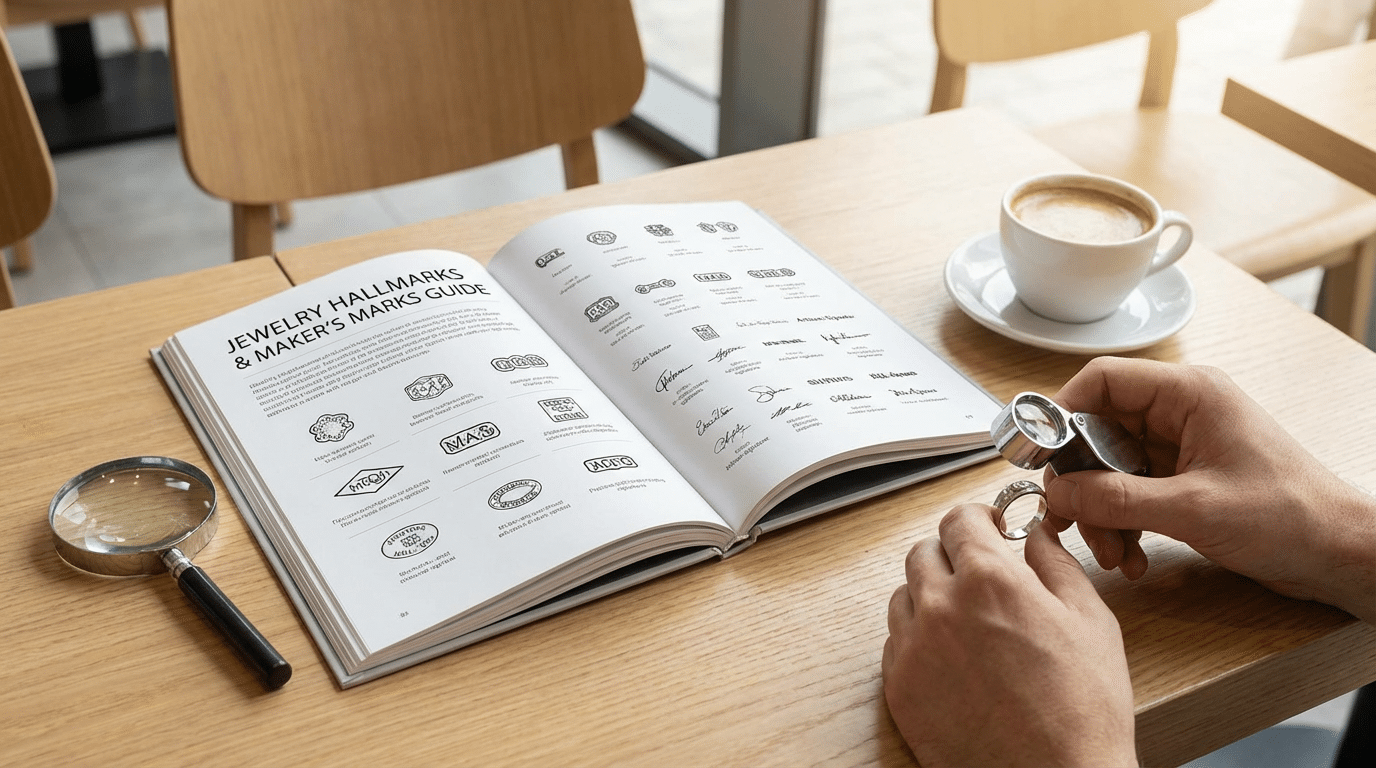
You’ve probably noticed tiny stamps inside a ring band or on the clasp of a necklace… but what do those jewelry hallmarks actually mean?
Are they about gold purity?
The maker or brand?
The country, year, or authenticity?
You’re in the right place.
In this guide, you’ll quickly understand jewelry hallmarks meaning—how to decode gold karat marks (14K, 18K, 750), silver marks (925, Sterling), platinum and palladium fineness numbers, plus maker’s marks, assay office symbols, and date letters from the UK, US, Europe, and China.
By the end, you’ll be able to look at any tiny stamp on your jewelry and know, in seconds, whether it’s real, where it’s from, and how valuable it might be.
Let’s decode those marks that everyone sees—but almost no one understands.
What Are Jewelry Hallmarks and Why They Matter
When you flip over a ring or bracelet and see tiny numbers or symbols, you’re looking at jewelry hallmarks. These aren’t decoration – they’re your best clue to what the piece is really made of, where it was tested, and sometimes who made it.
Legal definition and origin
A jewelry hallmark is a legally controlled stamp that confirms the precious metal content of a piece:
- Applied by an official assay office or authorized body
- Shows that the metal has been tested and meets a minimum purity standard
- Recognized in law in many countries (UK, most of Europe, parts of Asia)
Hallmarks started in medieval Europe as a way for guilds and governments to stop fraud and protect the trade in gold and silver. The idea hasn’t changed much: if you see a proper hallmark, you’re not just trusting the seller — you’re trusting an independent tester.
How hallmarks protect buyers and sellers
For buyers, hallmarks are your built‑in quality guarantee:
- Help you avoid overpaying for plated or low‑grade metal
- Support fair resale value and insurance claims
- Make it easier to identify authenticity when buying pre‑owned or vintage
For sellers and brands, hallmarks:
- Prove they’re meeting legal standards
- Build trust with customers and international markets
- Reduce disputes because the metal purity is documented
Hallmarks vs trademarks vs maker’s marks
These three often get mixed up, but they’re not the same thing:
- Hallmark – Official purity/assay mark (e.g., 925, 750, office symbol).
- Confirms metal fineness, tied to law and testing.
- Trademark – Registered brand name or logo (e.g., a luxury house’s logo).
- Protects brand identity, not metal quality.
- Maker’s mark (or sponsor’s mark) – A unique symbol or set of initials identifying who submitted the piece for hallmarking.
- Tells you who is responsible for the piece, not its purity by itself.
A complete set of jewelry hallmarks will often include all three: purity mark, maker’s mark, and sometimes a logo.
Why some jewelry has no hallmarks
Not every real gold or silver item is stamped. Common reasons:
- Country laws differ – The US, for example, allows unhallmarked pieces; marking is common but not always mandatory.
- Very small or delicate items – There may literally be no room for a clear stamp.
- Handmade or older pieces – Some vintage or artisan jewelry was never formally assayed.
- Wear and repair – Polishing, resizing, or heavy wear can erase marks over time.
- Plated or base metal – Cheap fashion jewelry often avoids hallmarks to stay away from legal trouble, using vague marks or none at all.
Bottom line: no hallmark doesn’t automatically mean fake, but it does mean you should rely more on testing, weight, feel, and professional evaluation before you assume a piece is solid gold, silver, or platinum.
Main Types of Jewelry Hallmarks (Jewelry Hallmarks Meaning)
When I’m checking a piece, I’m usually looking for a “cluster” of marks, not just one stamp. Here are the main jewelry hallmarks you’ll see and what they mean in plain English.
Precious Metal Purity Marks & Fineness Numbers
These are the most important marks for buyers:
- Gold – karat (K) or fineness:
- 9K, 10K, 14K, 18K, 22K, 24K
- 375, 417, 585, 750, 916, 999
- Silver:
- 925 / S925 / Sterling (92.5% silver)
- 800, 835, 900, 958 (Britannia)
- Platinum:
- 850, 900, 950
- Palladium:
- 500, 950, 999
These jewelry purity marks and fineness numbers tell you how much real gold/silver/platinum is in the alloy, not just “gold color.”
Maker’s or Sponsor’s Marks (Logos & Initials)
A maker’s mark (or sponsor’s mark) identifies who is responsible for the piece:
- Usually initials + symbol in a small frame (e.g., “AB”, “T&Co.”)
- Can be a brand name, logo, or a simple letter code
- Essential for maker’s mark lookup and verifying authenticity on designer jewelry
When we produce custom or private label pieces through our own facilities or via a trusted wholesale jewelry manufacturer (OEM/ODM), we always add a clear maker’s mark so customers can trace the origin.
Assay Office Symbols & Testing Responsibility
In countries with strict hallmark laws (like the UK):
- An assay office symbol shows which official lab tested and certified the metal.
- Example:
- UK: London, Birmingham, Sheffield, Edinburgh have different icons
- This mark means an independent body confirmed the purity—not just the seller.
Date Letters & Year Codes
Some systems use date letters to show when the piece was officially marked:
- Typically a single letter or letter + shape that corresponds to a specific year
- Common in British jewelry hallmarks and some European systems
- Handy for dating vintage jewelry hallmarks and spotting later additions or fakes
Country & Town Origin Marks
These marks show where the piece was assayed or made:
- Country symbols:
- French eagle’s head (gold), boar’s head (silver)
- German crescent moon + crown
- Town marks identify specific cities or assay offices
- Very useful for jewelry hallmarks identification and tracking export/import paths
Commemorative & Special Event Hallmarks
Some pieces carry extra symbols for:
- Anniversaries, royal events, special hallmarking years
- Limited-series runs and collectible pieces
They don’t change the purity, but they can boost collectability and value for collectors.
Import, Export & Convention (CCM) Marks
For international trade, you’ll sometimes see:
- Import/export marks – applied when crossing borders into certain countries
- Convention Hallmark (CCM balance scale):
- A small balance scale symbol showing the piece was hallmarked under the International Convention on Hallmarks
- Makes cross-border trade easier and gives buyers confidence in standardized testing
On some pieces, you’ll see a mix of local marks + convention marks, especially on jewelry produced for global markets.
Jewelry Purity Marks and Fineness Numbers
When you’re decoding jewelry hallmarks, purity marks and fineness numbers tell you exactly how much real precious metal you’re getting.
Gold Karat Marks (9k, 10k, 14k, 18k, 22k, 24k)
Karat (k or kt) shows how many parts out of 24 are pure gold:
- 9k – 37.5% gold (common in UK, EU budget jewelry)
- 10k – 41.7% gold (legal minimum “gold” in the US)
- 14k – 58.5% gold (global everyday standard – great balance of color and durability)
- 18k – 75% gold (luxury standard for fine jewelry)
- 22k – 91.6% gold (rich color, softer, popular in Asia/Middle East)
- 24k – 99.9% pure gold (too soft for most daily-wear pieces)
Gold Fineness Numbers (375, 585, 750, 916, 999)
Same story as karat, just written as parts per thousand:
- 375 = 9k
- 417 = 10k (often used in US)
- 585 = 14k
- 750 = 18k
- 916 / 917 = 22k
- 999 = essentially pure (24k)
You’ll see these millesimal fineness numbers more on European and Asian jewelry and in any serious gold hallmark symbols chart.
Silver Purity Marks and 925 Meaning
For silver, the key number is 925:
- 925 / “Sterling” / “Sterling Silver” = 92.5% pure silver
Most global fine jewelry uses this standard. When customers ask about silver 925 meaning, this is what they’re really asking.
Other real silver grades you’ll see:
- 800 / 835 / 900 – older or continental silver, lower purity, often antique or vintage
- Britannia 958 – 95.8% silver, a higher UK standard; softer but premium
Platinum and Palladium Hallmark Numbers
Platinum and palladium are usually marked only with fineness:
- Platinum:
- 850 – entry level platinum content
- 900 – 90% platinum
- 950 – 95% platinum (most modern fine pieces; standard in many platinum hallmark guides)
- Palladium:
- 500 – 50% palladium (older or lower cost alloys)
- 950 – 95% palladium (most quality fine jewelry)
- 999 – near-pure palladium (less common in jewelry)
Karat vs Fineness vs Carat
Don’t mix these up:
- Karat (k/kt) – purity of gold (24k scale)
- Fineness (e.g., 585, 925, 950) – purity of any precious metal, parts per thousand
- Carat (ct) – weight of gemstones, not metal (1 ct = 0.2 g)
How Purity Marks Differ Between Countries
You’ll see the same real metal, just labeled differently depending on where the piece was made:
- US – prefers karat marks (10k, 14k, 18k) for gold; “Sterling” or 925 for silver; FTC rules require accuracy and often a maker’s mark
- UK / EU – more fineness numbers (375, 585, 750, 925, 950) with extra official assay symbols
- Asia – often uses 24k / 999 for high-purity gold, plus local language marks; China, for example, uses S925 for silver and specific characters for high-purity gold and silver
If you’re sourcing or appraising pieces across borders, you need to read both systems fluently. That’s also why I always recommend formal appraisal when value gets serious; a professional with the right testing gear is much more reliable than guessing at stamps. If you’re figuring out where to take higher-end items, this guide on where to get jewelry appraised is a solid starting point: professional jewelry appraisal options and tips.
Country-Specific Jewelry Hallmark Systems (Jewelry Hallmarks Meaning)
When you’re decoding jewelry hallmarks, the first thing to know is this: every country plays by its own rules. If you sell, buy, or collect globally, you need at least a quick overview of the main systems.
UK & Commonwealth Hallmarks
The UK has one of the strictest and oldest hallmark systems. If a piece is described as gold, silver, platinum, or palladium and over a certain weight, it usually must be hallmarked by law.
Core UK rules (also used or adapted by many Commonwealth countries):
- Items are tested by an assay office before stamping.
- A “full” UK hallmark typically includes:
- Sponsor / maker’s mark (e.g., initials in a shaped cartouche).
- Standard (purity) mark – e.g., 375, 585, 750, 925, 950.
- Assay office mark – tells you where it was tested.
- Date letter – optional now, but still used by many.
British Standard Marks for Precious Metals
In the UK, the standard mark shows the metal and its fineness:
- Gold: 375 (9k), 585 (14k), 750 (18k), 916 (22k), 999 (24k).
- Silver: 800, 925 (sterling), 958 (Britannia).
- Platinum: 850, 900, 950.
- Palladium: 500, 950.
You’ll often see the number plus a tiny symbol:
- Lion passant for sterling silver (traditional).
- Britannia figure for 958 silver.
- Oval / lozenge-shaped frames for gold, platinum, palladium.
UK Assay Office Symbols (London, Birmingham, Sheffield, Edinburgh)
The assay office symbol tells you where the piece was officially tested:
- London – Leopard’s head.
- Birmingham – Anchor.
- Sheffield – Yorkshire rose (used to be a crown on silver).
- Edinburgh – Castle.
Ireland uses its own system with the Dublin harp and Hibernia mark, which you may see on older or Irish-made pieces.
Modern UK Date Letters (2000–2026 Snapshot)
Date letters are not legally required anymore, but when present they help you estimate the year. Each assay office uses:
- One letter per year, in a set font and frame shape.
- A new cycle starts with a new letter style.
To read them correctly, use an updated UK hallmark date letter chart (especially for 1998–2030), because the same letter can repeat in a different style in later cycles.
US Jewelry Hallmark Practices & Laws
The US system is looser:
- Hallmarking is not mandatory nationwide, but if you stamp a karat mark (e.g., 14K), you must:
- Meet minimum fineness.
- Show a responsible manufacturer’s or seller’s mark (e.g., a name or logo).
- There is no central assay office; testing is often done by manufacturers or independent labs.
This means US pieces might have only “14K” and a brand or maker’s mark, and still be fully legal.
What US Karat Marks Really Guarantee
In the US, karat marks are controlled by the FTC:
- 14K must be at least 58.5% gold (585).
- 10K is the legal minimum for something to be sold as “gold”.
- Fineness marks like .585, .750 can also be used.
- Tolerance is small, but plating and filled items must be clearly labeled (e.g., 14K GF, HGE).
If you want lower-maintenance, non-tarnishing pieces without precious metal hallmarks, many buyers now go for stainless steel jewelry, especially for everyday wear and wholesale orders, which we cover in depth in our guide to stainless steel jewelry and its benefits.
French Jewelry Hallmarks (Eagle, Boar, Minerva)
France uses tiny but very specific symbols:
- Eagle’s head – Standard French gold hallmark (usually 18k).
- Boar’s head – Silver hallmark for small items.
- Minerva head – French silver of higher fineness; often used on larger silverware and quality silver jewelry.
You’ll usually see these on the edge of rings, near clasps, or on edges of pendants.
Italian Jewelry Hallmarks: Star + Province
Modern Italian gold and silver often carry:
- A five-point star.
- A number – the registration number.
- A two-letter province code (e.g., VI for Vicenza).
Example: *1234 VI*. This identifies the specific Italian maker and region, and usually sits beside 750, 585, or 925 fineness numbers.
German Crescent Moon & Crown Marks
Germany’s classic hallmark combo:
- Crescent moon + crown – traditional mark for precious metal made in Germany.
- Usually followed by a fineness number:
- 800, 835, 925 for silver.
- 585, 750 for gold.
If you only see “Germany 925” with no crescent/crown on a modern piece, be cautious – this marking is heavily faked on low-end imports.
Chinese Jewelry Hallmarks (2026–2026 Rules)
China has been tightening and standardizing hallmarks:
- Marks must show:
- Metal type (e.g., Au, Ag, Pt).
- Fineness (e.g., 999, 925).
- Sometimes brand / factory code.
- Newer rules also push traceability and footprint-style marks, especially for bigger brands and chains.
On Chinese-made export jewelry, you’ll often see S925 for silver, and G750 / Au750 for 18k gold, sometimes combined with brand initials.
Meaning of 足金, 足银, and S925 in China
If you’re buying Chinese jewelry, these three are key:
- 足金 (zú jīn) – literally “full gold”. Usually means 99%+ pure gold (often 999 or 9999).
- 足银 (zú yín) – “full silver”, usually 99%+ pure silver.
- S925 – standard sterling silver, 92.5% silver; the “S” just emphasizes silver content.
You may see 足金999 or Au999 足金 to double-confirm high purity.
Convention (CCM) Balance Scale Hallmark
For international trade within countries that signed the Hallmarking Convention (CCM):
- The balance scale symbol is the Convention mark.
- It appears next to the national hallmark.
- It tells customs and buyers that the metal meets Convention standards, and usually doesn’t need to be re-assayed in another member country.
You’ll see this on gold, silver, platinum, and palladium from many European makers.
Mixed-Country Marks on One Piece
It’s normal to see multiple country systems on a single piece:
- Designed in Italy, made in China, assayed in the UK.
- Vintage French piece later re-hallmarked in the UK for resale.
- US brand outsourcing to European manufacturers.
Typical combos:
- Italian star mark + UK assay office + Convention balance scale.
- US brand logo + 750 + small European country symbol.
When you see mixed marks:
- Start with the purity mark (e.g., 750, 925).
- Identify any country symbols (eagle, star, crescent, leopard, anchor, etc.).
- Use a maker’s mark lookup or a hallmark identification app to connect the dots.
If you’re sourcing or designing pieces for international customers, understanding these country-specific hallmark systems is non‑negotiable. It protects your brand, cuts returns, and builds trust when you list metal fineness clearly—especially if you mix precious metals with long-lasting base metals like those used in our necklace supplies for wholesale production.
Famous Jewelry Hallmarks & Designer Stamps
What a Maker’s Mark Really Tells You
A maker’s mark isn’t just a logo – it’s proof of who made the piece and often where and when it was made. When I buy or design, I look for:
- Brand / studio identity – confirms it’s not a generic factory piece.
- Accountability for quality – serious makers stand behind their stamp.
- Traceability – helps you research age, style, and resale value.
For custom or studio jewelry, a clear maker’s mark can add more value than any generic “925” or “14K” stamp.
Big Luxury Brands & Their Typical Hallmarks
Most global luxury houses always combine a brand signature + metal purity. Basic patterns you’ll see:
- Brand name in clean, sharp font (no fuzzy or uneven letters).
- Metal purity: 750, 750/1000, 18K, 925, Pt950 etc.
- Often a serial number or internal code for traceability.
If the logo looks sloppy, misaligned, or the letters are wrong, I treat it as a red flag, no matter how “heavy” the piece feels.
Tiffany & Co. Stamps: Where to Look
Authentic Tiffany jewelry usually shows:
- “Tiffany & Co.” or “T & Co.” in crisp engraving.
- Metal mark like “925”, “750”, “PT950”.
- On rings: inside the band.
- On necklaces/bracelets: near the clasp tag or back of a pendant.
If you’re exploring upscale pieces after reading an expert guide to buying jewelry, always cross‑check Tiffany stamps against official reference photos before paying.
Cartier Hallmarks & Authenticity Clues
Real Cartier pieces are very consistent:
- “Cartier” in its distinct script.
- Metal marks: 750, Au750, Pt950, sometimes with French symbols.
- Serial number: clean, even, not crooked.
Watch for:
- Misspellings (e.g., Carter, Cartier with uneven letters).
- Poor engraving, sandblast-looking text, or random font styles.
Van Cleef & Arpels Signatures
Typical VCA details:
- “Van Cleef & Arpels” or “VCA” with the correct spacing.
- Metal: 750, Au750, Pt950.
- Often a serial number on the backside or inside the band.
On Alhambra and similar pieces, signatures are usually on the back of motifs or near clasps. Overly deep, shaky, or off‑center engraving is a warning sign.
Bulgari, David Yurman, Pandora & Other Popular Brands
Common patterns:
- Bulgari – “BVLGARI” and “750” or “925”, sharply engraved, often around the edge on some collections.
- David Yurman – “D. Yurman” or “David Yurman” plus “925”, “750”, “585” or “14K/18K”. Cables are very precisely finished.
- Pandora – “PANDORA” plus “ALE” (for Algot Enevoldsen) and “925”, “S925”, or “G585”.
If you want branded‑style design without paying brand markup, I normally suggest going with custom jewelry from trusted makers who still use proper hallmarks and studio stamps – similar to how we approach pieces through our own custom jewelry manufacturing partners.
Independent Artisan & Studio Marks
For small studios (like ours), marks usually include:
- Initials or logo inside a simple frame.
- Sometimes a year or tiny symbol for internal tracking.
- Always paired with metal purity (925, 950, 14K, 18K, etc.).
These marks are less standardized than big brands, but they’re crucial for proving authenticity and craft origin on future resale or appraisal.
Most‑Counterfeited Maker’s Marks to Watch
The most faked stamps worldwide:
- Tiffany & Co.
- Cartier
- Van Cleef & Arpels
- Bulgari
- Chanel, Hermès, Louis Vuitton jewelry
- Pandora ALE 925
Red flags:
- Marks that are too large, off‑center, or deeply scratched in.
- Fonts that don’t match official brand examples.
- Luxury brand stamp on a piece with poor finishing or wrong weight.
How to Research an Unknown Maker’s Mark
When I can’t recognize a stamp, I go step by step:
- Photograph the mark clearly (macro mode or phone close‑up).
- Note all letters, numbers, and shapes (stars, crowns, animals, etc.).
- Search by “maker’s mark [letters] jewelry” or use a maker’s mark lookup database.
- Compare with hallmark books, online forums, auction listings, and official brand sites.
- If it’s promising value‑wise, I’ll get a professional appraisal or contact a local jeweler/assay office.
The more precise your photo and description, the easier it is to decode any mystery hallmark.
How to Read a British Hallmark Step by Step

Basic UK hallmark structure
A full modern British jewelry hallmark usually appears as a small “row” or group of stamps, typically in this order:
- Sponsor’s / maker’s mark – usually 2–3 letters in a shaped cartouche
- Standard (purity) mark – metal type + fineness (e.g. 925, 750, 950)
- Assay office mark – symbol for the city that tested it
- Optional date letter – letter style telling you the year
Not every piece has all four, but this is the classic layout you’re looking for.
Finding the hallmark group on jewelry
On UK pieces, check:
- Rings – inside the band
- Chains/bracelets – near the clasp tag or end link
- Earrings – on the post or back
- Pendants – on the bail
- Bangles/watches – inside surface or clasp area
Use a 10x loupe or your phone’s macro mode and look for a small line of neat, repeated stamping – not random scratches.
Step 1: Identify the sponsor or maker’s mark
The sponsor’s mark tells you who is legally responsible for submitting the piece to the assay office.
- Usually 2–3 initials in a shaped box (e.g. “AB”, “T&Co”)
- Shape of the box (oval, rectangle, etc.) can help in dating older pieces
- Many factories, studios, and importers register their own marks, especially if they manufacture or produce jewelry to scale.
You can look up this mark in a maker’s mark directory or online database by typing “UK maker’s mark + initials + metal”.
Step 2: Read the standard (purity) mark
Next, confirm what metal and purity you’re dealing with:
- Gold – crown (older), or just numbers like 375, 585, 750, 916, 999
- Silver – lion passant (England), thistle (Scotland, older) or 925, 958 etc.
- Platinum – oval mark with 850, 900, 950
- Palladium – marks with 500, 950
Match the number to a simple chart:
- 375 = 9k gold
- 585 = 14k gold
- 750 = 18k gold
- 925 = sterling silver
- 950 = high-purity platinum or silver (Britannia)
Step 3: Spot the assay office symbol
The assay office symbol shows where it was tested:
- London – leopard’s head
- Birmingham – anchor
- Sheffield – Yorkshire rose
- Edinburgh – castle
For Irish pieces, you’ll see Dublin with a harp, but that’s under a different system.
These marks confirm that an official UK assay office checked the metal content – a big trust point if you’re sourcing or manufacturing jewelry for global buyers. If you’re planning to work with overseas factories or scale production, it’s worth understanding how local testing compares to UK standards, especially if you’re also exploring Chinese factories and export markets similar to those listed in top manufacturer overviews like leading jewelry factories in China.
Step 4: Use the date letter to estimate year
Modern UK hallmarking uses letter cycles to show the year:
- One letter per year
- Font, case (upper/lower), and border shape all matter
- The same letter can repeat in different cycles, but in a different style
To read it correctly, compare:
- The exact letter
- The font style (plain, serif, script)
- The shape of the cartouche around it
Then check a UK date letter chart for the right period (e.g. 2000–2026).
When marks are worn, faint, or incomplete
If you can only see part of the hallmark group:
- Try different light angles and a stronger loupe
- Take a macro photo and zoom in
- Compare what you can read (e.g. “75_” instead of “750”) with known options
- Use context: style, construction, clasp type, and weight can help confirm if a partial “750” is likely real 18k gold or not
Avoid guessing purity for resale or appraisal if the standard mark is missing or unreadable.
Tools and online databases for British hallmarks
To decode British jewelry hallmarks fast, I’d keep:
- 10x–20x loupe or USB microscope
- Digital scale & caliper (for checking if weight/size make sense for the metal)
- Official UK assay office websites – they publish free hallmark guides
- Online hallmark databases – search by letters + shape + city
- Printed or saved gold hallmark charts and UK date-letter timelines on your phone or desk
For serious buying, selling, or manufacturing, I treat hallmark reading as a non‑negotiable skill – it’s the first filter before I even think about pricing, branding, or design.
Vintage vs Modern Jewelry Hallmarks Meaning
How older hallmarks look vs new ones
Older jewelry hallmarks are usually:
- Deeper, sharper punch marks (you often see metal pushed up around the stamp)
- Smaller and more detailed, sometimes slightly uneven from hand-punching
- Often grouped tightly in a “hallmark line” inside rings or on the back of pendants
Modern hallmarks tend to be:
- Very clean and uniform, sometimes shallow
- Often larger fonts or simple logos for fast ID
- Sometimes split in different spots on the piece for design reasons
Changes in British & European hallmark laws
Over time, the UK and many European countries:
- Relaxed rules for mandatory full sets of marks
- Standardized millesimal fineness numbers (375, 585, 925, 950, etc.)
- Allowed laser marking and new formats for tiny or delicate pieces
This means a 1920s British ring and a 2020 British ring can both be legal and genuine, but the layout, depth, and style of the marks will look very different.
When some countries dropped date letters
- Many European countries stopped using date letters as a legal requirement because they slowed down production and complicated exports.
- Some kept them as optional or stylistic marks.
- Lack of a date letter on a modern piece doesn’t mean it’s fake – it just means you’ll rely more on style, wear, and maker’s mark to estimate age.
Laser engraving vs traditional punch marks
Punch marks
- Hit with a steel punch and hammer or press
- Leave a dent and metal displacement around the mark
- Common on vintage and antique jewelry
Laser-engraved marks
- Very clean edges, often grayish or slightly frosted
- Can be ultra-small and precise (good for thin bands)
- Won’t distort the shape of the ring or setting
If a piece claims to be from the 1930s but shows perfect modern laser marks, be cautious.
Hallmark placement in mass-produced jewelry
Modern mass production changed where and how marks appear:
- Brands move hallmarks to less visible spots to keep designs clean
- Multiple small stamps (logo, metal, size) are often lined up inside the band
- On fashion and gold-filled jewelry, you’ll often see brand + base metal info together – if you work with gold-filled jewelry manufacturers, this is now standard practice
Vintage pieces usually keep all main hallmarks grouped, often in one clear line.
New Chinese footprint & traceability marks after 2026
In China after 2026, many new pieces add:
- Footprint / traceability codes that link to production and testing records
- Clear purity words like 足金 (pure gold), 足银 (pure silver), S925
- Sometimes QR-like or serial-style codes for supply-chain tracking
These new Chinese jewelry marks make it easier for global buyers to confirm origin and authenticity on recent pieces.
What changing hallmarks mean for value & collectability
- Clear, complete vintage hallmarks support higher value because you can prove age, origin, and metal.
- Modern hallmarks help with trust and resale, but usually don’t add “antique premium” value yet.
- Rare or discontinued hallmark styles (old assay office symbols, old fineness systems) can make certain pieces more collectible.
Spotting re-stamped or altered hallmarks
Watch for:
- Double outlines or ghost images where someone re-struck or added a mark
- Stamps that cut into solder joints or sit half on a curve, half on a flat (often added later)
- Mismatched story: “Georgian ring” with a very modern font or laser mark
- Different wear level: heavily worn ring but very sharp, fresh-looking hallmark
When a hallmark looks “too new” for the age a seller claims, assume it’s either re-stamped, altered, or misdated and consider getting a professional appraisal before you buy.
Fake and Misleading Jewelry Hallmarks

Hallmarks are supposed to protect you. Faked or misleading ones do the opposite. If you buy jewelry online, from markets, or second‑hand, you need to know the common tricks and what the stamps really mean.
Commonly Abused Numbers and Symbols
Scammers use real hallmark numbers in fake ways. A quick rule:
| Mark / Symbol | Common Scam Use | What To Think |
|---|---|---|
| 585, 750, 916 | Stamped on plated or base metal | Very common on fake “European” gold |
| 925 | On brass or stainless | Extremely common on fake silver |
| 750 Italy, 585 Italy | Used to make anything look “Italian” and valuable | Country names alone prove nothing |
| Crown / scales / animal heads | Random “official looking” icons | Often nonsense marks with no legal meaning |
If the stamp looks too large, shallow, or uneven for the size of the piece, be suspicious.
585 vs 585K on Gold
This one confuses a lot of buyers.
- 585 = true 14k gold in millesimal fineness (58.5% pure gold).
- 585K = often used by factories copying the number without understanding it. It’s not a standard, and on cheap jewelry it’s a red flag.
Rule of thumb: Real European-style marks use numbers only (375, 585, 750). When you see number + K in a weird font or odd place, test it before you trust it.
EPNS, HGE, GF, GP – What They Really Mean
These marks are not solid gold or silver, and I’m blunt about that with customers:
| Mark | Full Term | What It Really Is |
|---|---|---|
| EPNS | Electro Plated Nickel Silver | Base metal with silver plating; no solid silver content |
| EP / EPNS A1 | Electro Plated | Plated tableware/jewelry, not sterling |
| HGE | Heavy Gold Electroplate | Thick gold plate on base metal |
| GF | Gold Filled | Mechanically bonded gold layer over base metal; higher quality than plating, but still not solid gold |
| GP / GEP | Gold Plated / Gold Electro Plated | Thin gold plating; cheapest gold finish |
If you actually want durable non-solid pieces, look into gold filled vs vermeil (I’ve broken this down clearly here: gold-filled vs vermeil comparison) so you know what you’re paying for.
Fake Silver Marks Like “Germany 925” or “Italy 925”
Country names are heavily abused on fake silver jewelry. Common tricks:
- “Italy 925” on very light chains or obviously plated beads
- “Germany 925”, “Mexico 925”, “Thailand 925” on costume jewelry
- Misleading “S925” stamps on brass or zinc alloy
None of those stamps prove anything by themselves. Check:
- Does the piece tarnish like silver (slow, grey/black, not flaking)?
- Is weight reasonable for solid silver? (Very light + big = suspicious.)
- Does the mark look laser-etched super crisp on a cheap piece? That’s often just decorative branding.
Red Flags on Luxury Brand Hallmarks
Counterfeiters love stamps from Tiffany, Cartier, Van Cleef, etc. Some red flags:
- Wrong font or spelling (“TIFFANY&CO”, missing spaces, crooked text)
- Missing or wrong metal marks (e.g., “Cartier” but only “925” on a design that should be 18k)
- No serial number where there should be one
- Logo on the wrong side, off-center, or too large for the piece
- Super bright “yellow gold” tone that looks like cheap plating
If the branding stamp is perfect but the metal mark looks sloppy (or vice versa), assume it’s not right and get it checked before you pay high-end prices.
Using Magnet Tests Safely at Home
Magnet tests are a quick filter, not proof.
- Use a strong neodymium magnet, not a fridge magnet.
- If it sticks hard: it’s definitely not solid gold, solid silver, or solid platinum.
- If it doesn’t stick: that doesn’t prove it’s real – many base metals are non-magnetic.
Tips:
- Test away from metal tables or tools.
- Chains can “move” toward a magnet due to clasps or internal wires – that alone doesn’t prove anything.
- Don’t scratch the piece with the magnet; some are strong enough to cause dings.
Basic Acid Testing and Its Limits
Acid testing is useful but not magic:
Pros:
- Cheap kits for gold/silver/platinum
- Quickly shows if a piece fails a claimed purity (e.g., “18k” that won’t pass 14k solution)
Limits:
- Can damage plating and surfaces
- Won’t always detect thick gold plating over base metal
- Can be misread if you don’t understand the reaction
- Some modern finishes (like PVD coated jewelry such as PVD-plated pieces) resist acid and give confusing results
If you’re testing expensive items, don’t carve them up with needles and acid. You’ll lower their value even if they’re real.
When to Stop Guessing and See a Professional
If any of this is true, bring the piece to a trusted jeweler or assay office:
- High-ticket purchase (engagement ring, heavy chain, luxury brand)
- Conflicting signs (good stamp, but wrong weight or color)
- Strong emotional value (family jewelry, heirlooms)
- You’ve already done magnet and basic tests and still aren’t sure
A professional jeweler or gem lab can:
- Use XRF or more accurate testing
- Confirm metals and sometimes origin
- Give you written reports for insurance or resale
Hallmarks are your first clue, not the final verdict. Treat suspicious stamps as warnings, not guarantees.
Quick Reference Jewelry Hallmark Charts

When you’re checking jewelry hallmarks, having a few quick charts on hand saves a lot of guessing. I’ve pulled together the core comparisons most people need when buying, reselling, or producing jewelry.
Gold Karat & Fineness Comparison
| Mark | Karat | Fineness (‰) | Gold Content |
|---|---|---|---|
| 9K | 9kt | 375 | 37.5% gold |
| 10K | 10kt | 417 | 41.7% gold |
| 14K | 14kt | 585 | 58.5% gold |
| 18K | 18kt | 750 | 75.0% gold |
| 22K | 22kt | 916 / 917 | 91.6–91.7% gold |
| 24K | 24kt | 999 | 99.9% gold |
Tip: If a number doesn’t match these (e.g., “585K” or “18K GP”), you’re usually not looking at solid gold.
Simple Silver Grades & Uses
| Mark | Fineness (‰) | Common Name | Typical Use |
|---|---|---|---|
| 800 / 830 | 800–830 | Low-grade silver | Older European flatware, decor |
| 835 / 900 | 835–900 | Continental silver | Vintage jewelry & hollowware |
| 925 / STER | 925 | Sterling silver | Modern jewelry, global standard |
| Britannia 958 | 958 | Britannia silver | High-end UK silver, premium pieces |
| S999 / 999 | 999 | Fine silver | Bullion, some modern collectible jewelry |
“925” and “STERLING” mean the same thing: 92.5% pure silver.
Platinum & Palladium Cheat Sheet
Platinum Marks
- 850 / Pt850 – 85% platinum
- 900 / Pt900 – 90% platinum
- 950 / Pt950 – 95% platinum (most common for fine jewelry)
Palladium Marks
- Pd500 – 50% palladium alloy
- Pd950 – 95% palladium (fine jewelry standard)
- Pd999 – 99.9% palladium (rare in jewelry, more for investment)
UK Hallmark Example (Labeled)
A full modern UK hallmark usually shows:
- Maker’s mark – e.g., “AB” in a shaped punch
- Fineness mark – e.g., 375, 585, 750, 925, 950 with metal symbol
- Assay office mark –
- London: leopard’s head
- Birmingham: anchor
- Sheffield: Yorkshire rose
- Edinburgh: castle
- Optional date letter – one letter in a shaped shield
If you work with UK suppliers or OEM production, learning these basics is non‑negotiable for trust and compliance.
Short UK Date Letter Snapshot (1998–2030)
Each assay office has its own font/shape, but the letter order is similar. A rough recent guide:
- Late 1990s: letters around Z, A, B depending on cycle
- 2000s: a–z (lowercase) cycles
- 2015–2020: mid‑alphabet lowercase letters
- 2020–2030: new cycles with different shield shapes
For exact year matching, always cross-check with a UK date letter chart; don’t guess from memory.
US Karat Marks vs Retail Labels
- Stamped: 10K, 14K, 18K, 585, 750, 417, 999, etc.
- What it legally means (FTC): average fineness must meet the karat standard within tight tolerance.
- Retail labels:
- “Gold filled” = brass base with thick bonded gold layer
- “Gold plated” (GP / HGE) = thin electroplated layer
- “Vermeil” = gold over sterling silver
If you sell plated products, be clear in your descriptions and aftercare guides (for example, how to clean gold-plated jewelry safely at home) to avoid disputes and returns.
Common European Country Symbols
- France:
- Gold: eagle’s head, owl (import)
- Silver: Minerva head, boar’s head
- Italy:
- Star symbol + number + province letters (e.g., ★1234 FI)
- Germany:
- Crescent moon + crown + fineness number (e.g., 800, 835, 925)
- Netherlands:
- Sword, lion, or specific animal symbols + number
- Switzerland:
- St. Bernard dog (gold), duck (silver), plus fineness
If you’re sourcing from multiple EU factories, expect to see mixed systems plus the Convention (CCM) balance scale on some pieces.
Chinese Purity Marks & Characters at a Glance
Common Chinese jewelry marks:
- 足金 (zú jīn) – “full gold”, usually ≥ 99% purity
- 足银 (zú yín) – high-purity silver, usually ≥ 99%
- S925 / Ag925 – sterling silver, global standard
- 3D硬金 / 3D硬足金 – lightweight, hard 3D gold technique (not fake, just hollow/process-based)
With the 2026–2026 Chinese rules, you’ll also see more traceability and manufacturer codes, especially from serious export-focused factories and China-based jewelry manufacturers.
How to Save or Print These Hallmark Guides
To make these charts actually useful day to day:
- Screenshot the tables and keep them in your phone’s photo album or notes app.
- Print a one-page cheat sheet and keep it near your testing kit or packing station.
- Save as PDF in your cloud drive so your whole team can reference the same data.
- If you run an online store, turn your internal hallmark chart into a simple “jewelry stamps meaning” help page so customers trust what they’re buying.
Keep these reference charts close whenever you’re buying stock, checking supplier samples, or answering customer questions about jewelry hallmarks meaning and metal purity.
Jewelry Hallmarks FAQ
Are jewelry hallmarks required in every country?
No. Some countries (UK, much of Europe, China) legally require precious metal hallmarks above a certain weight. Others, like the US, don’t require hallmarks but have strict rules if marks are used. Always assume “no mark = unknown metal,” not automatically fake.
Can real gold or silver be unmarked?
Yes. Real gold or silver can be:
- Very old and made before modern laws
- Handmade by a small studio that skipped marking
- Worn down so the stamp disappeared
But unmarked pieces are harder to sell and usually need lab, assay, or XRF testing to prove value.
What do 750, 585, 925, and 950 mean on jewelry?
These are millesimal fineness numbers (purity in parts per 1,000):
- 750 = 18k gold (75% pure gold)
- 585 = 14k gold (58.5% pure gold)
- 925 = sterling silver (92.5% pure silver)
- 950 = often platinum (95% platinum), sometimes high‑grade silver depending on country
If you’re buying in bulk or OEM, we align our alloys and stamping strictly to these standards for export markets.
Why do some brand pieces show ALE, AG, or other letters?
Those are maker’s marks or sponsor’s marks, not purity:
- ALE – used by Pandora (after founder Algot Enevoldsen)
- AG – can mean silver in some countries, or just part of a brand code
- Other letter combos – usually factory codes, studio marks, or internal tracking
On our own production, we use consistent maker’s marks so buyers and retailers can trace batches and manufacturing origin.
How to tell if a hallmark is worn off or never there?
Check:
- High-friction areas (ring shank bottom, bracelet clasp): if the surface is thinned and rounded, the mark may have worn off.
- Inside vs outside curves: marks on the inside last longer.
- Use a 10x loupe: sometimes faint impressions are still visible.
If the surface looks sharp and unworn but there’s no mark at all, it was probably never stamped.
Best free and paid tools to identify jewelry hallmarks
Free options:
- Online maker’s mark lookup and national assay office databases
- Community forums and collector groups (especially for antique silver marks)
Paid / pro options:
- Hallmark identification books and subscriptions
- Mobile apps with image recognition
- Jeweler or lab XRF testing
If you’re sourcing from overseas, pairing these tools with vetted suppliers is key; that’s why many buyers prefer working with specialized Chinese jewelry manufacturers that already follow EU/US hallmark rules and testing standards, like the vetted suppliers listed in this guide to top Chinese jewelry suppliers and factories.
When does a missing hallmark hurt resale value?
It hurts most when:
- The piece is modern and should legally be hallmarked in its market
- You’re selling through auction houses or branded resale platforms
- The item is high value (gold, platinum, designer) and buyers demand proof
For low-cost fashion or stainless-steel jewelry, buyers care far more about design and finish than stamps. If you’re in the fashion segment, focus on design, comfort, and skin safety—exactly what we optimize for in our own lines and discuss in our stainless collections breakdown at what stainless steel jewelry buyers really care about.
How often are hallmarks faked on mid-range jewelry?
More often than most people think. Common issues:
- Overstated purity (e.g., “750” on metal that tests closer to 585)
- Fake “925” on plated base metal
- Impersonated luxury brand stamps
This is exactly why I always tell global buyers: never rely on the stamp alone. Combine hallmarks with supplier reputation, lab tests on sample batches, and clear contracts that define metal purity and stamping rules.
The Unseen Hero: Why Earring Backings Define Quality Jewelry
Every jewelry brand owner knows the sinking feeling. A customer calls, distraught. They’ve lost one
Choosing the Best Jewelry Stone Setting for Mass Production
Selecting the right jewelry stone setting is one of the most pivotal decisions for any
Best Jewelry Stone Setting for Mass Production | HonHo
Choosing the best jewelry stone setting Choosing the best jewelry stone setting is one of