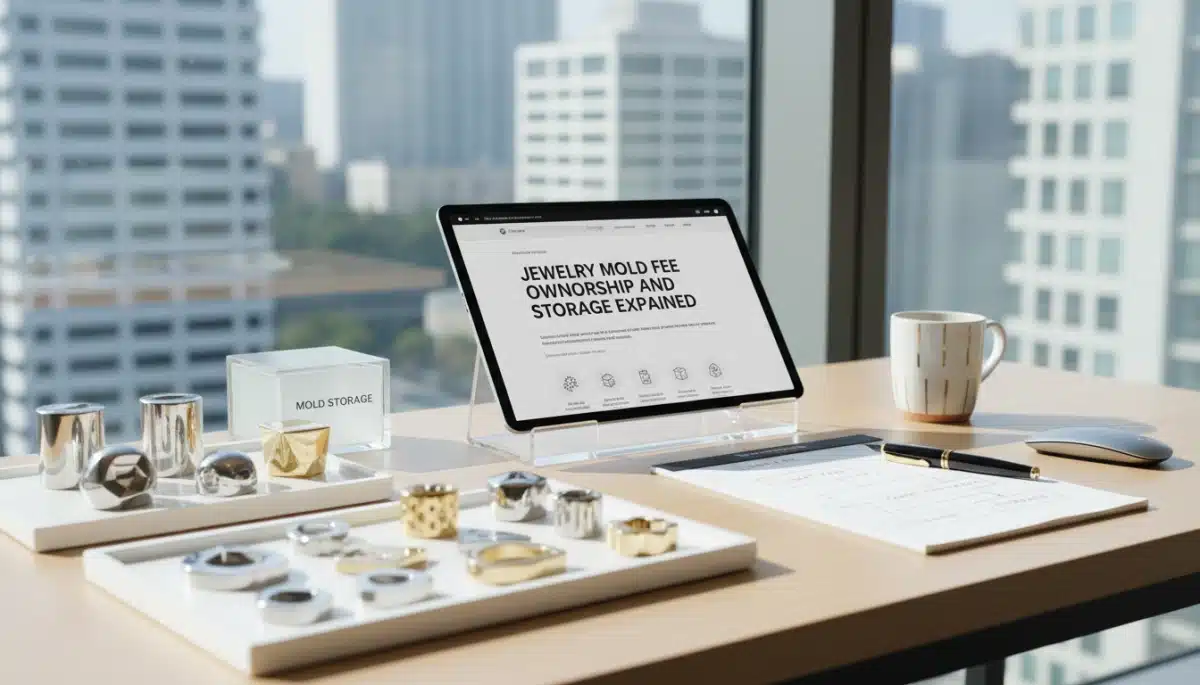
A jewelry mold fee (also called a tooling cost or custom jewelry mold charge) is a one-time setup cost you pay to create the physical mold needed to mass-produce your design.
You’re not paying for finished pieces here—you’re paying to build the tool that makes consistent, repeatable castings.
How a Jewelry Mold Is Created
We typically follow this process to turn your design into a production-ready mold:
- Master Model
- Created from CAD (computer file) or a hand-carved prototype
- Can be 3D-printed in wax/resin or made in metal
- Rubber or Silicone Mold
- The master model is pressed into rubber or silicone under heat and pressure
- The mold is cut open to release the master, leaving a detailed cavity
- Lost-Wax Casting
- Wax is injected into the mold to create wax copies
- Wax trees are built, then covered in plaster
- Wax is melted out (“lost wax”), and molten metal fills the cavity
This is the standard lost-wax casting mold workflow most professional jewelry casting services use.
Why Jewelry Molds Matter
A well-made rubber mold for jewelry or silicone jewelry mold is critical because it:
- Keeps dimensions, details, and branding marks consistent
- Allows scalable production once the design is approved
- Reduces defects, rework, and labor time
- Lowers your per-unit jewelry production cost over multiple runs
If you want to move from a single prototype to a real line, you need solid jewelry production tooling in place.
One-Time Mold Fee vs. Per-Unit Costs
It’s important to separate the jewelry mold fee from your ongoing production pricing:
| Cost Type | What It Covers | How Often You Pay |
|---|---|---|
| Mold Fee / Tooling Cost | CAD to mold process, master model, mold fabrication | One time per design |
| Per-Unit Production Cost | Metal, stones, labor, finishing, quality control | Every order |
| Development / Sample Fees | Prototypes, test castings, minor design adjustments | As needed |
- The one-time tooling cost is paid upfront so we can build your production-ready mold.
- After that, you only pay the per-piece rate and any agreed minimum order quantity with mold fee already covered.
Understanding this separation helps you budget correctly, compare jewelry manufacturer mold policies, and evaluate when high-volume mold discounts actually make sense for your brand.
Jewelry Mold Fee Cost Breakdown
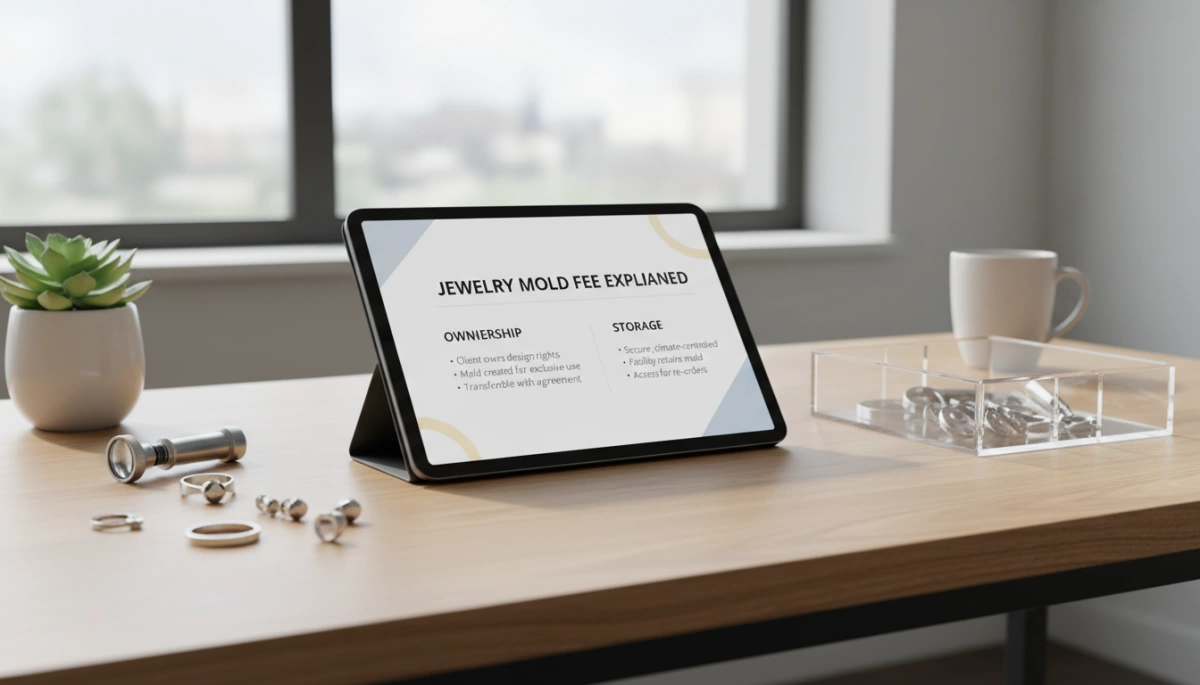
When I quote a jewelry mold fee (tooling cost), here’s what’s really driving that number:
Main Cost Drivers
The custom jewelry mold charge depends on:
- Design complexity – Deep cutouts, openwork, 3D shapes, and undercuts need more prep and a more advanced mold.
- Fine details – Tiny pavé settings, micro logos, and sharp textures require higher-precision molds and more time.
- Size & structure – Big pendants, chunky rings, and multi-part pieces often need larger or multiple molds.
- Type of jewelry – Rings, hoops, layered pendants, and multi-component stainless steel pieces each mold differently.
In short: the more complex and detailed the design, the higher the jewelry tooling cost.
How Number of Molds Affects Tooling Cost
One design doesn’t always mean one mold. Total tooling cost goes up when:
- The piece has multiple parts (e.g., charm + bail + frame).
- You need different sizes (ring size run, hoop diameters).
- You want both left/right versions (earrings, asymmetrical pieces).
Each extra mold adds to your custom design mold fee, but it pays off once you hit higher reorder jewelry production volumes.
Mold Materials: Rubber, Silicone, Metal
I choose mold material based on your design and production plan:
- Rubber mold for jewelry
- Best for: standard lost-wax casting, basic to mid-level detail
- Pros: affordable, quick to make
- Cons: limited lifespan vs. silicone/metal
- Silicone jewelry mold
- Best for: very fine detail, delicate textures, complex shapes
- Pros: high detail, clean surfaces
- Cons: higher initial tooling cost
- Metal mold for jewelry casting
- Best for: high-volume production, repeat OEM or private label lines
- Pros: longest life, stable sizing, consistent quality
- Cons: highest mold fee upfront; worth it only if you reorder often
Typical Price Ranges (Ballpark)
Actual numbers depend on design and market, but for most custom jewelry mold fees:
- Simple rubber/silicone mold: $80–$250 per mold
- Complex or multi-part designs: $250–$600+
- Precision metal molds (for big volume): $800–$2,000+
For brands sourcing overseas from China jewelry manufacturers, pricing is usually on the lower side for rubber/silicone molds, especially if you’re working with a volume-focused factory like a professional OEM supplier similar to what we offer on our China jewelry manufacturing services.
When Mold Fees Are Reduced, Waived, or Credited
I’m flexible with jewelry mold fee policy when you’re serious about volume:
- Reduced mold fee if your first order hits a certain minimum order quantity with mold fee.
- Tooling fee waiver on very high-volume or long-term programs.
- Credit-back programs where part or all of the mold fee is:
- Credited against your first large order, or
- Amortized over multiple repeat order jewelry pricing cycles.
For US brands planning ongoing collections or private label lines, the smart move is to treat the mold as a one-time tooling cost that you spread across 6–12 months of reorders. Once the mold is done, your reorders are cheaper and faster, and your per-piece cost drops hard.
Jewelry Mold Fee Explained: Ownership Rules
What “mold ownership” really means
In jewelry manufacturing, mold ownership means who has the legal right to control, use, move, or destroy the mold created for your custom design. That includes:
- Who can approve new production from that mold
- Whether the mold can be used for other clients
- Whether you can transfer the mold to another factory
- Who decides when it’s repaired, remade, or disposed of
If the ownership rules aren’t clear, your jewelry tooling cost can become a sunk cost you can’t fully control.
Customer-owned vs. manufacturer-owned molds
Most factories follow one of two mold ownership models:
- Customer-owned jewelry molds
- You pay a custom jewelry mold charge that covers full tooling cost
- The mold is dedicated to your brand only (OEM / private label)
- You can request the mold to be shipped to another manufacturer (subject to contract)
- Factory cannot legally reuse your mold or design without your written approval
- Manufacturer-owned molds
- Factory subsidizes or fully waives the tooling cost
- They keep legal ownership of the mold and full control of storage
- Often tied to minimum order quantities and ongoing production with that factory
- You usually cannot take the mold if you change suppliers
When I work with small US brands through our own wholesale custom jewelry manufacturer setup, I push for customer-owned molds on unique, branded designs to protect their long-term leverage and IP.
Does paying the full mold fee mean you own it?
Not automatically. Paying the full mold fee or “one-time tooling cost” usually implies you’re buying ownership, but in practice it only counts if:
- The contract clearly states: “Mold is owned by Customer”
- The quote or invoice lists the mold as a customer-owned asset
- There’s a clause that allows mold transfer or release upon request
If the terms only say “mold fee” or “setup fee” without ownership language, many overseas factories will still treat it as their asset, even if you paid 100% of the custom design mold fee.
Why clear contracts and written mold agreements matter
You should always have mold ownership and usage rights in writing. A solid jewelry manufacturer mold policy or contract should cover:
- Who owns the mold and the design (customer vs factory)
- Exclusive use: whether the mold can be used for anyone else
- Mold transfer rights if you change suppliers
- Storage period, storage fees (if any), and disposal rules
- What happens if the mold is lost, damaged, or destroyed
If you’re a new or small brand looking for custom jewelry production support, work only with manufacturers who clearly define mold ownership and storage in advance. Transparent partners, like the ones we highlight when we vet reliable wholesale custom jewelry manufacturers for small businesses, will never dodge these questions.
Risks of unclear mold ownership
When mold ownership is vague, you’re exposed to real business risks:
- Lost access to your mold
- Factory can refuse to release it when you move production
- You may be forced to pay a second jewelry tooling cost to remake it elsewhere
- Reuse of your design
- Factory can quietly use your mold for other clients (especially in overseas manufacturing)
- Your “exclusive” design ends up on marketplaces at lower prices
- Production disruption
- Disputes over who owns the mold can stall reorders and delay launches
- Weakened IP protection
- Harder to prove your design is exclusive if your own factory treats the mold as theirs
Bottom line: before you pay any jewelry mold fee, lock down who owns the mold, who can use it, and what happens if you walk away. That clarity is worth far more than whatever you save on a cheap, no-contract tooling fee.
Intellectual Property and Design Protection for Jewelry Molds
When you pay a jewelry mold fee or any tooling cost, you’re not just paying for a piece of rubber or silicone—you’re protecting your intellectual property and your brand. The mold is a physical copy of your design, so whoever controls the mold can, in practice, control who gets that design in metal.
How Jewelry Molds Tie Into Your IP and Branding
Your mold is a direct link to your jewelry intellectual property:
- It holds your exact shapes, logo details, textures, and proportions.
- Any factory with that mold can reproduce your custom jewelry design without your permission.
- If you’re building a brand in the U.S. market, your mold is part of your brand assets, just like your logo files and CAD files.
This is why mold ownership in manufacturing, mold usage rights, and clear tooling agreements matter just as much as your per-unit jewelry production cost.
Extra Protection When Working With Overseas Manufacturers
If you’re producing overseas (China, Thailand, etc.), you need to be more intentional about jewelry design protection:
- Never rely on verbal promises. Get everything in writing.
- Work only with manufacturers that have clear jewelry mold fee policies and are used to OEM/private label work for U.S. brands (similar to how we structure agreements as an ODM jewelry manufacturer).
- Keep control over your CAD files and master models; share only what’s necessary.
- Consider splitting your supply chain (CAD with one partner, production with another) if a design is extremely sensitive.
Key Contract Clauses: Exclusivity, Non-Disclosure, Non-Reproduction
Before you approve any custom jewelry mold charge, make sure your contract calls out:
- Exclusivity Clause
- States that your jewelry design and mold are for your brand only.
- Factory cannot sell your design (or very similar variants) to other customers.
- Non-Disclosure (NDA) Clause
- Factory cannot share your CAD files, molds, samples, or production photos without permission.
- Covers employees, subcontractors, and partner factories.
- Non-Reproduction Clause
- Factory cannot produce extra units beyond your purchase orders.
- No “night runs,” no selling overstock, no listing your designs on their own website/marketplaces.
Make sure these terms are tied to your mold ownership, not just to a one-time order.
How to Stop Factories From Using Your Mold for Other Clients
You won’t stop abuse with “trust” alone—you stop it with structure:
- Own the mold in writing: The contract should clearly say you are the owner of all jewelry molds, tooling, and master models created for your brand.
- Label and document: Ask for photos of your molds with your brand name or code physically marked on them.
- Audit-friendly terms: Give yourself the right to inspect or request mold photos, and to demand proof of destruction if molds are ever disposed of.
- Order history tracking: Compare your purchase volumes to realistic capacity from each mold; if something feels off, you’ll know where to dig.
If you ever catch a factory using your mold for others, you should be able to point directly to breach of the non-reproduction and exclusivity clauses.
When to Use NDAs, Design Registrations, and Trademarks
Use the right protection tools at the right time:
- NDAs (Non-Disclosure Agreements)
- Use before you send CAD files, sketches, or samples to any potential jewelry supplier.
- Essential for OEM and private label projects, especially with new factories.
- Design Registrations / Design Patents
- Consider this for truly unique, high-value designs that you plan to sell at scale in the U.S.
- Gives you stronger legal ground if someone copies your exact look.
- Trademarks
- Protects your brand name, logo, and sometimes distinct brand elements (like a signature tag or symbol).
- Even if someone copies your design, you can often stop them from using your brand identity and confusing your U.S. customers.
In short, your jewelry mold, tooling cost, and ownership agreement are part of your IP strategy. If you treat the mold like a simple production tool, you leave money—and control—on the table. If you treat it like a core brand asset, you get long-term security, cleaner reorders, and a lot less stress as you scale.
Mold Storage: How and Where Your Jewelry Molds Are Kept
When you pay a jewelry mold fee or tooling cost, storage is a big part of the real value. If you’re planning custom jewelry production in the U.S. (or with overseas partners), you need to know exactly how your molds are handled, where they sit, and how that affects future reorders.
Standard Jewelry Mold Storage Practices
Most professional jewelry factories and workshops will:
- Store molds (rubber, silicone, or metal) in dry, temperature-controlled areas
- Keep customer molds separate from their own in-house tooling
- Use labeled boxes, drawers, or racks by client name, SKU, and collection
- Restrict access so your mold can’t “accidentally” be used for other clients
If a manufacturer can clearly show you their jewelry mold storage practices—just like they should be able to explain basic topics such as jewelry hallmarks and metal markings—it’s usually a sign they run a serious operation.
How Long Molds Are Kept Before Disposal
There’s no universal rule, but common policies for inactive molds are:
- 1–2 years of no orders: some factories flag the mold as “inactive”
- 2–5 years of no activity: many will archive or prepare for disposal
- Before disposal, good manufacturers will:
- Email or call you first
- Offer paid storage extension or ship the mold to you at your cost
You want this timeframe and the mold disposal policy written into your quote or contract, especially if you reorder slowly or seasonally.
Environmental Factors That Affect Mold Life
Even if you’ve paid a one-time tooling cost, mold life isn’t infinite. Things that shorten mold lifespan:
- Heat – softens rubber/silicone and distorts fine details
- Humidity – can cause warping, sticking, or even mild surface mold on old rubber
- Rough handling – tears gates, damages small prongs, weakens edges
Ask where your molds are physically stored and how they’re protected. Proper storage is part of your jewelry mold maintenance and directly affects casting quality over time.
Labeling, Cataloging, and Tracking for Easy Reorders
For smooth reorder jewelry production, your manufacturer should have:
- Unique mold ID codes linked to your CAD, photos, and order history
- Clear labels: client name, item code, metal, size range, version
- A digital system (ERP, spreadsheet, or database) so they can:
- Find your mold in minutes
- Pull up your past quantities, metals, and finishes
- Quote reorders quickly without “re-developing” the design
This is where owning a mold really pays off—your reorders are faster, cheaper, and more consistent when your mold is properly cataloged, not just tossed in a box.
If You Switch Manufacturers but They Still Store Your Mold
This is where mold ownership in manufacturing really shows up:
- If you clearly own the jewelry mold (contract says “customer-owned mold”), you can:
- Request the original mold be shipped to you or your new factory
- Pay for packing, insurance, and freight and move on
- If the factory claims ownership, they may:
- Refuse to release the mold
- Offer to sell you the mold at an extra cost
- Use it as leverage to keep your production
To protect yourself:
- Lock in mold ownership, storage period, and release terms in writing before you pay any custom jewelry mold charge.
- Make sure it states whether the factory can keep a copy, remake from your samples, or reuse your design for others (ideally, they can’t).
Handled right, mold storage should support your brand long term—not trap you with a single supplier.
Mold Maintenance and Longevity
When you pay a jewelry mold fee (tooling cost), you’re not just buying a one-time tool—you’re buying repeatable quality over time. How long that mold actually lasts depends on the material and how it’s treated.
How Many Casts per Mold Type?
Here’s a quick, realistic range most US jewelry brands can expect:
| Mold Type | Typical Use | Approx. Casts per Mold* |
|---|---|---|
| Rubber mold for jewelry | Standard lost-wax casting | ~300–800 casts |
| Silicone jewelry mold | Higher detail, more delicate work | ~400–1,000 casts |
| Metal mold for jewelry | High-volume, machine production | 5,000+ casts |
*Actual mold life depends on design complexity, temperature control, and how carefully the factory handles it.
Common Wear-and-Tear Issues
As molds age, you’ll see it in the final jewelry quality. Typical problems:
- Softened or rounded details – fine lines, textures, and prongs lose sharpness.
- Flash and extra seams – wax leaks along mold splits, causing more cleanup and polishing labor.
- Misalignment – mold halves don’t register perfectly, leading to crooked parts or uneven thickness.
- Micro tears or cracks – especially around thin areas like settings or logo details.
Once these issues show up, your “perfect” first production run isn’t what you get on the 50th unless the mold is maintained.
How We Maintain Jewelry Molds
Good jewelry manufacturers don’t just throw molds on a shelf and hope for the best. To extend mold life and protect your jewelry tooling cost, here’s what we typically do:
- Controlled storage – store molds flat, away from heat, UV, and humidity to avoid warping.
- Regular inspections – check molds after batches for cracks, shrinkage, or deformation.
- Careful injection and release – avoid over-heating wax or metal and use release agents correctly.
- Limited overuse – retire or refresh molds instead of pushing them far past their good casting life.
If you’re working with overseas suppliers, look for partners that are public about their jewelry manufacturing standards and policies, not just price.
When a Mold Needs Repair, Refresh, or Remake
A responsible factory should flag mold issues before they ruin a full batch. Typical stages:
- Repair – minor fixes like cleaning vents, re-cutting registration keys, or patching small tears.
- Refresh – making a new rubber or silicone mold from the original master or best existing casting.
- Full remake – if the mold is too worn or the master is gone, we remake from CAD or a sample; this can mean a new mold fee or partial tooling cost.
You should always be told when a new mold is being made, especially if that affects your custom jewelry mold charge or lead time.
Who Pays When the Mold Wears Out?
This is where mold ownership and factory policy really matter:
- Customer pays again (common)
- If the contract says the original jewelry mold fee only covers creating the first mold.
- When the mold has reached a “normal” lifespan (for example, 600+ casts from a rubber mold).
- Factory covers or discounts (better policies)
- If the mold wore out unusually fast due to poor handling.
- For high-volume or long-term clients where we amortize tooling cost over many orders.
- When we’ve promised a certain mold life or minimum number of reorders.
To protect yourself, always ask in writing:
- “How many casts is this mold expected to last?”
- “If the mold wears out, do I pay a new mold fee or do you?”
- “Is there a price break or tooling fee waiver after a certain order volume?”
Getting clear answers on mold maintenance and longevity upfront will save you from surprise costs and inconsistent quality on future reorders.
Storage Fees and Hidden Costs for Jewelry Mold Fee
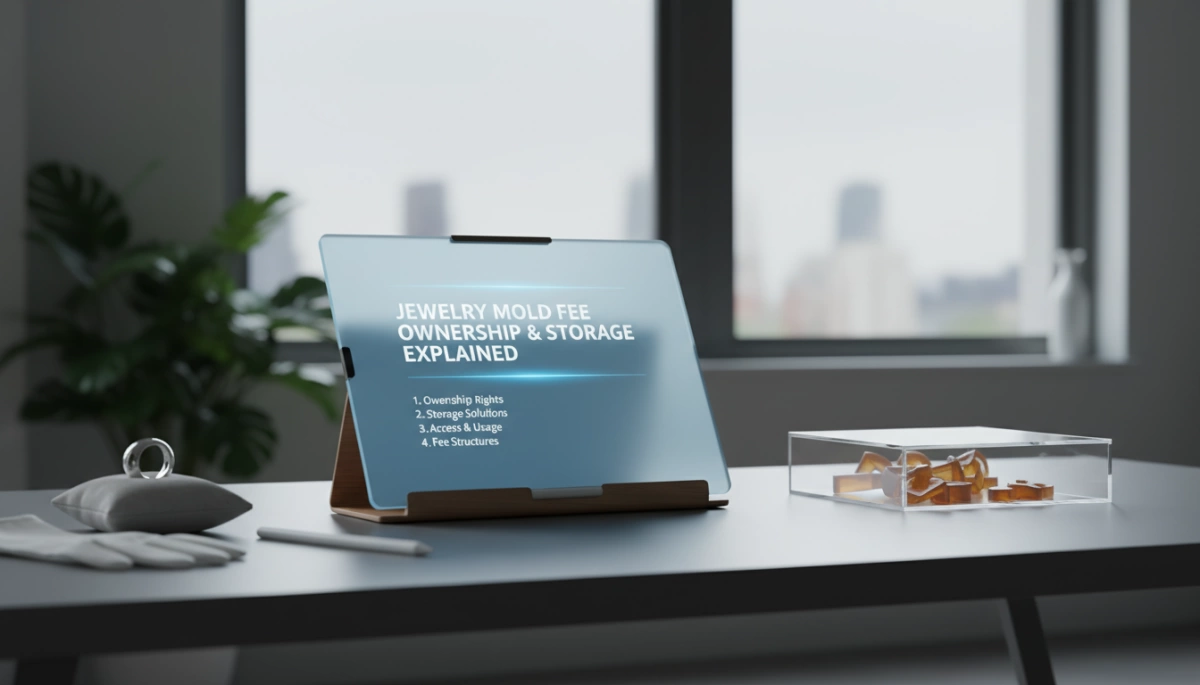
When Mold Storage Is Included vs. Extra
For most custom jewelry production, basic mold storage is included in your initial jewelry mold fee for a certain period. Common setups I see:
- Included storage (no extra charge)
- 1–2 years of storage after your last order
- As long as you reorder at least once per year
- Extra mold storage fees kick in when:
- You stop reordering for 12–24 months
- You have a very large number of molds taking up space
- You ask for guaranteed long‑term storage (3–5+ years)
If a jewelry manufacturer is handling a lot of OEM / private label molds like we do, they have to be clear about when storage is free and when it becomes a paid service.
Typical Jewelry Mold Storage Fee Structures
Jewelry mold storage charges usually follow one of these models:
- Flat rate per year
- Example: $50–$150 per year for all your molds under one brand
- Per mold, per year
- Example: $5–$20 per mold annually (common with smaller workshops)
- Per design, per year
- One fee for each style number, regardless of how many molds that style uses
- Tiered storage with minimums
- Free up to X molds, then a small fee above that
With larger overseas manufacturers, mold storage is often baked into your overall jewelry production tooling and reorder model. With more transparent factories, they’ll explain this clearly when they quote your custom jewelry mold charge.
Fair vs. Excessive Mold Storage Charges
You can usually spot fair vs. unreasonable storage fees quickly:
Fair mold storage fees:
- Clearly written in the quote or contract
- Reasonable vs. your annual order volume
- No surprise “administration charges” attached
- Discounts or waivers for repeat/high-volume clients
Excessive mold storage charges:
- Fees suddenly appear after the mold is already made
- Storage costs approach the original jewelry tooling cost each year
- You’re forced to pay high storage fees just to keep mold access
- They charge you to “find” your mold every time you reorder
If a factory uses storage fees to lock you in or pressure you into constant reorders, that’s a red flag.
How to Avoid Surprise Mold Storage Costs
To keep your custom jewelry production cost clean and predictable:
- Lock storage terms in writing before you approve any mold fee
- Ask, “How many years of storage are included in this price?”
- Confirm, “What happens if I don’t order for 12–24 months?”
- Get an email or contract saying:
- Included storage period
- When and how storage fees start
- Exact fee structure (per mold / per design / per year)
- Ask how they handle mold disposal if you go inactive
A professional jewelry manufacturer mold policy will spell this out clearly, the same way we do when we onboard new custom clients or OEM brands for 3D design and custom jewelry manufacturing.
What to Negotiate Before Paying the Mold Fee
Before you pay any jewelry mold fee or tooling cost, negotiate these storage points:
- Free storage period
- Aim for at least 2–3 years of free storage after your last order
- Caps on storage fees
- A maximum annual fee, not open-ended extra charges
- No-pay window after inactivity
- Example: They must notify you and give you 30–60 days to reorder or decide what to do with your mold
- Clear disposal or return policy
- Can you have the mold shipped back? At what cost?
- Waivers for growth
- If your reorders hit a certain volume, ask them to waive storage fees entirely
If you’re working with a high-volume wholesale jewelry manufacturer or an OEM/ODM partner like we operate as, they should be prepared to talk straight about mold ownership, storage, and all related hidden costs right at the quoting stage, not after the fact.
Impact of Mold Ownership on Reorders
How mold ownership changes reorder pricing and timelines
When you own your jewelry mold, every reorder is basically production-only cost. You’re not paying that custom jewelry mold charge or tooling cost again, so your price per piece drops and your margins go up. Lead times also shrink because the factory can go straight to casting instead of setting up new tooling.
Typical impact on reorder jewelry production:
- No repeat jewelry mold fee or tooling cost
- Faster turnaround (often 3–7 days saved on setup and sampling)
- Less back-and-forth on dimensions and details
Why reorders are cheaper and faster
Once a rubber mold for jewelry or silicone jewelry mold is approved:
- The factory reuses the same tooling for lost-wax casting
- Shrinkage, polishing, and stone fit are already dialed in
- Waste and defect rates are lower, which keeps pricing stable
That’s why serious jewelry manufacturers build pricing around a one-time tooling cost that gets “amortized” over repeat runs.
Realistic cost savings across runs
Here’s a simple, realistic example for the U.S. market:
| Order Round | Qty | Mold / Tooling Cost | Unit Production Cost | Total Cost | Effective Cost per Piece |
|---|---|---|---|---|---|
| First run | 100 | $250 mold fee | $12 per piece | $1,450 | $14.50 |
| Second run | 100 | $0 (mold owned) | $12 per piece | $1,200 | $12.00 |
| Third run | 300 | $0 (mold owned) | $10.50 per piece* | $3,150 | $10.50 |
*Larger runs often unlock high-volume mold discounts and better unit rates.
Over a few seasons, your jewelry tooling cost per piece drops sharply, which is why I always plan designs for multiple reorders, not just a one-off launch. If you’re new to production, it helps to understand the full development path from CAD to mold; you can see how this works in practice in my guide on how to make jewelry from design to production.
How reorder minimums and mold access are linked
Most factories tie minimum order quantity with mold fee and reorders together:
- Lower mold fee but higher reorder MOQ
- Or higher mold fee up front but more flexible reorders
- Some OEM jewelry mold fee offers waive or credit molds once you hit a lifetime quantity
Your mold usage rights should clearly say:
- What the reorder MOQ is (per style, per color, per size)
- How long they will honor your reorder pricing and mold access
What happens if you lose ownership or access
If you don’t truly control the mold (or the contract is vague), you’re exposed:
- The manufacturer can:
- Refuse to run small reorders
- Raise prices because “you can’t go anywhere else”
- Charge a new custom design mold fee if they claim the original is “lost” or worn out
- You can’t move production easily to a new supplier, because your jewelry mold ownership in manufacturing is unclear
- In some overseas jewelry manufacturing molds setups, they may even reuse your look for other clients if exclusivity isn’t locked in
To protect your reorder position, I always push for:
- Clear wording that the mold is customer-owned jewelry molds, even if the factory stores it
- Guaranteed access for future repeat order jewelry pricing
- A defined process and cost to release the mold or replicate it if needed
If you plan ongoing collections or private label lines, your mold fee policy is just as important as your per-piece price.
Using Your Jewelry Mold With Other Manufacturers
Can You Move a Customer-Owned Mold?
If you clearly own the mold in your contract, you can usually move it to another jewelry manufacturer. This is common when brands want better pricing, quality, or service. Make sure your agreement says in plain English:
- You own the mold and all tooling
- The factory must release and return the mold on request
- You can use the mold with any other supplier (no usage restriction)
Without those lines, “mold ownership in manufacturing” can be argued, and some factories will try to keep it.
Shipping, Insurance, and Risk
Moving a physical jewelry mold (rubber, silicone, or metal) isn’t hard, but you have to protect it like any other asset:
- Use secure packaging – rigid box, padding, no exposed surfaces
- Insure the shipment for the full mold replacement value (tooling cost + time)
- Ship with tracking and signature required
- Share photos of the mold before shipping, so both sides agree on its condition
If the mold is lost or damaged in transit, your insurance claim is your only realistic recovery path, so don’t skip that step.
When a Factory Refuses to Release Your Mold
If a jewelry manufacturer refuses to hand over your mold:
- Check the contract – Do they legally own it? Or are they simply stonewalling?
- Ask for a written explanation – Email only, so you have a paper trail.
- Leverage unpaid orders – If you still owe money, they may be holding the mold as “security.”
- Use legal pressure – A short letter from an attorney often changes the tone fast.
- Be ready to walk away – Sometimes it’s cheaper to remake the mold than fight for it endlessly.
This is exactly why clear “who owns jewelry molds” clauses matter before you start any custom jewelry production.
Alternatives to Moving the Physical Mold
If you can’t get your mold back, or you’d rather not ship it, you still have options:
- CAD Files – Send your 3D CAD files to the new factory so they can rebuild the jewelry mold.
- Master Model – Provide a metal or resin master model; they’ll create a new rubber or silicone jewelry mold from it.
- High-Resolution Photos + Specs – In a worst case, a skilled OEM jewelry manufacturer can reverse-engineer your custom design with detailed photos, measurements, and stone sizes.
This is often faster and safer than arguing over a lost or “hostage” mold.
Legal and Relationship Tips for Changing Suppliers
When transitioning to a new jewelry factory, especially overseas:
- Lock in mold usage rights, ownership, and mold transfer terms in writing from day one.
- Add clauses that say the factory cannot reproduce or sell your design to anyone else.
- Keep communication calm and professional—burning bridges can backfire if you ever need old tooling data or records.
- Ask the new supplier to clearly break out mold fee vs. per-unit cost in their quote (similar to how we split costs in our wholesale jewelry pricing breakdown).
Handled right, moving your customer-owned jewelry molds is a one-time hassle that sets you up for better pricing, faster reorders, and more control over your brand long term.
Best Practices for Jewelry Mold Fee Agreements
When you’re talking about a jewelry mold fee or any tooling cost, the agreement is everything. If it’s not in writing, it doesn’t exist. Here’s how I lock this down in my own contracts and what I recommend you do too.
Key Questions Before You Approve Any Mold Fee
Before you pay a custom jewelry mold charge, ask:
- Who owns the mold? Customer-owned or factory-owned? Get the wording exact.
- Can I move the mold to another manufacturer later? If yes, what’s the process and cost?
- How long will you store my mold? Be specific: “X years from last order.”
- Are there mold storage fees? Flat fee, annual, or included in production?
- Will the mold fee be credited on future orders? Any high-volume mold discounts or tooling fee waiver options?
- Is this a one-time tooling cost or will there be remake fees later? Under what conditions?
These questions prevent surprises on reorders, mold ownership, and long-term jewelry production tooling costs.
What to Lock Into the Contract
Your jewelry manufacturer mold policy needs to be in the contract, in plain English. I make sure these points are written and signed:
- Mold fee amount & what’s included
- CAD to mold process, prototype, final production mold, and test samples.
- Mold ownership in manufacturing
- “Client owns all molds, masters, CAD files, and related tooling for this design.”
- Storage terms
- Storage location, duration, and who pays ongoing mold storage fees.
- Usage rights
- “Factory may only use molds for [Brand Name] orders and may not produce for any third party.”
This is where you protect your custom jewelry production cost and keep control over your designs.
Sample Terms to Clarify (Copy-Paste Style)
You don’t need legalese. You need clarity. Examples you can adapt:
- Exclusivity
- “The manufacturer may not use the client’s molds, CAD files, or master models to produce jewelry for any other customer, online store, or brand.”
- Storage period
- “Molds will be stored for a minimum of 3 years from the date of the last order, at no additional cost. After that period, any storage fees must be approved in writing by the client before being charged.”
- Disposal rules
- “The manufacturer must notify the client in writing at least 60 days before destroying or disposing of any molds, and must offer the option to ship the molds back to the client at client’s cost.”
These terms keep you in control of mold life span, storage, and disposal, not the factory.
How Small Brands Can Negotiate Mold Fees
Even as a new or small brand in the U.S., you have more leverage than you think. Here’s how I usually approach it:
- Trade volume for terms
- “I’ll commit to a reorder if the mold fee is partially credited after X units.”
- Negotiate step-by-step
- Lower upfront jewelry tooling cost in exchange for a slightly higher first production run price.
- Bundle designs
- Ask for a reduced custom design mold fee if you develop multiple pieces at once.
- Ask for transparency
- Request a breakdown: design, master model, rubber mold for jewelry, silicone jewelry mold, test casting, adjustments.
This kind of straight talk is common with serious, transparent jewelry casting services in the U.S. market.
Red Flags in Quotes and Contracts
If you see these, I’d walk:
- No written mold ownership clause
- If they “don’t do that,” they likely treat all molds as factory-owned.
- Vague mold storage practices
- “We will keep it as long as possible” is code for “We’ll do whatever we want.”
- Hidden mold storage fees
- Storage fees that only show up on the invoice later, not in the quote.
- No limit on mold reuse
- No language about intellectual property jewelry molds, exclusivity, or non-reproduction.
- Refusal to release molds
- If they say in advance they’ll never allow mold transfer between manufacturers, think twice.
You want a partner who is clear on mold usage rights, fair storage fees, and total transparency—ideally the same way you’d expect clear information when comparing things like sustainable jewelry companies and their sourcing practices.
Locking down your jewelry mold fee, tooling cost, mold ownership, and storage rules in writing is what protects your brand, your margins, and your ability to reorder on your own terms.
Working With Transparent Jewelry Manufacturers
When you’re paying a jewelry mold fee or any tooling cost, you need a factory that’s straight with you from day one. As a manufacturer, I can tell you: clear mold policies aren’t “nice to have” — they’re the only way to build long-term trust and keep your total jewelry production cost under control.
Why Clear Mold Policies Matter
A transparent jewelry manufacturer will spell out, in writing:
- What the jewelry mold fee covers (CAD, master model, rubber/silicone mold, test casting, revisions).
- Who owns the mold (customer-owned vs. factory-owned, and what “ownership” actually means).
- How and where molds are stored, and for how long.
- What happens on reorders (no new tooling cost, lower per-unit pricing, faster lead times).
When you can see exactly how your jewelry tooling cost is structured, it’s easier to price your line for the US market and avoid surprise charges later.
How We Explain Mold Fee, Ownership, and Storage Upfront
A good OEM jewelry manufacturer should walk you through this in normal language, not legal jargon:
- Mold fee: Is it a one-time tooling cost? Is any part credited back on high-volume reorders?
- Mold ownership: Do you fully own the mold and can you move it to another factory if needed?
- Mold usage rights: Is your design exclusive, or can the mold be reused for other clients?
- Storage policy: How long we store your mold, whether there are storage fees, and our mold disposal policy.
If you’re looking for an OEM partner that works this way, check out how we handle projects as a best OEM jewelry manufacturer.
What a Client-Friendly Mold Policy Looks Like
In practical terms, a customer-focused jewelry mold fee policy usually includes:
- Clear one-time tooling cost per design, with no hidden add-ons.
- Written statement that you own the mold once it’s paid in full (or clear terms if you don’t).
- Defined storage period (for example, 2–3 years after last order) before any disposal.
- No surprise storage fees — or at least storage costs disclosed before you commit.
- Simple mold transfer process if you want to move to another jewelry manufacturer.
This kind of mold policy is what lets small US brands and private label clients scale without constant renegotiation.
Communication That Prevents Mold Problems
Most mold disputes come from poor communication, not bad intentions. To avoid that, your manufacturer should:
- Confirm timelines: how long from CAD to mold, from mold to first casting, and to full production.
- Share update photos or videos of the master model, mold, and first samples.
- Explain limits on revisions included in the original jewelry mold fee.
- Flag when a mold update or remake is needed as your order volume grows.
When these details are discussed before you pay your custom jewelry mold charge, you stay in control of your brand and your margins.
Realistic Expectations for Timelines and Updates
For most US brands working with overseas jewelry manufacturing:
- CAD to mold: usually 5–10 business days for a new custom design.
- Mold testing and sample approval: 1–3 weeks, depending on complexity.
- Mold updates (small tweaks): 2–7 days.
- Full mold remake (if worn out or major design change): similar to creating a new mold and may involve a new tooling cost.
A transparent jewelry mold fee policy sets these expectations upfront, so you’re never guessing when your line will be ready or why a cost changed.
FAQ: Jewelry Mold Fee, Ownership, and Storage
What is actually included in a jewelry mold fee?
A jewelry mold fee (tooling cost) usually covers:
- CAD adjustment or pre-production file setup
- Making the master model or cleaning up your supplied model
- Creating the rubber or silicone mold (or metal mold for higher volumes)
- Test casting and basic tweaks so the piece casts cleanly
It normally does not include:
- Final plating, stones, or full production costs
- Major design changes after the mold is finished
- Long-term storage fees (those are usually separate)
Always ask your jewelry manufacturer for a line-item breakdown of the custom jewelry mold charge so you know exactly what you’re paying for.
Do I automatically own the mold once I pay for it?
No, not automatically. In jewelry production, paying the mold fee ≠ owning the mold unless the contract clearly says so. Common setups:
- Customer-owned mold: You fully paid the tooling, and the agreement states the mold is yours and can be moved.
- Factory-owned mold: The fee is treated as a setup or development fee; the physical mold stays with the factory.
If mold ownership in manufacturing matters to you, get it in writing with clear mold usage rights and transfer terms.
How long will my mold be stored if I stop ordering?
Storage time depends on the factory’s mold policy, but typical timelines:
- 1–3 years of inactivity before they mark the mold for disposal
- Some keep molds longer for active clients or brands with regular seasonal orders
Ask upfront:
- “How long do you keep inactive molds?”
- “Will you notify me before disposal?”
This is crucial if you plan seasonal or long-gap reorders of your custom designs.
Are there ongoing storage fees for my jewelry molds?
Sometimes yes, sometimes no. Common approaches:
- Included storage: Free for active clients or for a set period (e.g., 1–2 years).
- Storage fees: Flat annual fee per mold or per design once you stop ordering or after a grace period.
Watch for:
- Hidden mold storage fees buried in the quote
- Charges that don’t match your actual reorder plans
Before paying any jewelry tooling cost, confirm if, when, and how much storage will cost over time.
How long do jewelry molds usually last before needing replacement?
Mold life span depends on material, design, and how often it’s used:
- Rubber mold for jewelry: Roughly 300–800 casts if handled well
- Silicone jewelry mold: Often 500–1,000 casts and better detail for fine work
- Metal mold for jewelry casting: Thousands of cycles, used for very high-volume OEM jewelry mold runs
Delicate designs, thin prongs, and deep textures wear molds out faster. Ask your supplier who pays for a remake once normal wear-and-tear kicks in.
Can I take my mold to another jewelry manufacturer?
You can only move a mold if:
- The mold agreement states you own the physical mold, and
- There’s no exclusivity that locks production to that factory
If you own it, you can:
- Request the physical mold
- Ship it (insured) to a new factory
- Or send CAD files and master models instead
If the factory refuses to release a mold you own, that’s a contract and relationship issue—and a big red flag. In many cases, it’s smarter to start fresh with a new supplier who offers a transparent custom jewelry manufacturer agreement from day one.
What if my manufacturer uses my mold without permission?
If a factory reuses your private label jewelry molds or jewelry casting tools for other clients without approval, they’re likely violating:
- Your contract (if you have exclusivity or non-reproduction clauses)
- Your intellectual property rights, depending on the design and region
Steps I recommend:
- Collect proof: Photos, listings, or samples that show your design being reused.
- Review your contract: Look for mold usage rights, NDA, non-reproduction, and exclusivity terms.
- Send a formal notice: Ask them to stop production and remove listings immediately.
- Consider legal action: Work with an IP lawyer if the design has real commercial value.
To avoid this problem, lock in non-disclosure and non-reproduction clauses before paying any custom design mold fee—especially with overseas jewelry manufacturing molds or large costume jewelry runs.
Surgical Steel vs Sterling Silver: Buyer Guide
You’re pricing a new collection, and the sample tray is already split down the middle.
How to Gold Plated Jewelry the Right Way for Lasting Color
You probably have a launch already in motion, a supplier sample on your desk, and
What Is a Shank on a Ring: Guide to Design & Durability
You’re refining a ring design, the stone looks right, the setting is approved, and the