You’ve got the sample in hand, the price looks workable, and the first quote sounds clean. Then the follow-up starts, the plating spec is fuzzy, the fit is slightly off, and the production date slips just enough to miss the launch window. That’s when a manufacturer jewelry decision stops being a sourcing task and becomes a cash-flow problem, because every delay pushes packaging, content, retail sell-in, and preorder timing further down the calendar.
The hard part is that the mistake usually doesn’t look like a mistake at first. The piece can look right in photos, the sample can pass a quick review, and the supplier can still be wrong for your business model. In jewelry manufacturing, the key test is whether the factory can repeat the result at scale, document the spec, and protect your working capital while it does it.
For buyers, that means the right partner isn’t just the cheapest quote. It’s the one that can convert a design brief into a feasible production plan, hold tolerances, control plating and finishing, and keep the order moving without surprising you on deposits or rework. That’s the lens that matters when you’re choosing custom jewelry, wholesale jewelry, or a private label line that has to launch on time and stay within margin.
When the Wrong Manufacturer Costs You the Launch
A buyer can lose a launch without ever getting a broken part in the box. The more common failure is subtler. The sample arrives, everyone likes the look, and then the bulk run exposes a plating issue, a fit issue, or a compliance gap that should have been caught before tooling.
In practice, the first bad decision is often made on price alone. A low quote can hide weak sampling discipline, vague plating control, or a supplier that treats tolerances as optional. Once production starts, those gaps show up as rework, delayed approvals, and inventory that ties up cash while you negotiate fixes.
Why the first mistake is rarely the last one
Jewelry runs are interconnected. If the band thickness is wrong, the ring size can feel off. If the setting height changes, packaging inserts may no longer fit. If the plating spec is unclear, you can end up with a finish that looks acceptable on day one but fails to meet your channel expectations later.
Practical rule: if a supplier can only talk about appearance and can’t talk about tolerances, finish targets, or inspection steps, you’re still too early in the buying process.
That’s why the manufacturer choice shapes everything downstream. MOQ, material choice, plating thickness, and even the approval rhythm all depend on whether the partner can execute consistently. In jewelry manufacturing, a cheap mistake usually costs more than a careful quote.
The broader market scale makes the decision even less forgiving. The U.S. Jewelry Manufacturing industry is estimated at $16.4 billion in 2026 with 10,280 businesses operating in the sector, and the UK Jewellery Manufacturing market is estimated at £1.0 billion in 2026 (IBISWorld). That’s a large industrial base, not a hobby market. In a sector that sized, production discipline matters because the consequences of a missed launch travel fast across retail relationships and replenishment cycles.
What a Manufacturer Jewelry Partner Actually Does
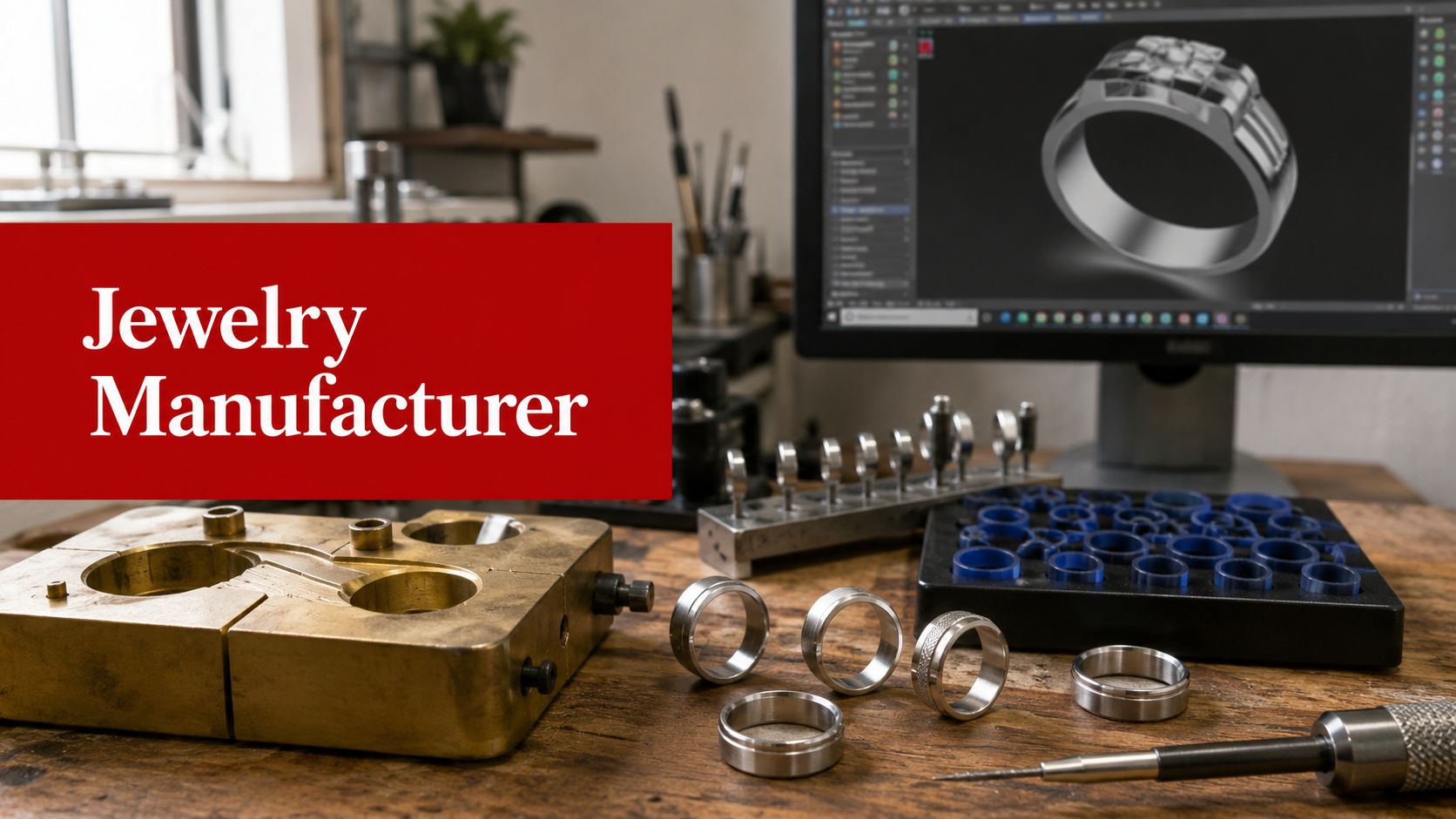
A real jewelry manufacturer doesn’t just “make pieces.” It translates a design into a repeatable process, then controls the parts of production that most buyers can’t see from a render. That usually includes CAD, sampling, mold building, metal forming, setting, plating, finishing, inspection, packaging, and export coordination.

OEM and ODM are the two words buyers will hear most often. OEM means the factory builds to your spec, while ODM means the factory offers a base design that you adapt. The difference matters because it changes who owns the starting point, how much design work comes first, and how much control you keep over the final line.
OEM and ODM in the real world
An OEM stainless steel ring project usually starts with your sketch, dimensions, target finish, and packaging direction. The supplier turns that into CAD, confirms feasibility, makes a sample, and then repeats the approved version at scale. That path works best when you already know what the customer should receive and you want the factory to match your brief.
An ODM project starts closer to the factory’s own design library. You might select a necklace shape or bracelet profile, then change the stone layout, finish, or logo placement. That can shorten development because the base geometry already exists, but it also means you need to check where the factory’s original design stops and your custom work begins.
A strong capability page should make those boundaries obvious. Look for evidence of in-house CAD, sampling, plating, finishing, and private label support, not just broad claims about “full service.” If the supplier lists those functions separately, it’s easier to tell whether they’re integrated or just outsourcing pieces of the job.
For a practical reference point, HonHo Jewelry’s jewelry manufacturing overview is the kind of page buyers should read for service scope, not marketing tone. It shows how a manufacturer can combine production, finishing, and fulfillment into one workflow, which reduces friction when you’re ordering custom jewelry or wholesale jewelry across several SKUs.
Material Lines and What They Mean for Your Collection
Material choice is a business decision before it’s a design decision. The same silhouette can behave very differently in stainless steel, brass, 925 sterling silver, or gold filled, because each line changes cost, durability, plating behavior, and the kind of customer who expects it.
How to read the material trade-off
Stainless steel is usually the practical choice for harder-wearing fashion collections, especially when the brand wants a clean base for plated finishes. It tends to suit chain programs, rings, and earring lines where durability and repeat wear matter more than precious-metal positioning.
Brass gives more flexibility on forming and pricing, which is why it shows up often in fashion jewelry and mixed-material lines. It can work well for detailed shapes and heavier decorative profiles, but it asks more of your plating and finishing control if you want the surface to stay consistent.
925 sterling silver fits brands that need a premium metal story and a higher customer expectation around intrinsic value. It’s common in fine or bridge collections where the buyer wants a genuine silver base rather than a plated fashion substrate.
Gold filled sits in a different lane from plated jewelry because the gold layer is part of the construction, not just a surface finish. For buyers comparing those options, this gold filled comparison guide is useful when you’re deciding whether the collection needs a more durable gold look or a lower-cost visual effect.
Practical rule: choose the metal by channel first, then by design. If your promise is everyday wear, the base material has to support that promise, not fight it.
A stainless steel chain program can make sense for high-volume wholesale because it keeps the line resilient and easier to standardize. A 925 silver earring line can make sense for a premium DTC brand where perceived value and material story carry more weight. Brass often works when you need sculptural flexibility and controlled price points, but only if the plating plan is durable enough for the customer’s wear pattern.
| Material | Relative Cost | Durability | Plating Compatibility | Best Fit For |
|---|---|---|---|---|
| Stainless Steel | Lower to moderate | High | Strong | Volume fashion lines, chains, rings |
| Brass | Lower | Moderate | Strong with proper prep | Fashion shapes, detailed designs |
| 925 Sterling Silver | Higher | High | Less about plating, more about finish | Premium DTC, silver-first collections |
| Gold Filled | Higher than plated fashion bases | High | Built for lasting gold appearance | Higher-trust gold-look programs |
The biggest mistake is choosing material from the sample alone. A sample can look beautiful in isolation and still be wrong for your warranty, price tier, or reorder plan. A collection should begin with a material line that matches your margin, your audience, and the finish promise you can defend.
The Production Workflow From CAD to Crate
Jewelry production works in a sequence, and each step has a buyer decision attached to it. If you approve too quickly, you lock in a flaw. If you approve too slowly, you burn schedule and cash.

The flow usually starts with CAD and rendering. That’s where dimensions, stone placement, and surface geometry are translated into something the factory can build. If your brief is weak, that’s where the problems begin, because a pretty sketch doesn’t tell a manufacturer how the piece should fit or where the tolerances land. The CAD design guide is the kind of resource buyers should use before asking for a quote.
Where delays usually happen
Mold building and sampling come next. This is the stage where a supplier proves whether the design can be manufactured cleanly. A sample may reveal that a bracelet wall is too thin, a clasp feels unstable, or a charm needs more reinforcement before plating.
Pre-production approval is the hard gate. Once the sample is signed off, the factory moves into casting or stamping, then setting, plating, finishing, and final inspection. Each approval should answer a concrete question, not a vague one. Is the thickness right. Does the profile close correctly. Does the finish match the reference. Does the packaging still fit.
A charm bracelet project is a good example of how one small change ripples through the process. If the sample thickness changes after approval, the clasp fit can shift, the plating behavior can change, and the final packaged piece may no longer sit correctly in the insert. What looked like a minor adjustment becomes a schedule problem.
What to approve at each stage
- CAD sign-off: Dimensions, tolerances, and stone or component placement.
- Sample approval: Fit, feel, finish quality, and visible proportions.
- Pre-production approval: Final construction, plating direction, and packaging compatibility.
- Final inspection: Surface consistency, assembly integrity, and shipment readiness.
Typical cycles depend on the complexity of the line, but the key buyer lesson is simple: approve the right thing at the right time. HonHo Jewelry’s stated workflow of CAD in 1 to 2 days, sampling in 7 to 20 days, and production in 25 to 35 days is a useful benchmark for how tightly a coordinated manufacturer can move when the approvals are clean.
Quality, Compliance, and What Buyers Can Actually Verify
A quote is not a quality plan. Buyers need documents, test methods, and inspection standards they can check before money moves into production. That’s especially true when the line will sit in retail, travel through customs, or be sold under a brand that has to answer for every defect.

The documents that matter
The strongest quality pack usually includes plating thickness targets, material composition, hardware specs, finish reference photos, and compliance declarations before production starts. Those items matter because they determine how the piece wears, how it resists corrosion, and whether it fits channel requirements in major markets. That’s the standard buyers should expect, not a vague promise that the product is “good quality.”
For the regulatory side, terms like REACH, ISO 9001:2015, and SMETA should be understood as evidence the supplier can document systems and controls, not just style capability. If a retailer asks for proof of nickel-free compliance, the useful answer is a record set, not a sentence in an email. HonHo Jewelry’s ISO 9001 jewelry page is a good example of how a manufacturer can present process certification alongside production scope.
How to read a claim without getting misled
Salt-spray testing is useful only when you know what it’s checking. It doesn’t prove the piece will never wear, but it does show whether the finish is being evaluated for corrosion resistance under controlled conditions. The same logic applies to plating thickness. A thicker or more controlled finish usually means the factory is thinking about wear performance instead of relying on visual shine alone.
Practical rule: ask for the test result, the target, and the pass criteria. A compliance claim without those three things is just advertising.
What buyers should verify depends on the channel. Retail buyers usually need cleaner documentation and clearer declarations. DTC brands need enough evidence to protect returns and reviews. In both cases, the important question is not whether the supplier says the product is compliant, but whether they can show the file trail behind that statement.
What Actually Drives Cost Beyond the Unit Price
The quote number on the first page is rarely the actual cost. By the time a jewelry order reaches your warehouse, the spend has usually been shaped by deposits, finish complexity, plating thickness, MOQ, and the cost of mistakes that had to be fixed before shipment.
The hidden levers in a quote
Deposits matter because they affect working capital. Many outsourced jewelry manufacturing arrangements require upfront payment or at least a negotiated supplier term, which means the buyer funds production before any sell-through happens. That hits emerging DTC brands harder than it hits established accounts because the inventory sits on the buyer’s balance sheet longer.
MOQ has a different effect depending on the metal. A small MOQ for 925 silver is not the same as the same number of brass units, because the material value and production yield change the cash tied up in each piece. That’s why a “low MOQ” headline can still be expensive if the underlying material or finish is premium.
The finish itself can move the number more than most buyers expect. A stronger plating stack, a more complex surface, or a tighter color-retention target usually adds cost up front, but it can lower returns and reduce warranty exposure later. That trade-off is especially important when the customer expects a gold tone to hold up under regular wear.
A better way to compare suppliers
- Ask for deposit timing: Know how much cash leaves before sampling and before bulk.
- Check plating assumptions: Confirm the thickness target and any protective layers.
- Compare rework risk: A lower quote means little if the factory has to redo batches.
- Review packaging fit: Custom inserts and branded boxes can affect freight and approval timing.
The wholesale conversation should include landed cost, not just piece price. HonHo Jewelry’s wholesale pricing guide belongs in any buyer’s stack because pricing in jewelry manufacturing is shaped by production choices, not by the unit number alone.
Questions to Ask Before You Sign a Quote
A supplier call goes better when the questions are concrete. Broad, polite questions tend to produce broad answers, and broad answers usually hide the parts of the job that cost you later.

The questions that expose real capability
Can you show me the exact production path for this style? A strong answer names CAD, sampling, plating, finishing, inspection, and shipping instead of jumping straight to price.
What material options do you run in-house? You want a direct answer that matches the factory’s real production scope, not a catalog of everything they can “source.”
How do you control plating thickness and color consistency? The right answer includes a target, a measurement method, and some way to hold the finish from sample to bulk.
What documents do you provide before bulk production? Look for compliance declarations, finish references, and approval records.
What is your MOQ by material and by style complexity? A real supplier can explain why one style needs more setup than another.
How do you handle rework and defect handling? The answer should be specific about inspection, correction, and escalation.
What packaging and logistics can you coordinate? If the factory handles boxes, pouches, and shipping together, you’ll usually see fewer handoff problems.
How do you protect design confidentiality? For custom jewelry, this matters more than most first-time buyers realize.
Best practice: keep the call focused on proof. If a supplier talks only about speed and discounts, you’re still missing the control points that protect launch timing.
HonHo Jewelry’s stated capabilities fit many of these buyer concerns in practical terms, including in-house PVD and electroplating, adjustable plating thickness from 0.03 to 5 microns, a two-year plating color retention warranty, hypoallergenic, nickel-free manufacturing, documented defect rates below 0.5%, and certifications including REACH, ISO 9001:2015, and SMETA. Those are the kinds of facts that matter because they map directly to color retention, compliance, and rework control.
Putting It Together for Your Brand Stage
The right manufacturer depends on where the brand is standing today, not on what sounds impressive in a pitch deck. An emerging DTC brand usually needs flexible MOQs, one or two core material lines, and a supplier that can move from CAD to sample without friction. An established retailer usually needs tighter documentation, repeatability, and a cleaner approval trail for wholesale jewelry programs.
Independent designers should lean hard on custom jewelry production only where it creates brand identity. For repeatable basics, OEM or ODM can preserve cash and keep reorder risk under control. Sourcing teams should ask the same three questions every time, how the factory protects color retention, how it documents compliance, and how it handles rework when a batch misses spec.
The fastest way to compare suppliers is to see who can answer those questions without improvising. If the answers are clear, the manufacturing process is probably clear too.
A CTA for HonHo Jewelry.
Private Label Jewelry Manufacturer: Your 2026 Guide
You’re probably at the point where the design looks good on screen, the supplier inbox
Custom Stainless Steel Bracelets a Buyer’s OEM Guide
A lot of new bracelet projects start the same way. A founder has a sketch,
Parts of Jewelry Glossary of Components and Sourcing Tips
Almost 40% of jewelry returns in the US are linked to skin sensitivity or premature