
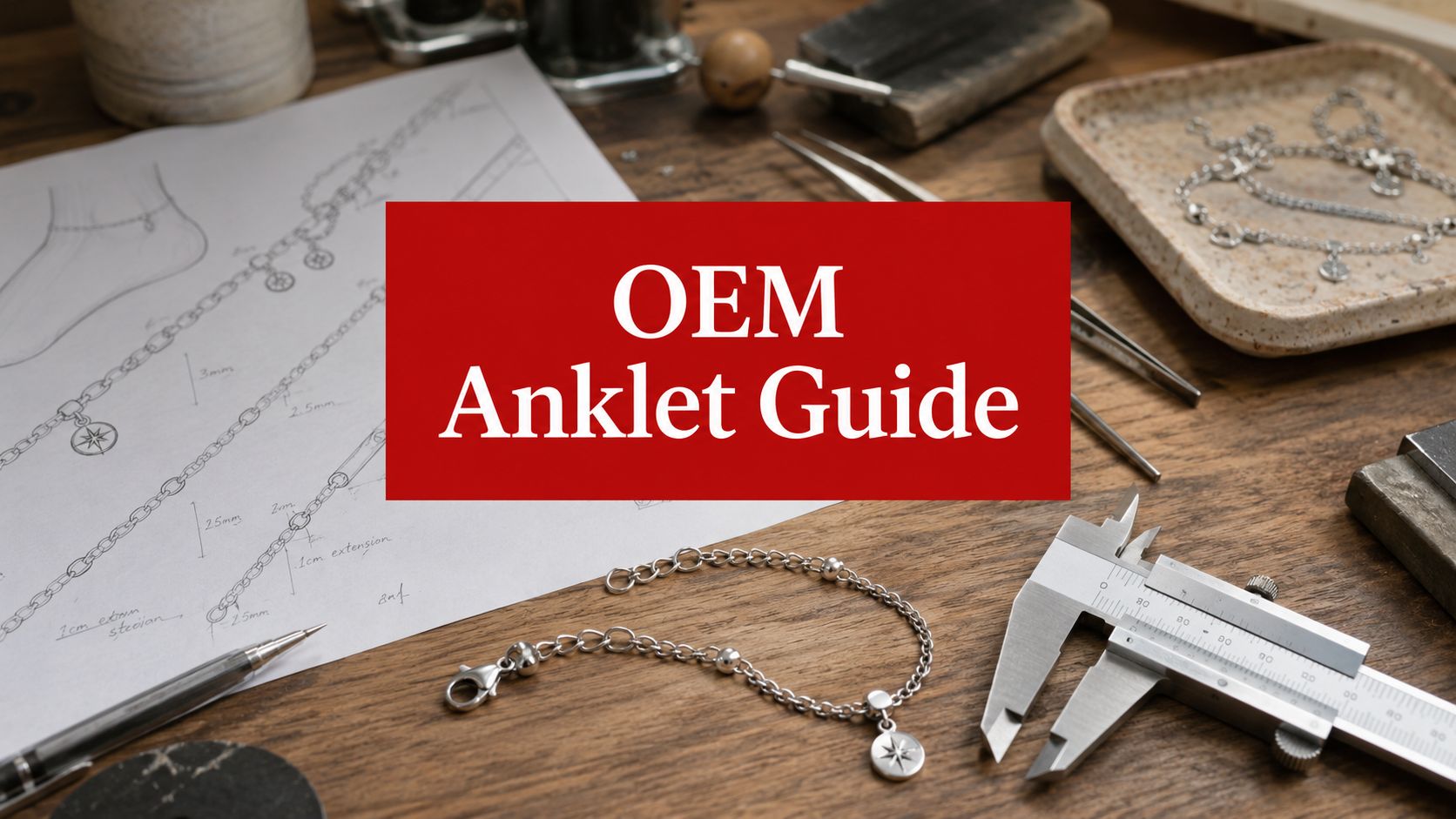
You’re probably in one of two positions right now. Your customers are already asking for anklets, or you’re watching competitors add them and wondering how to launch without taking on avoidable quality problems.
That instinct makes sense. Stainless steel anklets sit at the intersection of fashion demand, practical wearability, and manageable production cost. But anklets are less forgiving than many other jewelry categories. They deal with sweat, seawater, lotion, friction from shoes, and repeated pulling at the clasp. A necklace can survive shortcuts that an anklet won’t.
That’s why the essential work isn’t choosing an on-trend silhouette. It’s getting the specification right from the start: steel grade, chain construction, clasp consistency, surface finishing, plating control, testing, packaging, and production planning. Buyers don’t usually see those details. They definitely notice the consequences.
The Rising Demand for Durable Stainless Steel Anklets
A lot of brands enter anklets because the category looks simple. In production, it isn’t. The pieces are small, but the failure points are concentrated. If the chain flips awkwardly, the extender drags, the plating is too thin, or the clasp grade doesn’t match the base metal, returns show up fast.
The opportunity is real. Demand for anklets as a jewelry category has surged by 439% over the last six months, with anklets ranking among the top 3–4 search keywords on Alibaba.com for jewelry accessories, capturing a 3.12% click rate, and showing a supply-demand ratio of 1.36 in the stainless steel anklet segment according to this anklet demand snapshot. That combination matters. It shows strong buyer interest and pressure on factories to keep up.
Why this category rewards disciplined manufacturing
Fast-growing categories attract rushed sourcing. That’s usually where brands get into trouble. A stainless steel anklet line can look profitable on paper and still become expensive if the product brief is loose.
The strongest launches usually share a few traits:
- They define wear conditions early. An anklet intended for beach wear needs a different material decision than a fashion-only party piece.
- They treat the clasp and extender as core engineering parts. Most complaints come from breakage, snagging, slippage, or visible discoloration at these points.
- They validate the finish before scale-up. “Waterproof” isn’t a useful factory instruction unless plating method, thickness, and test standard are specified.
Buyers don’t reward hidden shortcuts. They punish them later through returns, bad reviews, and reorder hesitation.
For brands building a private label line, the smarter move is to work backward from the wear promise. If you plan to market your product as tarnish-resistant, hypoallergenic, or suitable for daily wear, the factory spec has to support that claim. A good starting point is understanding what stainless steel jewelry buyers really care about beyond price. In anklets, those concerns become more demanding, not less.
From Concept to CAD Your Anklet Design Blueprint
A brand approves a pretty sketch, requests a sample, and then loses two weeks correcting avoidable issues. The chain flips on the ankle. The charm sits off-center. The extender is too long and catches on socks. Those problems usually start before sampling, at brief level.
Anklet development gets cheaper and faster when the design brief answers manufacturing questions early. A reference image shows style direction. A usable tech pack defines how the piece will be built, worn, assembled, and quoted.

What your anklet tech pack should include
For stainless steel anklets, the brief should give the factory enough detail to produce a CAD file, estimate weight, choose components, and flag risks before sample making. In practice, these are the points that matter most:
- Chain style
Specify the exact construction, not just the aesthetic. Curb, cable, figaro, rope, snake, box, paperclip, and satellite chains behave differently once worn at the ankle. Some stay flat. Some rotate. Some hide scratches better. Some accept charm attachments without creating stress at one link. - Overall length and fit logic
State the wearable length range and the extender length. Also note whether the fit should sit close to the ankle bone or hang lower. A long extender may photograph well, but in production it can add visual clutter, extra weight, and more snag risk. - Clasp type and component size
A lobster clasp is still the safest default for daily-wear anklets because it balances security, serviceability, and supplier availability. Spring rings can suit lighter styles, but very small sizes are harder for end users to operate. If magnetic closures are requested, specify pull-force expectations and test them in sampling. - Charm or station placement
Mark exact positions for logo tags, pearls, stones, bezel settings, and decorative stations. A few millimeters can change how the anklet hangs. Placement also affects balance during walking, especially on asymmetrical designs. - Target metal spec
If the line is intended for frequent water, sweat, or resort wear, note that in the brief so the factory can build around the right base material and finish system. If you need a refresher on material expectations, this guide to 316L stainless steel jewelry applications and performance is a useful reference before CAD starts.
CAD turns a design idea into a manufacturable structure
A polished render is only a small part of CAD value. The practical benefit is that CAD exposes weak points before metal, labor, and plating costs are committed.
At this stage, I look closely at link wire thickness, solder locations, jump ring inner diameter, charm hole clearance, clasp connection geometry, and the transition between chain and extender. On an anklet, tiny proportion errors become wear problems fast. A jump ring that looks acceptable on screen may still open under repeated movement if the gauge is too fine. A charm that clears the chain in a render may strike the ankle bone or flip backward in use.
Factories that handle jewelry CAD daily often return first drafts quickly, but speed is not the main issue. Revision discipline is. GIA notes that CAD has become standard in jewelry product development because it improves precision, visualization, and pre-production problem solving in ways hand sketches cannot (GIA overview of CAD/CAM in jewelry design). That matters more than a fast render if the file still leaves attachment points or dimensions open to guesswork.
Common pre-sampling mistakes
Several mistakes keep repeating across anklet projects, especially with new collections:
- Finish direction is vague. “Gold” does not tell the factory whether you want bright yellow, champagne, rose tone, mirror polish, brushed effect, or a specific coating route.
- Weight is never discussed. A piece can look delicate in CAD and still feel heavy on foot because of dense charms, thick cast parts, or oversized clasps.
- Component substitutions are left open. If the clasp, extender end tag, logo plate, and jump rings are not locked, purchasing teams may replace them with available stock parts.
- Tolerance is ignored. Micro charms, ultra-fine links, and tiny stone seats can all be drawn. That does not mean they can be assembled consistently at a commercial reject rate.
- Wear behavior is not reviewed. Brands approve a front-view render without checking whether the chain twists, whether stations migrate, or whether the clasp weight pulls the anklet off-center.
One written note can prevent an expensive revision loop.
Practical rule: If a feature affects comfort, durability, appearance, or your marketing claim, put it in the tech pack before sampling.
OEM and ODM projects separate clearly here. OEM clients usually arrive with fixed dimensions, branding rules, and a stronger approval process. ODM clients often need the factory to recommend chain gauge, extender length, or clasp sizing based on target price and expected wear conditions. Both routes can produce a strong anklet line. The difference is how much engineering support the supplier needs to provide before the first sample is approved.
Choosing Your Core Material 304 vs 316L Steel
Most stainless steel anklet problems start with a material decision that looked harmless during quoting. On paper, 304 and 316L can both sound acceptable. In real wear, especially below the ankle bone, they don’t perform the same way.
If the collection is positioned around occasional wear and a tighter target price, 304 can be workable. If the product is meant for sweat, seawater, travel, resort wear, or frequent shower exposure, 316L is usually the safer choice.

Where 304 works and where it doesn’t
304 stainless steel is widely used because it balances cost, machinability, and good general corrosion resistance. For many jewelry categories, that’s enough. Earrings, pendants, and some bracelets live easier lives than anklets.
But anklets deal with a harsher environment. Sweat sits on the skin longer. Sand adds abrasion. Salt exposure is common. Movement at the ankle also creates repeated metal-on-skin and metal-on-shoe friction. Those conditions push material limits faster.
Why 316L is the benchmark for exposed wear
For stainless steel anklets exposed to sweat and seawater, 316L surgical-grade stainless is the industry benchmark due to its superior chloride resistance according to this 316L anklet material guide. That matters because chloride exposure is one of the biggest real-world stressors for anklets.
The same source notes a real cost trade-off. 316L costs about 20 to 30% more than 304 at the raw material level, which typically adds $0.50 to $2.00 per finished anklet, depending on design and order structure. That increase is meaningful, but it’s usually small compared with the cost of replacements, customer service time, and lost repeat business if the product disappoints.
A useful reference point for buyers comparing specifications is this 316L stainless steel jewelry guide, especially when you’re deciding what should stay premium and what can remain cost-sensitive in the line.
A short comparison table for sourcing decisions
| Decision point | 304 stainless steel | 316L stainless steel |
|---|---|---|
| Best use case | Fashion-led daily wear with lower exposure | Water-facing, travel, resort, and premium wear |
| Corrosion margin | Good | Stronger under chloride exposure |
| Cost impact | Lower | Higher raw and finished cost |
| Brand positioning | Value and trend | Durability and reduced complaint risk |
The mistake that quietly ruins a good spec
One of the most common factory shortcuts is mixing grades inside one anklet. A supplier may quote a 316L chain but use 304 for the clasp, extension chain, jump rings, or logo tag. That creates a weak point exactly where stress and exposure already concentrate.
Pairing a 316L anklet with 304-grade clasps creates galvanic corrosion weak points, as noted in the same Alibaba material guide. In practice, that means the customer sees failure at the closure area and assumes the whole anklet is poor quality.
Match all exposed components to the promised grade. Chain only is not enough.
When brands ask whether 316L is “worth it,” the answer depends on the selling promise. If you’ll market stainless steel anklets as water-friendly, hypoallergenic, or built for daily wear, 316L is often the more coherent choice. If you’re launching a trend capsule with stricter price ceilings and lighter expected use, 304 may still fit, but only if the product copy and customer expectation stay aligned with that decision.
Mastering the Finish Plating and Surface Treatments
Base metal determines structural durability. Finish determines what the customer sees, feels, and judges within the first few wears. Consequently, many anklet lines look premium in a sample tray and then fall apart in daily use.
The finish decision has two parts. First, the coating method. Second, the surface preparation under that coating. If either one is handled casually, color retention suffers.

Why PVD is usually the better route for anklets
For plated stainless steel anklets, PVD thickness in the range of 0.03 to 0.1 microns is considered optimal for a hypoallergenic, nickel-free finish, and maintaining that range with TiN protective layers supports a documented defect rate below 0.5 percent under 100 percent inspection protocols, according to this stainless steel jewelry production process reference.
That’s the practical side of the “waterproof jewelry” conversation. A lot of market language stays vague. Factory language can’t. If you want better color retention, plating thickness and protective layering have to be specified and checked.
For buyers comparing coating routes, this overview of PVD vs electroplating in jewelry coating is useful because the choice affects appearance, wear life, and price positioning.
PVD versus electroplating in real product terms
PVD usually makes more sense when the anklet is intended for longer wear and stronger color durability. Electroplating still has value, especially for certain tones, fashion cycles, or cost targets. But the trade-off should be explicit.
- PVD suits daily-wear positioning. It’s commonly chosen for gold, black, and other durable fashion finishes on stainless steel.
- Electroplating offers flexibility. It can help when the line needs particular looks, softer launch budgets, or finish variation across multiple SKUs.
- Surface prep matters for both. A poor polish underneath any coating will telegraph through the finish.
Surface finishing is not just cosmetic
Before plating, the metal surface needs to be stable and smooth. High-end stainless steel jewelry manufacturing commonly controls surface roughness at Ra ≤ 0.05 μm, with ultra-high-end orders reaching 0.02 μm for a super mirror finish, according to this 316L surface finishing reference. For anklets, smoother surfaces don’t just look cleaner. They also feel better against the skin and support more stable coating adhesion.
A few finish directions tend to work well in this category:
- Mirror polish for minimal chains and polished logo accents
- Brushed or satin for a quieter premium look that hides light handling marks
- Sandblasted or micro-textured zones for contrast on charms or tags
- Selective plating when a brand wants mixed-metal detailing without changing the whole construction
A beautiful anklet sample can still be a weak product. The finish only performs as well as the polishing, coating spec, and inspection behind it.
One practical example from manufacturing is a simple heart charm anklet. It looks easy. It isn’t. The charm edges need smooth polishing, the jump ring must be sized to avoid awkward flipping, and the coated surface has to stay visually consistent across chain, clasp, and charm. Small products expose mismatch quickly.
Navigating Production Sampling MOQ and Lead Times
A stainless steel anklet line usually slips off schedule before bulk production starts. Significant delays often emerge earlier, during sampling, when brands are still changing chain gauge, extender length, clasp type, logo size, and packaging dimensions at the same time. If those decisions are not frozen in a controlled way, the sample may look acceptable on arrival but still be wrong for wear, assembly, or margin.
Lead time planning works better when each stage has a job. CAD confirms proportion and construction logic. The first sample checks physical wear and visual consistency. A pre-production sample confirms that the approved details can be repeated at scale with the actual factory process, not just in a one-off bench sample.
What sampling needs to prove
For anklets, the sample stage should answer manufacturing questions, not just styling questions.
Check these points before approving:
- Wear length and drop across the target size range, especially with 2 inch extenders that can shift the charm position
- Chain strength versus look so the style keeps a fine appearance without creating excess breakage risk in daily wear
- Clasp usability for the intended customer, because a spring ring may look cleaner while a lobster clasp is often easier to handle
- Charm orientation and balance so decorative parts sit correctly instead of rolling under the ankle bone
- Component match across chain, clasp, jump rings, extender, and tag, because small color or polish differences show quickly on stainless steel
- Pack-out fit if the anklet will ship in a card, pouch, or rigid gift box
I usually advise brands to wear the sample for several days before approval. An anklet behaves differently from a necklace. It sees more motion, more contact, and more accidental pulling during real use.
MOQ should follow how you plan to test the line
Low MOQ sounds attractive, but the cheaper decision is not always the smaller order. Unit cost rises when the factory has to split plating runs, logo setup, packaging materials, and labor across too few pieces. At the same time, ordering too many styles too early ties up cash in weak sellers.
A better launch structure is narrow and deliberate. Start with one volume style, one close variation, and one brand-defining design. That gives enough range to read customer response without scattering inventory across too many SKUs.
Some suppliers are set up for that model more comfortably than others. If you are comparing factories, this overview of low MOQ jewelry manufacturers helps frame what order structures are realistic for a new stainless steel anklet program.
Lead times depend on revision control
Factory capacity is only one part of the schedule. Revision discipline matters just as much.
A typical delay looks like this. The approved CAD shows a 1.5 mm chain, the sample request email says 1.8 mm, the logo tag artwork is updated in chat, and the packaging insert still carries the old SKU code. Production then pauses while the team sorts out which file is current. That costs days, and sometimes forces remakes.
Teams that centralize spec sheets, BOMs, artwork files, purchase orders, and approval history usually avoid that churn. If your business manages multiple suppliers or frequent SKU changes, this guide on automating messy documents for ERP/TMS is useful for tightening handoffs between sourcing, operations, and logistics.
Ask the supplier for milestone dates, not one final ship date. The schedule should show CAD approval, sample build, sample revision if needed, packaging approval, pre-production confirmation, bulk production, final inspection, and dispatch. That level of detail exposes risk early and makes delivery dates much more dependable.
Ensuring Lasting Quality A Guide to QA Testing Protocols
Quality control for stainless steel anklets can’t stop at visual inspection. A polished sample may still fail under sweat, flex, or repeated clasp use. If the line is positioned as premium or giftable, testing becomes part of the product itself, not an optional extra.
The quality threshold should be written into the purchase standard. Otherwise, “acceptable” becomes too loose.

Set the right acceptance level first
Industry standards for jewelry production typically use an AQL of 2.5 for major defects, but luxury-positioned brands should require AQL 1.0. The same quality framework can be supported by an Artificial Sweat Resistance Test that simulates three years of daily wear in 48 hours, according to this AQL and sweat test reference for jewelry production.
That difference matters. AQL 2.5 may be acceptable for commodity fashion jewelry. It’s often too loose for a brand trying to build repeat purchase trust through premium finishing and consistent wear experience.
A useful benchmark for buyers assessing process maturity is whether the supplier works to documented systems such as ISO 9001 in jewelry manufacturing. The certification itself isn’t the whole answer, but it usually signals better traceability and process discipline.
The tests that matter most for anklets
A solid QA plan for anklets usually includes several layers:
- Material verification to confirm the promised steel grade is used across components
- Dimensional checks against CAD or approved sample, especially for chain length and extender proportion
- Surface inspection for scratches, pits, plating inconsistency, and rough edges
- Corrosion testing such as salt spray or sweat simulation for products intended for extended wear
- Clasp cycling to check opening reliability and wear at the closure point
- Adhesion and coating verification so plated surfaces don’t fade prematurely under normal use
Why brands should ask for documented results
A factory saying “we inspect everything” isn’t enough. The useful question is what gets inspected, when, and against which standard.
If your brand promise includes hypoallergenic wear or lasting color, ask for the test method before you ask for the quote.
This is one reason a structured manufacturing partner can help. HonHo Jewelry, for example, handles custom jewelry development with in-house plating, quality control testing, private label support, and documented inspection workflows. That setup can reduce handoff risk because the design, finishing, and QA teams work from the same product file.
The practical goal is simple. Catch failure in the factory, not in the customer’s first week of wear.
Go-to-Market Your Strategy for Pricing Packaging and Logistics
A stainless steel anklet line becomes commercially stronger when pricing, packaging, and delivery all reflect the product spec you chose earlier. If you build with 316L, tighter QA, and a controlled finish, your retail positioning should show that. If you choose a simpler 304 fashion style with lighter finishing, price it as an accessible trend item instead of forcing a premium story.
Pricing works best when it’s tied to product logic, not just competitor screenshots. Chain weight, clasp quality, finish route, packaging format, and reorder predictability all affect margin. For teams refining launch math or bundle strategy, this overview of powerful e-commerce pricing models is a practical resource. It’s useful when you’re deciding whether anklets should anchor entry price points, sit inside a set, or support higher-margin coordinated collections.
Packaging should protect and explain the product
Anklets are small, but they tangle easily and can arrive looking cheaper than they are if packaging is poorly planned. Good private label packaging does three jobs at once:
- Protects the chain and clasp during transit
- Presents the finish cleanly without abrasion from movement in the box
- Supports customer understanding through care cards, material notes, or wear guidance
A minimalist card-and-pouch setup can work for trend-led wholesale jewelry. A rigid box may make more sense for gifting, premium DTC presentation, or retail shelving.
Logistics is part of the buying experience
Production isn’t finished when the carton leaves the factory. Lead time reliability, export paperwork accuracy, and courier coordination directly affect launch timing and stock health. End-to-end planning addresses these challenges. One supplier handling product, branded packaging, and dispatch usually creates fewer timing mismatches than splitting those tasks across multiple vendors.
For brands and distributors, the most stable setup is usually the one that reduces friction between design approval and final delivery. That’s what keeps reorders simple, margin planning cleaner, and launch calendars more predictable.
If you’re building a stainless steel anklet line and want support with OEM/ODM development, sampling, plating, QA, packaging, and fulfillment, HonHo Jewelry provides end-to-end manufacturing for fashion jewelry brands and wholesale buyers.
Zinc Alloy in Jewelry: Guide to Properties & Sourcing 2026
A sourcing team usually reaches zinc alloy after the same meeting. Design wants bigger shapes,
Allergic Reactions to Jewelry: Prevent & Protect Your Skin
Jewelry allergies aren’t a niche customer-service issue. They sit at the intersection of product safety,
8 Key Types of Chain Clasps: A Guide for Brands
More Than a Closure: Choosing the Right Clasp for Your Jewelry Brand You’re finalizing a