
You’re halfway through a production run, the chain looks right, the plating matches the sample, and then a handful of necklaces come back because the closure feels fiddly or won’t stay shut. That’s usually the moment a buyer realizes the clasp wasn’t a small detail at all, it was part of the product’s actual performance.
In jewelry manufacturing, different kinds of necklace clasps affect more than styling. They change how a piece opens, how it wears, how much stress it can handle, and how often a customer may need a replacement or repair. For brands, wholesalers, and designers, that means clasp selection belongs in the spec sheet, not as an afterthought during sampling.
Why the Clasp Deserves More Attention Than It Gets
A buyer can approve a chain, a pendant, and a finish, then lose sleep over a closure that fails after launch. That failure usually isn’t dramatic, it’s a clasp that opens too easily, feels awkward in hand, or doesn’t suit the necklace’s actual weight. In wholesale jewelry, those small breakdowns show up later as returns, complaints, and avoidable rework.

A clasp is a mechanical system, not just a decorative endpoint. It has to hold load, tolerate repeated opening and closing, and stay compatible with the chain, plating, and wearer’s hands. Historical necklace dating also leans heavily on clasp type, because different fasteners track closely with major jewelry eras, from early cords and loops to hook fastenings, ribbon closures, tongue clasps, and spring ring clasps Navette Jewellery’s clasp timeline.
What buyers usually miss
Most product briefs spend pages on chain style and stone size, then bury the clasp in a footnote. That’s risky, because clasp choice affects the customer’s first physical interaction with the piece. If the closure is hard to manipulate, the necklace feels cheap even when the rest of the build is strong.
Practical rule: choose the clasp at the same time you choose chain gauge and pendant weight. If you leave it to the end, you often end up forcing the wrong hardware into the design.
This matters just as much in modern production as it does in antique identification. Standardized closures grew alongside scaled manufacturing, and today the clasp still signals age, construction quality, and intended use in both vintage pieces and contemporary collections Navette Jewellery’s clasp guide.
The Major Necklace Clasp Types Explained
A clasp choice affects more than the closing motion. It changes how the piece feels in hand, how much load the hardware can tolerate, and how well the metal finish survives repeated contact. In a production brief, that makes clasp selection a hardware decision, not a vocabulary exercise.
Everyday workhorses
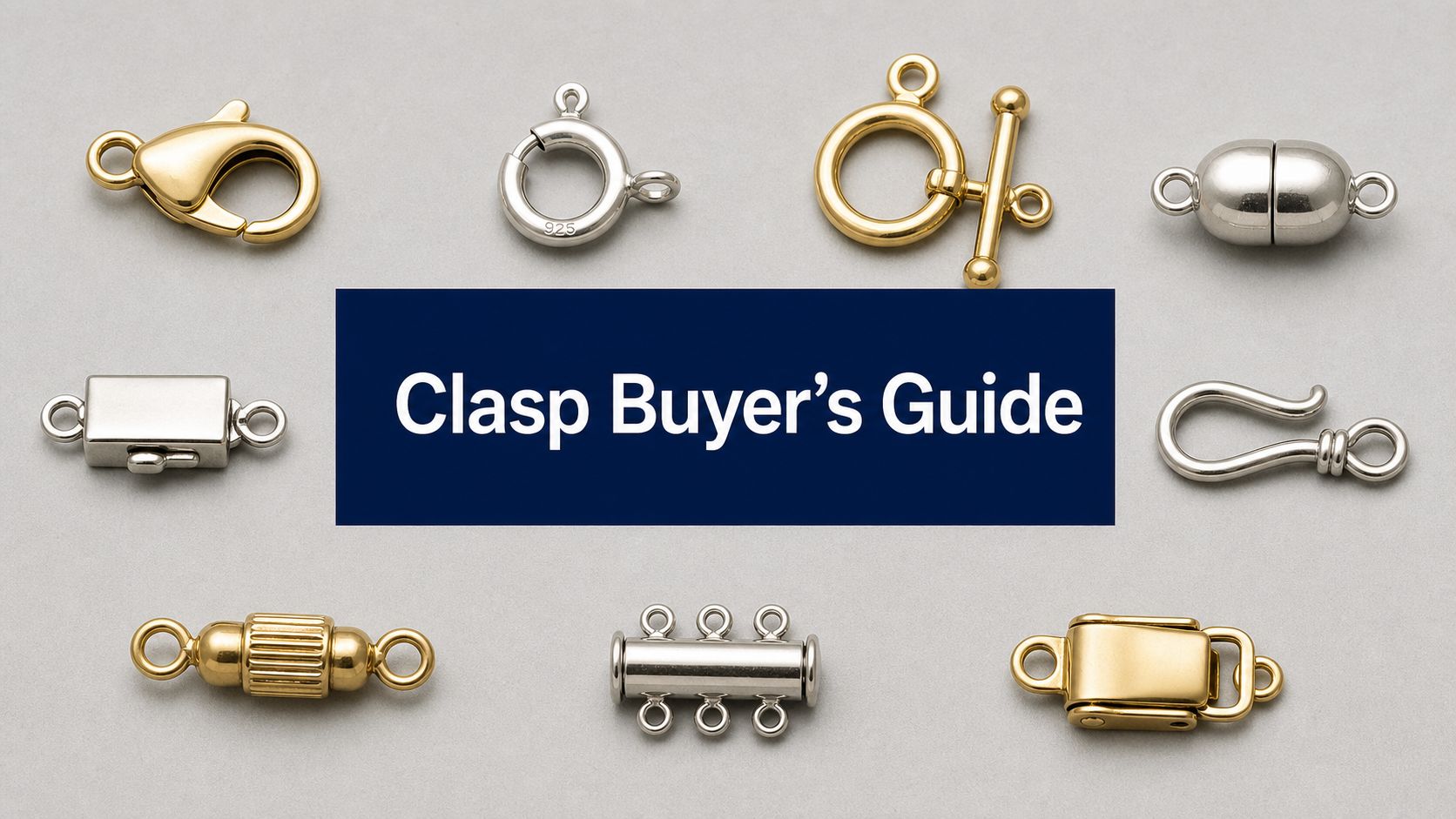
A lobster claw clasp uses a spring-loaded lever and a hinged gate. In production, it is usually the first option for everyday chains, medium-weight necklaces, and mainstream programs because it balances familiar handling with dependable holding power Blue Nile’s clasp overview.
A spring ring clasp is the smaller circular option with a tiny lever. It fits delicate necklaces, lightweight chains, and pieces where the closure should stay visually quiet, but the small size also makes it harder for some wearers to manage, especially in a hurry.
A magnetic clasp snaps shut on contact. That makes it useful for customers who struggle with tiny hardware, yet it belongs on lighter pieces with modest load demands, not on heavy pendants or necklaces that will see rough daily wear Greenwich Jewelers’ clasp guide.
Decorative and specialized closures
A toggle clasp uses a bar and ring. It works well on statement necklaces and designs where the clasp is part of the visual language, but security depends on bar length, ring size, and how the necklace hangs, so it needs careful testing before it goes into production.
A box clasp slides a tab into a shaped housing and locks into place. It is a common choice for formal, heirloom, and strand-style designs because the profile stays clean while the closure feels firmer than many decorative options.
A hook-and-eye or fishhook clasp is simpler and often reads as more vintage or handcrafted. A barrel clasp twists together, which keeps the fastening visually quiet but makes one-handed operation less convenient and can expose more threads or wear points if the surrounding build is not well matched.
A slide or tube clasp binds multiple strands into one closure. A fold-over clasp snaps over a bar in a compact format, and a concealed clasp hides within the design so the closure does not break the necklace’s visual line. For hardware selection, a jewelry findings guide is useful when you are matching clasp style with chain ends, jump rings, and other attachment parts Halstead Bead’s clasp reference.
Some closures sell the design. Others disappear into it. Good production work knows the difference before the sample is cut.
Video reference
Comparing Clasps by Strength, Security, and Ease of Use
A clasp that looks refined on a sample can still fail the job if it does not match the necklace’s load, the wearer’s handling habits, and the way the closure is built. In production, I treat clasp selection as a hardware decision, not a styling detail.
Strength and handling in real use
Buyer guidance puts lobster claw clasps at about 12 to 18 lb tensile strength, spring ring clasps at about 6 to 10 lb, and box clasps at 20 to 30+ lb under controlled vertical pull tests Alibaba buyer’s clasp guide. That is why box clasps suit heirloom strands and heavier constructions, while spring rings belong on lighter chains. The numbers are useful as a production reference, but they still need to be checked against chain gauge, jump ring size, and the rest of the assembly.
Ease of use tells a different story. Lobster claws usually give the best balance between security and daily handling, while spring rings are smaller and harder for some wearers to operate, especially when dexterity is limited Blue Nile’s clasp comparison. Magnetic closures are the easiest to open and close, but that convenience narrows the range of pieces they suit. On a collection meant for frequent wear, I would test the clasp with real hands, not just with a bench pull test.
Failure modes buyers should care about
Spring ring hinges can fatigue after repeated cycles. Magnetic clasps can become less dependable if plating wears at the contact surface. Toggles can slip if the bar is too thin or the necklace hangs at the wrong angle. These are design problems, not just user problems, because they show up after repeated wear, not just at the sample stage.
| Clasp Type | Typical Tensile Strength | Ease of Use | Best Fit |
|---|---|---|---|
| Lobster claw | 12 to 18 lb | Good balance | Everyday chains, medium-weight necklaces |
| Spring ring | 6 to 10 lb | Moderate to harder for small hardware | Delicate, lightweight pieces |
| Box clasp | 20 to 30+ lb | Moderate | Heavier strands, heirloom styles |
| Magnetic clasp | Varies by build | Very easy | Lightweight, convenience-led designs |
| Toggle clasp | Depends on bar tension | Easy when sized well | Statement pieces, decorative use |
For stainless steel programs, the clasp should be matched to the base metal instead of treated as a separate accessory. A 316L stainless steel jewelry guide is useful when you want the hardware, finish, and necklace body to behave as one system.
Matching Clasps to Materials and Plating
A clasp doesn’t perform the same way on every base metal. The same mechanism can feel sturdy on stainless steel and unreliable on plated brass if the contact points wear too fast or the finish is too thin at the wear surface. That’s why material pairing matters as much as clasp style.
Base metal changes the decision
PVD-finished stainless steel tolerates harder use because the substrate itself is durable and the finish is built for wear. For production teams, that makes lobster claws and other hard-working closures easier to trust on everyday stainless collections. On electroplated brass, the issue is different, because the wear point can expose the base more quickly if plating thickness isn’t specified carefully.
That’s especially relevant for magnetic clasps. They’re practical, but the contact surface takes repeated handling, so a weak finish can show wear sooner. On fine pieces, that doesn’t just affect appearance, it affects confidence in the closure.
Match the clasp to the alloy and the promise
For 925 silver, spring rings and barrel clasps can make sense when the design calls for a subtle closure and the necklace itself isn’t under heavy load. For gold filled pieces, lobster claws and hidden clasps are often more appropriate when the brief calls for a premium feel without visual clutter. In plated product, the clasp should be treated as part of the finish system, not a throwaway component.
Buyer check: ask whether the clasp finish, base metal, and chain alloy were tested together. A good closure on paper can still fail when the wrong plating stack is used.
Hypoallergenic, nickel-free, lead-free, and cadmium-free specs apply to findings too, not just the visible centerpiece. That distinction matters in sourcing because the clasp touches skin, flexes often, and gets handled more than most components. For plating thickness and finish planning, this gold plating thickness guide is a practical reference when you’re aligning wear expectations with finish choice.
Sourcing, Customization, and MOQ Considerations
A clasp decision only works if the factory can source or build it at the right pace. In OEM and ODM jewelry manufacturing, the closure choice affects tooling, plating workflow, inspection, and packing, so the sourcing conversation should start early.
What’s easy to source and what isn’t
Standard lobster claws, spring rings, box clasps, toggles, and magnetic closures are usually easier to pull from a broad findings library. HonHo Jewelry, for example, works from a 5,000 plus parts library that covers chains, clasps, and findings, which helps when a buyer wants to move quickly without custom tooling. Custom shapes, branded bars, and integrated concealed closures usually require more development discipline.
That development time matters. CAD can take 1 to 2 days, sampling 7 to 20 days, and typical production 25 to 35 days when the spec is straightforward and approvals stay on schedule. If you’re running a low-volume line, a low MOQ jewelry manufacturer guide helps frame how clasp complexity affects ordering strategy.
What to confirm before you approve a sample
- Lead Time: ask when the clasp can be tooled, plated, and packed.
- Plating Workflow: confirm whether the finish is applied in-house or outsourced.
- MOQ: make sure the clasp choice matches your run size, not just your design taste.
- Sampling: request a pre-production sample with the exact closure.
- Customization: confirm tooling fees, logo options, and whether the clasp can be branded cleanly.
A flexible MOQ starting from 30 pieces per style for 925 silver can make custom clasp testing more realistic for smaller collections. For private label or wholesale jewelry programs, that flexibility often decides whether a new closure gets approved at all.
Choosing the Right Clasp for Your Collection
A DTC brand launching everyday layering chains usually needs the least drama and the most reliability. In that case, a lobster claw usually makes sense because it’s easy to teach customers, familiar to wear, and suitable for daily handling without drawing attention away from the chain.
A wholesaler building a bridal or statement line can justify a box clasp, toggle, or even a concealed closure if the design calls for visual continuity. A decorative front closure can add presence, but only if the chain weight and wear pattern support it. A delicate spring ring on a men’s chain, by contrast, is a mismatch waiting to happen.
An independent designer working in 925 silver often wants subtle hardware that doesn’t fight the design. That’s where a spring ring or barrel clasp can fit, provided the necklace isn’t carrying a heavy pendant. A fashion retailer moving into stainless steel and PVD-finished lines can lean harder into lobster claws, because the substrate and finish both support a more rugged closure.
For chain architecture, this types of chains guide helps you pair closure style with the necklace body instead of treating them separately.
Final Recommendations and Quick Reference Checklist
For fine chains, use a spring ring only when the necklace stays light and discreetness matters more than ease of use. For mid-weight everyday chains, choose a lobster claw. For pendant-forward or heavier pieces, move up to a box clasp or a well-sized lobster claw. For multi-strand bead work, use a box, slide, or multi-loop closure. For men’s or unisex chains, keep the closure sturdy, easy to grip, and visually aligned with the rest of the build.
Quick checklist for suppliers
- Tensile strength: confirm the closure matches the necklace weight.
- Plating compatibility: verify the clasp finish works with the base metal.
- Hypoallergenic compliance: check the clasp materials, not just the main body.
- MOQ and lead time: confirm both before sampling.
- QC testing: ask for open-close cycle checks and wear verification.
If you’re sourcing custom jewelry, HonHo Jewelry can build necklace closures into OEM or ODM production, from clasp selection through plating, inspection, and packaging. Visit HonHo Jewelry to discuss necklace hardware, custom jewelry production, and wholesale orders with a team that works directly from spec.
Surgical Steel vs Sterling Silver: Buyer Guide
You’re pricing a new collection, and the sample tray is already split down the middle.
How to Gold Plated Jewelry the Right Way for Lasting Color
You probably have a launch already in motion, a supplier sample on your desk, and
What Is a Shank on a Ring: Guide to Design & Durability
You’re refining a ring design, the stone looks right, the setting is approved, and the