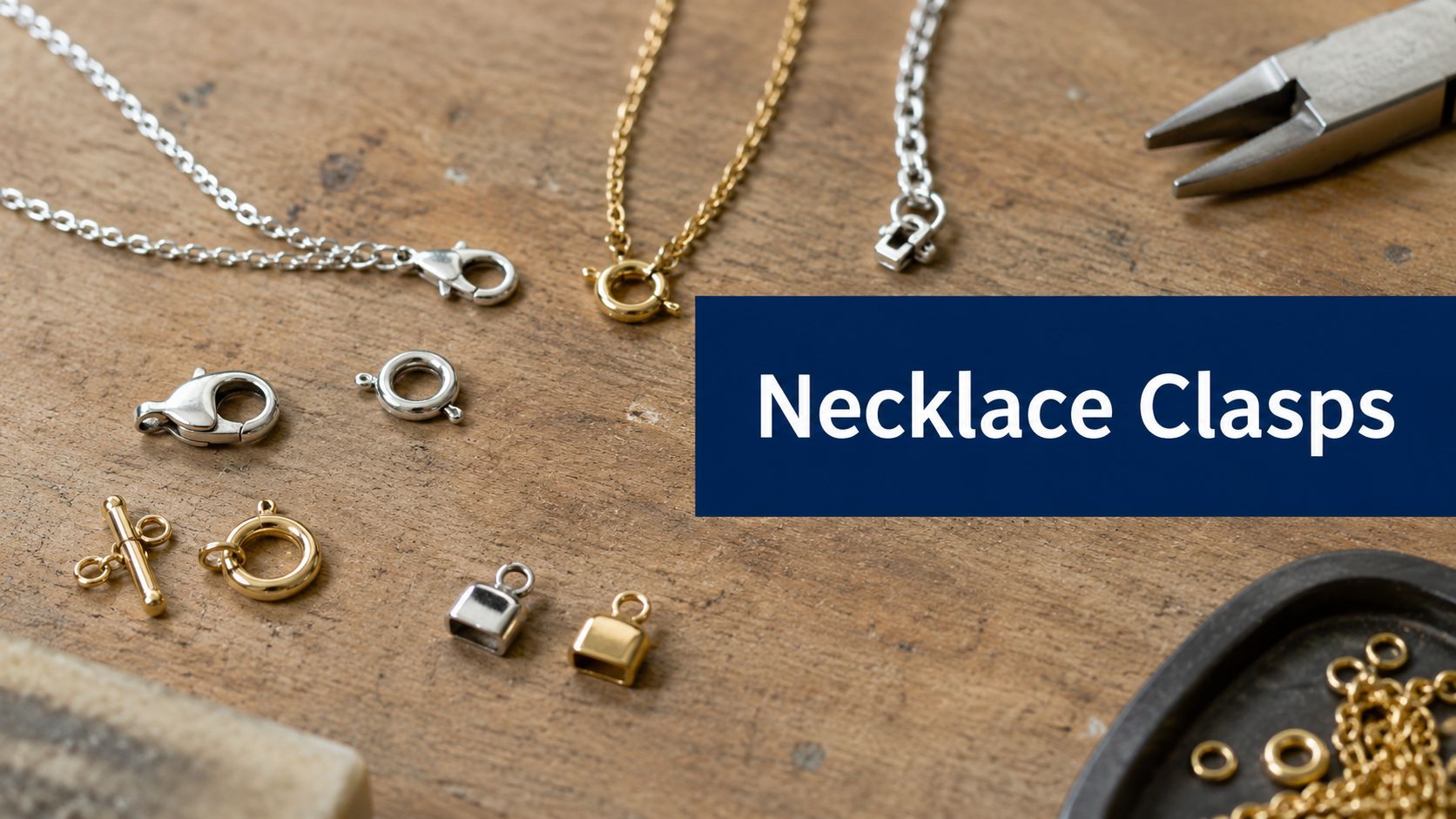
What Is a Necklace Clasp Called? Guide to All Types

You’re usually looking up what a necklace clasp is called for a simple reason. You need to replace one, compare suppliers, approve a sample, or figure out why a piece feels secure in the hand but frustrating to wear.
That small closure at the back of the necklace often decides whether a design feels premium or cheap. Buyers notice it when it fails, when it tangles hair, when plating wears unevenly, or when it’s so small they can’t fasten it without help. For brands and distributors, that means the clasp isn’t just a finding. It’s part of product quality, customer experience, and return risk.
The Unsung Hero of Jewelry The Importance of a Good Clasp
A necklace clasp is the fastening mechanism that opens and closes the piece. If you’re asking what is a necklace clasp called, the practical answer is that there isn’t just one name. The closure is generally called a clasp, but the exact term depends on the mechanism, such as lobster clasp, spring ring clasp, or box clasp.
That distinction matters more than many new brands expect. A chain can look beautiful in CAD and still fail in real use if the clasp doesn’t match the necklace weight, style, and customer profile. A lightweight fashion chain and a gemstone strand don’t ask for the same closure. Neither do a minimalist DTC collection and a bridal or heirloom line.
In manufacturing, the clasp also affects assembly speed, polishing, plating consistency, and final inspection. Teams sourcing complete findings sets usually look at the clasp, jump rings, extender, and end caps as one system, not as separate parts. That’s why a strong jewelry findings reference is useful early in development, before the sample reaches the approval stage.
Why brands can’t treat it as an afterthought
A poor clasp creates problems in three places at once:
- At wear stage: It can open unintentionally, feel hard to use, or snag fabric and hair.
- At production stage: It can slow assembly if sizing and ring compatibility are off.
- At brand stage: It changes how customers judge quality, even when the pendant or chain itself looks excellent.
Practical rule: If a customer struggles to open or trust the clasp, they won’t describe the necklace as “well made,” no matter how strong the design concept is.
A good clasp does two jobs at once. It keeps the jewelry secure, and it disappears into the experience when it’s doing its job correctly.
A Visual Guide to Common Necklace Clasp Types
The term “necklace clasp” is often used broadly. In trade language, you need the specific mechanism name. That’s what suppliers, production teams, and QC staff rely on when reviewing samples or confirming BOM details.
To make identification easier, here’s a visual reference.

Basic closures
Lobster clasp
This is the clasp most buyers mean when they ask what a standard necklace clasp is called. It uses a spring-loaded lever and is also referred to in some catalogs as a trigger clasp or TE clasp. The lobster claw clasp, named for its resemblance to a lobster’s pinchers, became the dominant fastening for fine chain necklaces from the 1970s onward. It’s widely cited as one of the most secure options, sharing top ranking with the box clasp, and it’s a standard for over 60% of modern chain jewelry according to Jewelers Mutual’s clasp guide.
Spring ring clasp
This is the small circular clasp with a tiny lever. It’s recognized as one of the most basic and popular necklace clasps in use globally, and it became the dominant fastening mechanism for lighter chain necklaces in 1900 according to Authority Jewelry’s overview of necklace clasps. It remains common on delicate chains because it’s compact and integrates cleanly into lighter designs.
For chain-driven collections, clasp choice should always be checked against chain style and end fitting. A cable chain, box chain, snake chain, or rolo chain may require different visual balance and ring sizing, making a practical types of chains guide useful during product planning.
Decorative and specialty clasps
Toggle clasp
A toggle uses a T-bar and a ring. The bar passes through the ring and locks by position. It’s often visible by design, so it functions as both closure and style element. It works well when you want the clasp to be part of the necklace language rather than hidden hardware.
Magnetic clasp
Magnetic closures are built for convenience. They separate and reconnect through magnetic force, often in a barrel-like shape. These aren’t usually the first choice when maximum security is the top priority, but they’re valuable when ease of use matters more, especially for wearers with limited grip strength.
Box clasp
A box clasp uses a tongue-and-groove style enclosure where a tab slides into a rectangular housing. It’s frequently used on pearl necklaces, formal strands, and fine jewelry because the closure sits neatly and can be integrated into the visual finish of the piece.
Here’s a useful close-up video if you want to identify clasp styles faster in real products and sample reviews:
Functional clasps
Hook and eye clasp
This is one of the most straightforward closures. A hook catches onto a loop. It’s easy to understand and easy to produce, but it usually suits lighter or more casual jewelry rather than security-critical pieces.
S-hook clasp
An S-hook is exactly what it sounds like. One end hooks onto the opposite ring or chain link. It can look artisanal, handmade, or rustic depending on the finish and silhouette.
Barrel clasp
A barrel clasp is a screw-together mechanism. It’s especially associated with vintage and antique-inspired jewelry, and barrel clasps are among the most frequently found closure types on Victorian and Edwardian necklaces according to Mozeris Fine Antiques’ guide to antique clasp identification. In modern production, it suits designs where a discreet cylindrical closure is preferred.
A clasp name isn’t just labeling. It signals how the necklace is built, how it wears, and what kind of customer experience it’s likely to deliver.
How to Choose the Right Clasp Security Aesthetics and Usability
The wrong clasp usually fails in one of three ways. It isn’t secure enough, it’s awkward to operate, or it looks out of place on the finished piece.
Good selection starts with the necklace itself. Weight, wearing frequency, customer age range, and product positioning all matter. A fashion necklace for occasional wear can accept different trade-offs than a daily chain with a pendant.
Start with the mechanical requirement
From a mechanical standpoint, a clasp’s spring mechanism must have a tensile rating of at least 3x the total weight of the jewelry piece to prevent failure. Standard lobster claws also exhibit spring fatigue after approximately 5 years of daily use, which matters when evaluating long-term durability according to Fire Mountain Gems’ technical overview.
That means clasp choice isn’t just about shape. It’s about service life. If a brand is developing jewelry meant for everyday wear, the mechanism has to survive repeated use without weak recoil, sticking open, or losing secure closure.
Clasp comparison guide
| Clasp Type | Security Level | Ease of Use | Best For |
|---|---|---|---|
| Lobster clasp | High | Moderate | Everyday chains, fine chain necklaces, general-purpose programs |
| Spring ring clasp | Moderate | Lower for many users | Delicate lightweight chains, subtle minimal looks |
| Box clasp | High | Moderate | Pearl strands, heirloom-style pieces, heavier formal jewelry |
| Magnetic clasp | Lower than security-first options | High | Wearers who prioritize dexterity and simple fastening |
Security versus usability
A lot of product briefs focus only on security. That’s a mistake. Some customers can’t comfortably operate a tiny spring ring or a small lobster trigger, especially if they have limited grip strength or reduced dexterity.
That’s why inclusive design often pushes teams to think beyond the “most secure” answer. If your target customer struggles to put the necklace on, the product still fails in use. Material choice also matters here. If you’re building for sensitive-skin customers, clasp finish and metal compliance should be reviewed alongside closure type. A practical nickel-free jewelry guide helps brands connect user comfort with findings decisions instead of treating them separately.
Buyer check: Ask two questions before approval. Will this clasp stay closed in daily wear, and can the intended customer actually fasten it without frustration?
Match the clasp to the design language
Some clasps should disappear. Others should be seen.
Use a lobster clasp when you want a low-profile, dependable default. Use a box clasp when the necklace deserves a cleaner, more integrated closure. Use a toggle or S-hook when the closure is meant to participate in the look. Use magnetic options carefully, and usually only when usability is a defining requirement.
Clasp Materials Plating and Sizing in Jewelry Production
Clasp quality doesn’t stop at mechanism. Material, plating system, and size matching all shape how the finished piece performs in the field.
A lobster clasp in stainless steel behaves differently from one in brass or 925 sterling silver. Stainless steel is often chosen for fashion jewelry programs that need durability and stable everyday wear. Brass gives more flexibility in many fashion applications and works well across plated collections. Sterling silver fits fine jewelry positioning, but it still requires correct component matching and finishing discipline.

Material and closure must work together
Box clasps are the industry standard for pearl necklaces and heirloom jewelry due to superior mechanical enclosure. In 925 sterling silver and gold-filled production, they’re preferred for heavy gemstone strands because their closed geometry prevents the chain from slipping out under lateral pressure, which is a common failure point for spring rings according to Diamondrensu’s clasp type education page.
That’s a good example of production logic. A spring ring may look neat on paper, but lateral pressure can expose its weakness in the wrong application. A heavier strand, a more formal product category, or a necklace worn under movement all push the brand toward a better-enclosed mechanism.
Plating and finish affect customer perception
Plating consistency matters most on parts the customer touches. Clasps receive frequent contact from fingers, nails, skin, perfume residue, and friction against rings or extenders. If the closure loses color before the chain does, the whole necklace looks aged unevenly.
For plated jewelry programs, teams usually compare standard electroplating with PVD depending on the base material and collection goals. If you’re specifying plated findings, it’s worth understanding gold plating thickness before approving final samples, because the clasp often reveals finish weakness sooner than larger visible components.
Sizing is a real production decision
Clasp size changes both function and appearance. An undersized clasp can feel flimsy or difficult to use. An oversized clasp can throw off the balance of a delicate chain.
In practice, buyers should review:
- Chain compatibility: The clasp opening must fit the end ring cleanly.
- Visual proportion: A fine chain needs a clasp that doesn’t dominate the silhouette.
- User handling: Tiny triggers look refined, but they often reduce ease of use.
- Weight match: The clasp should support the piece without creating drag at the back of the neck.
A necklace doesn’t feel finished until the clasp, chain, jump rings, extender, and plating all behave like one system.
Sourcing Clasps A Guide for Jewelry Brands and Designers
Sourcing clasps sounds simple until approvals start. Then the problems show up fast. The color doesn’t match the chain, the trigger feels weak, the jump ring fit is off, the MOQ is impractical, or the supplier can’t hold the same finish across repeat orders.
That’s why experienced brands don’t buy clasps as isolated parts when they can avoid it. They source them as part of a controlled production workflow.

What buyers should check before placing an order
For jewelry pieces exceeding 20g, industry standards mandate safety redundancy through integrated safety chains or dual-catch mechanisms. The clasp should also ideally constitute 12–18% of the total piece weight for better load distribution and balance according to Alibaba’s jewelry clasp buying guide.
Those details matter because many sourcing errors begin with incomplete specs. A buyer may request “lobster clasp, gold plated” and still leave out key information that affects production and wear.
Use this checklist before RFQ stage:
- Define the mechanism clearly: Say lobster, spring ring, box, magnetic, barrel, or toggle. Don’t stop at “standard clasp.”
- Specify the metal family: Stainless steel, brass, gold-filled, or 925 sterling silver each affect process route and finish behavior.
- Confirm finish expectations: The clasp, chain, extender, and tag need plating consistency.
- Test the user experience: Open and close the sample repeatedly, ideally with the target wearer in mind.
- Review heavy-piece safety: If the necklace is substantial, redundancy isn’t optional.
Why integrated sourcing works better
Brands that split components across multiple vendors often create their own QC problems. One factory supplies the chain, another supplies the clasp, and a third handles plating. When something fails, nobody owns the mismatch.
An integrated manufacturing partner simplifies that. CAD, sampling, metal choice, plating, assembly, inspection, and packaging stay connected. That’s especially useful for brands building private label or OEM/ODM programs with multiple SKUs and repeat production runs. If you’re evaluating manufacturing partners, this guide on how to find a jewelry manufacturer is a practical place to start.
Sourcing doesn’t end at hardware
For newer DTC brands, sourcing also includes presentation and digital selling. Once the clasp spec is right, you still need product pages, close-up photos, and a clear way to explain why your jewelry feels better made. If you’re building that front-end from scratch, the Solo AI platform for jewelers is a useful resource for getting a jewelry site online without turning the website into a separate project.
Good sourcing reduces surprises. Great sourcing makes the clasp disappear from customer complaints entirely.
Conclusion Securing Your Design with the Perfect Clasp
The answer to what is a necklace clasp called depends on the closure you’re using. In everyday trade language, it may be called a clasp. In production, that’s not precise enough. You need the exact mechanism name, because lobster, spring ring, box, magnetic, toggle, barrel, and hook styles all solve different problems.
The stronger insight is this: a clasp isn’t a tiny back-end part. It’s a visible expression of product judgment. It affects security, comfort, repairability, manufacturing efficiency, and how customers describe the quality of your jewelry after real wear.
One of the most overlooked decisions is the security versus dexterity trade-off. Many guides praise lobster clasps for security, but they often skip the wear issues tied to spring-ring fatigue and don’t spend enough time on inclusive options like magnetic closures for users with limited grip strength, as discussed by Diamondrensu Australia’s clasp education article. For brands, that’s not a minor detail. It changes who can comfortably wear your product.
A well-chosen clasp makes the necklace feel intentional from end to end. The chain hangs correctly, the closure fits the product category, the finish stays consistent, and the wearer doesn’t have to think twice about fastening it. That’s the standard worth designing for.
If you’re building a jewelry line and want expert support on clasps, chains, plating, sampling, and full OEM/ODM production, HonHo Jewelry can help you develop pieces that look refined, wear reliably, and scale cleanly from sample to bulk order.