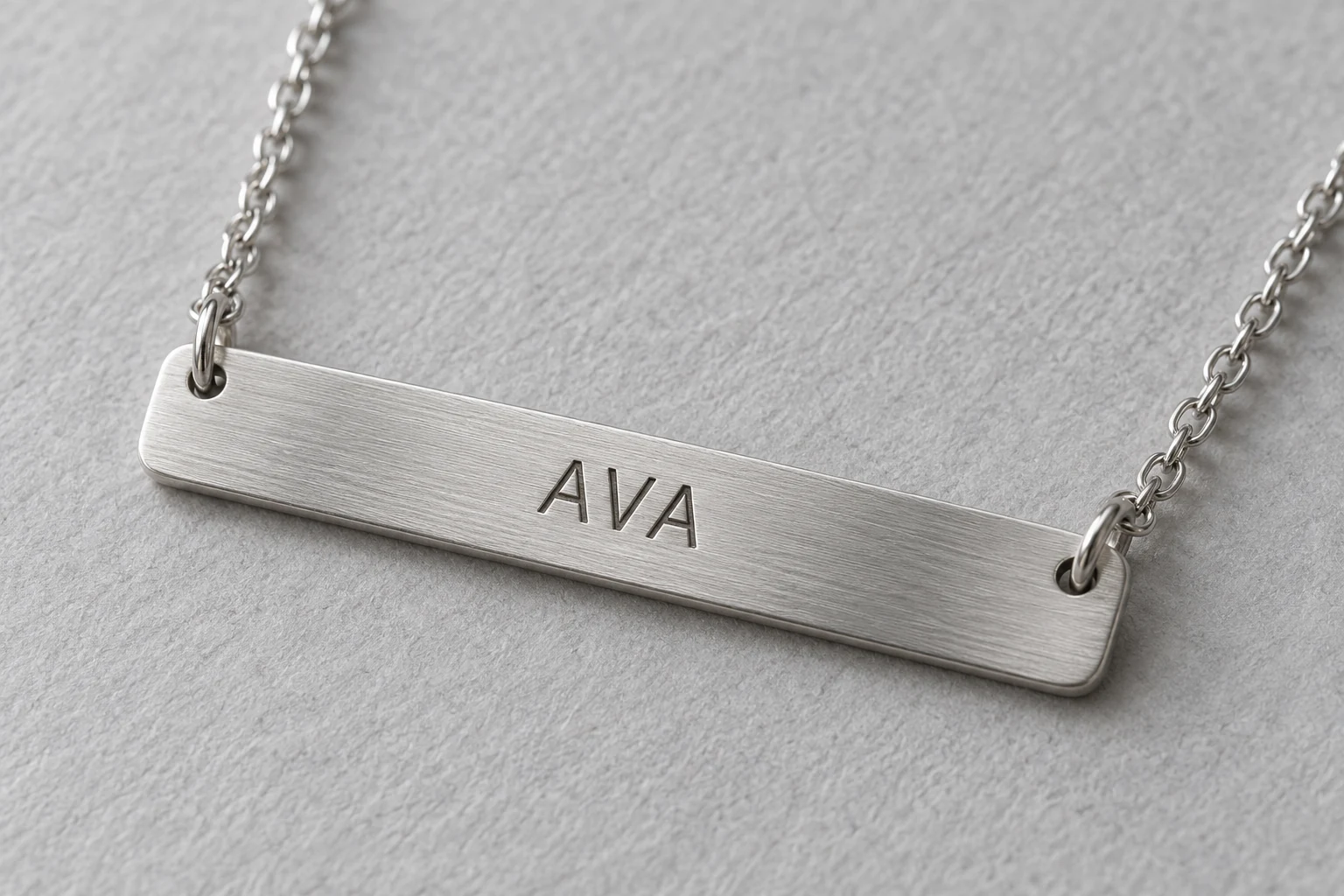
Custom stainless steel name bar necklaces combine a simple shape with several production decisions: the bar dimensions, surface finish, engraving layout, chain attachment and personalization workflow. For a wholesale order, define those details before approving the sample. A clear name layout does not compensate for rough edges, an unbalanced attachment or an incorrectly packed personalized item.
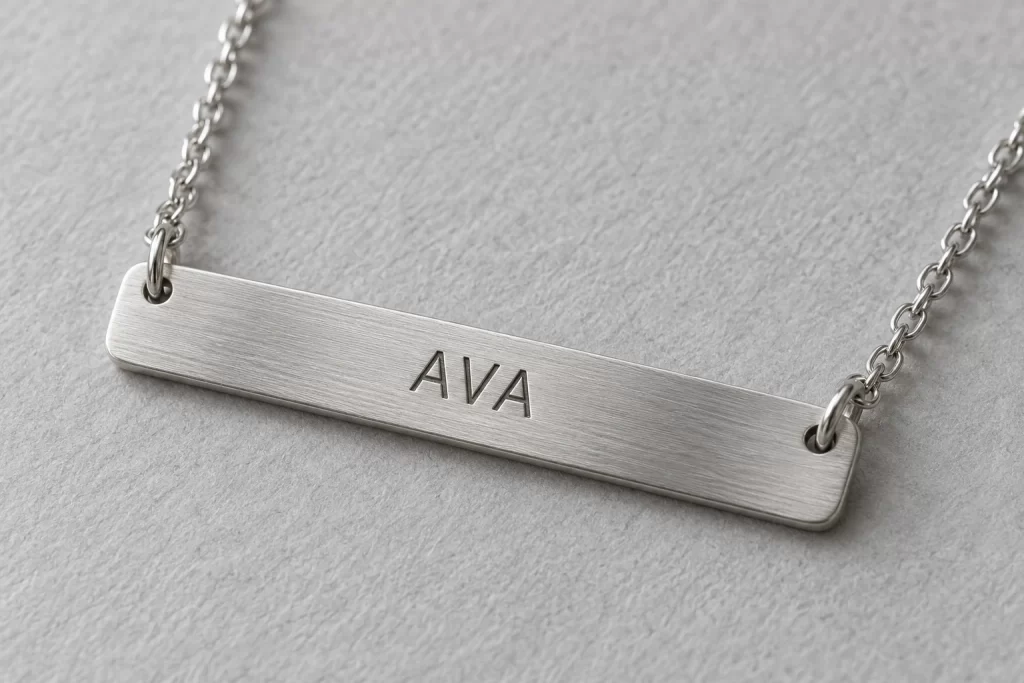
Record the finished length, height and thickness of the bar, its edge profile and whether the front is flat or curved. Show the back as well as the front. A thicker blank can feel different in wear, and a curved surface can change how an engraving looks under light.
Stainless steel should be specified by grade rather than by a general “surgical” label. HonHo offers custom stainless steel development with 304 and 316L options; confirm the grade for each component in the project specification. Neither grade should be described as nickel free simply because it is stainless steel. See our material and nickel-testing guide for that distinction.
| Part of the design | Decision to record | Sample check |
|---|---|---|
| Bar | Dimensions, thickness, curve and corner radius | Comfort, balance and edge smoothness. |
| Attachment | Hole or loop positions and connector dimensions | Symmetry and whether the bar hangs level. |
| Chain | Style, width, construction and finished length | Appearance, movement and connection strength. |
| Clasp and extender | Type, size and usable adjustment length | Ease of fastening and final wearing length. |
| Finish | Polish or texture, color reference and coating specification | Consistency across bar, chain and findings. |
| Personalization | Artwork, text, font, placement and method | Approved proof matches the finished item. |
Provide the usable marking area with clearance from edges and attachment holes. Record the maximum width and height of the artwork, alignment and whether the design includes front and back engraving. Long names, coordinates and small symbols need separate proofs because they do not occupy space in the same way.
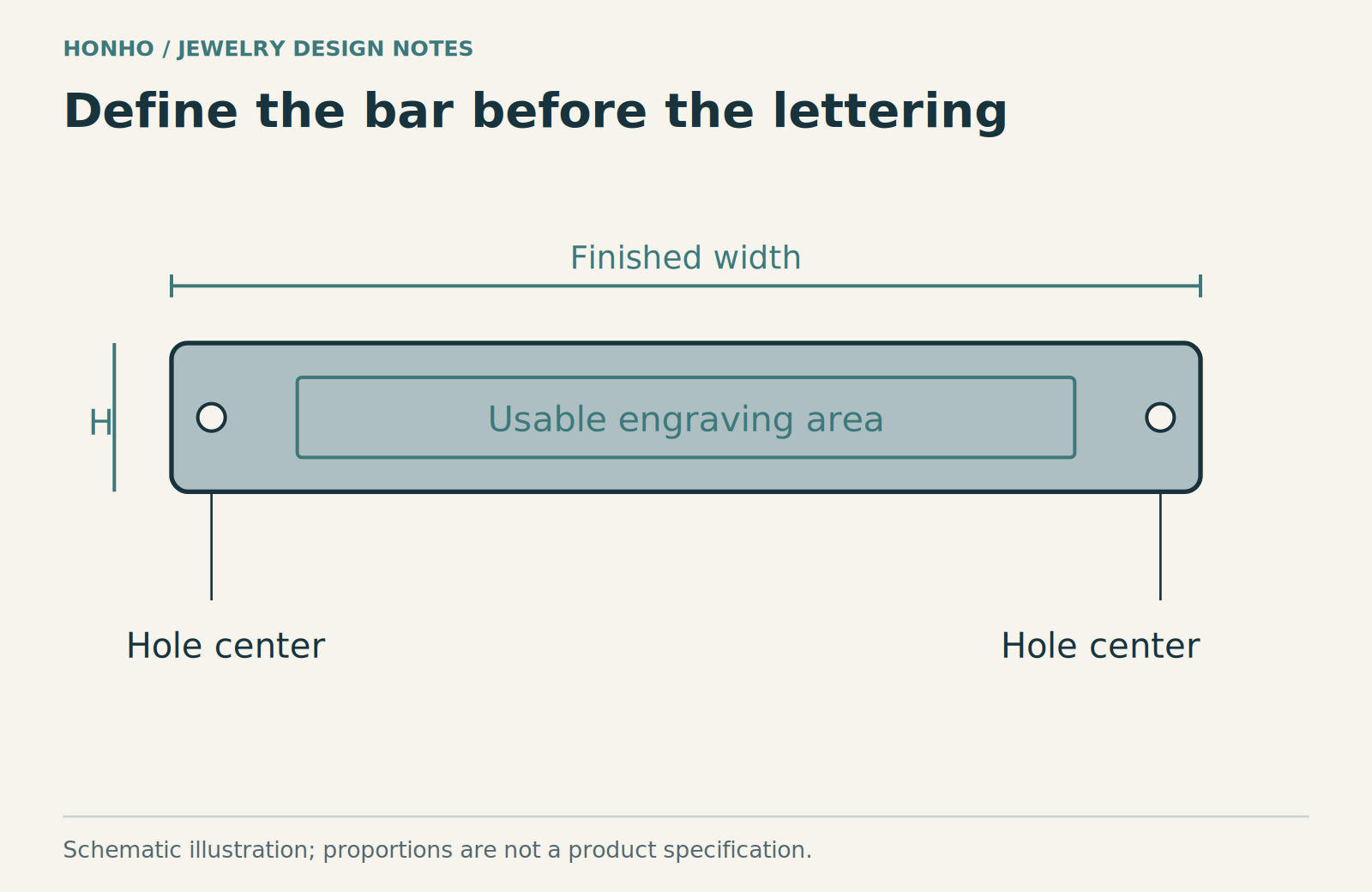
Supply exact text with capitalization, accents and punctuation. Choose a font that the production workflow can reproduce and provide vector artwork where appropriate. An image of a font is a reference, not a reliable text instruction.
A visible laser mark, an engraved recess and a filled engraving can look and feel different. Ask for a sample of the proposed method on the actual finish. Specify whether the goal is subtle contrast, a tactile recess or another defined appearance, rather than using “laser engraving” to imply one universal result.
Agree whether marking takes place before or after the finish. The sequence can affect contrast and surface appearance. A proof on an uncoated blank does not fully establish the result on the final colored product.
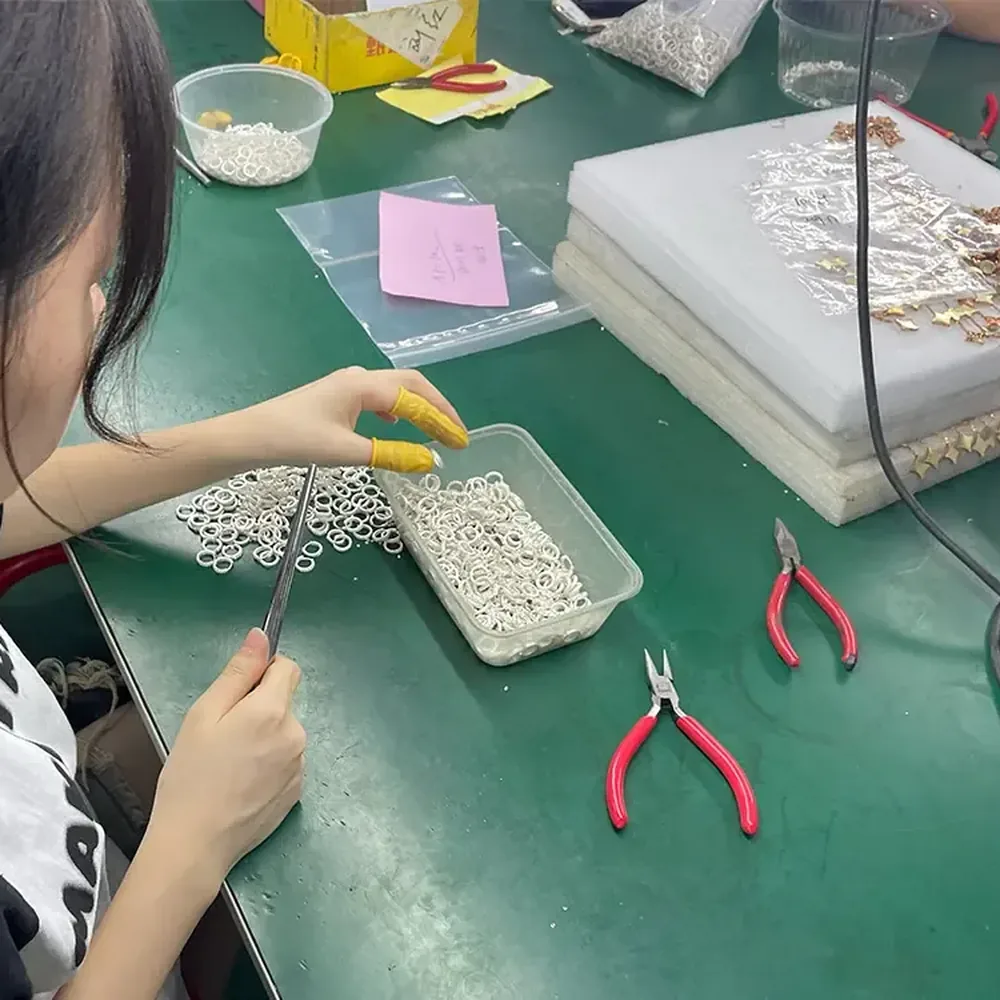
A bar fixed at both ends needs balanced connection points. Review the complete necklace laid flat and in a normal wearing position to see whether the bar tilts or twists. Confirm whether the stated necklace length includes the bar, clasp and extender; inconsistent measuring conventions can cause avoidable order disputes.
Cable and other chain styles can create different visual weights. Use the chain style comparison to select a construction, then confirm actual dimensions and weight on the sample. For the fastening, use our clasp selection checklist rather than choosing by appearance alone.
A horizontal bar fixed at two ends should hang in the intended orientation when the necklace is worn, not only when it is laid flat. Show the hole centers or attachment loops on the drawing and state whether the connectors are free to move. Review how the chain approaches each end and whether a connector presses against the engraved face.
A vertical bar with a top bail creates a different marking area and a different balance. Check whether the bar rotates enough to expose its reverse and whether front-and-back personalization remains readable. A four-sided bar needs a view identifying each face; “engrave the back” can be ambiguous when the supplier and buyer orient the part differently.
For a fixed horizontal bar, identify whether the specified length includes the bar, clasp and connecting rings. State the extender as a separate length if it is additional. Measure the complete finished sample using the agreed method. Without this convention, two nominally identical necklaces can sit differently because one supplier quoted chain length alone.
Choose sample text that exercises the design’s limits: a longer name, narrow letters, an accent, a date or a small symbol where those options will be offered. Confirm the usable width and height, then approve the lettering at actual size. Reducing the entire design to fit a long name can make thin strokes unreadable even when the mock-up looks attractive on a large monitor.
Set a rule for text that does not fit. The choices might be a smaller approved font, a second line, a wider bar or a customer revision, depending on the design. Record who approves the change. Production should not silently drop an accent, shorten a name or substitute a different symbol.
A preview is enlarged, evenly lit and usually viewed straight on. A small metal bar moves, reflects light and may have brushing or a colored finish behind the letters. Approve the proposed text at its actual size, then inspect it on a finished sample from more than one angle. Ask for an ordinary close photograph as well as a studio image. A dark render should not be the only evidence for a subtle mark on reflective steel.
Check the spaces inside and between letters, not just whether the entire name fits. A long name compressed into a fixed width can close up thin strokes or make accents hard to distinguish. Set separate limits for the approved fonts and bar sizes instead of advertising one character count for every option. When a name exceeds the readable area, ask the customer to approve a different layout before manufacture.
If black or colored filling is part of the design, specify it separately from the engraved recess and agree the care instructions. A maker’s question about faded letter filling illustrates why those two features matter. Do not tell customers to add household ink or paint to an unknown finish; have the maker assess the material and suitable restoration method.
For handwriting, send a clear original scan or photograph with the requested word identified. Keep the source file as well as any cleaned artwork. Enlarging a small screenshot does not recover missing strokes. Ask the production team which file format and usable marking size suit the proposed process, and approve any tracing or simplification against the original.
A customer question about a blurry handwriting upload is a good reminder to settle artwork quality before ordering. The goal is not merely a clean-looking word: it is preservation of the intended handwriting. A designer should not replace a distinctive letter with a standard font or invent a missing stroke without approval.
For names using accents or a script the production team does not read, obtain approval from someone who can verify the exact text. Keep a text reference alongside the final outlined artwork. Confirm reading direction, connected letters and the orientation of the selected face. Do not rely on a screenshot’s appearance to resolve a language or spelling question.
For a collection, make one difficult artwork example part of sample approval and record how subsequent customer files will be checked. Send HonHo that example with the drawing and quantity split. This lets the team assess the personalization work before you promise a font, character limit or handwriting service to buyers.
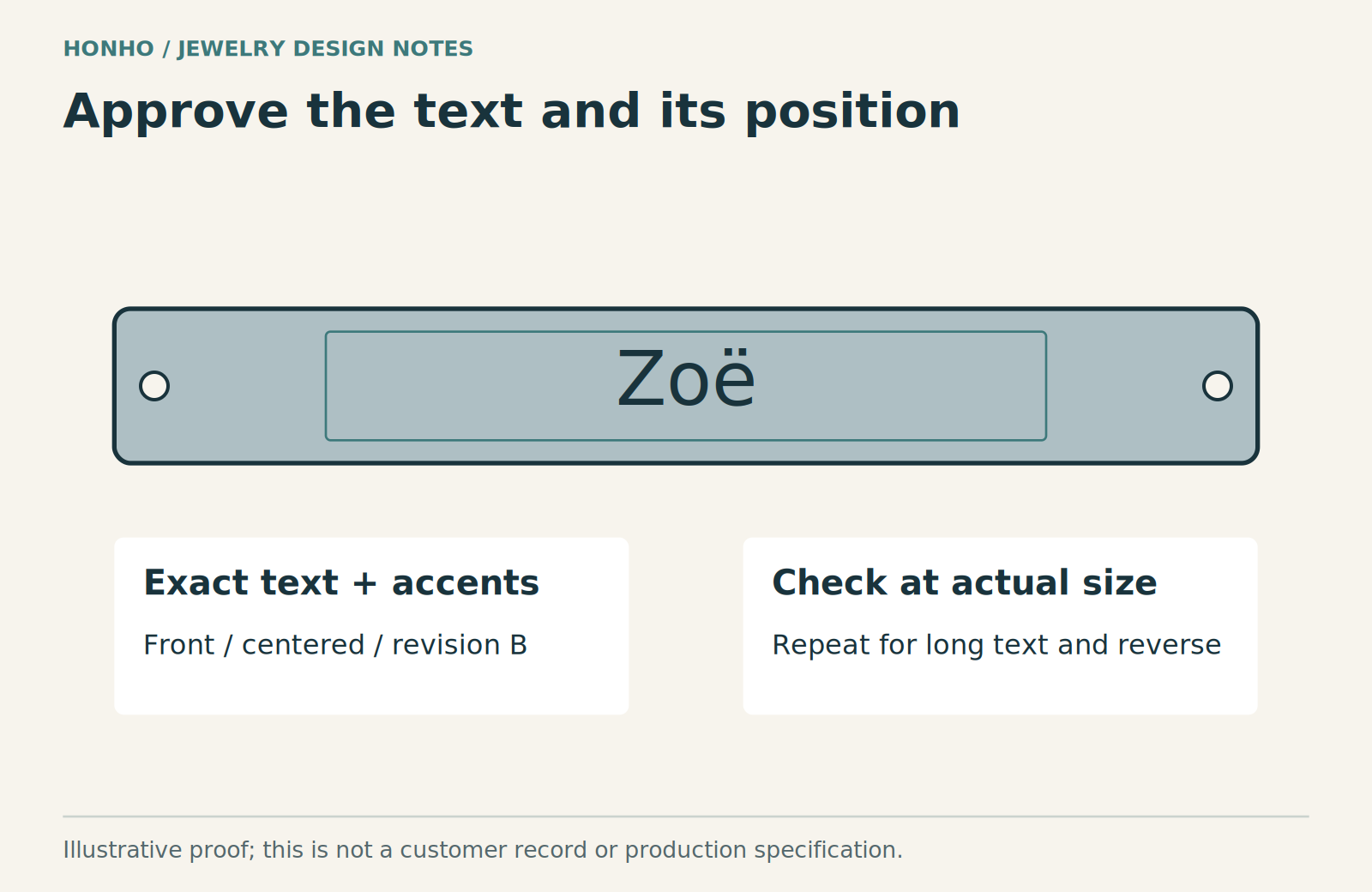
Send only the information needed for personalization. Avoid adding unrelated customer details to a production file. If text changes after approval, issue a new revision and confirm whether production has already started.
| Field | Example format | Approval question |
|---|---|---|
| Order identifier | NB-017, line 2 | Can the packed piece be matched without displaying unnecessary customer details? |
| Exact text | Zoë / ZOE / Zoé | Are spelling, accents and capitalization preserved? |
| Position | Front, centered in the approved engraving area | Is the position defined by dimensions rather than a cropped mock-up? |
| Artwork revision | Font proof B, approved date | Is the same file used for the sample and order? |
The example above is a workflow illustration, not a customer record. Include a longest-name proof as well as a short one. Check that narrow strokes remain readable at actual size, that spacing does not run into the attachment holes, and that a rear engraving will face the intended direction. A screen preview enlarged several times is insufficient for approving tiny lettering.
Specify the decorative coating separately from the steel grade. A gold-colored necklace does not establish a particular gold content, and “PVD” alone does not describe every layer. The gold-plated jewelry guide explains the questions to ask.
Inspect the bar edges and connection points after finishing. Compare the chain, clasp and bar against the approved color reference. Give customers care instructions for the actual coating and construction; our stainless steel jewelry cleaning guide provides a gentle starting point.
Include the drawing, grade, finish, chain specification, personalization method, quantity per style and color, packaging and target market. Ask whether mixed names create additional setup charges and what proof or file format is required. Do not assume that a total quantity automatically covers unlimited personalized variants.
Ask HonHo to confirm the minimum quantity by style, color and variant in the current project quotation. Sampling and production schedules should state the approval milestone that starts each stage, whether days are working days, and the effect of revisions or special components. Use the written schedule for that order rather than a general blog estimate.
Create separate checks for spelling and alignment, surface damage, chain length and closure. That makes a remake instruction precise: a correct bar on the wrong chain needs a different correction from a misspelled bar. Keep customer text only as long as necessary for the order and the agreed after-sales process.
Separate the standard product checks from the personalized-data checks. The bar shape, chain length, finish and closure can be checked against the product specification. Each engraved text must be matched to its approved order line. Sampling a few spellings cannot establish that every unique name in a mixed-name order is correct.
| Checkpoint | Record | Example of a preventable error |
|---|---|---|
| Artwork release | Approved text, face, font and revision | Old spelling reused after a correction |
| Engraving inspection | Order-line match and orientation check | Reverse engraving upside down |
| Assembly | Chain length, finish and connector check | Correct bar on the wrong length |
| Packing | Item-to-label match using the order identifier | Two personalized pieces exchanged |
Approve the packaging with the same care as the engraving. Use an identifier that lets the production and packing teams reconcile the item without exposing unnecessary customer information. Keep the personalization file version attached to the order, and agree how corrections received after release will be handled.
A new bar shape or attachment can require development or tooling. Front-and-back work, several fonts, filled lettering, a special surface finish or many individualized files can add setup and handling. The number of names is therefore a separate quantity from the number of physical styles. Ask how the proposed workflow is priced before presenting unlimited options to retail customers.
HonHo’s current starting quantity for custom stainless steel styles is 50 pieces per style. Explain the number of names, colors and chain lengths within that quantity and ask how those variants will be grouped. Sample pricing depends on the design and personalization work; request it as a separate line rather than assuming it is included in the unit price.
Current sample planning is 15–20 days at the earliest, with an outer planning window of one month; bulk production is planned at 25–35 days. Confirm the agreed starting milestone, day basis and effect of revisions in the quotation. An expedited initial metal blank can be available as quickly as three days with an additional charge for an accepted project. That blank is not the fully engraved, finished and approved necklace.
To begin, send the bar drawing, preferred grade, finish reference, chain specification, quantity split and a small representative personalization file. Ask HonHo to identify the artwork and construction decisions that must be settled before a final production price and schedule can be confirmed.
It depends on the bar geometry, finish and production method. Specify both layouts and approve a representative sample before committing to the design.
No. Fine strokes and tight spacing can become difficult to reproduce or read. Approve the exact font and text at the actual marking size.
Check the complete necklace against both the product specification and the approved personalization record. Correct text, correct finish and correct packaging must all match.
Send HonHo your bar necklace design and order breakdown to review the sample and personalization requirements.
Updated October 18, 2026.
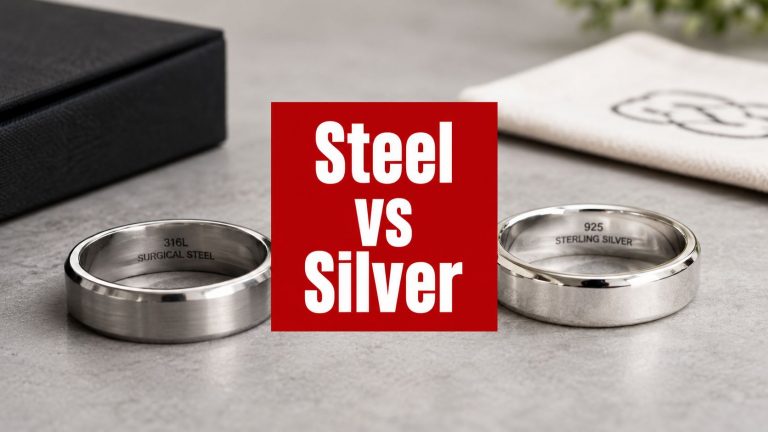
You’re pricing a new collection, and the sample tray is already split down the middle. The 316L surgical steel pieces look cleaner on cost and daily wear, the
You probably have a launch already in motion, a supplier sample on your desk, and one uncomfortable question underneath it all, will this gold color still look clean
If you are developing the ring itself, compare ring fabrication, casting and CAD methods before approving the shank dimensions and manufacturing route. You’re refining a ring design, the