
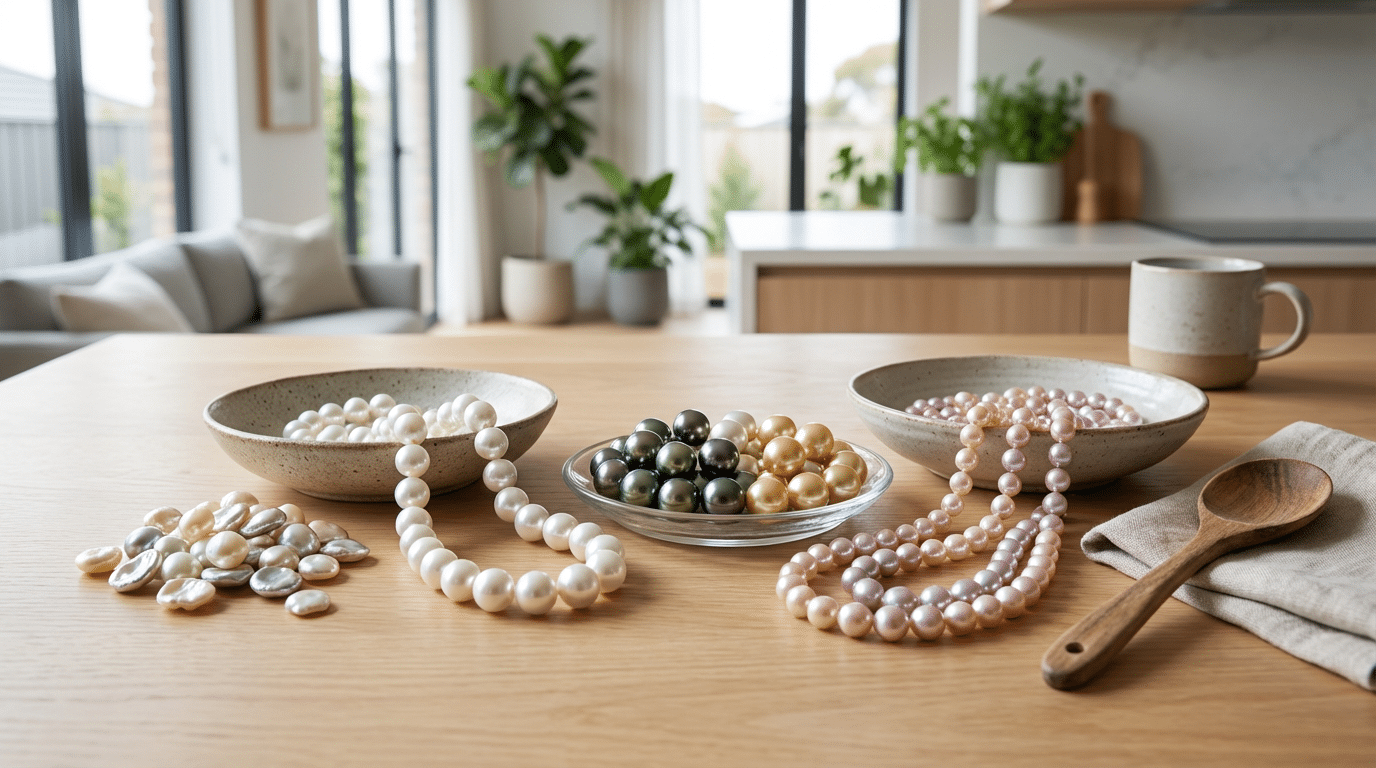
What Are Pearls?
When you hear “pearls,” you probably think of that soft glow and timeless elegance. But what are pearls, exactly?
At their core, pearls are organic gemstones formed inside living creatures—mainly oysters and mussels, collectively called mollusks. Unlike diamonds or sapphires that come from deep within the earth, pearls grow in bodies of water.
How Pearls Form Naturally Inside Mollusks
Inside the shell, a mollusk has a soft body lined with a tissue called the mantle. This mantle is responsible for producing nacre (also known as mother-of-pearl).
When an irritant gets inside the shell—traditionally something like:
- A tiny parasite
- A grain of sand or debris
- A piece of broken shell
the mollusk protects itself by coating the intruder with layer upon layer of nacre. Over time, these layers build up into a pearl.
Think of it as the mollusk’s natural defense system turning irritation into beauty.
Natural vs. Cultured Pearl Formation
Both natural pearls and cultured pearls form in the same biological way—through layers of nacre. The difference is how the process starts:
- Natural pearls
- Start completely by chance in the wild
- No human interference
- Extremely rare today because of overfishing and pollution
- Cultured pearls
- Begin when a pearl farmer carefully inserts a nucleus (usually a bead or tissue) into the mollusk
- The mollusk then does what it naturally does—coating it with nacre
- Make up about 99% of the pearl market
So yes: cultured pearls are real pearls. The mollusk still creates them; humans just give the process a predictable starting point.
Why Pearls Are Different from Traditional Gemstones
Pearls stand apart from classic gemstones in a few key ways:
- They’re born ready to wear
- Most gemstones need cutting and polishing
- Pearls come out of the shell with their natural luster and shape
- They’re organic, not mineral
- Formed by living creatures, not geological pressure
- This gives them a softer, more glowing sheen rather than a sharp sparkle
- They’re softer and more delicate
- Pearls rank about 2.5–4.5 on the Mohs hardness scale
- Diamonds are a 10, sapphires around 9
- Pearls need more gentle care but reward you with a uniquely silky, luminous look
This is why I always say: a diamond dazzles, but a pearl glows.
Main Types of Pearls
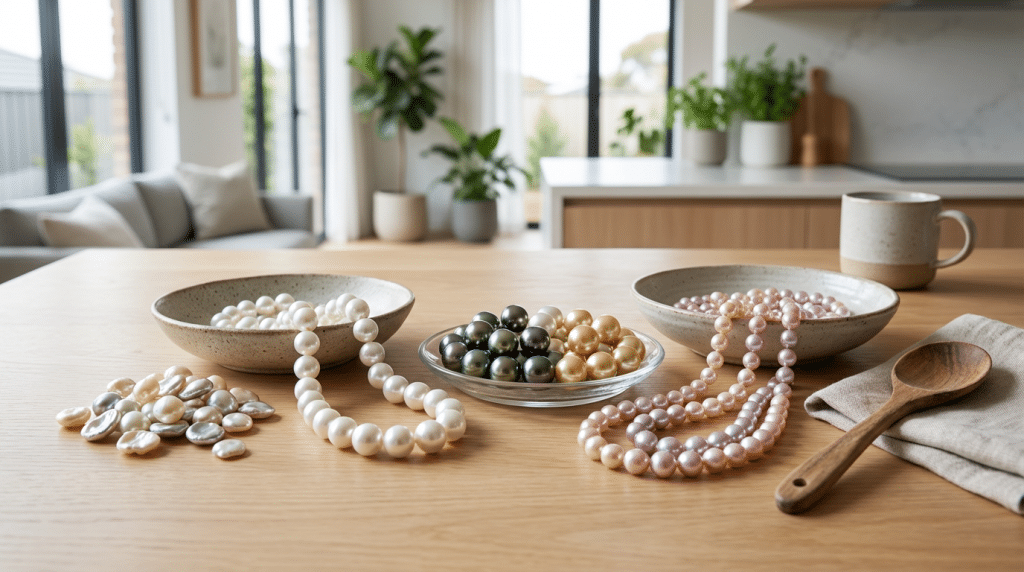
Natural vs. Cultured Pearls – The Basics
When people talk about different types of pearls, they’re first talking about how they form:
- Natural pearls: Form 100% on their own inside wild oysters or mussels, with no human help. Every natural pearl is a total accident of nature.
- Cultured pearls: Form the same way (layer by layer of nacre), but farmers start the process by gently inserting tissue or a bead inside the mollusk. The mollusk then does the rest.
Both are real pearls. The difference is how the process starts, not how the pearl grows.
Why Most Pearls Today Are Cultured
More than 99% of pearls on the market are cultured because:
- Wild oysters are overfished and protected in many areas.
- Natural pearls are extremely rare and expensive.
- Cultured pearls let farms produce consistent size, color, and shape at scale.
That’s why most pieces you see in jewelry stores or in wholesale necklace supplies come from cultured pearl types like freshwater, Akoya, Tahitian, or South Sea. If you’re planning to design or source jewelry, this is what you’ll be working with 99% of the time.
How Pearl Types Affect Price, Style, and Durability
Each pearl type has its own “personality” that affects how it wears and what it costs:
- Price
- Freshwater: Most affordable, ideal for everyday and bulk buys.
- Akoya: Classic mid–high range for fine strands.
- Tahitian & South Sea: Larger, rarer, and generally high-end.
- Natural pearls: Top of the market, mainly for serious collectors.
- Style
- Freshwater: Fun shapes, colors, and modern looks.
- Akoya: Clean, round, and formal – the “traditional” pearl necklace.
- Tahitian: Dark, bold, great for statement or fashion-forward designs.
- South Sea: Big, luxurious, perfect for premium collections.
- Durability
- Pearls with thicker nacre (often Tahitian, South Sea, good-quality freshwater) handle daily wear better.
- Thinner-nacre pearls can lose luster faster if not cared for properly.
If you’re building a jewelry line or buying for yourself, first decide:
- What’s your budget?
- Do you want classic elegance or a bolder, modern look?
- How often will you wear the piece?
For broader sourcing and style planning beyond pearls, you can also look at our general guide on how to buy jewelry for your brand or store to match pearl types with your target customers and price points.
Natural Pearls
What makes a pearl “natural”?
A natural pearl forms 100% on its own inside a wild mollusk, with no human help, no implant, no seeding.
- An irritant (like a tiny parasite) gets inside the shell.
- The mollusk defends itself by coating it with layer after layer of nacre.
- Over years, that build-up becomes a pearl – shape, size, and color are all random.
If a pearl has been intentionally seeded by people, it’s not natural – it’s cultured, even if the nacre is real.
Why natural pearls are extremely rare today
Natural pearls are rare because:
- Overfishing & pollution wiped out many wild oyster beds.
- Diving for wild pearls is expensive, dangerous, and unpredictable.
- One oyster in thousands might hold a pearl, and most of those aren’t gem-quality.
- Today, most mollusks are farmed for cultured pearls, not left wild for natural pearl hunting.
That’s why genuine natural pearls make up a tiny fraction of the global market and sit in the same “unicorn” category as top-tier colored diamonds.
Famous historical natural pearls
A few natural pearls have made history and pushed prices sky high:
- La Peregrina – A drop-shaped natural pearl once owned by Spanish royalty and later Elizabeth Taylor. Its story of royal ownership and perfect shape turned it into a legend.
- The Pearl of Lao Tzu (Pearl of Allah) – A massive non-nacreous clam “pearl” with more myth than proof behind it, but still widely talked about.
- Marie Antoinette’s Pearls – Natural pearls from her collection have sold at auction for millions due to their direct royal connection.
These stories matter because provenance (who owned it, where it came from) is a key driver of natural pearl prices.
How natural pearls are valued and priced
Natural pearls are priced more like rare art than standard jewelry. Value depends on:
- Origin & documentation – Lab reports (e.g., GIA) confirming “natural” and “saltwater” are non‑negotiable for serious buyers.
- Size – Larger, well-formed pearls are extremely rare and can multiply the price.
- Shape – Round and symmetrical drops are worth the most.
- Luster & surface – Strong luster and clean surface = higher value.
- History – Royal, noble, or celebrity ownership can add massive premiums.
You’ll usually see natural pearls at high-end auctions, not in regular retail. A well-matched natural pearl strand can easily hit six or seven figures.
Who natural pearls are really for
To be blunt, natural pearls are not for everyday buyers. They’re ideal for:
- Collectors & investors looking for ultra-rare assets.
- High jewelry clients who want museum-grade pieces.
- People obsessed with antique or royal-era jewelry and willing to pay for documented provenance.
If you just want beautiful pearls to wear, cultured pearls give you better design options, far lower prices, and less stress about damage. Natural pearls are a niche luxury for those who treat jewelry like an asset class, not just an accessory.
If you’re mixing natural pearls with gold-plated pieces, make sure you know how to clean and maintain your jewelry without harsh chemicals, especially around delicate nacre and plating; a good starting point is this guide on how to clean gold-plated jewelry.
Cultured Pearls
How Cultured Pearls Are Created
Cultured pearls are real pearls grown with a bit of human help. Instead of waiting for nature to do it by chance, pearl farmers:
- Gently open the mollusk (oyster or mussel)
- Insert a small nucleus (often a bead or tissue piece)
- Return it to clean, controlled water so it can coat the nucleus with nacre
The rest is natural biology: the mollusk builds up layers of nacre over months or years, just like a natural pearl. The result: the same material, structure, and look—just guided and scaled by people.
Why Cultured Pearls Dominate the Market
Cultured pearls account for roughly 99% of pearls sold today because they:
- Make beautiful pearls available at normal budgets
- Offer more consistent size, color, and shape for jewelry design
- Can be produced reliably year after year
Without cultured pearl types, pearl jewelry would be rare, ultra-expensive, and mostly limited to collectors.
Main Types of Cultured Pearls
When people talk about different types of pearls, they usually mean these four cultured categories:
- Freshwater pearls – Mostly farmed in lakes and rivers (especially in China). Huge variety, best value.
- Akoya pearls – Classic saltwater “round white strand” pearls, mainly from Japan and China.
- Tahitian pearls – Naturally dark pearls from French Polynesia, famous for peacock and black-green tones.
- South Sea pearls – Large, luxury pearls from Australia, Indonesia, and the Philippines, in white and golden shades.
Each group has its own look, price range, and “personality,” so I always match them to the buyer’s style and budget rather than pushing just one type.
Ethical & Environmental Angles
Modern cultured pearl farming can be surprisingly positive for the environment when done right:
- Oysters and mussels need clean water, so farms have a strong incentive to protect local seas and rivers
- Mollusks filter water naturally, helping improve water quality around farms
- No mining is involved, unlike many traditional gemstones
The key is responsible producers. When I work with custom jewelry manufacturers, I look for partners who combine good farming practices with ethical labor standards, the same way I vet any costume jewelry manufacturers we collaborate with.
Cultured pearls give you real, beautiful pearls, at accessible prices, without the extreme environmental footprint of many mined stones.
Freshwater pearls

Where freshwater pearls come from
Most freshwater pearls on the global market are farmed in China, mainly in lakes, rivers, and controlled ponds. Smaller volumes also come from the US and parts of Europe, but China dominates thanks to advanced farming techniques and stable supply, which keeps prices friendly for everyday buyers and small jewelry brands.
Common freshwater pearl shapes
Freshwater pearls are famous for variety. The main shapes you’ll see are:
- Round & near-round – great for classic studs and strands
- Baroque – irregular, organic shapes with tons of character
- Coin – flat, disc-like, perfect for modern necklaces and earrings
- Keshi – small, all-nacre pearls with strong luster, often freeform
- Ripple / flame – textured surface with deep, liquid-looking luster
This shape range is exactly why I reach for freshwater pearls when designing affordable custom pieces or testing new styles for market.
Size and color range
Freshwater pearls cover a wide range of looks:
- Size: usually 5–10 mm, but large 10–14 mm “statement” pearls are now common
- Natural colors: white, cream, pink, peach, lavender
- Treated/dyed: deeper purples, blues, silvers, even black tones
They’re ideal if you want to experiment with color without paying luxury-level prices.
Price and value for money
Freshwater pearls are the best value entry point into real pearls:
- Small studs / simple pendants: often under $50–$100
- Good quality strands (6–8 mm): roughly $80–$400+ depending on luster, matching, and size
- Top-grade, large, round strands: can climb higher, but still cheaper than Akoya or South Sea of similar size
Because costs are lower, you can invest more into better findings and durable metals like 316L stainless steel jewelry, which I often use to build everyday-friendly pearl pieces that don’t tarnish fast and stay within budget (see my breakdown of 316L stainless steel jewelry benefits).
Pros of freshwater pearls
Why I like working with freshwater pearls for global customers:
- Versatile: works for minimal, classic, and bold fashion designs
- Affordable: real pearls without luxury markups
- Huge variety: more shapes, colors, and sizes than any other pearl type
- Durable enough for daily wear when set and cared for properly
They’re perfect if you’re just starting to build a jewelry collection or testing new product lines for a small business.
Cons of freshwater pearls
There are trade-offs you should know:
- Luster: usually softer than top Akoya or South Sea (though high-grade freshwater can be impressive)
- Prestige: seen as less “luxury” than saltwater pearls in many markets
- Resale value: generally lower; not the best pick if you’re thinking purely as an investor
Best uses for freshwater pearls
I recommend freshwater pearls when you need:
- Everyday jewelry: studs, simple pendants, casual chokers, stacking bracelets
- Gifts: birthdays, graduations, bridesmaid sets, corporate gifting
- Starter strands: your first real pearl necklace that looks good, feels comfortable, and doesn’t destroy your budget
If you want real pearls that you can actually wear often, mix with modern metals, and still keep costs under control, freshwater pearls are the smartest starting point.
Akoya Pearls
Akoya cultured pearls are the classic “string of pearls” most people picture. They’re mainly grown in Japan (premium origin) and China, where farms carefully culture them in saltwater using Akoya oysters.
What Akoya Pearls Look Like
- Shape: Usually very round and well-matched – ideal for traditional strands
- Luster: High, sharp, mirror-like shine that reflects light clearly
- Size range: About 4–9 mm, with 7–8 mm being the most popular for necklaces
- Colors & overtones:
- Body color: white to cream
- Overtones: soft rose/pink, silver, or ivory
- Rose overtone is often seen as the most flattering and “luxury” look
Why Akoya Are the Classic Strand Pearls
Akoya pearls are the standard for a timeless, elegant strand because they combine:
- Very round shapes
- Strong luster that looks polished and dressy
- Consistent matching across a full necklace
They sit perfectly with office outfits, suits, little black dresses, and bridal gowns. If you want that “old-money” pearl vibe, Akoya is the easiest way to get it.
Akoya Pearl Price Range & What Affects Cost
You’ll see Akoya pearl jewelry roughly in these brackets (for global retail):
- Entry level: $150–$400 – smaller sizes, more surface marks, simpler findings
- Mid-range: $400–$1,500 – 6.5–8 mm, better luster, cleaner surfaces, well-matched strands
- High-end: $1,500+ – top luster, near-perfect surfaces, strong overtones, premium Japanese origin
Main factors that push the price up:
- Size: 8–9 mm Akoya are much rarer and pricier than 6–7 mm
- Luster & surface quality: Sharper shine + fewer blemishes = higher cost
- Matching: Perfectly matched strands are more expensive
- Origin & branding: Renowned Japanese farms often cost more than mass-market Chinese production
If you’re building a collection that mixes pearls with other metals like gold-filled or vermeil, it pairs well with higher-quality findings (for example, using premium metals instead of basic fashion plating, similar to the logic behind choosing gold-filled vs vermeil finishes).
Simple Care Tips for Akoya Pearls
Keep Akoya pearls sharp and glossy by:
- Last on, first off: Put them on after perfume, hairspray, and makeup
- Wipe after wearing: Use a soft, dry cloth to remove skin oils
- No harsh cleaners: Just mild soapy water if needed, then wipe and air-dry
- Store safely: Lay flat in a soft pouch or lined box, away from other jewelry that can scratch
- Restring regularly: For frequently worn strands, restring every 1–2 years on silk with knots
Who Akoya Pearls Are Best For
Akoya pearls are a smart pick if you:
- Want a classic, polished look for the office or client meetings
- Need bridal jewelry that photographs beautifully and feels timeless
- Prefer refined, minimal luxury over big and flashy pieces
- Are buying your first “real” pearl strand and want something you can rely on for decades
For global shoppers who want timeless style without overthinking trends, Akoya pearls are the go-to: elegant, recognizable, and always appropriate.
Tahitian Black Pearls
Tahitian black pearls are for people who want pearls that actually stand out, not just blend in.
Where Tahitian pearls come from
Tahitian pearls are cultured in French Polynesia, mainly around Tahiti and nearby atolls. They grow inside the black-lipped oyster (Pinctada margaritifera), which naturally produces darker tones than Akoya or South Sea oysters.
Natural dark colors & “peacock” overtones
Tahitian pearls aren’t just “black.” Their body colors and overtones can include:
- Black / charcoal
- Green and blue-green
- Gray / silver
- Peacock (a mix of green, blue, and rose)
- Eggplant / aubergine (deep purple tones)
Peacock overtone means the pearl shows a multi-color shimmer (usually green + blue + pink) over a darker base, similar to a peacock feather. It’s one of the most prized looks for Tahitian pearls.
Size range & common shapes
Tahitian pearls are naturally larger than Akoya:
- Typical size: 8–14 mm
- Premium sizes: 11–14 mm+ (rare and more expensive)
Common shapes:
- Round / near-round – top price, used in luxury strands
- Drop / oval – perfect for pendants and earrings
- Baroque / circled – organic, artistic shapes with strong character and better price for the size
Price range & what affects value
Tahitian pearl prices vary a lot depending on quality:
- Entry-level jewelry: from around $150–$300 (baroque, smaller sizes, more surface marks)
- Mid-range: $300–$2,000 (nice luster, 9–11 mm, well-matched pieces)
- High-end: $2,000+ (large, round, clean, strong peacock or vivid overtones, matched strands)
Main value drivers:
- Size – bigger = pricier, especially above 11 mm
- Shape – perfectly round costs the most
- Luster – sharp reflection and depth add serious value
- Surface – fewer blemishes = higher grade
- Color & overtone – rare peacock and vivid greens/blues command a premium
- Matching – well-matched strands or pairs always cost more than single loose pearls
If you’re planning to commission custom Tahitian pieces, pairing strong pearls with a professional maker that understands quality casting and finishing (for example, teams experienced in lost wax casting) makes a big difference in the final look.
Styling ideas: bold vs minimal
Bold looks:
- Chunky Tahitian strand with baroque or circled pearls
- Oversized single-pearl ring or cocktail pendant
- Mixed metal settings (black rhodium, yellow gold, and white gold together)
Minimal looks:
- One clean round Tahitian on a simple chain
- Small matched studs or delicate drops
- Slim bangle with a single center pearl
Tahitian pearls pair especially well with:
- Black, white, and neutral outfits
- Jewel tones: emerald, navy, burgundy
- Streetwear or tailored office looks when you want an “elevated edge”
Who Tahitian pearls are best for
Tahitian black pearls are ideal if you:
- Love statement jewelry that still feels refined
- Want something more modern and edgy than classic white strands
- Prefer fewer, better pieces over lots of small, simple items
- Already own white pearls and want a second, bolder option
If you’re building a focused jewelry collection for global, style-aware customers, a tight selection of strong-luster, 9–11 mm Tahitian pearls (especially peacock and green tones) will hit the sweet spot between drama, wearability, and price.
South Sea Pearls
South Sea pearls are the heavy hitters of the pearl world – big, rare, and seriously luxurious.
Where South Sea Pearls Are Farmed
Most South Sea pearls come from:
- Australia – top-grade white South Sea pearls
- Philippines – strong in golden South Sea pearls
- Indonesia – a mix of white, cream, and rich golden tones
They’re grown in Pinctada maxima oysters, which are much larger than Akoya oysters – that’s why the pearls get so big.
White South Sea vs Golden South Sea Pearls
- White South Sea pearls
- Colors: white to silvery white, sometimes with soft rose or silver overtones
- Look: clean, elegant, very “high jewelry”
- Golden South Sea pearls
- Colors: light champagne to deep, rich 24k-style gold
- Look: bold, luxurious, instantly eye-catching
Deep golden tones with smooth surfaces and strong luster are some of the most expensive pearls on the market.
Size and Signature Luster
- Typical size: about 9–16 mm, with exceptional pearls reaching 18–20+ mm
- Luster: not sharp like Akoya, but a soft, satin-like glow that looks almost velvety on the skin
- Shapes: mostly round and near-round, with some drops and baroques for statement pieces
That creamy, diffused shine is what makes South Sea pearls look so high-end in real life.
Why They’re the “Rolls-Royce” of Pearls
South Sea pearls have this reputation because of:
- Rarity: fewer farms, longer growing times (2–4 years in the oyster)
- Size + luster combo: large pearls with thick nacre and luxury glow
- High production cost: big oysters, clean waters, strict farming standards
Put simply: very low supply, very high demand – especially for matched strands of large, round pearls.
Rarity, Investment Potential, and Price
Rough price brackets (per piece or per pair, not full strands):
- Entry-level baroque / smaller sizes: $300–$800
- Good quality round 10–13 mm: $800–$3,000+
- High-end round 14–16 mm or deep golden: $3,000–$15,000+
- Top-grade matched strands: can run into five or six figures
Because of their rarity, well-bought, high-quality South Sea pearls tend to hold value better than most commercial pearls, especially for:
- Large, round, high-luster whites
- Deep golden colors with clean surfaces
For wholesale or brand sourcing, I always price South Sea carefully alongside other premium lines, similar to how I structure wholesale jewelry pricing for higher-end materials.
Who Should Consider South Sea Pearls
South Sea pearls make sense if you:
- Want one hero piece (a pendant, studs, or a ring) you can wear for life
- Are building a luxury or fine jewelry brand and need a true flagship product
- Prefer understated wealth – quiet but clearly expensive
- Are comfortable with fine jewelry budgets and think long-term, not fast fashion
They’re not the first step for most buyers – they’re the upgrade once you already know you love pearls and want the best.
Less Common Pearl Types: Conch Pearls
What Are Conch Pearls?
Conch pearls come from the Queen Conch shell (not from oysters) and are non-nacreous – meaning they don’t have the typical layered nacre you see in most pearls. Instead, they have a smooth, porcelain-like surface with a soft inner glow rather than a sharp “mirror” luster.
How Conch Pearls Form Without Nacre
Unlike cultured pearls, conch pearls form spontaneously inside the conch as a natural irritation response. There’s no nucleus and no farming process. That’s why:
- You can’t reliably “farm” conch pearls.
- Most conch shells never produce a pearl at all.
- Almost every conch pearl is one-of-a-kind in size, shape, and color.
Colors and Flame Patterns
Conch pearls are loved for their warm, tropical colors:
- Soft to intense pink (the most coveted)
- Peach, salmon, cream, and sometimes white or yellow
Their signature is the “flame” pattern – a wavy, flame-like effect that seems to move under the surface when you rotate the pearl. Strong, clean flame patterns and saturated pink tones push the price into serious collector territory, similar to how top-quality gemstones and fine gold pieces are valued in high-end and investment-focused jewelry.
Why Conch Pearls Are Rare and Collectible
Conch pearls are rare because:
- The Queen Conch is mainly harvested for meat, not pearls.
- Only a tiny fraction of shells ever contain a pearl.
- Even fewer are gem-quality with strong color and flame.
That combo of natural formation + zero cultivation + tiny supply makes them:
- Highly collectible
- Priced more like fine gems than standard pearls
- Popular with serious collectors and bespoke jewelry buyers
Common Jewelry Uses for Conch Pearls
Because they’re rare and often small, conch pearls are usually set as hero stones, not in full strands. You’ll most often see them in:
- High-end rings (center stone with diamond accents)
- Pendants and lockets
- Earrings (matched pairs are especially rare and expensive)
- One-of-a-kind designer pieces and heirloom-level jewelry
If you want something truly uncommon and you’re already comfortable evaluating fine jewelry and hallmarks, conch pearls are a smart way to add a standout piece to your collection, similar to owning a rare signed vintage piece or a custom-crafted item with meaningful jewelry hallmarks.
Melo Melo Pearls
Melo melo pearls are a completely different category from classic nacreous pearls (like Akoya or South Sea). They don’t come from oysters at all, but from the melo melo sea snail, and they don’t have layers of nacre. That’s why their surface looks more like polished porcelain than a traditional pearl.
You’ll recognize melo melo pearls by their:
- Distinctive colors: rich orange, yellow‑orange, and sometimes creamy tones
- Porcelain-like finish: smooth, glossy surface instead of a pearly, rainbow orient
- Natural swirl patterns that give each pearl a one‑of‑a‑kind character
They’re mainly found in the waters of Southeast Asia (especially Vietnam, Myanmar, and surrounding regions), and they’re never farmed—only discovered by chance. That makes high-quality melo melo pearls incredibly scarce.
Serious collectors chase melo melo pearls because:
- They’re non-nacreous and ultra-rare, even compared with top South Sea or conch pearls
- Fine specimens with strong orange color and clean surface are true trophy gems
- They work perfectly as center stones in bespoke high jewelry, especially when paired with custom metalwork from a specialist custom jewelry manufacturer.
If you’re building a serious gem collection or commissioning a one‑off statement piece, a strong-color melo melo pearl is one of the most exclusive options you can own.
Kasumiga Pearls
Kasumiga pearls are a niche favorite in the “different types of pearls” world because they mix the best of both freshwater and saltwater traits. They’re grown in Lake Kasumigaura in Japan in very limited quantities, so supply is tight and prices reflect that.
These cultured pearls use freshwater mussels but are nucleated more like saltwater pearls. That’s why you often see:
- Strong, almost metallic luster (saltwater vibe)
- Thicker nacre and slightly more organic shapes (freshwater vibe)
Kasumiga pearls are known for vivid, unusual colors you rarely see elsewhere:
- Deep rose, lavender, plum, peach, and gold tones
- Complex overtones and “blushy” surfaces that feel very artistic
- Visible natural texture and ripples that designers intentionally highlight rather than hide
High-end designers love Kasumiga pearls for:
- One-of-a-kind pendants and cocktail rings
- Asymmetrical baroque earrings and modern statement necklaces
- Mixed-metal designs (especially with stainless steel jewelry or warm gold tones) that let the color do the talking
If you want something more original than classic Akoya and more refined than standard freshwater, Kasumiga pearls are a smart pick for standout, limited-edition pieces.
Edison Pearls

Edison pearls are next‑gen large freshwater cultured pearls grown with a similar method to saltwater pearls: a single bead nucleus is implanted into a freshwater mussel, then left to build thick nacre over several years. This hybrid approach gives Edison pearls that classic “round, big, and bright” look without South Sea pricing.
Key traits of Edison pearls:
- Big size, bold presence
- Commonly 11–16 mm, with some even larger
- Usually round or near-round, very clean surfaces
- Strong, sharp luster that can rival higher‑end saltwater pearls
- Colors & price range
- Natural shades: white, pink, lavender, peach, plum, and metallic tones
- Fashion colors (dyed): aubergine, bronze, deep gold, vivid purple
- Pricing runs mid-range: more than standard freshwater, less than South Sea.
- Entry pieces: from around $80–$200
- High-grade, large pairs/solitaires: can move into the several hundred+ range
- Why they’re perfect for modern, bold designs
- One big Edison pearl on a chain gives instant statement with minimal metal.
- Great for chunky pendants, cocktail rings, asymmetrical earrings, and mixed-metal looks; if you’re already experimenting with layered chains or different types of chains, a single Edison centerpiece ties everything together.
- The mix of size, strong luster, and fun colors makes them ideal if you want pearls that feel fresh, fashion‑forward, and Instagram‑ready, not traditional or conservative.
If you like your jewelry clean but impactful, and you want one pearl to do the talking, Edison pearls are one of the best value plays on the market right now.
Pearl Shapes Guide: From Round to Baroque
When people talk about different types of pearls, shape is one of the first things that affects price, vibe, and how the jewelry wears day to day.
Main Pearl Shapes (Quick Breakdown)
- Round
Perfect (or close to perfect) spheres.- Most classic and formal
- Highest demand and usually the most expensive
- Near-Round
Look round when worn, but slightly off under close inspection.- Great value vs true round
- Ideal for everyday strands and studs
- Oval
Elongated, elegant shape.- Beautiful in long necklaces and drops
- Slightly cheaper than round, but still refined
- Drop / Teardrop
Rounded on one end, tapered on the other.- Perfect for earrings and pendants
- Gives a soft, romantic, feminine look
- Button
Flat on one side, domed on the other.- Comfortable as studs and rings
- Sit close to the skin, clean and modern
- Circled / Ringed
Visible rings or grooves wrapping around the pearl.- Strong character, very “organic” feel
- Great in casual or artsy designs
- Baroque
Irregular, freeform shapes.- Every piece is unique
- Big look for less money vs round pearls
How Pearl Shape Looks in Real Jewelry
- Round / Near-Round – Best for classic strands, office studs, and bridal sets. They read “polished” and “timeless.”
- Drop / Oval – Shine in earrings and pendants; they move nicely and elongate the neck.
- Button – Perfect for clean, minimalist studs or bezel-set rings.
- Circled / Baroque – Amazing in chunky necklaces, statement earrings, and designer pieces where we want personality, not perfection.
How Shape Affects Price, Rarity & Style
- Price
- Most expensive: Fine round pearls
- Mid: Near-round, oval, drop, button
- Best value: Baroque and circled (you get size and presence for less)
- Rarity
- Perfectly round + high luster + clean surface = rare and premium
- High-quality baroque can also be collectible if the shape is beautiful and the luster is strong
- Style
- Round = classic, formal, “old money”
- Baroque / circled = modern, artsy, fashion-forward
- Drop / oval = elegant, soft, feminine
- Button = clean, minimal, easy to wear
If you’re pairing pearls with metal, shapes like baroque and button look great with sterling silver settings from reliable wholesale suppliers like our own sterling silver jewelry collections, especially for modern and mixed-metal looks.
Baroque vs Round: Which Should You Pick?
Choose round pearls if you:
- Want a traditional strand or bridal set
- Need something that works for business, events, and formal wear
- Care about resale value and “investment” appeal
Choose baroque pearls if you:
- Love unique, one-of-a-kind pieces
- Want a bigger, bolder look for your budget
- Prefer modern, artistic, or slightly edgy style
- Don’t mind visible natural “imperfections” and organic shapes
If budget is tight and you want impact, I usually tell buyers:
- Start with baroque or near-round for a larger, more interesting look for the same money you’d spend on small round pearls.
Pearl Colors and Overtones
Body Color vs Overtone vs Orient
Let me keep this simple:
- Body color – the main color you see first (white, pink, black, gold, etc.).
- Overtone – a soft “tint” that floats on top of the body color (rose, silver, cream, green, blue).
- Orient – a rainbow-like, oil-slick effect you see moving across the surface on some high‑quality pearls and baroque pearls.
Think of it like this:
Body = base paint, Overtone = filter, Orient = subtle rainbow highlight.
Common Pearl Colors by Type
Freshwater pearls (mostly from China)
- Body: white, cream, pink, peach, lavender, purple
- Overtones: rose, gold, subtle green
- Great if you want a lot of color options at lower prices.
Akoya pearls
- Body: white to cream
- Overtones: rose (romantic), silver (cool), ivory/cream (warm)
- Classic “bridal” white, perfect for formal strands.
Tahitian pearls (black pearls)
- Body: charcoal, black, dark green, dark gray
- Overtones: peacock (green + rose + blue mix), green, blue, aubergine (eggplant), silver
- If you like edgy or statement jewelry, these are it.
South Sea pearls (white & golden)
- White South Sea: white to silvery-white with silver, blue or cream overtones
- Golden South Sea: light champagne to deep golden with warm, honey overtones
- These scream luxury and prestige.
How Lighting Changes Pearl Color
Pearls are very sensitive to light:
- Daylight (indirect) – shows true body color and overtone most accurately.
- Warm indoor light – makes pearls look creamier and warmer.
- Cool LED / office light – pulls out silvery, bluish tones.
- Spotlights – can exaggerate luster and make dark pearls look brighter.
Always check pearls in at least two types of light before you commit.
Simple Pearl Color Chart (Quick View)
| Pearl Type | Main Body Colors | Typical Overtones |
|---|---|---|
| Freshwater | White, cream, pink, peach, lavender | Rose, gold, green |
| Akoya | White, cream | Rose, silver, ivory/cream |
| Tahitian | Black, gray, green, charcoal | Peacock, green, blue, aubergine |
| White South Sea | White, silvery white | Silver, blue, cream |
| Golden South Sea | Light champagne to deep gold | Warm honey, bronze, peach |
Matching Pearl Colors to Wardrobe & Skin Tone
Use color to support your everyday style:
By skin tone
- Cool / pink undertone
- Best: white Akoya with rose or silver overtone, silvery South Sea, cool lavender freshwater, blue/peacock Tahitian.
- Warm / yellow or olive undertone
- Best: cream Akoya, peach / golden freshwater, golden South Sea, green or peacock Tahitian.
- Neutral undertone
- You can wear almost anything – pick based on wardrobe and mood.
By wardrobe
- Office / minimal style
- White Akoya, white freshwater, light Tahitian gray – easy with black, navy, white, beige.
- Romantic / soft colors
- Pink, peach, lavender freshwater; rose-overtone Akoya.
- Bold, modern looks
- Dark Tahitian, deep golden South Sea, mixed-color freshwater strands.
- Everyday basics
- White or off‑white freshwater with soft overtones – they go with jeans, T‑shirts, dresses, everything.
If you’re designing or sourcing pieces, I usually pair classic white Akoya or freshwater strands with simple chains from our own fashion necklace collections to keep the look clean but still global‑market ready.
How to Choose the Right Pearl Type
1. Start With Budget & Expectations
Be clear on two things first:
- How much you want to spend
- How you’ll actually wear the pearls (daily, special events, or as an investment)
If you already buy fine jewelry or custom pieces, it’s the same mindset you’d use when deciding between gold vermeil and solid gold — you balance style, durability, and budget before you move forward.
2. Budget Breakdown & Best Pearl Types
| Budget (USD) | Best Pearl Types | What You Can Expect |
|---|---|---|
| <$200 | Freshwater, small Edison | Everyday studs, simple pendants, casual strands |
| $200–$1,000 | High-grade freshwater, entry Akoya, more Edison | Classic necklaces, bridal sets, quality gifts |
| $1,000–$5,000 | Fine Akoya, nice Tahitian, smaller South Sea | Luxury strands, statement pieces, heirloom gifts |
| $5,000+ | Top South Sea, top Tahitian, rare natural pieces | Investment-level, collector-grade, designer sets |
Quick rule:
- On a tight budget → Freshwater / Edison
- Want classic “string of pearls” → Akoya
- Want dark statement pearls → Tahitian
- Want big, luxe, “Rolls-Royce” pearls → South Sea
3. Match Pearls to Skin Tone & Style
Skin tone (guideline, not a rule):
- Fair / cool: White Akoya, silver Tahitian, white South Sea, rose overtones
- Medium / neutral: Almost anything – peacock Tahitian, classic whites, light gold
- Deep / warm: Golden South Sea, darker Tahitian, rich cream and champagne tones
Personal style:
- Minimal, office, timeless: Round Akoya, white South Sea, simple studs and short strands
- Bold, fashion-forward: Baroque Tahitian, Edison, large freshwater, mixed shapes
- Romantic / bridal: White Akoya, high-luster freshwater, small South Sea drops
4. Choose by Occasion
- Daily wear:
- Freshwater, Edison, and some Akoya studs/pendants
- Focus on comfort, durability, and easy styling
- Bridal:
- Akoya strands, white South Sea pendants, high-luster freshwater sets
- Gifts:
- Freshwater studs/pendants (<$200)
- Akoya or Tahitian for milestone birthdays/anniversaries
- Investment / heirloom:
- Top-grade South Sea, fine matched Tahitian, rare natural pearls
If you’re planning custom or bridal pieces, it can be smart to work with experienced custom jewelry manufacturers so the pearls and metalwork are balanced correctly.
5. Key Questions Before You Buy
Ask yourself honestly:
- What’s my realistic budget?
- Do I want classic white or unique colors?
- Will I wear this every day or just a few times a year?
- Do I care more about brand prestige, size, or luster?
- Do I want something easy to replace or kept for decades?
- Am I okay with cultured pearls (99% of the market), or am I hunting true natural pearls as a collector?
Answer these and the “right” pearl type usually becomes obvious.
Pearl Quality Factors (Quick Guide)

When I sort different types of pearls for my own collections, I always come back to 7 core value factors. Learn these once, and you can judge most strands with just your eyes.
1. Main Pearl Value Factors
Size
- Bigger = rarer = higher price (especially over 8–9 mm).
- Same quality: 10 mm South Sea will cost far more than 6–7 mm Akoya or freshwater.
Shape
- Perfect round: most prized and expensive.
- Near-round / oval / drop: slightly cheaper, great for earrings and pendants.
- Baroque / circled: more affordable, artistic, and unique.
Luster (shine)
- How sharp and bright reflections look on the surface.
- High luster = mirror-like, crisp reflections, “glow from within” = premium price.
- Dull / chalky = cheaper, often thinner nacre.
Surface
- Fewer spots, pits, and lines = higher value.
- Minor flaws are normal; what matters is how visible they are from arm’s length.
Color
- Body color (white, cream, black, gold, etc.).
- Overtone (rosé, silver, cream, green, peacock).
- Rare, vivid, or very flattering colors bring higher prices.
Nacre Thickness
- Thicker nacre = deeper luster + longer life.
- Especially critical for Akoya and South Sea pearls; thin nacre looks glassy and wears out faster.
Matching
- On strands and bracelets: consistent size, color, luster, and shape costs more.
- Perfectly matched sets (earrings + pendant) always command a premium.
2. How These Factors Change Look & Price
In real life:
- A smaller, round, clean, high-luster pearl can beat a larger but dull or spotty one.
- Tahitian and South Sea: size and clean surface drive price sharply.
- Freshwater: you can trade a bit of perfection for better value (e.g., baroque shapes with great luster).
For a deeper breakdown of how quality ties into cost and sourcing, I’ve shared practical pricing examples in my guide to different types of pearls and their value.
3. Simple Pearl Grading Cheat Sheet
Not all brands use the same system, but this quick reference works well:
| Grade | Luster | Surface | Shape / Matching |
|---|---|---|---|
| Top (AAA / AAAAA) | Very sharp, mirror | Almost clean | Round to near-round, very well matched |
| High (AA–AAA) | Bright, sharp | Small flaws, not obvious | Good shape, good matching |
| Mid (A–AA) | Medium, soft | Visible flaws | Mixed shapes, OK matching |
| Low | Dull, flat | Heavy blemishes | Poor shape and matching |
If a seller claims “AAA+” at a very low price, assume it’s more like mid-grade in real life.
4. How to Judge Pearl Quality with the Naked Eye
You don’t need tools. Do this in 10–20 seconds:
- Check luster first
- Hold pearls under natural or white light.
- Look at your reflection in the pearl.
- Clear and sharp = high quality. Blurry or hazy = lower luster.
- Scan the surface
- Roll the pearl between your fingers.
- Look for spots, pits, scratches, or chalky areas.
- A few tiny marks are normal; many big ones = cheaper.
- Look at matching
- For strands: lay flat on a white background.
- Do any pearls stand out as darker, more yellow, or smaller? Poor matching lowers value.
- Assess shape
- Are they mostly round, or clearly off-round/baroque?
- Decide if you want classic (round) or artsy (baroque) before judging.
- Do the “tooth test” (only on your own pearls)
- Gently rub one pearl against your front tooth.
- Real nacre feels slightly gritty / sandy.
- Fake glass/plastic feels perfectly smooth.
If you’re buying in bulk for resale or private label projects, get used to comparing batches side by side. I cover how I apply these quality factors at scale in my custom jewelry quality assurance process.
Care and Maintenance for Different Types of Pearls

Basic rules for wearing pearls (without ruining them)
Treat pearls like a delicate skin-care product, not a rock.
- Last on, first off – put pearls on after perfume, hairspray, lotion, and makeup. Take them off before you cleanse your face or shower.
- Avoid: perfume, hair spray, sunscreen, sweat, pool water, hot tubs, strong cleaners.
- Don’t wear pearls in the shower, gym, sauna, or beach.
- Wipe pearls with a soft, clean cloth after every wear to remove sweat and skin oils.
If you wear other jewelry, especially metal chains or bangles, don’t let them rub hard against your pearls; metal is harder and will scratch nacre over time. For metal pieces, follow separate care guides like these tips on cleaning gold-plated jewelry safely.
How to clean pearls safely at home
Keep it simple. No harsh chemicals. No ultrasonic cleaners.
- Prepare a bowl of lukewarm water + a drop of mild soap (no detergent, no bleach).
- Dip a soft cloth into the soapy water, wring it out well.
- Gently wipe each pearl – don’t soak the entire strand, you don’t want to weaken the silk thread.
- Wipe again with a cloth dampened in clean water.
- Lay flat on a soft towel and let it air-dry completely before storing.
Never use: silver polish, jewelry dips, steam cleaners, alcohol, or vinegar on any type of pearls.
Storage tips to protect luster and nacre
Pearls need to “breathe” and they like a bit of moisture from the air.
- Store pearls in a soft pouch or fabric-lined box, separate from hard gemstones and metal jewelry.
- Avoid plastic bags and airtight containers – they can dry pearls out and cause cracking over years.
- Don’t hang heavy pearl strands for long-term storage; it stretches the silk. Lay them flat.
- Keep them away from direct sunlight, radiators, and extreme heat.
If you store other jewelry in the same box, make sure sharp metal edges or harder stones are in separate compartments. For metal-care, use gentle routines similar to those used for cleaning copper jewelry without damage.
How often to restring pearl necklaces and bracelets
The more you wear them, the faster the thread wears.
- General rule: every 1–2 years if worn often.
- Heavy strands (South Sea, Tahitian, large Edison) or daily-wear pieces: every 12 months is smarter.
- Check the knots: if they look dirty, frayed, or spaced out, it’s time.
- Always ask for knotting between each pearl – it protects from rubbing and prevents losing the whole strand if it breaks.
Common mistakes that kill a pearl’s life
Avoid these if you want your pearls to last decades:
- Wearing pearls in the shower, pool, ocean, or spa
- Storing pearls in hard jewelry boxes mixed with metal chains and rings
- Using ultrasonic cleaners, chemical dips, or strong detergents
- Letting perfume or hairspray land directly on the strand
- Never restringing until the thread snaps
- Leaving pearls in a hot car or on a sunny windowsill
Take care of them, and good pearls (Akoya, South Sea, Tahitian, quality freshwater) can easily outlast you and be passed on as heirlooms.
Pearl FAQ – Different Types of Pearls, Value & Everyday Wear
Are Tahitian pearls really black?
Not truly jet black most of the time. Tahitian “black” pearls are naturally dark, but their body color ranges from:
- Charcoal, silver, and deep green
- Peacock (green + pink/purple mix)
- Eggplant (purple tones)
When you see a truly inky black pearl, it’s often color-treated. Natural dark shades with strong overtones (especially peacock) are the most valuable.
Which type of pearl is the most expensive?
At the top end, the most expensive pearls are usually:
- Top-quality South Sea pearls (especially large, perfectly round, clean surface)
- Fine natural pearls (ultra-rare, mostly sold at auction)
- Exceptional golden South Sea and peacock Tahitian strands
For most buyers, high-grade South Sea and Tahitian pearls sit in the highest price brackets, while rare natural pearls are more for collectors and museums.
Freshwater vs Akoya – which should I get first?
Here’s the quick rule:
- Freshwater pearls:
- Best if you want affordable, everyday, low-stress jewelry
- More shapes and colors, great for gifts and trend pieces
- Akoya pearls:
- Best if you want that classic, high-luster “wedding/office” strand
- More traditional, more prestige, usually higher resale
If it’s your first “real” strand and you care about classic style, start with Akoya. If you want more pieces for the same budget, start with freshwater.
Can I wear pearls every day without ruining them?
Yes, if you’re a bit careful. Follow these rules:
- Last on, first off: put pearls on after makeup, perfume, and hairspray
- Avoid: showers, pools, hot tubs, gym, and harsh cleaners
- Wipe after wear: soft cloth to remove sweat and oils
Treat them like you would fine gold jewelry (see how karat choices affect durability in this guide to 14k vs 24k gold), and you’ll be fine for everyday use.
How long do good pearls actually last?
High-quality pearls can easily last 50–100+ years if you:
- Store them properly (soft pouch, no scratching against other gems)
- Restring strands every 1–3 years
- Keep them away from strong chemicals and extreme dryness
Well-kept heirloom strands are common, so think in decades, not years.
How can I tell if my pearls are real or fake?
Quick home checks (not 100% perfect, but helpful):
- Tooth test: gently rub a pearl on your front tooth
- Real: slightly gritty
- Fake glass/plastic: totally smooth
- Look at the drill hole:
- Real: usually smaller, with nacre around the hole
- Fake: big, sharp-edged, sometimes painted-looking
- Shape & surface:
- Real: small imperfections, slight variations
- Fake: too perfect, identical
For high-value pieces, get a professional appraisal or lab report.
What pearl size looks best for everyday necklaces?
Most people land in this range:
- 6–7 mm: subtle, minimal, good for teens or very understated style
- 7–8 mm: classic daily size for most necklines
- 8–9 mm: a bit bolder, great for office and smart casual
If you’re unsure, 7–8 mm is the safest, most versatile everyday size.
Are cultured pearls “real” pearls?
Yes. Cultured pearls are real pearls formed by oysters or mussels; humans just help start the process. They have real nacre, real luster, and real value.
Fake pearls are imitation (glass, plastic, shell beads) with a coating, not grown in a mollusk.
Do pearls hold their value over time?
It depends on type and quality:
- High-quality Akoya, Tahitian, and South Sea strands: can hold value reasonably well, especially if well-kept
- Mass-market freshwater pearls: great to wear, not great as “investments”
- Natural pearls, conch, melo melo: mainly for serious collectors and auctions
Think of most pearls as wearable luxury, not a financial investment, and you won’t be disappointed.
Surgical Steel vs Sterling Silver: Buyer Guide
You’re pricing a new collection, and the sample tray is already split down the middle.
How to Gold Plated Jewelry the Right Way for Lasting Color
You probably have a launch already in motion, a supplier sample on your desk, and
What Is a Shank on a Ring: Guide to Design & Durability
You’re refining a ring design, the stone looks right, the setting is approved, and the