

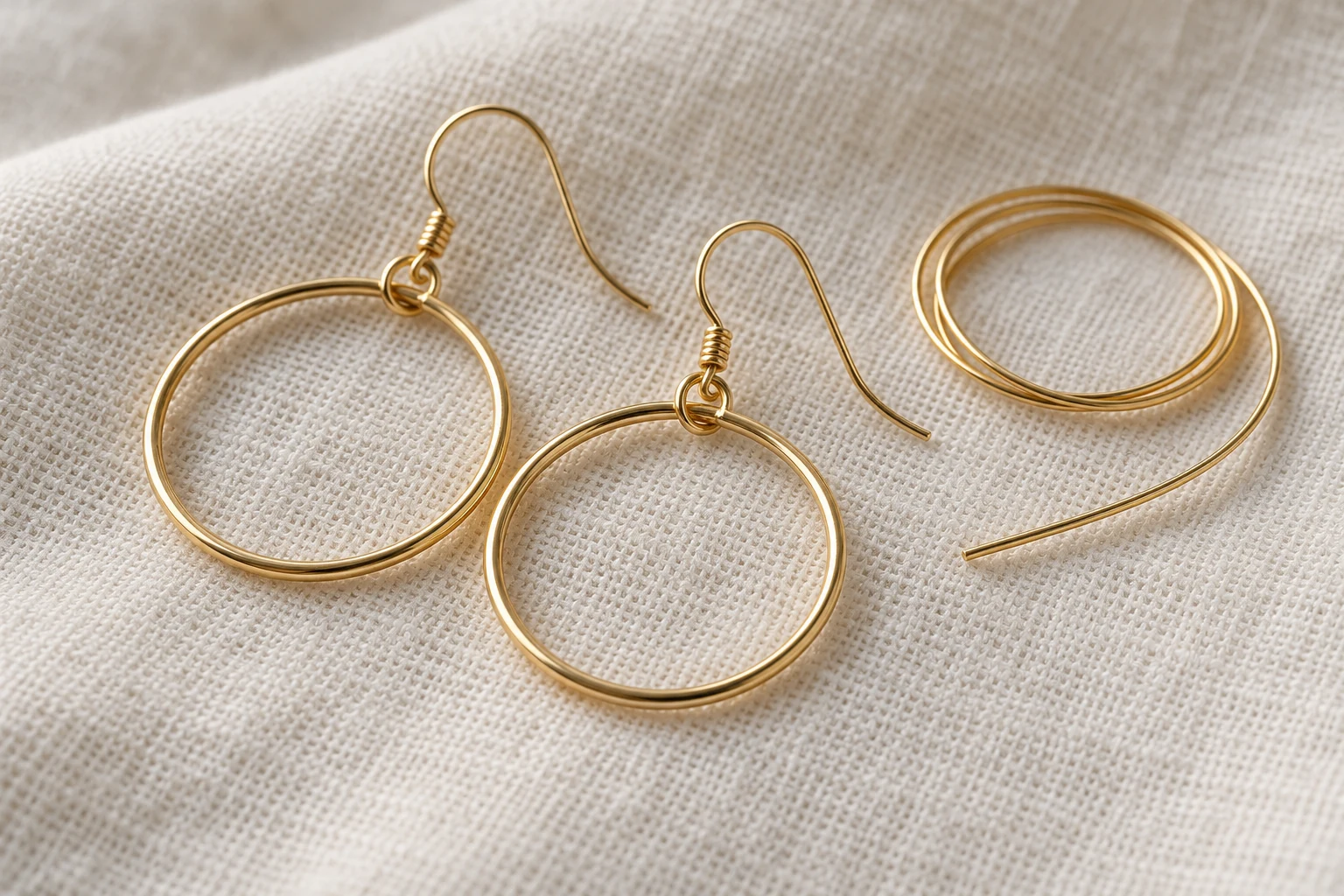
Gold-filled jewelry uses a gold-alloy layer mechanically bonded to a base-metal core. It is different from an electroplated coating and from a gold alloy used throughout the piece. The useful buying questions are the gold-layer specification, how the component is constructed, and whether the findings match the advertised description.
In the U.S. FTC Jewelry Guides, the gold-filled description is associated with a mechanically applied gold-alloy layer of at least 10 karat that accounts for at least one-twentieth of the total metal weight under the stated provisions. Consult the FTC’s gold-content and coating guidance for the full labeling context.
The fraction refers to the weight of the gold alloy layer, not that amount of pure gold. Requirements and accepted descriptions should also be checked for the destination market; a U.S. labeling explanation should not be represented as one universal worldwide rule.
A stamp is a claim, not a laboratory result. Ask for the supplier’s specification and traceability. Also determine whether the description covers the chain, clasp, jump rings and other attached parts or only a particular component.
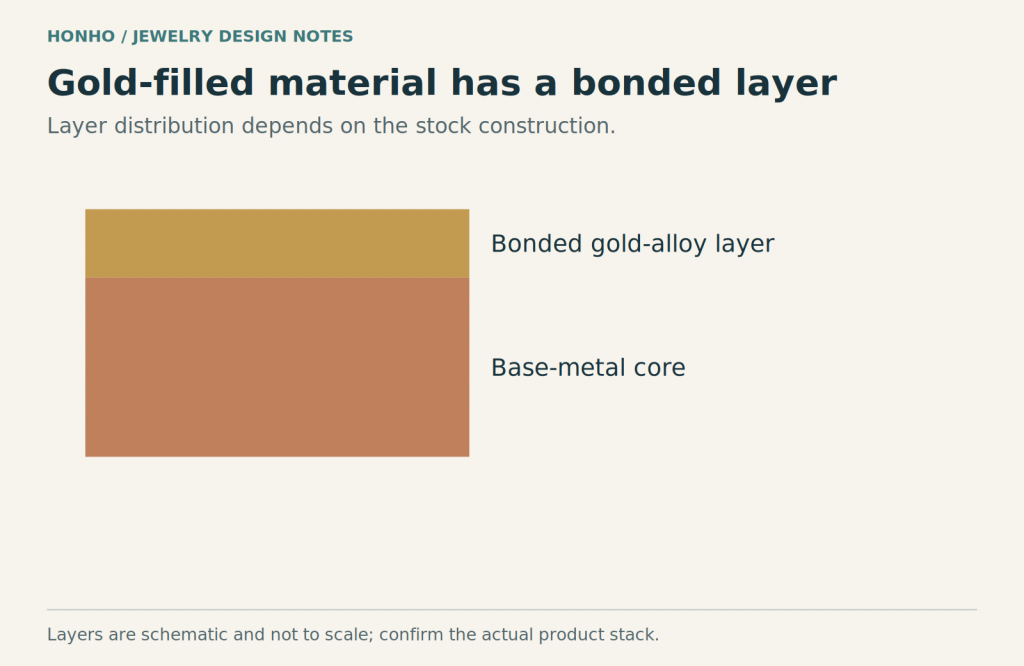
Gold-filled stock is produced by bonding layers and processing the resulting material into forms suitable for components. The layer distribution and fabrication steps affect the finished part. Cutting, forming and joining require attention to edges and seams; an assembled piece may include separately sourced findings.
Gold plating applies a coating by a different process. Do not treat a plated item as gold filled because the supplier calls the coating “thick” or because it has a similar color. Our gold-plated jewelry guide explains those coating questions.
| Construction | What the description establishes | Buyer check |
|---|---|---|
| Gold filled | A specified mechanically bonded gold-alloy layer and core construction | Layer fraction, karat, fabrication and component coverage. |
| Gold plated | A gold or gold-alloy coating over a substrate | Base material, coating layers and thickness specification. |
| Solid gold alloy | The specified metal part is a gold alloy throughout | Karat, hollow or solid physical construction and separate findings. |
For a broader purchase comparison, see gold filled versus gold plated. Choose by verified construction and intended use, not by a general ranking that ignores the actual product.
The useful distinction is visible in a cross-section: gold-filled material has a gold-alloy layer bonded to a different metal beneath it. Fabrication changes the shape of that starting material. A sheet can be cut and formed; wire or tube can become a component. The supplier needs to explain how the layer is distributed on the form being used and what happens at a cut edge, drilled hole or joined area.
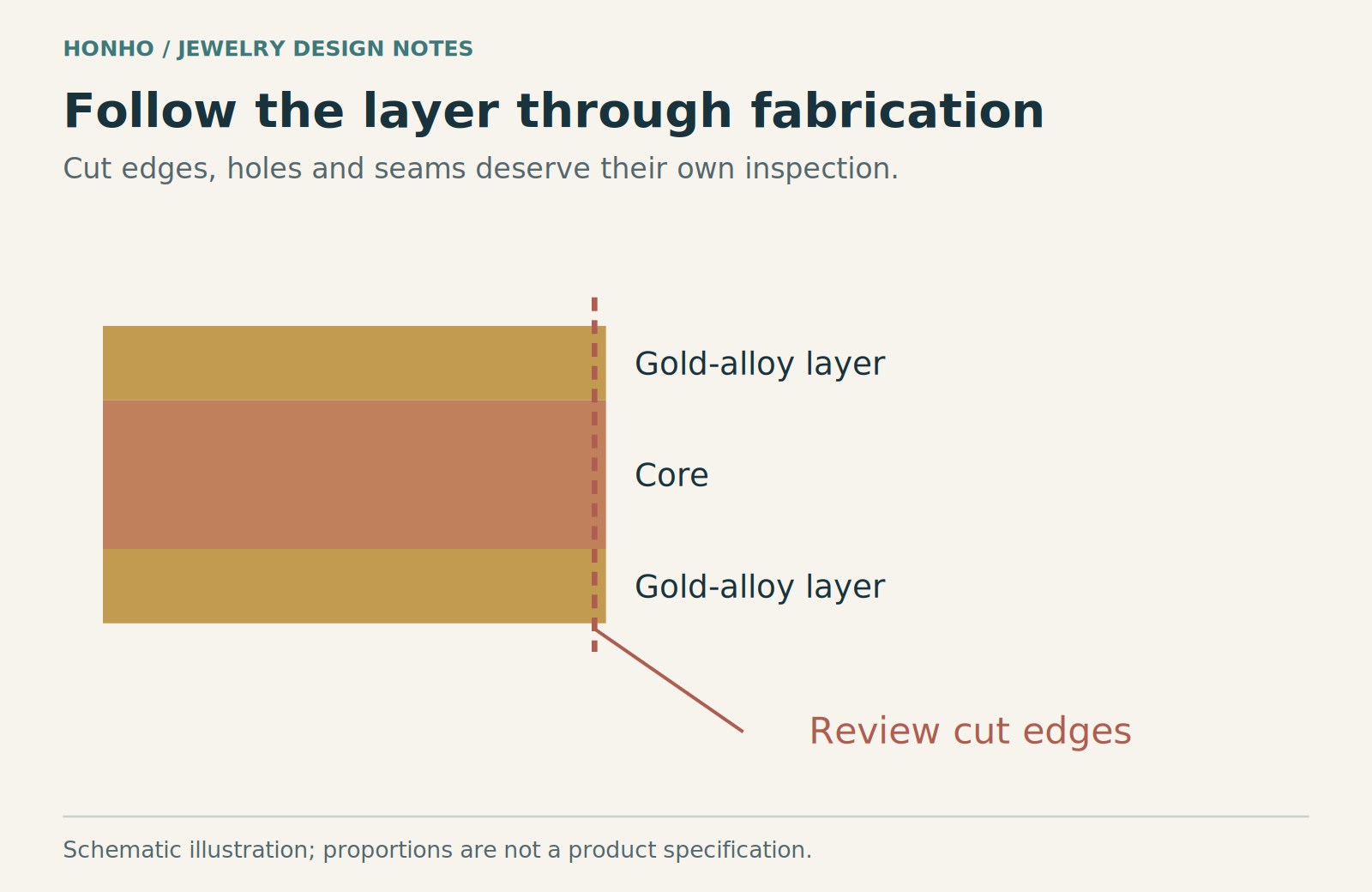
This is why a flat-layer diagram should never be treated as a dimensional drawing for every gold-filled product. Single-sided, double-sided and tubular constructions can distribute the gold alloy differently. Ask which construction applies to the component you are ordering. The material declaration should identify the supplied stock or finished part, not merely a general description copied from a catalog.
For a simple arithmetic illustration, suppose a qualifying metal article weighs 10 grams and its stated 1/20 gold-alloy layer accounts for 0.5 gram. If that layer is 14K, the nominal pure-gold contribution in that layer is 0.5 × 14/24, approximately 0.292 gram. This calculation explains the two different fractions. It is not an assay, a valuation, or a way to establish that a real article satisfies its labeling requirements.
The component declaration and applicable rules determine what weight is being described. Stones, nonmetal parts and separately constructed findings make casual whole-product calculations unreliable. For purchasing, obtain the manufacturer’s specification and supporting records rather than estimating layer thickness or scrap value from the retail title.
A surface measurement can help characterize the place measured, using an appropriate method and calibration. It does not automatically establish a whole article’s layer weight fraction, the construction at concealed seams, or the material of a separate clasp. Tell the testing laboratory which claim you need to verify so it can recommend a suitable combination of documents and tests.
For an unfamiliar component, ask the supplier to describe its manufacturing route and provide traceability for the material. If the evidence only identifies a gold-colored outer surface, the mechanically bonded construction claim remains unresolved. Avoid approving product copy until the scope of that claim is clear.
Its bonded gold-alloy layer can provide useful wear resistance, but construction and use still matter. A ring rubbing against hard surfaces has a different wear pattern from a pendant. Chains also experience movement between links, while clasps have their own contact points.
A fixed promise of ten, twenty or thirty years cannot be established from the name “gold filled.” Ask about the particular component, layer distribution, exposed areas, finish and recommended care. Compare samples and any product-specific evidence without converting a test result into an unsupported lifetime claim.
Gold alloys can change appearance under some conditions, and wear can expose underlying material. Discoloration should be assessed on the item rather than dismissed as impossible. A supplier should explain the available remedy if a finish problem develops.
The construction name does not guarantee that every wearer will tolerate the piece. Gold alloys contain other metals, and the core or separate findings may differ. Ask for the relevant material information, especially for posts, backs and clasps.
Do not recommend a fashion-jewelry material for a fresh piercing solely because it is gold filled. Follow the qualified professional’s requirements for that use. Our nickel-free jewelry guide explains how composition and release claims differ.
Follow the seller’s instructions for the actual construction, stones and coatings. A soft cloth and gentle cleaning suitable for all components are preferable to aggressive polishing. Remove residue without attempting to grind away a worn area.
For a fuller routine, use our gold-filled jewelry care guide. Cleaning can remove residue, but it cannot replace metal that has worn away.
A formed wire hoop, a flat stamped charm and a linked necklace expose different construction details. For the hoop, examine the ends, fastening and any point that is opened repeatedly. For the charm, inspect the cut perimeter, hole and any attached loop. For the necklace, review the chain ends and each separate finding. Give those locations their own checks on the approved sample.
Discuss any heat-intensive joining or later alteration with the manufacturer before the design is approved. The concern is preserving the intended layered construction and appearance through fabrication and repair. A generic instruction to solder or polish “as usual” leaves too much uncertainty when the surface layer is part of the material claim.
| Component | Information to request | Sample review |
|---|---|---|
| Formed wire or tube | Stock construction, dimensions and layer description | Ends, bends, seams and fastening areas |
| Sheet-derived charm | Layer distribution and treatment of the cut perimeter | Edges, holes and detail after finishing |
| Chain assembly | Chain specification plus separate end and clasp specifications | Moving contacts and connected components |
| Mixed-material piece | Which named parts are gold filled and which are not | Color coordination and accurate product description |
Retain the approved sample, component list and supplier material description. On a reorder, check whether the chain source, clasp, soldered attachment or stock construction has changed. A replacement finding can look similar while requiring a different description in the listing. Require approval for material changes before production rather than discovering them when the packed order arrives.
Record the care instructions and the repair or replacement route you will offer customers. A product sold for regular wear should be supported by clear information about contact, cleaning and any limitations of the construction. Avoid building a return policy around an assumed number of years of finish life.
A heavily sculpted cast shape may be easier to develop in a specified base metal with a separately defined gold coating. A component designed around bonded sheet or wire may suit a gold-filled route. Ask for a feasibility explanation before requesting a price. If HonHo proposes electroplated brass or silver as an alternative, evaluate it under its actual construction name, with its own coating specification and sample approval. Similar color does not make the alternatives materially identical.
A marking is useful information, but it is not a substitute for a traceable description of the finished article. In a jewelers’ discussion about gold-filled labeling, the original question was whether the term simply renamed plating. That uncertainty is understandable when sellers mix construction terms, color names and karat numbers in one title.
Start with the exact wording on the invoice and product specification. Ask which parts are gold filled, the karat of the bonded alloy, its stated weight fraction, and who supplied or manufactured those components. A necklace can combine a gold-filled chain with a plated pendant or a differently constructed clasp. Describe that combination explicitly rather than extending one component’s description to the whole necklace.
A missing stamp alone does not establish fraud, and a visible stamp alone does not authenticate the material. A magnet, a color comparison or an unusually high price cannot settle the construction either. Avoid scratching or applying acid to a finished piece to test an online claim; a suitable professional assessment depends on the question being investigated and may damage the item if the wrong method is used.
Ask the examiner whether the proposed method can distinguish surface composition, a deposited coating and a mechanically bonded construction, and whether it can support the claimed weight fraction. These are different questions. An attractive surface reading should not be presented as proof of the full article’s construction. Keep the supplier specification, component records and any test report together.
For an everyday chain, look beyond the chain body. Check the end fittings, clasp operation and whether a replacement clasp of the appropriate material can be fitted later. For a formed hoop, review the closure, exposed ends and the areas handled each time it is opened. A retailer should know whether repair requires a replacement component or work on the bonded stock itself.
Ask a jeweler about feasibility before sizing, soldering or deeply engraving a finished piece. Removing material can expose the core at a worked area; heat and joining also need a process suitable for that construction. An instruction to “polish it until the scratch disappears” is unsuitable when the bonded layer must be preserved.
For a brand, request one sample with the most demanding detail in the proposed range, such as a small formed closure or an attachment close to a cut edge. Inspect that detail after finishing. If the supplier cannot make it consistently in bonded stock, compare a revised shape or another clearly labeled construction before committing to the collection.
Keep the answers with the sample approval record. A photograph, gold color or magnet test cannot establish the full construction. If a supplier changes a clasp or finding, review whether the product description and supporting evidence still apply.
Do not assume the terms imply an identical specification. Ask for the actual gold-alloy fraction, karat and construction, then check the applicable labeling rules.
Sometimes, but the bonded construction and any surface damage affect feasibility. A jeweler should assess the specific ring before cutting, heating or polishing it.
No single label settles the purchase. Compare verified construction, design, wear expectations, care and price for the actual pieces.
If you are planning a collection, ask HonHo to review your material and design requirements and confirm feasibility before building the quotation around a particular construction.
Updated October 18, 2026.
You’re pricing a new collection, and the sample tray is already split down the middle. The 316L surgical steel pieces look cleaner on cost and daily wear, the
You probably have a launch already in motion, a supplier sample on your desk, and one uncomfortable question underneath it all, will this gold color still look clean
If you are developing the ring itself, compare ring fabrication, casting and CAD methods before approving the shank dimensions and manufacturing route. You’re refining a ring design, the