Choosing a Chinese jewelry supplier starts with a practical question: can this supplier repeatedly make your specified design, with the required documentation, at the agreed cost and schedule? A polished catalog or a low unit price cannot answer that alone. Use a written product brief, a representative sample and a documented approval process to assess the fit.
Identify who will make each part of the order
Ask whether the business manufactures the main components, assembles purchased findings, coordinates subcontractors or combines these roles. Outsourcing is not automatically a problem; undisclosed changes and unclear responsibility are. Establish who controls casting or forming, polishing, setting, coating, assembly and inspection.
Match the supplier’s capabilities to your material and design. A workshop experienced with cast brass statement earrings may not use the same processes as a supplier of stainless steel chains. Review the relevant jewelry manufacturing capabilities and ask for samples that reflect your intended construction. For a brass collection, use the brass jewelry buying checklist to define the material and finish questions.
Turn the design into one controlled specification
Use a drawing revision and a bill of materials that both sides can identify. Include dimensions, material grades, surface texture, stones, settings, findings, logo position, finish and packaging. If a requirement is still undecided, mark it as an open item instead of allowing it to become an assumption.
| Risk |
Useful instruction |
Approval evidence |
| Different proportions |
Dimensioned front, side and back views |
Measurements of the finished sample. |
| Different gold color |
Physical color reference and finish specification |
Comparison under agreed lighting. |
| Substituted findings |
Post, back, clasp and chain specifications |
Approved component list and change record. |
| Unclear stone grade |
Material, cut, size, color and appearance limits |
Reference stones or approved sample. |
| Late packaging changes |
Artwork, dimensions, label content and packing method |
Approved packaging proof and packed sample. |
After a call, send a concise written decision record: what changed, which file now governs and what remains open. Ask the supplier to confirm the actual instruction, not simply acknowledge receipt. This keeps communication useful across time zones and languages without relying on stereotypes about how a team communicates.
Use sample approval as a production decision
A CAD rendering checks visual direction. A resin model may help assess scale. A finished metal sample is needed to assess material feel, weight, fit, setting and coating. Do not treat those stages as interchangeable.
Approve the final sample with its file revision and a list of any agreed deviations. Retain matching references with the buyer and supplier where practical. If a sample looks right but the clasp is difficult to operate, resolve that before authorizing the bulk order.
During jewelry sampling, separate appearance approvals from dimensional, functional and testing approvals. A beautiful photograph does not close every technical question.
Specify coatings without making unsupported promises
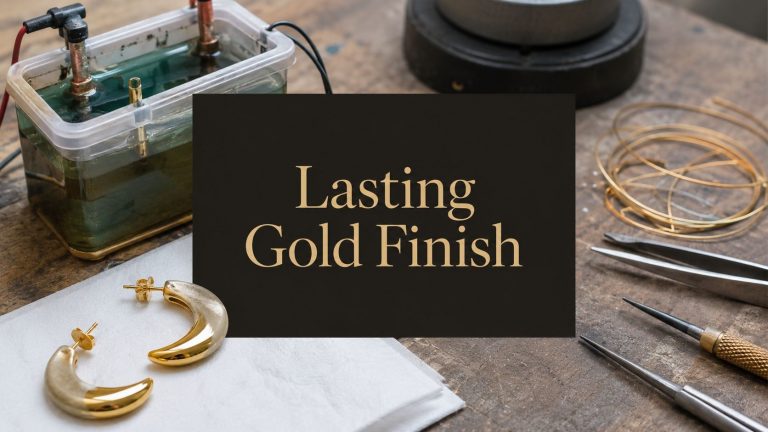
Ask for the substrate, intermediate layers, decorative coating and any topcoat. Record the thickness requirement for the relevant layer and the measurement method. “PVD,” “18K color” and “waterproof” are not equivalent specifications.
For a finish comparison, see PVD versus electroplating. Agree the product-specific checks and acceptance criteria. A salt-spray result describes performance under that test; it cannot be converted directly into a promise of two years or any other fixed period of consumer wear.
Verify reports and audits for their actual purpose
Match product reports to the model, finish, tested components and market requirements. Confirm the report issuer and sample information. Company-level documentation does not replace a finished-product test, and an unrelated sample report does not prove that a new design passes.
Social auditing serves a different purpose. Sedex explains that SMETA is an audit methodology, not a certification. If such an audit matters to your sourcing policy, check the site, date, scope and corrective actions instead of accepting a “certified” badge without context. This guide does not assert that a particular HonHo facility holds an audit or certification not documented for your project.
Build a realistic production schedule
Work backward from the required delivery date through transit, final inspection, production, sample revisions and approvals. Confirm when the lead-time clock starts and which buyer decisions can move the schedule. Stone procurement, custom findings, packaging and special testing may need separate milestones.
HonHo’s current custom-order starting point is 50 pieces per style and color. Planning ranges are generally 25–30 days for brass or 925 sterling silver samples, 25–35 days for stainless steel samples, and 35–45 days for bulk production. Confirm the project-specific schedule in the quotation, including the impact of revisions and shipping.
Make quotes and order terms comparable
Separate tooling, development, sample, unit-production, packaging and testing costs. Confirm currency, validity, delivery term and named place, freight, duties and taxes. Agree the treatment of rejected pieces, rework and approved design changes before the order starts.
If custom designs or molds are involved, record file ownership, permitted use, tooling ownership and reorder access in the written agreement. Do not assume that paying a sample fee settles those questions. Use our custom jewelry quote template to organize the commercial brief.
Questions to ask before approving bulk production
- Which drawing, bill of materials and sample revision governs this order?
- Are all findings and packaging components approved?
- Which tests and inspection criteria apply to the actual finish and market?
- Who must approve a material, supplier or process substitution?
- What records will identify the production batch?
- What happens if the final inspection finds a discrepancy?
The manufacturer vetting guide covers the wider qualification process. To discuss a project with HonHo, send the design brief, order split and destination market so feasibility and the approval sequence can be reviewed together.