

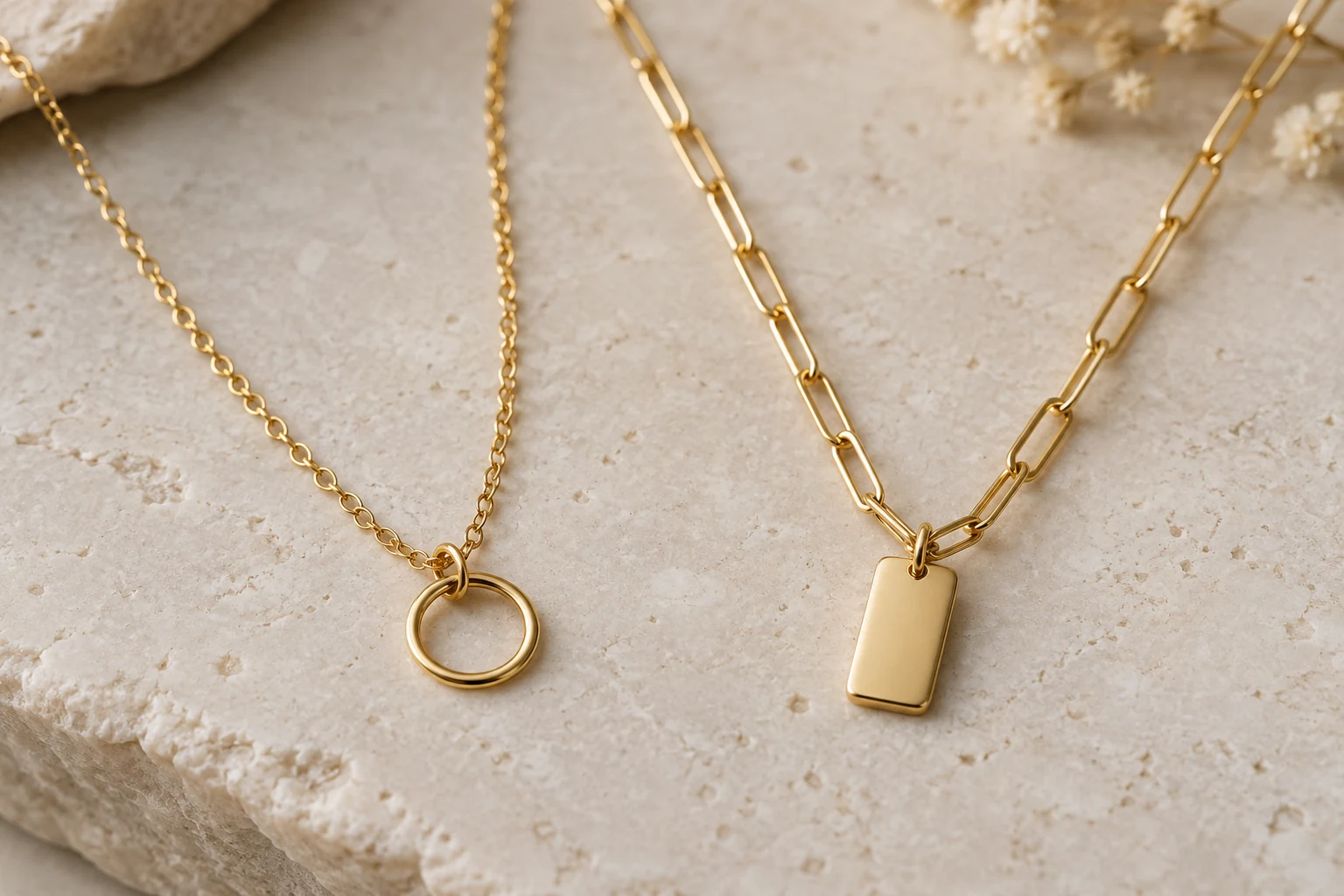
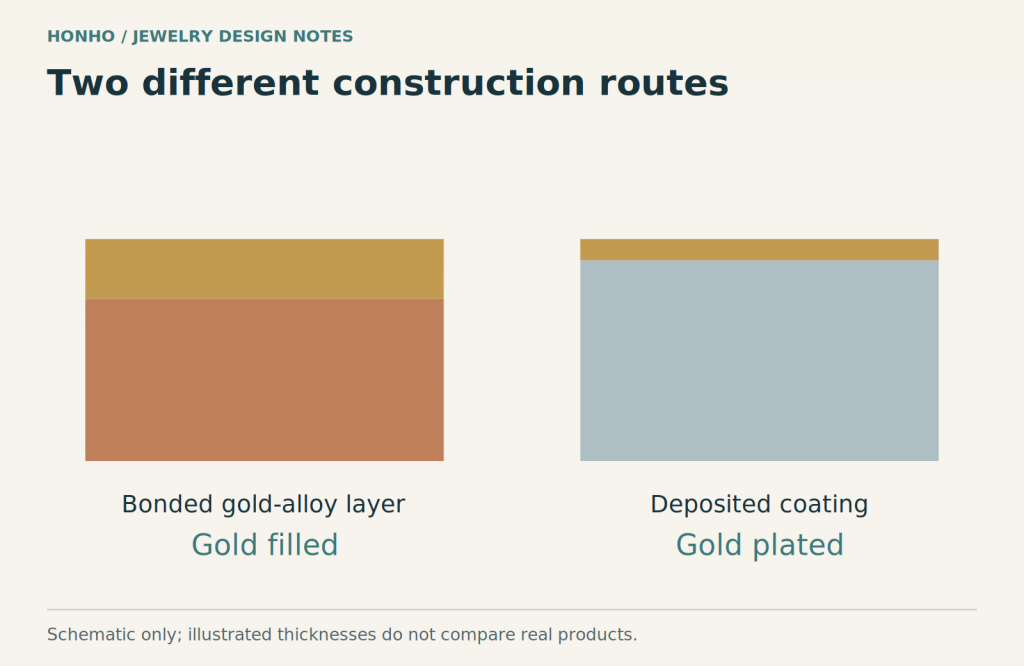
Gold-filled and gold-plated jewelry use different ways of placing gold alloy over another metal. Gold filled uses a mechanically bonded layer; gold plating deposits a surface layer through a plating process. Choose between them by the design, component construction and required product description, then compare documented specifications. Neither name alone promises a fixed lifespan or freedom from skin reactions.
| Question | Gold filled | Gold plated |
|---|---|---|
| How is the gold layer applied? | A gold-alloy layer is mechanically bonded to a base-metal core. | Gold or gold alloy is deposited onto a prepared substrate. |
| Where does the design start? | Often with bonded stock or components such as wire, sheet or tubing. | With a substrate whose shape and preparation suit the coating process. |
| What must be specified? | Gold fineness, weight relationship, component coverage and finishing details. | Substrate, layer stack, gold description, thickness and measurement method. |
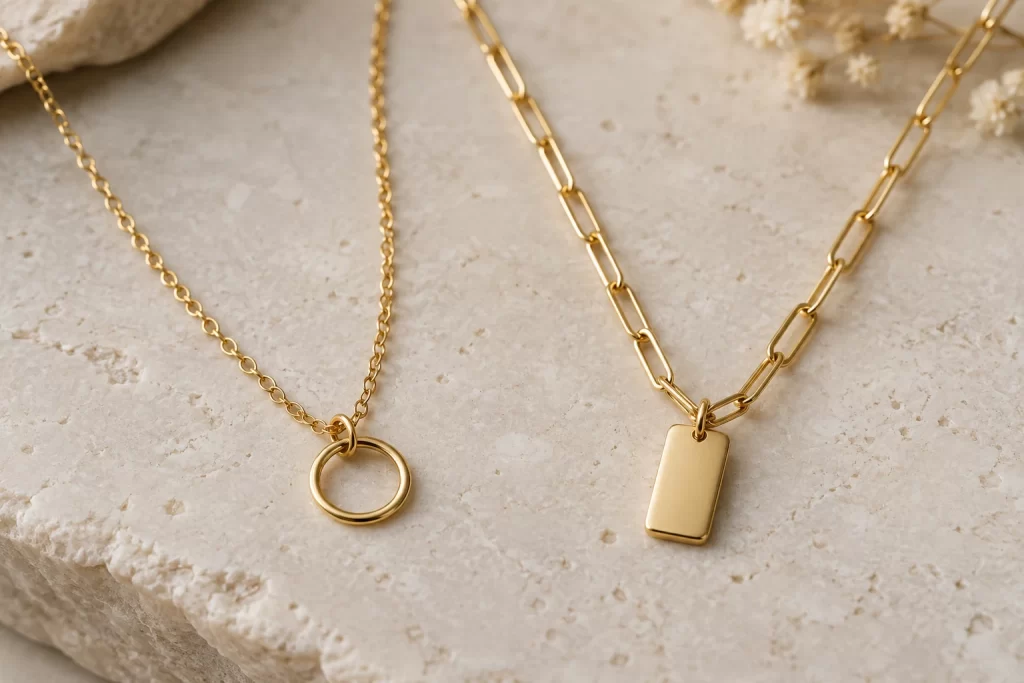
| What can a photo prove? | Visible shape and color, but not the bonded construction. | Visible shape and color, but not layer thickness or adhesion. |
For U.S. descriptions, the FTC Jewelry Guides provide the labeling framework. The familiar 1/20 gold-filled relationship concerns the gold-alloy layer relative to metal weight; it is not a statement that the whole item is that karat of gold. See the gold-filled markings guide for component-level questions.
Ask a supplier to identify the body, surface layer and separate findings for each version. Then compare dimensions and weight. A heavier chain in one quotation and a lighter chain in the other can change the feel and cost enough to obscure the material comparison. Keep the clasp, chain length, pendant size and packaging consistent where you are trying to isolate the effect of construction.
A stated gold-filled weight fraction concerns the gold-alloy layer’s share of the relevant metal weight. A plated-layer thickness concerns a distance measured at a location using a suitable method. There is no single conversion that makes every 1/20 article equivalent to one universal micron value. Shape, area, material density and layer distribution affect the relationship.
Use the appropriate evidence for each claim. A coating reading alone cannot establish an entire item’s bonded-layer construction or weight fraction. A supplier declaration for bonded stock does not describe every separately purchased finding on an assembled necklace. Treat these as distinct checks when you approve the product description.
On a ring, the inner surface, lower shank and raised edges may see repeated contact. On a necklace, the links move against one another and the pendant can rub on its chain. On an earring, the post and backing have their own fit and movement. Mark these locations on the sample review instead of using one material name as a prediction of lifetime.
If a brand wants to compare performance, agree the same relevant exposure and evaluation conditions for both finished samples. Record appearance before and after, any functional change, and the actual test method. A longer test result for one sample should remain a result under those conditions; converting it into customer-wear years requires additional evidence.
A simple wire-formed hoop or an assembly using available bonded components may be a candidate for gold-filled construction. A sculptural cast pendant has a different manufacturing route: ask how its actual shape would be made rather than assuming a gold-filled label can be applied to any casting. Supplier capabilities and stock availability determine the options.
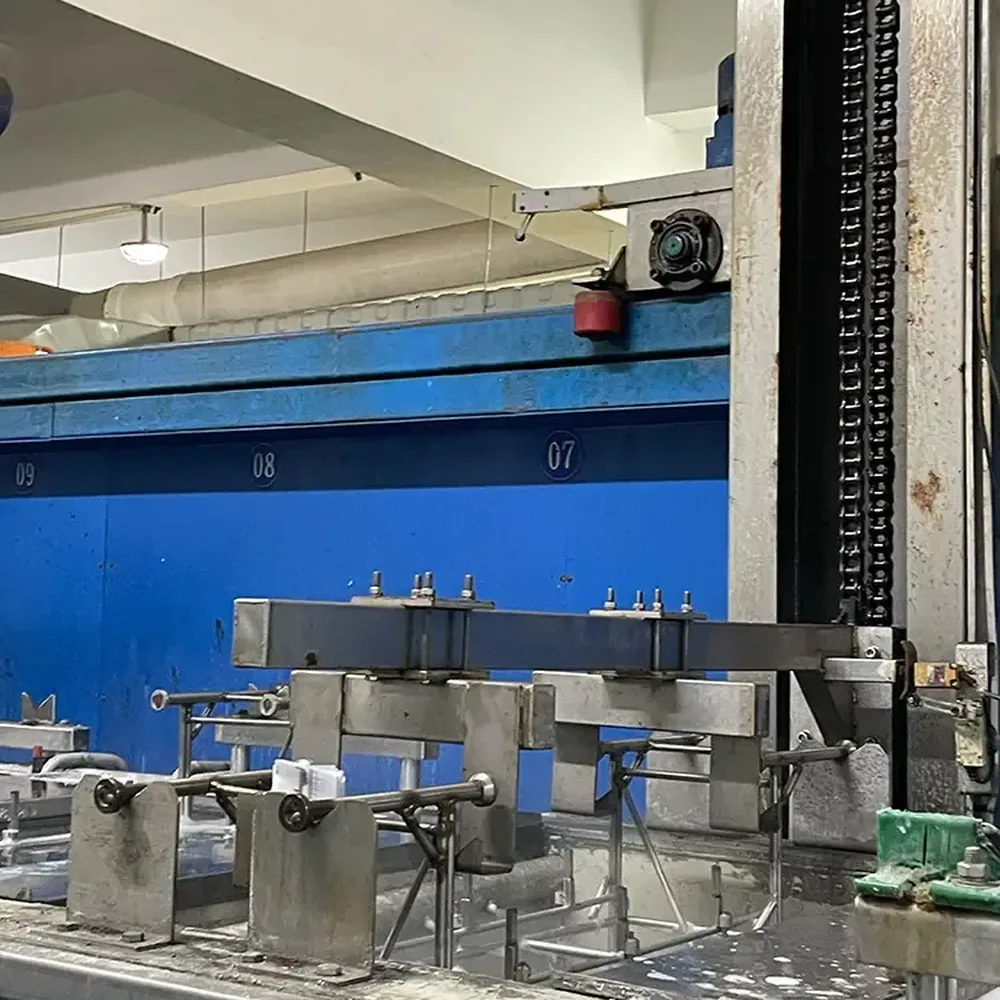
Gold plating can be considered for a broader range of suitable prepared shapes, but difficult recesses, contact points and moving parts still need process review. A design with a large polished face needs different appearance checks from a textured pendant. The underlying finish contributes to the final appearance; coating does not automatically hide poor preparation.
Suppose a necklace combines a gold-filled chain with a plated cast pendant and a separately sourced clasp. Calling the entire assembly gold filled could obscure those differences. Ask the supplier to identify each part, and write a product description that makes the mixed construction clear. This is a purchasing example, not a description of a specific HonHo SKU.
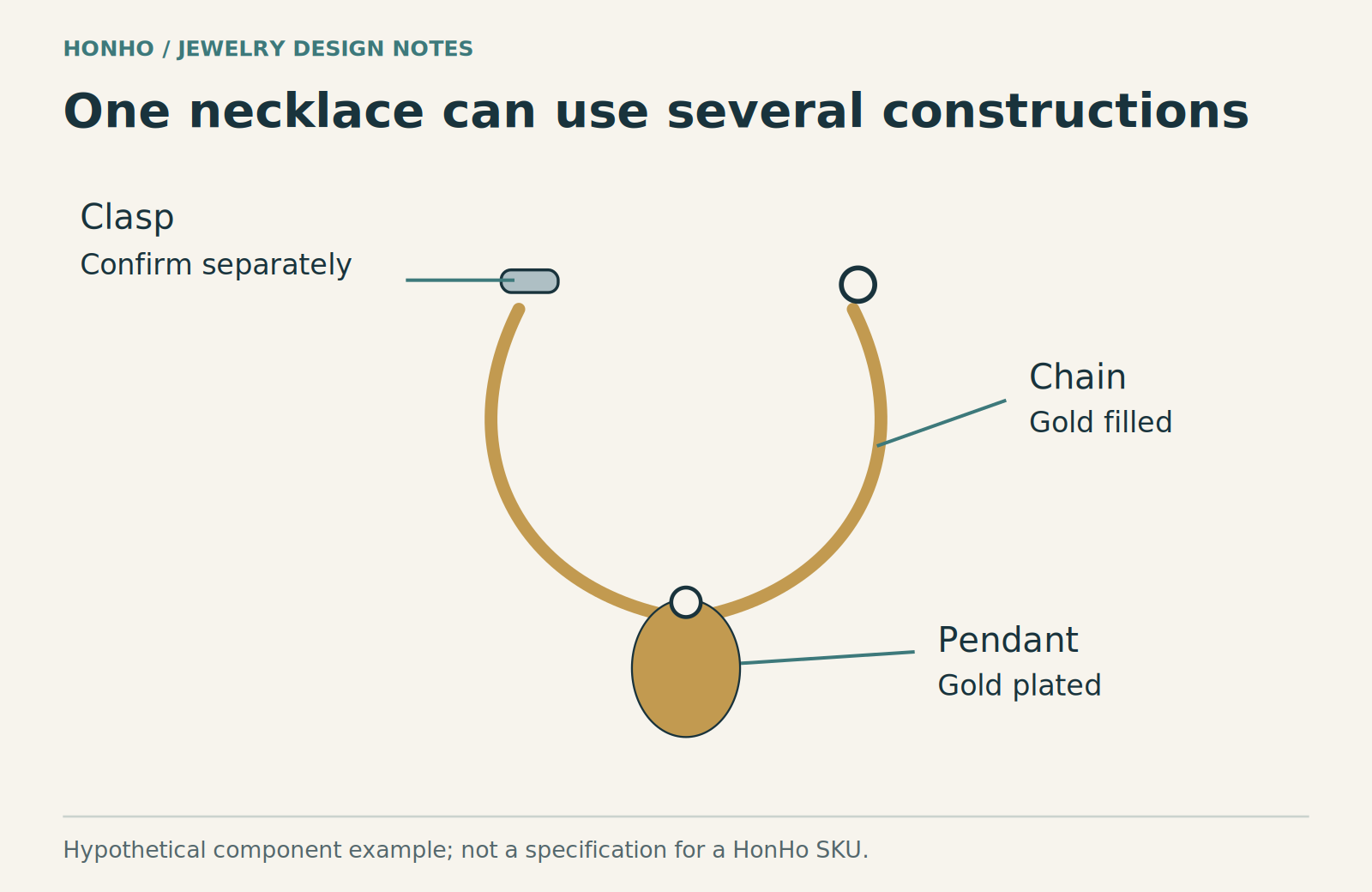
Keep the component bill with the approved sample. If the clasp changes on reorder, compare both its material description and its fit. A color match does not establish that the replacement has the same construction or that the original report covers it.
Layer quantity matters, but so do coverage, joining, adhesion where applicable, surface preparation and use. Rings and bracelets receive rubbing that a pendant may avoid. Cut edges and repaired areas deserve particular attention on layered materials. No universal “gold filled lasts X years, plated lasts Y months” table can predict an individual finished piece.
Ask for the relevant test conditions and the product tested. A flat test coupon, a chain sample and a finished ring provide different evidence. Keep a warranty separate from a test result: one states a seller’s remedy under conditions, while the other records what happened to a sample in a method.
PVD describes a deposition process, not automatically a gold content. Gold-colored coatings can use different chemistries. Vermeil is a separate term with market-specific requirements for a gold coating on silver. Neither should be substituted for gold filled because the item looks similar. The plated layer and label guide covers the questions to put in the quotation.
Ask whether the chosen form is available in suitable bonded stock and how the ends and joining areas will be handled. Compare the finished hoop’s section, weight and fastening with a plated alternative of the same intended size. An attractive surface is only part of the decision; closure fit, edges and repair options also need review.
Start with manufacturability. A cast or otherwise formed substrate with a specified coating may offer a practical route for complex relief. Ask how polishing reaches the recesses, how the bail is attached and where coating coverage will be checked. Do not describe an electroplated casting as gold filled merely because the gold layer is comparatively thick.
Compare the entire chain assembly, including end fittings and clasp. For a plated route, review articulation after all protective treatments. HonHo has identified stiffness concerns with some fine brass or silver chains using a 2.5 µm thick-gold specification plus E-coating. A protection option without E-coating can be discussed for suitable projects, but its movement and finish still need sample approval.
For the gold-filled option, confirm the chain’s actual construction and each separate finding. Keep both candidate samples at the same finished length and review them with the proposed pendant. This makes differences in drape and balance visible without treating a catalog name as proof.
Terms such as “18K finish,” “gold bonded” and “premium gold” may leave the construction unanswered. A Reddit discussion asking whether gold filled is rebranded plating shows the practical confusion. Treat that question as a reason to request a clearer specification, not as evidence that a seller’s product is genuine or false.
For mechanically bonded material, ask for the karat and gold-alloy weight fraction. For plated material, ask for the substrate, gold-bearing layer, fineness, thickness basis and any protective treatment. Then identify the construction of each separate component. If one supplier quotes a gold-filled chain with a plated charm and another quotes both parts plated, the offers differ even when the product titles sound similar.
The U.S. FTC Jewelry Guides distinguish these descriptions. Their gold-filled example uses a mechanically applied layer of at least 10-karat gold alloy constituting at least one twentieth of the article’s metal weight. That is an alloy-weight description, not a universal thickness in micrometers. Use the rules applicable to the market where the item will be sold.
A meaningful comparison holds the design as steady as the two routes allow: dimensions, chain length, weight, closure, stones, finish, packaging and quantity. If the construction requires a different shape or assembly, show that change in the quote. A lower unit price can be attractive, but it should be clear whether it comes from a simpler design, a different material or a different finishing specification.
| Decision | Information that makes the comparison useful |
|---|---|
| Initial order | Finished unit price, development charges, minimum quantities and what the sample includes. |
| Customer use | Expected friction and exposure, care instructions, and evidence supporting any resistance claim. |
| Repair | Replaceable findings, refinishing feasibility and the service available in the selling market. |
| Repeat supply | Material records, approved sample, acceptable color variation and notification before a component changes. |
For a delicate chain, drape and working connections may matter more to the customer than a broad claim that one category is always better. For a sculptural pendant, the achievable shape and finish may decide the route. For a frequently handled ring, ask how the actual design will be evaluated at its contact surfaces. None of those choices can be reduced to a fixed number of years inferred from the words gold filled or gold plated.
HonHo can review the design, substrate and proposed finish for a custom project. If mechanically bonded stock is essential, state that requirement at the start and obtain confirmation of the feasible construction before proceeding. A quotation for electroplating or PVD should not be silently substituted for gold-filled manufacture.
| Compare | Gold-filled proposal | Gold-plated proposal |
|---|---|---|
| Material evidence | Bonded construction, gold-alloy fraction and fineness | Substrate, coating stack and relevant gold-layer description |
| Design feasibility | Available stock forms, edges and joining route | Substrate fabrication, preparation and coating access |
| Separate components | Confirm which findings share the construction | Confirm each finding’s material and finish |
| Sample approval | Final geometry, appearance and function | Final geometry, appearance and function after coating |
| Commercial scope | Development, units, packaging and repair terms | Development, units, packaging and refinishing terms |
Ask for clearly described alternatives if either route is unsuitable or outside budget. Preserve the actual material names in the quote and eventual listing. A retailer should be able to explain why it selected a construction in terms of the design, price position, care and evidence, without claiming that every example in one category outperforms every example in the other.
For HonHo development, send the design and intended construction for a feasibility review. The confirmed project scope should state which manufacturing route and material claims can be supplied. Keep this article’s design comparison separate from a supplier’s proof of a particular gold-filled capability or product specification.
Gold-filled and plated samples may differ enough that comparing the lowest unit price is misleading. Use the RFQ template to document what each offer includes. If the design is not yet fixed, compare construction options before commissioning tooling.
Consult a jeweler or the manufacturer about the specific piece. Abrasive polishing removes surface material; replating and soldering are not suitable for every assembly. Stones, adhesives, hollow sections and exposed edges can limit the repair. Follow product-specific care and avoid making allergy or waterproof claims solely from either label.
Send HonHo your design and the constructions you are considering. Ask which route is feasible and request a quotation with comparable dimensions, findings, finish and quantities. Contact HonHo with these details.
Updated October 18, 2026.
You’re pricing a new collection, and the sample tray is already split down the middle. The 316L surgical steel pieces look cleaner on cost and daily wear, the
You probably have a launch already in motion, a supplier sample on your desk, and one uncomfortable question underneath it all, will this gold color still look clean
If you are developing the ring itself, compare ring fabrication, casting and CAD methods before approving the shank dimensions and manufacturing route. You’re refining a ring design, the