Rhodium Plating on Brass: A Manufacturer’s Guide for 2026

Most advice about rhodium-plated jewelry treats rhodium as the whole story. In production, that’s the fastest way to get returns.
Rhodium plating on brass can look excellent. It gives brass a bright white finish, strong surface hardness, and good tarnish resistance while keeping the base material cost-effective for fashion collections. But brass is not a passive substrate. It’s an active alloy, and if the factory handles it like silver or stainless steel, the finish can fail from underneath even when the top surface looks perfect at shipment.
That’s why the actual question isn’t “Can brass be rhodium plated?” It can. The actual question is whether the supplier controls the substrate preparation, barrier layers, thickness targets, and quality checks needed to make that finish hold up in real wear.
For buyers sourcing custom jewelry, wholesale jewelry, or private label collections, this distinction matters. It affects color consistency, skin-contact performance, return rates, and whether a plated ring still looks saleable after months in a customer’s rotation. If you want a dependable result, you have to evaluate the full production process, not just the final metal named on the spec sheet. For related background on the base metal itself, see this guide on whether brass jewelry tarnishes.
Why Rhodium Plating on Brass Is Deceptively Complex
Rhodium sounds simple in consumer marketing. Bright. Premium. Tarnish-resistant. Hypoallergenic at the surface. Brass also sounds simple. Affordable, easy to cast, easy to shape, and widely used in fashion jewelry manufacturing. Put the two together and many buyers assume they’ve found the ideal balance.
That assumption causes most quality problems.
Brass contains copper and zinc, and both matter during finishing. A rhodium layer is thin by nature, so it doesn’t behave like a thick structural shell that permanently isolates the base metal. If the surface prep is weak, or if the barrier system underneath is missing, brass can interfere with adhesion and appearance over time. The customer then sees wear-through, discoloration, or irritation complaints and blames the rhodium, when the underlying problem started much earlier in production.
Why the finish can mislead buyers
A newly plated sample often looks flawless. That’s exactly why weak production methods slip through sourcing decisions. Fresh rhodium has a clean, reflective white tone and naturally increases the perceived value of fashion jewelry, especially in earrings, pendants, and trend-led ring programs.
What the sample doesn’t show is whether the factory cleaned the brass correctly, sealed porosity, added the right underplating, and controlled contamination between process baths. Those details decide whether the finish survives wear.
Practical rule: If a supplier only talks about rhodium color and not about substrate preparation, they’re skipping the part that determines whether the plating lasts.
Brass is workable, but not forgiving
From a production manager’s perspective, brass is popular for good reasons. It supports detailed molds, sculptural forms, and a broad range of OEM and ODM development needs. It also fits commercial price points better than precious-metal bases for many wholesale jewelry programs.
But brass doesn’t forgive shortcuts. It needs a tightly controlled finishing route. Rhodium plating on brass is successful when the factory treats brass as a demanding substrate and builds the finish in layers. It fails when rhodium is treated like a cosmetic topcoat that can solve every problem by itself.
That’s why brands should stop asking for “rhodium plated brass” as if it’s one simple specification. It’s a manufacturing system.
The Critical Steps for Plating Brass with Rhodium
The most important fact in this entire process is straightforward. “Rhodium plating fails on brass without a mandatory undercoat, regardless of plating thickness. Copper or Nickel underplating is required for good adhesion and to avoid base metal migration through the rhodium layer.” This requirement is spelled out in With Clarity’s rhodium plating guide.
That one point eliminates a lot of confusion. Buyers often focus on the top layer because rhodium is the visible finish. In real jewelry production, the hidden layers are what make the visible layer viable.
To understand the process visually, this short video gives useful context on plating workflow:
The production sequence that actually works
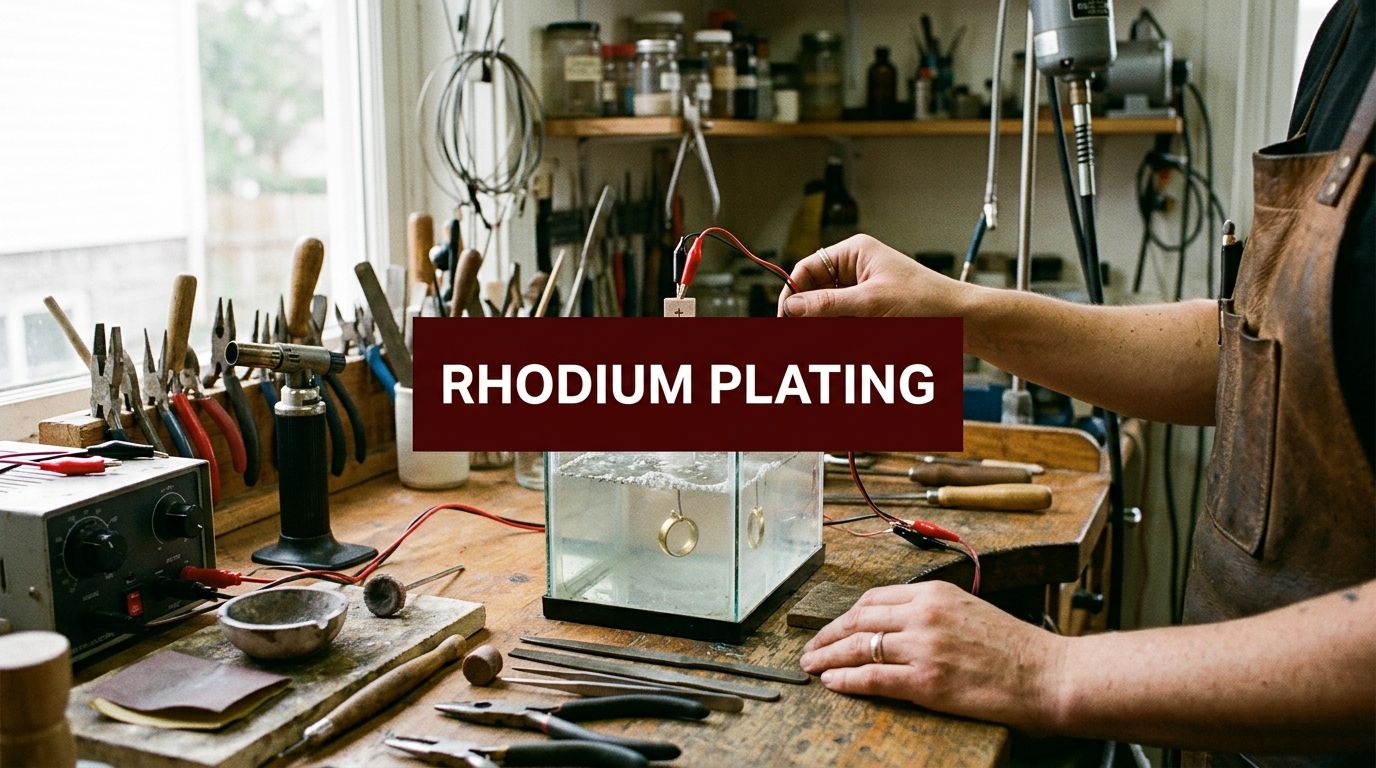
A workable rhodium process for brass usually follows a controlled sequence:
- Surface preparation
The brass has to be polished, degreased, and cleaned thoroughly. Any residue left from casting, polishing compound, or handling can weaken adhesion before plating even starts. - Activation of the base metal
Brass surfaces oxidize easily. The line has to reactivate the surface before further deposition, or the next layer won’t bond consistently. - Barrier underplating
This is a mandatory step. Copper and/or nickel is applied first to improve adhesion and block base metal migration from the brass. - Rhodium topcoat
The rhodium gives the final white color, hardness, and reflective finish. - Final inspection and wear testing
Appearance alone isn’t enough. The factory should verify thickness, consistency, and adhesion before shipment.
Why underplating matters more than buyers expect
The common customer fear is “Will it turn my skin green?” Rhodium itself doesn’t create that issue. The risk appears when the brass underneath starts affecting the surface because the barrier system wasn’t built properly.
That’s why experienced factories don’t treat underplating as optional. They specify it in the production sheet, monitor bath condition, and check whether the plated part geometry allows even coverage in recessed zones, edges, and high-contact areas. Rings, adjustable styles, and chain-linked bracelets are especially sensitive because wear concentrates on edges and moving points.
A bright rhodium finish can hide a weak foundation at first. It can’t protect a bad foundation for long.
Electroplating and PVD don’t solve the same problem
Brands sometimes compare electroplated rhodium with PVD as if they are direct substitutes. They aren’t. Rhodium finishing on brass is an electroplating conversation first, because rhodium is the decorative top layer in that system. PVD becomes relevant when you’re evaluating alternate white finishes or adding protective engineering elsewhere in the finish stack.
For sourcing teams that need a practical comparison of process behavior, wear profile, and application limits, this overview of PVD vs electroplating jewelry coating is useful.
Modern factories also use protective layers such as TiN in broader coating strategies where appropriate. The key point is simple. No advanced topcoat fixes sloppy substrate prep. The process has to be built from the brass upward.
How Plating Thickness Defines Durability and Lifespan
“Good plating” is not a usable spec. On brass, it usually leads to inconsistent wear, because one factory may quote a bright white finish with minimal rhodium deposit while another builds enough thickness to survive real contact.
For rhodium plating on brass, the numbers matter. According to Sintered Filter’s rhodium plating reference, rhodium plating on brass delivers exceptional wear resistance, with a Vickers hardness of 400–800 HV. For decorative jewelry applications, Class 2 plating at 0.25 μm is standard, while frequently worn items like rings typically use 0.25–0.50 μm (Class 2–3). That belongs in the purchase order, along with the underplate requirement and the test method used to verify deposit thickness.
A thicker rhodium layer does not fix a weak build underneath. It does give the finish more working life before abrasion breaks through high-contact points.
Thickness has to follow how the piece is worn
Production teams get in trouble when they apply one plating target across an entire brass collection. Earrings, pendants, rings, cuffs, and bracelets do not fail in the same places or at the same speed. A ring rubs on counters, handles, keyboards, and the inside of the finger. Earrings do not.
That changes how I would spec each category:
| Product type | Practical plating view |
|---|---|
| Earrings and occasional-wear pendants | Decorative rhodium thickness can be acceptable if the underplate is stable and abrasion is low |
| Fashion rings | Higher rhodium target is usually justified because edges, shanks, and undersides wear first |
| Bracelets and bangles | Need tighter process control because rubbing exposes thin spots quickly, especially near closures and curved edges |
Buyers often understand this faster when they compare rhodium targets with better-known plating standards in other finishes. This guide on the thickness of gold plating is useful for aligning internal spec language across categories.
Hardness helps while coverage remains continuous
Rhodium earns its reputation partly because it is hard. Sharretts Plating’s rhodium plating overview notes that electroplated rhodium has a Vickers hardness ranging from 400 to 550, which helps the surface resist scratching and maintain a crisp white appearance.
That advantage has a limit. Hardness improves surface performance. It does not prevent wear-through once the coating is thin at edges, corners, jump-ring contact points, or the bottom of a ring shank.
This is why thickness control and coverage control have to be reviewed together.
Lifespan comes from the full plating stack, not the rhodium line item alone
Brands often ask how long rhodium plating on brass will last. The honest answer is that service life depends on where the item is worn, how often it rubs, how well the brass was prepared, and whether the barrier system under the rhodium was built correctly.
In production, I treat rhodium thickness as the final durability adjustment, not the whole durability plan. If the nickel or palladium barrier is too thin, porous, or uneven, adding rhodium on top only delays the failure. If the underlayers are sound and the rhodium target matches the product category, wear is far more predictable and customer complaints drop.
Buyer checkpoint: Approve rhodium plating by item type, wear pattern, underplate specification, and verified thickness. Color alone is not a quality standard.
That distinction matters for product planning. An occasional-wear earring can carry a different durability target than an everyday ring, and the product page should say so clearly. Honest expectation setting reduces returns, but the manufacturing work still starts with a proper substrate and plating stack.
Identifying and Preventing Common Plating Failures
Most complaints about rhodium-plated brass fall into a few familiar categories. The finish peels. The white color dulls from underneath. High-contact areas wear through sooner than expected. In many cases, the customer describes it as “tarnish,” but the production cause is more specific than that.
One useful reality check comes from Karini Jewelry’s care overview, which notes that rhodium plating applied to brass is typically a very thin layer that wears off quickly, often requiring re-plating within a short timeframe because brass is prone to rapid corrosion when the protective rhodium layer diminishes. Once that protective layer is compromised, the substrate starts dictating the customer experience.
Failure patterns and what usually caused them
Here’s how production teams should read the most common defects:
- Peeling or flaking
This usually points to weak cleaning, poor activation, contamination between process stages, or an adhesion problem in the underlayers. - Yellowing, dullness, or greenish skin complaints
This often signals barrier failure. The base metal is no longer isolated effectively, so the customer is seeing the consequences of substrate exposure. - Fast wear on rings and bracelets
This can be a normal outcome if the item was underspecified for its use. It can also indicate thin deposition at edges, shanks, or contact zones. - Patchy appearance across one batch
This often traces back to inconsistent polishing, uneven rack positioning, or poor process control inside the plating line.
QA should target the known failure modes
A serious jewelry manufacturer doesn’t rely on visual inspection alone. The QA plan should match the failure risks of the material and finish combination.
For plated brass programs, buyers should ask for process control such as:
- Thickness verification: XRF testing is commonly used to confirm whether the deposited layer matches the agreed specification.
- Adhesion checks: Tape tests and related adhesion checks help identify weak bonding before the goods are packed.
- Corrosion simulation: Salt spray testing is valuable for understanding how the plated system behaves under aggressive conditions.
- Wear-focused review: Rings, cuffs, chain connectors, and clasp zones should receive extra inspection because they’re the first places to show weakness.
In supplier evaluation, care guidance also matters. This article on whether rhodium-plated jewelry tarnishes is useful because it frames customer expectations around the finish rather than treating plating as permanent.
Good QA doesn’t make plating immortal. It catches avoidable failure before the customer does.
What buyers should ask before approving a supplier
A practical sourcing conversation should include questions like these:
| Question | Why it matters |
|---|---|
| What underplating is used on brass parts | This tells you whether the factory understands migration risk |
| How is plating thickness verified | This separates controlled production from guesswork |
| Which items receive wear-focused inspection | High-friction designs need more than standard visual checks |
| How are samples finished compared with mass production | Some suppliers overbuild samples and underbuild bulk orders |
If a factory can’t answer these clearly, the risk isn’t theoretical. It’s already in the process.
Positioning Rhodium-Plated Brass in Your Collection
Rhodium-plated brass is easy to misposition. Brands see the bright white finish and present it like a long-term metal story. In production, it belongs in a fashion category with a controlled lifespan, and that difference should shape assortment, pricing, care messaging, and margin targets from the start.
This matters even more with brass than with sterling silver or stainless steel because the finish quality depends heavily on what sits under the rhodium. A good sample can look identical to a weak one on day one. The gap shows up later, when poor prep or thin barrier layers let the base metal affect the surface. If the underplating is right, rhodium-plated brass can be a strong commercial option. If it is wrong, the category creates returns.
Where it fits best
The best use case is design-led jewelry where shape, scale, and finish drive the sale. Statement earrings, pendants, necklace components, brooches, and occasion styles usually make sense. These pieces give brass room to do what it does well. It casts into detailed forms, holds sharp decorative features, and supports a silver-tone look at a fashion price.
High-contact categories need stricter judgment. Rings, bracelets, cuffs, and heavy-wear chains can work, but only if the brand accepts shorter service life and specs the plating system accordingly. If the customer promise is daily wear with minimal maintenance, brass with rhodium is often the wrong material story.
Compared with rhodium-plated sterling silver, brass usually fits better in price-sensitive collections, seasonal launches, and larger-volume programs. Compared with stainless steel, brass offers more freedom for intricate casting and refined surface detail, while steel usually holds up better in simple, hard-wearing styles. Good assortment planning starts with honest use-case matching, not just finish appearance.
Build the customer message around reality
Product pages should sell the look without overstating the lifespan. The clearest message is also the safest one for the brand.
A practical consumer-facing description should cover:
- Bright white finish: Rhodium gives the piece a clean, reflective silver-tone surface with a premium look.
- Wear profile: Best for fashion wear, occasion use, and moderate handling rather than constant abrasion.
- Care requirements: Keep it away from chemicals, rough friction, and repeated water exposure. Store pieces separately and wipe them after wear.
- Maintenance expectations: Some styles, especially high-contact ones, may need replating as part of normal ownership.
That last point should be written plainly. Earrings and pendants usually hold their finish longer because they see less friction. Rings and bracelets wear faster because they are in constant contact with skin, hard surfaces, and daily movement. Clear care language does more than reduce complaints. It protects positioning.
Customers accept finish wear more readily when the brand described the product honestly before the sale.
Merchandising should support the category story
Rhodium-plated brass sells best when the presentation matches the promise. Clean lighting, disciplined grouping, and polished fixtures help the surface read as refined rather than merely bright. Retail teams working on arranging products to attract customers can use that approach to separate higher-finish fashion pieces from basic silver-tone inventory.
For growing brands, the merchandising decision and the manufacturing decision are tied together. If the collection is presented as premium fashion jewelry, the production standard has to support that claim with consistent color, smooth polishing, and stable underplating across bulk orders. Brands that are still refining supplier strategy should review this guide to choosing the right jewelry manufacturer for success before expanding a plated brass program.
Partnering for Quality in Custom Jewelry Manufacturing
The core lesson is simple. Rhodium plating on brass succeeds or fails long before the final rhodium layer is applied. The visible finish matters, but process control matters more.
For brands developing custom jewelry, supplier selection becomes a commercial decision, not just a technical one. A capable manufacturer should be able to support CAD development, prototyping, polishing standards, underplating strategy, electroplating control, and final QA in one coordinated workflow. If those steps are fragmented across multiple vendors, consistency gets harder to maintain and troubleshooting gets slower.
What a dependable manufacturing partner should control
When evaluating an OEM or ODM supplier for plated brass jewelry, look for a partner that can manage the full chain:
- Development support: CAD, sampling, mold review, and pre-production verification help catch finish risks before mass production.
- Coating capability: In-house electroplating and complementary finishing options reduce variation and shorten communication loops.
- Material compliance: Nickel-free, lead-free, and cadmium-free production standards are important for modern retail channels.
- Inspection discipline: Thickness verification, adhesion checks, corrosion testing, and full-order inspection lower sourcing risk.
Why integration lowers risk
A vertically integrated partner can keep design intent, finishing specs, and QA expectations aligned. That matters when you’re building private label lines with multiple SKUs, mixed finishes, and retailer deadlines. It also matters when you need practical answers about whether a design should stay in brass, move to stainless steel, or shift to sterling silver based on wear profile and target positioning.
For sourcing teams comparing vendors, this guide on choosing the right jewelry manufacturer for success is a useful starting point because it focuses on the operational issues that influence reliability, not just price.
A strong supplier relationship should give you more than a quotation. It should give you process clarity. That includes realistic lead times, documented inspection standards, finish options matched to the product category, and direct feedback when a design is likely to create plating issues in production.
If a brand wants rhodium-plated brass to perform well, the answer isn’t a magic coating. It’s a disciplined manufacturing system.
If you’re developing rhodium-plated brass styles and want a manufacturing partner that can manage the details behind a stable finish, HonHo Jewelry supports OEM and ODM production from CAD and sampling through plating, QA, private label, and global fulfillment. Their team works across brass, stainless steel, 925 sterling silver, and gold filled lines, with in-house electroplating, PVD capability, thickness control, corrosion testing, and flexible production support for both emerging brands and established wholesale programs.