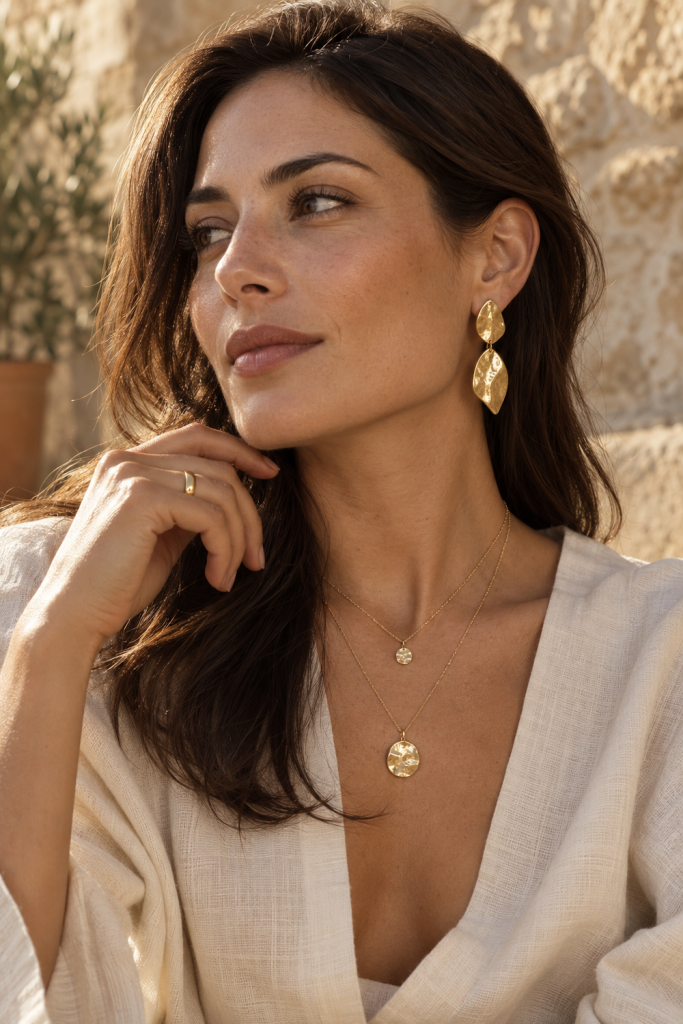

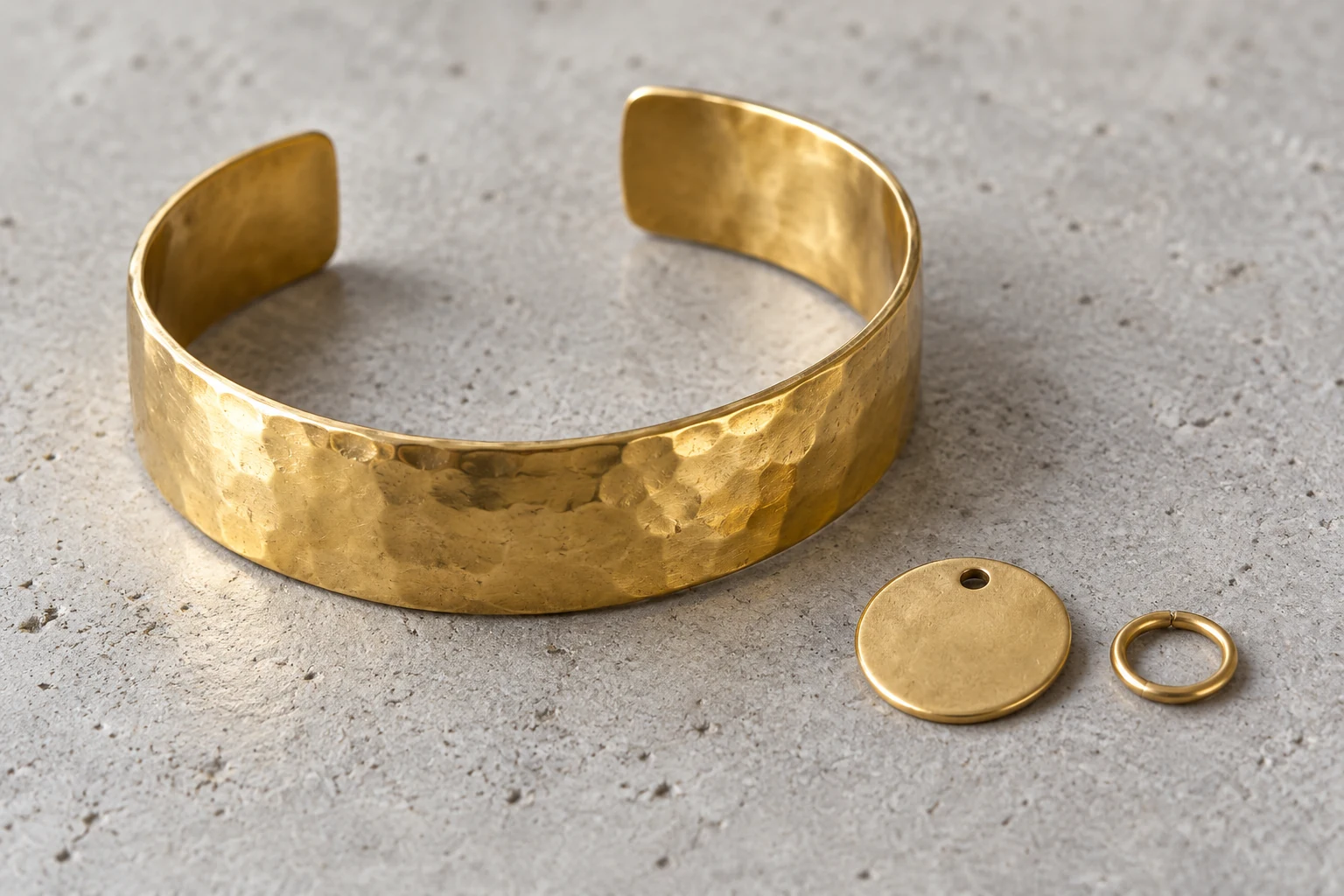
Brass jewelry is made from a copper-zinc alloy. It can be formed into detailed earrings, pendants, rings and cuffs, and it is often used beneath decorative coatings. Its suitability depends on the alloy, the shape and the finish. Bare brass can change color, while a gold-colored coating has its own wear and care requirements.
Brass is a family of alloys, not one fixed recipe. The International Copper Association’s alloy overview describes the differences in properties across copper-zinc alloys. For a jewelry order, request the actual alloy specification and any applicable restricted-substance evidence. A yellow color or a magnet test cannot identify the composition.
The body also may not describe every component. A brass earring can have a different post, backing, solder or stone setting. A brass pendant can hang on a steel chain. Those combinations should be stated clearly rather than hidden under a single material name.
| Construction | Appearance and care question | What to ask |
|---|---|---|
| Bare brass | The metal surface can darken or develop a patina. | Is that change intended, and what cleaning method is approved? |
| Brass with a clear coating | A transparent layer may slow surface change while intact. | What is the coating, and how should worn areas be repaired? |
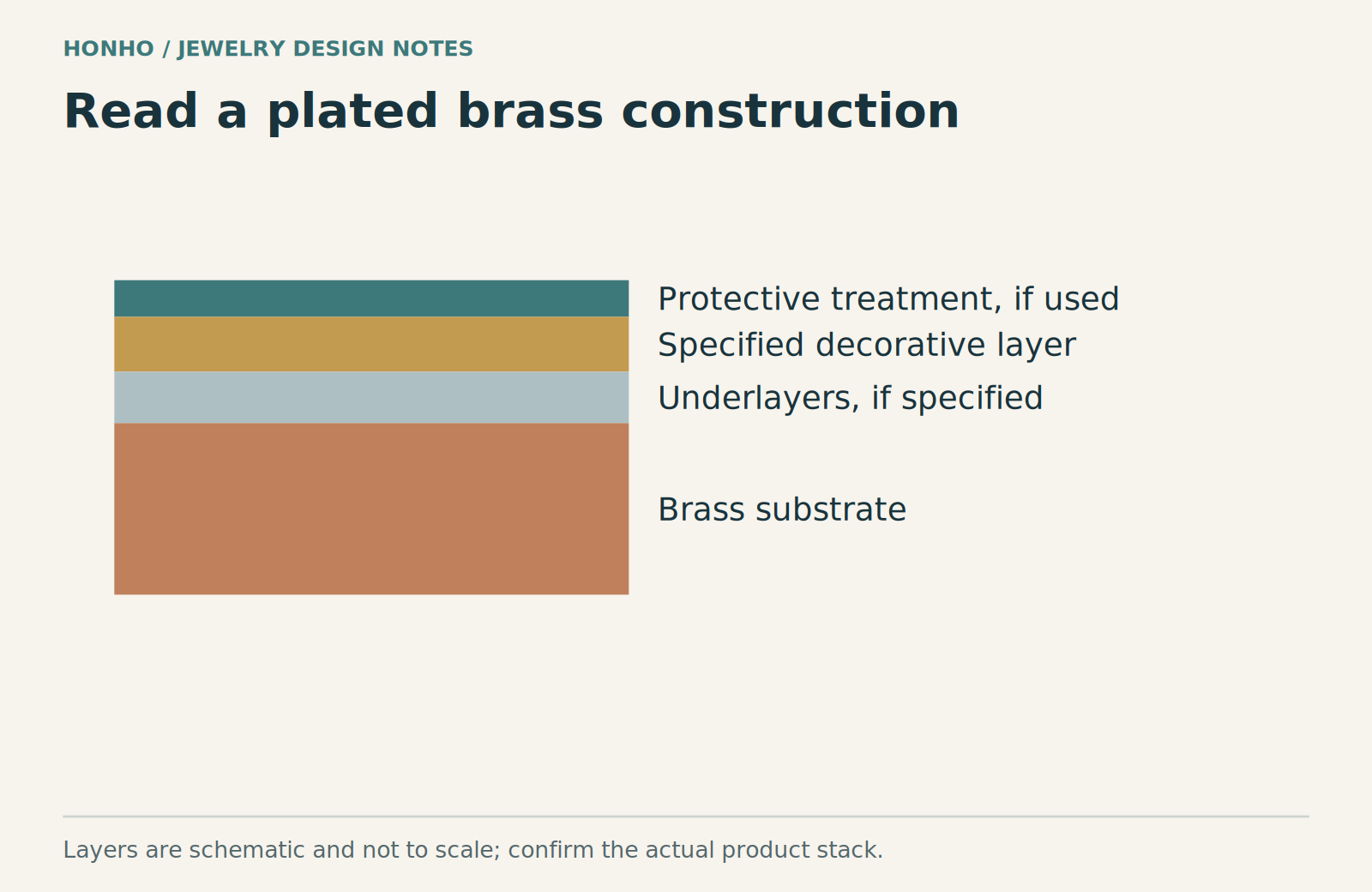
| Gold-plated brass | The visible gold layer and the underlying brass are different materials. | What is the complete coating system and the scope of the gold claim? |
| Antiqued or textured brass | Dark areas may be part of the deliberate finish. | Which areas should remain dark and must not be polished away? |
Use the gold-plated jewelry guide when comparing coatings. A finish name does not provide a universal service life, and a thicker decorative layer alone does not settle adhesion or the condition of the underlying surface.
For earrings, check the finished weight per earring and how the post or hook positions the design. A large hollow hoop and a smaller solid casting can feel quite different. Compare an actual pair rather than estimating comfort from the front-view size.

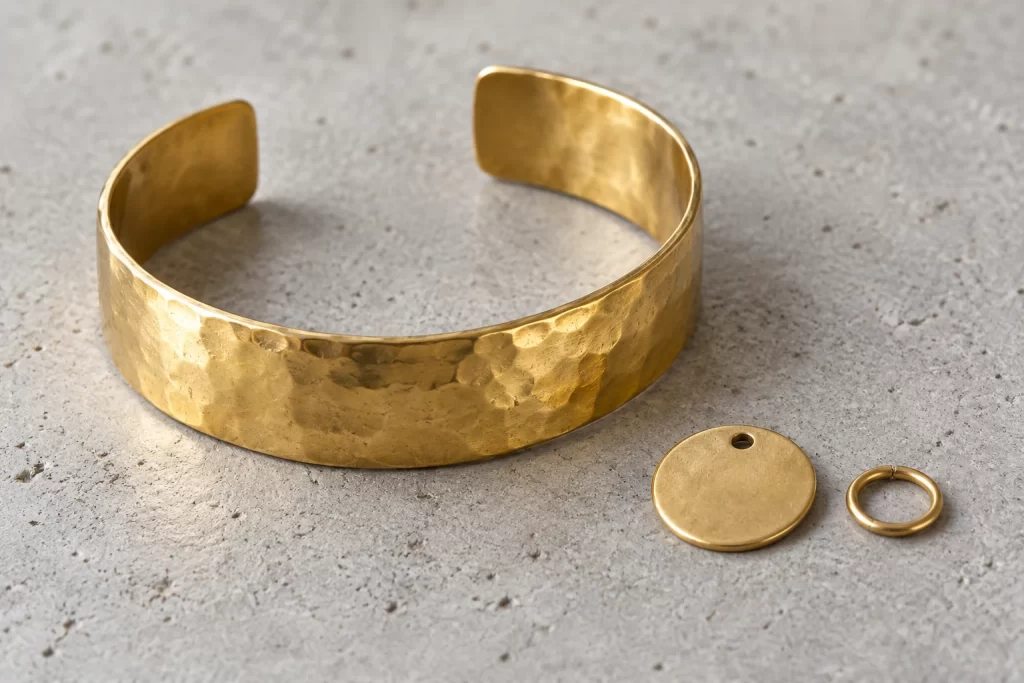
For cuffs, approve the opening, inner profile and edge finish. Do not assume a cuff is intended to be repeatedly bent simply because brass can be formed during manufacture. Ask whether the design is adjustable and how the wearer should fit it. Rings need smooth contact surfaces and an agreed size; a decorative finish on a ring receives different contact from a suspended pendant.
For necklaces, review the pendant, bail, chain and clasp together. A heavy pendant can rotate, catch or pull on a visually delicate chain. The chain construction guide explains the dimensions to compare.
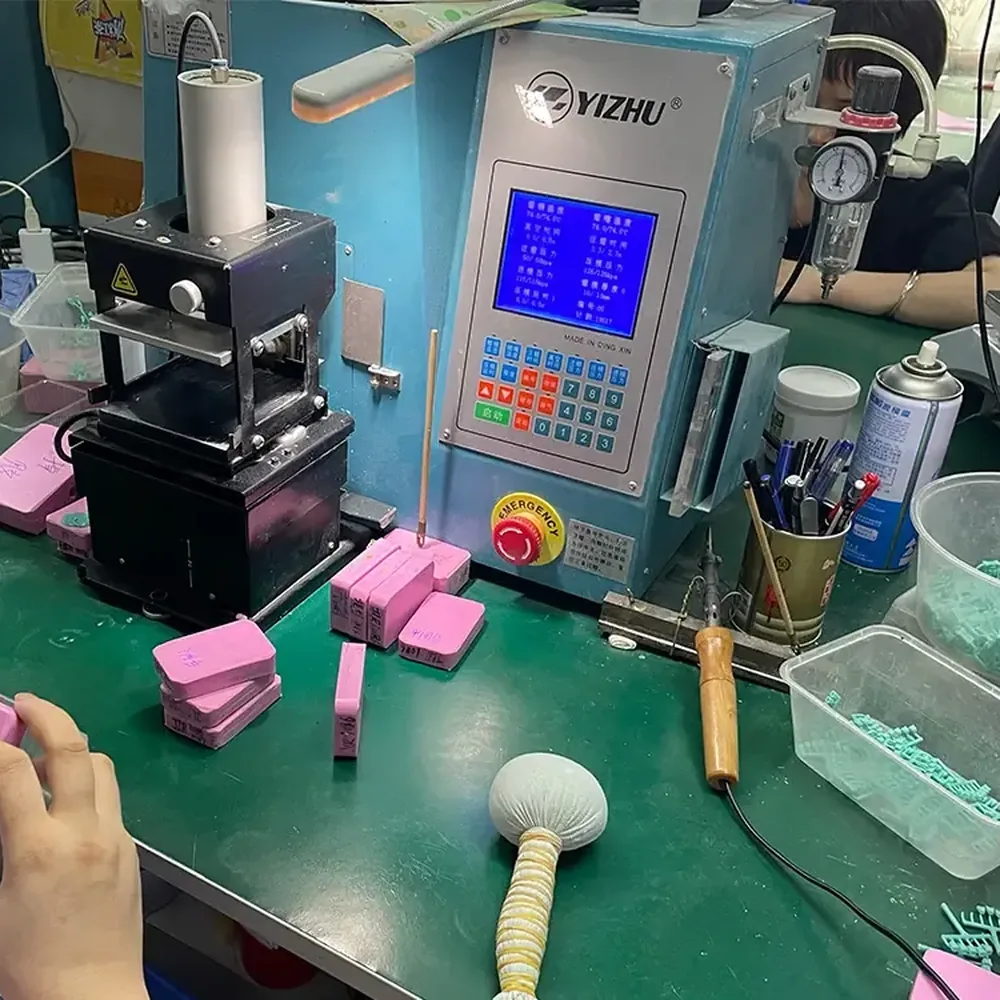
A sculptural pendant with relief detail may suit a casting route. A flat geometric earring may suit cutting or stamping from sheet. Wire and tube can produce another group of shapes, including lightweight profiles whose outer dimensions look substantial. These are design options to discuss with the manufacturer, not interchangeable ways to make an identical product at an identical cost.
For casting, ask the supplier to review thin sections, transitions between thick and thin areas, access for cleanup, and the surfaces where gates will be removed. For sheet construction, discuss cut edges, flatness, forming and the position of attachments. For hollow or assembled shapes, ask where seams sit and how those areas will be finished. A photograph taken only from the front can conceal all of these decisions.
Consider a wide hoop earring. Making it as a heavy solid section, a hollow profile or an assembled shell changes weight, joining work and inspection points. A buyer comparing only the outside diameter may think the quotes describe the same earring. Request a side view, the section description and finished weight per earring so that comfort and cost can be assessed together.
Mark the edges, lettering and relief that define the design. If a logo needs a crisp border or a recessed pattern needs a dark contrast, show those requirements in the drawing and approved sample. Finishing removes or changes the surface, so very shallow details need a feasibility check before a mold or tool is approved. Inspect the final coated sample, since its appearance is the one the customer receives.
For earrings, compare the decorative body with the skin-contact post and backing. For a cuff, check the inner surface and opening. For a pendant, check the bail and the way it hangs on the chosen chain. These parts may need different materials or constructions; list them individually in the order.
Bare brass can discolor as its surface reacts with its environment. Moisture, residues and the condition of any coating influence what the wearer sees. A green mark is not by itself a diagnosis of allergy, and a clean-looking surface is not proof that an item is suitable for a person with metal sensitivity. Stop wearing an item that causes irritation and obtain appropriate medical advice.
Identify the surface before trying to remove discoloration. An abrasive that brightens bare brass can remove an intended patina or damage plating. Our brass tarnish and care guide separates those cases. Avoid treating lemon, vinegar, salt or nail polish as universal jewelry-care solutions.
Start with the design and the required product description. Brass may suit a formed or sculptural coated design; steel may suit a different construction and finishing route; sterling silver carries a different metal identity and care expectation. Compare actual samples for weight, edge comfort, detail, repair options and finish. Broad material labels cannot establish which finished piece is better.
A claim that a brass item is recycled, responsibly sourced or lower-impact needs evidence for that item and its supply chain. Recyclability alone does not prove recycled content or a particular environmental advantage. Likewise, artificial patina and period-inspired styling do not authenticate a vintage piece.
A clear treatment can change how brass looks even when it is intended to protect the surface. A maker in this brass-coating discussion describes a practical concern: coated wire looked more yellow or matte, while a chain introduced friction between moving links. The comments offer different coating experiences. They do not establish a universal product or a service life.
Approve the treatment on the assembled design. Compare the color and gloss with an untreated reference under the same light, then check the movement required in normal use. A chain needs to drape; a hinged earring needs to open and close cleanly. A coating that looks acceptable on a flat plate can still be unsuitable around an articulated joint. Do not strip an unknown finish from saleable stock simply to try a home sealant.
HonHo’s manufacturing experience includes fine brass and sterling silver cable (O), snake and rope chains becoming stiff with some specifications combining a 2.5 µm gold layer and E-coating. This is a design-and-process warning, not a claim that every chain with that thickness will fail. Forcing stiff links to move can damage the finish or the chain. For a suitable project, discuss whether a gold-protection option without E-coating is appropriate, then approve the complete sample and care requirements.
| What the design needs | What to inspect after finishing | What to record |
|---|---|---|
| Soft chain drape | Links move freely without forcing or scraping | Chain construction, treatment and an approved movement reference |
| A bright bare-brass appearance | Color, gloss and whether the surface has a clear film | Allowed finish change and the care or renewal method |
| A textured cuff | Edges, high points and recesses | Where darker contrast belongs and which surfaces the wearer may clean |
| A working hinge or clasp | Normal opening, full closure and no finish buildup at moving areas | Functional acceptance criteria on the final coated assembly |
A buyer who likes a bright gold-like surface may be disappointed by bare brass even when the piece is well made. Another buyer may prefer its changing patina. Decide which expectation your product is meant to meet before selecting the surface treatment. Photograph the approved finish, name the material accurately and give care advice that matches that construction.
For a ring worn through frequent hand washing, surface wear and maintenance deserve more attention than they might on an occasionally worn pendant. If maintaining a permanently bright appearance is the priority, compare a documented coated construction with other suitable materials. If gradual change is part of the design, explain it plainly before purchase. There is no credible single number of months or years that covers every brass alloy, coating, wearer and use condition.
For a production inquiry, describe the expected use rather than asking only for “anti-tarnish brass.” State whether the item is bare, antiqued or plated; whether it has moving links; and which visual changes are unacceptable. HonHo can discuss the proposed finish and sample review for that design. Questions about a coating’s thickness can also be discussed through the confirmed customer sample-checking service, with the layer and measurement requirements agreed first.
Start with the intended appearance and use. An uncoated brass collection can make gradual color change part of its character, with suitable care instructions. A bright plated collection needs a defined coating system and a reference for the color the buyer expects. An antiqued design needs an agreed distribution of darker recesses and brighter raised surfaces. “Gold color” or “antique brass” alone gives a workshop too little information.
| Design intention | Specify | Review on the sample |
|---|---|---|
| Warm bare-metal appearance | Alloy, texture and whether a protective coating is included | Consistency of surface preparation and the approved care method |
| Bright gold-plated finish | Substrate, coating layers, gold description and color reference | Coverage, edge finish, color match and agreed coating checks |
| Darkened relief | Areas intended to remain dark and areas intended to be bright | Readable detail without an uneven or accidentally polished effect |
| Matching multi-part set | Reference sample and acceptable variation across components | Body, chain and findings viewed together |
Where testing is required, connect the report to the actual article or components and destination market. A declaration for the brass body does not automatically cover solder, an earring post or a separately purchased clasp. Agree what must happen if a supplier changes one of those parts after sample approval.
When a brass quote exceeds the target, ask which operations drive it. A complicated relief, inaccessible polishing area, several soldered attachments or many stone settings can add labor even when the metal itself is relatively inexpensive. Simplifying one feature may achieve more than thinning the entire piece, which can change comfort, stiffness or the intended feel.
Request an original option and a revised option with the differences stated. For example, compare the same pendant with an integrated bail and a separately assembled bail, if both are feasible. Review movement, appearance and repair implications on samples before accepting the price saving. Do not allow a lighter body, different chain or omitted protective layer to enter the order as an undocumented substitution.
For a HonHo brass inquiry, send the design, finished dimensions, target weight or weight preference, finish, quantity split and sales market. Brass minimum quantities, sample charges and any tooling depend on the proposed project and should be stated in its quotation. A supplier can give a more useful answer when it knows whether your priority is a particular retail price, a sculptural appearance, low earring weight or a finish that must coordinate with an existing collection.
For a production order, use the brass wholesale specification checklist. It covers quotation and batch approval; this guide explains the material choices behind those decisions.
Planning a brass design? Send HonHo front and side views, target dimensions and weight, finish requirements and the order breakdown. Ask for the construction and sample scope to be stated in the quotation. Contact HonHo with these details.
Updated October 18, 2026.
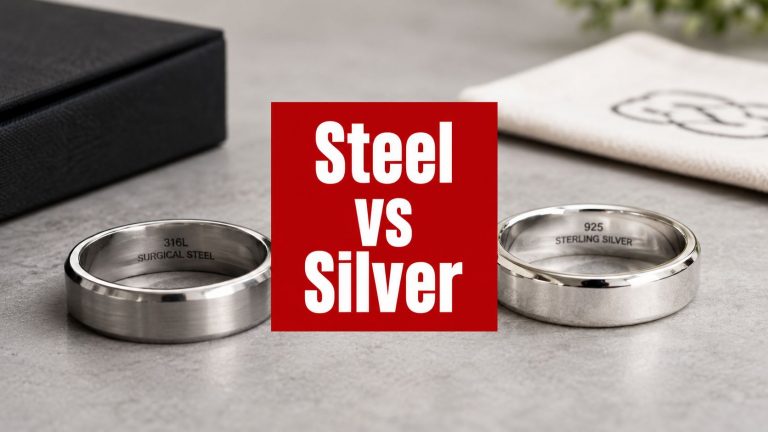
You’re pricing a new collection, and the sample tray is already split down the middle. The 316L surgical steel pieces look cleaner on cost and daily wear, the
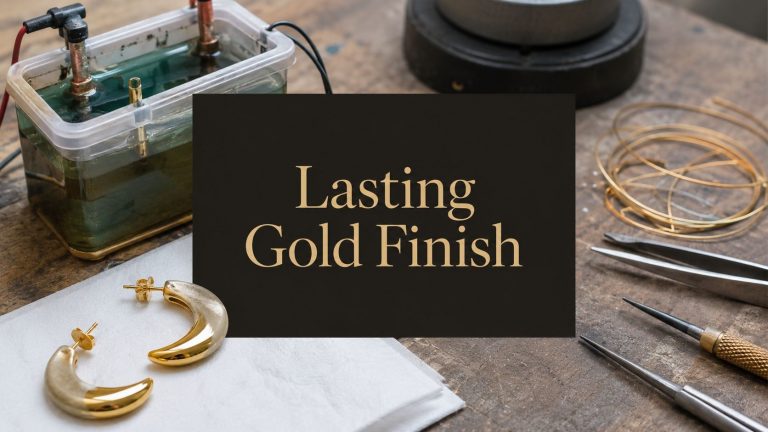
You probably have a launch already in motion, a supplier sample on your desk, and one uncomfortable question underneath it all, will this gold color still look clean
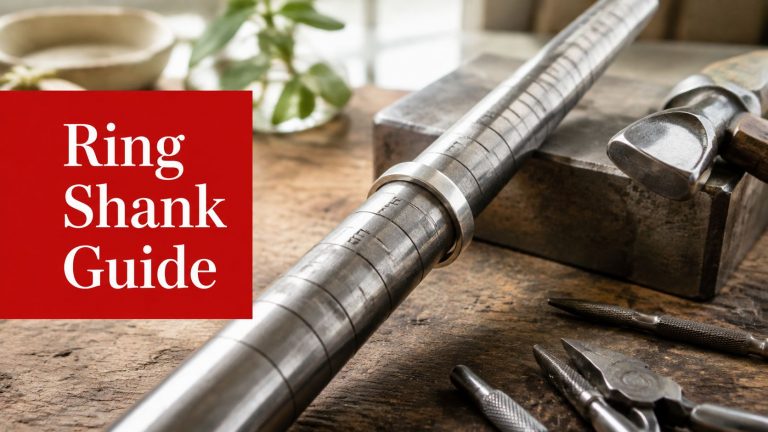
If you are developing the ring itself, compare ring fabrication, casting and CAD methods before approving the shank dimensions and manufacturing route. You’re refining a ring design, the