

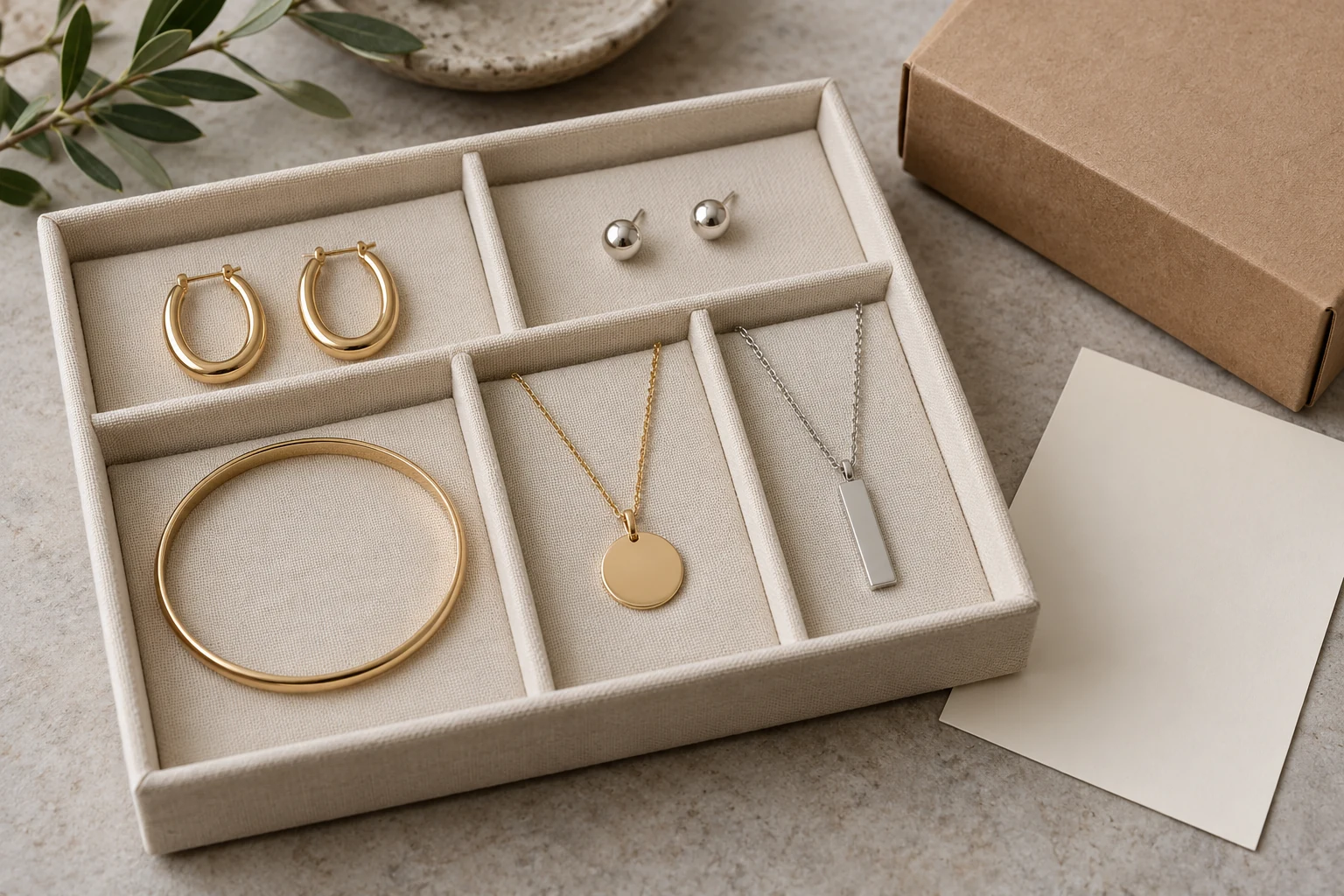
A first fashion jewelry wholesale order should test a clear assortment, a defined product specification and a supplier’s ability to deliver it. Choose whether you need existing stock, modified catalog designs or custom production before comparing unit prices. Each route has different development work and ordering constraints.
| Route | Useful when | Confirm before ordering |
|---|---|---|
| Existing stock | You want to evaluate listed styles without developing a new design. | Available variants, actual specifications, packaging and replenishment terms. |
| Private label or modified catalog | An existing design suits the collection with limited changes. | Permitted changes, branding work, sample needs and minimum quantities. |
| Custom development | The design, dimensions or construction are specific to your brand. | Development cost, tooling, sample approval and design ownership. |
For listed products, start with HonHo Jewelry Wholesale and confirm current product details. For a new design, use the custom quotation checklist. Do not assume a stock item and a made-to-order version have the same cost, lead time or material options.
Choose the channel that fits the way you want to select stock. The current terms below apply to ready-stock purchasing, not to a new custom design or an altered catalog product.
| Ready-stock route | Per-style minimum | Minimum order value | How to select |
|---|---|---|---|
| Self-service wholesale website | No per-style MOQ | US$100 | Choose available products and variants on the wholesale site |
| Sales-assisted PDF catalog | 5 pieces per style | US$300 | Ask sales for the latest catalog and confirm current availability |
Use the wholesale link above for the self-service route. For catalog assistance, contact HonHo with the product types and materials you are seeking. Identify the catalog version and item references when ordering so that quantities, finish and availability can be checked against the correct selection.
Logo work, changes to a finding, a different coating or a new size can move a request into a production or development workflow. Ask whether the change is available and which minimum quantity, sample work and schedule apply. A ready-stock order minimum should not be used to promise custom manufacturing at the same quantity.
Write down what the first order should tell you: whether customers prefer a particular hoop size, necklace length or finish, for example. Avoid changing every variable at once. If one design is offered in several colors and sizes, track those variants separately so that a popular style does not conceal a poorly selling option.
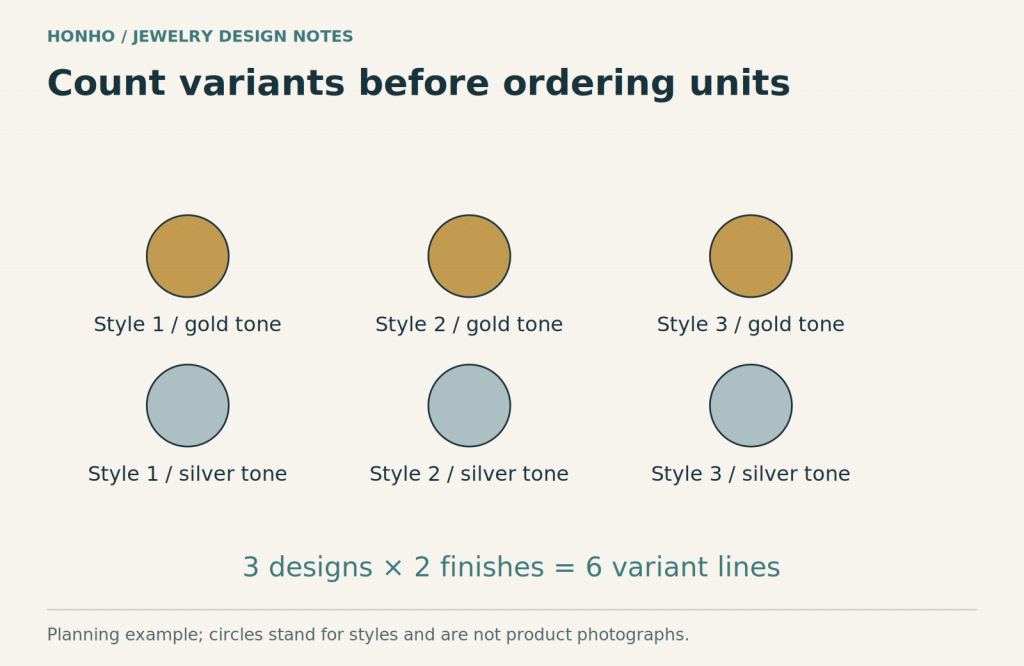
As a planning illustration, six designs with two finish variants create twelve stock lines before any size options are added. This is arithmetic, not a recommended order size. Compare that variant count with the supplier’s MOQ rules and the quantities you can reasonably inspect, photograph and sell.
| Product detail | Ask for | Avoid assuming |
|---|---|---|
| Body and findings | Alloy or grade for the main part and separate components. | Every part is the same metal because the color matches. |
| Gold-colored finish | Actual coating description and relevant evidence. | Gold color automatically means a specified gold content. |
| Earrings | Weight per earring, post and backing details. | A front-view photo establishes comfort. |
| Necklaces | Finished length, extender, chain and clasp construction. | Two nominal lengths use the same measuring convention. |
| Stones or pearls | Identity, origin where relevant and treatments. | A retail grading adjective is a universal standard. |
The brass buying guide, steel material guide and plating guide address different parts of that specification. Use the guide relevant to the proposed construction rather than choosing a material solely from a trend claim.
Use the costs that belong to the order: goods, required packaging, inspection, freight and destination charges that have been confirmed for the shipment. Keep one-time development charges visible. Record the exchange rate and date if costs are converted between currencies, and leave unconfirmed items marked as estimates.
For an illustrative calculation, assume 100 units cost US$600 in goods, US$80 in freight and US$20 in additional packaging, with no other charges included in this example. The known total is US$700, or US$7 per unit. If only 95 units are available for sale in that scenario, dividing US$700 by 95 gives approximately US$7.37 per saleable unit. These invented planning inputs demonstrate arithmetic; they are not HonHo prices, an expected defect rate or a complete landed-cost quotation.
From that starting point, account separately for your own selling costs, returns, discounts and overhead. A standard markup copied from another retailer cannot establish your margin. Make the assumptions visible so you can update the calculation when real shipping and sales information becomes available.
Do not treat one acceptable sample as proof of every later piece. Agree the production inspection plan and the process for material or component changes. If the supplier proposes an alternative clasp or coating, assess its effect before accepting the substitution.
Count cartons and packed units against the order, then identify style, color and size before putting the stock on sale. Keep any packing or quantity discrepancy with the shipment record. Inspect according to the agreed plan, and separate pieces that need review so they are not mixed back into accepted stock.
| Receiving check | Useful record |
|---|---|
| Quantity and variant | SKU, ordered quantity, received quantity and unit definition |
| Appearance | Comparison with the approved reference under consistent light |
| Function | Closures, posts, backs, moving links and relevant assembly checks |
| Customer information | Material description, care card, label and packaging version |
| Exception | Photograph, affected quantity and supplier response |
Settle the claims process before ordering: what evidence is needed, who reviews it and what repair, replacement or other remedy is agreed. A written process lets a small business handle a problem without inventing its own production diagnosis.
A small opening order limits the amount tied up in stock, but it does not guarantee that the same design will be available again. Ask whether a style is a continuing line, a seasonal purchase or a limited lot. Confirm how availability is checked and whether replenishment will use the same findings, dimensions and finish.
A new jewelry seller’s question about repeatedly running out of findings illustrates the practical issue: purchasing and quality need to work together. Supplier names in a forum are leads to investigate, not proof of the quality of your next order.
Keep the component and finished-product references attached to your own SKU. Before substituting a nearly identical style, check what changes for the customer: necklace length, earring weight, fastening action, material description or care. A matching photograph does not make two lots interchangeable. For HonHo stock purchases, send the current item references and quantities when asking about availability rather than relying on an old catalog screenshot.
Putting a brand on the packaging, marking the jewelry and changing the product are three different requests. State which you need. Confirm the marking location, artwork, packaging quantity and any sample work, then ask whether the request changes the minimum order or schedule.
Also confirm permission to use supplied product photographs and descriptions. Photograph the actual delivered sample where fit, scale or finish matters, and write material claims from the agreed specification. Do not copy a supplier’s universal “waterproof” or “hypoallergenic” label onto every SKU without evidence that supports it.
Reserve pieces for photography, inspection and customer-service replacements when planning saleable stock. Name those uses in your order calculation. They are ordinary inventory decisions, not an assumed defect allowance, and they can explain why the number available for sale is lower than the quantity purchased.
Review units sold, returns and repeat requests by variant over a stated period. Record why a piece came back: uncomfortable weight, confusing size, difficult fastening, finish concern or another reason. A popular design with recurring functional complaints needs a different decision from a slow-selling style that customers simply overlook. Keep approved and rejected samples clearly separated so a rejected version is not used as the next production reference.
Before replenishing, confirm current stock or production timing and whether the specification has changed. Use the retained sample and component references to resolve any variation. Send HonHo the style references, quantities and the practical issue you are trying to solve; that makes a follow-up inquiry more useful than requesting a general list of best sellers.
Include the chosen designs, quantities by variant, materials, finish, logo and packaging requirements, destination market and target delivery window. Ask the supplier to identify uncertainties before pricing. The manufacturer selection guide helps you assess process fit, while the RFQ checklist keeps the commercial comparison organized.
To plan a stock order, send HonHo the catalog or product references, variants and quantities, and say whether you want self-service stock or sales-assisted catalog purchasing. Contact HonHo with these details.
Updated October 18, 2026.
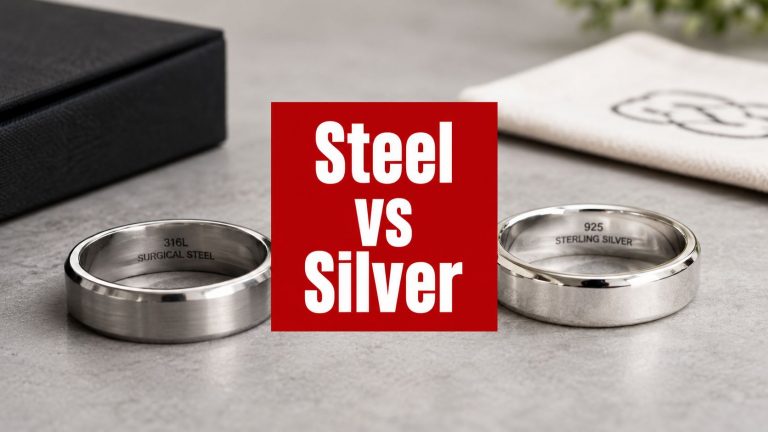
You’re pricing a new collection, and the sample tray is already split down the middle. The 316L surgical steel pieces look cleaner on cost and daily wear, the
You probably have a launch already in motion, a supplier sample on your desk, and one uncomfortable question underneath it all, will this gold color still look clean
If you are developing the ring itself, compare ring fabrication, casting and CAD methods before approving the shank dimensions and manufacturing route. You’re refining a ring design, the